Last updated: 9 October 2026
Brand video production for small business means creating strategic video content — founder stories, testimonials, demonstrations — that builds trust and drives measurable returns. Professional brand videos for UK SMEs typically cost between £1,500 and £8,000 depending on complexity, with many businesses reporting positive returns within six months of launching video content.
Key Takeaways
- Brand video production for UK small businesses typically costs between £1,500 for a basic brand story and £8,000 for a comprehensive multi-video campaign, with many SMEs allocating under £5,000 per project.
- Video content tends to generate more social shares than text and images combined, and viewers generally retain more of a message from video than from reading text alone.
- Google's algorithm increasingly favours video-rich pages for commercial search queries, and AI-powered search tools such as ChatGPT, Perplexity and Google's AI Overviews are now surfacing video content directly in answers.
- Authentic, story-driven brand videos featuring real business owners and customers tend to outperform heavily scripted corporate content in engagement and completion rates.
What Is Brand Video Production for Small Business?
Brand video production for small business is the strategic creation of video content — founder stories, testimonials, product demonstrations, behind-the-scenes footage and values-driven narratives — that communicates a company's identity and builds trust with target audiences, rather than simply promoting a product. Unlike generic promotional videos, brand video production focuses on building emotional connections and differentiating a business in competitive markets. For UK small businesses, this typically includes the production stages of pre-production (scripting, storyboarding, location scouting), filming (single or multi-day shoots with professional equipment), and post-production (editing, colour grading, sound design, motion graphics). The format has moved on from traditional television-style commercials toward authentic, mobile-first content built for platforms such as Instagram, LinkedIn and YouTube, and increasingly for AI-powered search interfaces where video snippets can appear directly inside conversational answers.
Professional brand video production differs from DIY smartphone content in technical quality, strategic messaging and production value. Smartphone videos serve immediate social media needs well, but professionally produced brand videos maintain consistent quality across platforms, follow brand guidelines consistently, and tend to achieve higher conversion rates than user-generated content when driving purchase decisions. Businesses weighing up how video fits alongside their wider identity may also want to understand the distinction covered in Brand Guidelines vs Brand Identity: The UK Difference, since video content should follow the same visual and tonal rules as the rest of a brand's assets.
How Much Does Brand Video Production Cost for UK Small Businesses in 2026?
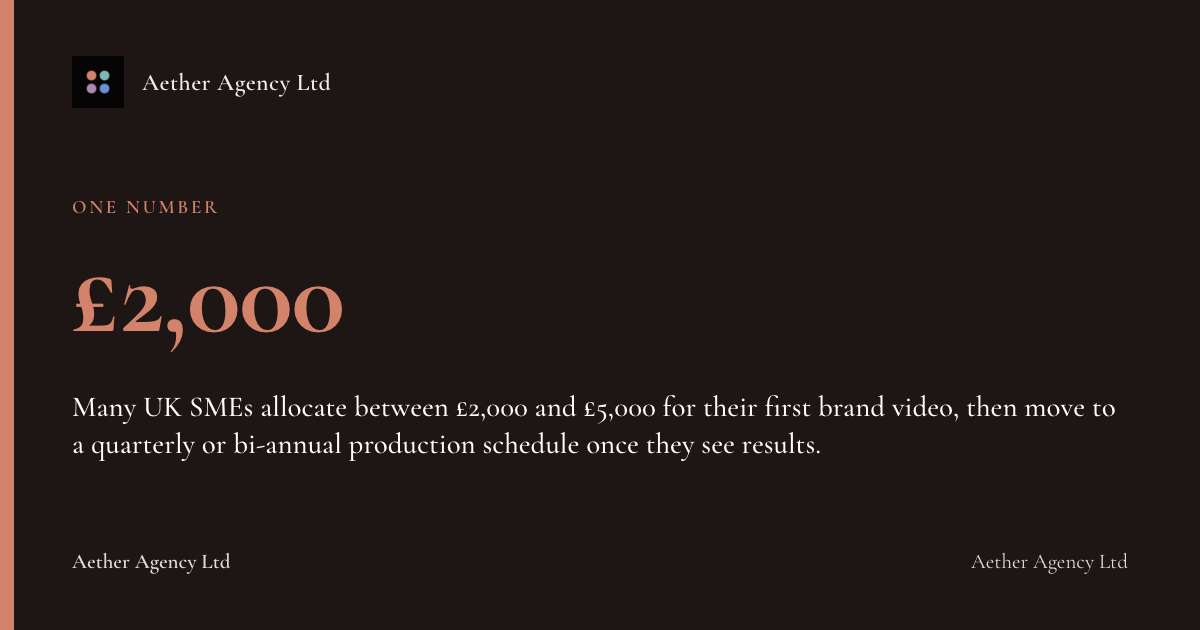
Brand video production for UK small businesses costs between £1,500 and £8,000 per project, with most SMEs spending somewhere in the middle of that range for a full-service production covering pre-production, filming and post-production (excluding ongoing distribution costs). Location affects pricing significantly: London-based productions typically command a premium over regional rates, while production complexity — single-location versus multi-location shoots with several interviews, B-roll sequences and motion graphics — drives the largest cost variation. Many UK SMEs allocate between £2,000 and £5,000 for their first brand video, then move to a quarterly or bi-annual production schedule once they see results.
| Production Tier | London & Southeast | Major Cities (Manchester, Birmingham, Edinburgh) | Regional UK | Typical Deliverables |
|---|---|---|---|---|
| Essential Brand Story | £2,500 - £3,500 | £1,800 - £2,800 | £1,500 - £2,200 | Single-location shoot, 1-2 minute final edit, basic graphics |
| Professional Brand Package | £4,000 - £6,000 | £3,200 - £4,800 | £2,800 - £4,000 | Multi-location, 2-3 videos, testimonials, motion graphics |
| Comprehensive Campaign | £6,500 - £10,000 | £5,000 - £8,000 | £4,200 - £6,500 | Multiple videos, drone footage, advanced editing, social cuts |
Real-World Cost Scenarios
Scenario 1: Local service business (Leeds plumber) A 90-second brand story featuring the founder, workshop footage, and three customer testimonials filmed across two half-days. Includes social media cuts for Instagram Reels and LinkedIn. Total investment: £2,400 (regional rate, single location, basic motion graphics).
Scenario 2: E-commerce fashion brand (London-based) Three-video series including brand origin story, product showcase with models, and behind-the-scenes manufacturing footage. Multi-location shoot across studio and factory, drone footage, advanced colour grading. Total investment: £7,200 (London premium, multiple locations, higher production value).
Scenario 3: Professional services firm (Birmingham accountancy) Two-minute explainer video with CEO interview, office B-roll, animated infographics explaining services, and client testimonials. Single-day shoot with professional lighting and sound. Total investment: £3,800 (major city rate, moderate complexity).
Why Small Businesses Need Brand Video Production in 2026
Small businesses need brand video production in 2026 because consumer attention has shifted decisively toward video-first content, and algorithm changes across Google, social platforms and AI search engines now favour video content for visibility. UK small businesses running active video marketing strategies tend to grow revenue faster than those without a video presence. Beyond algorithmic advantages, video addresses the trust deficit small businesses face when competing against established brands: authentic brand videos humanise a company, showcase the people behind it, and build emotional connections that static content struggles to create. Many UK consumers say brand videos have influenced a purchase decision, with trust cited as the primary driver.
The rise of generative AI search is changing how brand video functions in 2026. Platforms such as ChatGPT, Perplexity and Google's AI Overviews increasingly surface video content directly inside conversational answers, meaning well-optimised brand videos can appear as a source when potential customers ask AI assistants about local services or product comparisons. This reflects a shift from traditional SEO — competing for a place among ten blue links — toward Generative Engine Optimisation (GEO), where a single video excerpt may be the only result a user sees. Small businesses that build strategic brand video content now are positioning themselves to capture this search behaviour before larger competitors catch up.
Video also addresses the attention economy challenge directly: UK consumers spend considerably more time daily watching online video than reading text-based content, so a small business without video has a limited presence in the medium where its audience actually spends time.
Essential Brand Video Formats for Small Business
Small businesses should prioritise five core video formats, each serving a distinct stage of the customer journey. The founder story video introduces the people behind a business — why the company exists, what problems it solves, and what values drive its decisions — typically running 90 seconds to 2 minutes and performing well on LinkedIn and company websites, where viewers often report increased trust after watching. Customer testimonial videos provide social proof through authentic client experiences, ideally featuring specific problems solved and measurable outcomes; these work particularly well for service businesses where trust precedes purchase. Product or service demonstration videos show rather than tell, walking viewers through features and use cases, and can meaningfully reduce customer service enquiries for UK small businesses.
Behind-the-scenes content humanises a business by showing team culture, production processes or day-to-day operations, and tends to excel on Instagram Stories, TikTok and increasingly LinkedIn, where authenticity drives engagement. Values and mission videos articulate what a business stands for beyond profit, resonating with UK consumers who weigh brand values in purchase decisions. Each format serves a different purpose — founder stories build connection, testimonials provide proof, demonstrations educate, behind-the-scenes content entertains, and values videos align audiences with purpose — and the most effective small business video strategies deploy all five across a 12-month content calendar rather than relying on a single hero video.
In-House vs Professional Production: What Works for Small Business
Small businesses choosing between in-house smartphone content and professional production generally get the best results from both, deployed strategically. In-house content works well for real-time social media updates, Instagram Stories, quick announcements, and maintaining a consistent presence between professional productions — it's immediate, authentic and costs nothing beyond time. However, in-house content typically lacks the technical quality, strategic messaging and conversion optimisation that professional productions deliver; professionally produced videos tend to achieve longer average view duration and higher conversion rates than user-generated content when driving purchase decisions.
The hybrid approach works best in practice: invest in professional brand video production for cornerstone content (founder story, main product videos, testimonial compilations) intended to run for 12-18 months across websites, paid advertising and email campaigns, and use in-house content for ephemeral social media and behind-the-scenes updates between professional shoots. This maximises ROI while maintaining consistent presence, and UK small businesses using a hybrid model tend to report higher marketing effectiveness than those relying exclusively on one approach.
How to Plan Your Brand Video Production Project
Planning brand video production starts with defining measurable objectives — a target number of qualified leads per month, a reduction in customer service calls, an increase in average order value, or a defined number of views within a set period — rather than vague aims like "increase awareness." Campaigns with specific, documented objectives tend to perform considerably better than those without clear targets. Once objectives are set, identify the precise target audience using demographic and psychographic data: a Leeds-based boutique gym targeting 25-40-year-old professionals needs fundamentally different messaging, tone and platform strategy than a Cotswolds artisan food producer targeting 45-60-year-old affluent consumers. The script and storyboard should come directly from this audience understanding, addressing specific pain points and objections rather than generic brand messages.
Location scouting affects both production value and cost. Filming at business premises reduces location fees but may limit visual interest; external locations add production value but increase complexity and cost. Talent selection — whether featuring the owner, employees, customers or professional presenters — should align with authenticity goals, since UK audiences in 2026 tend to respond more favourably to genuine business owners and real customers than polished actors. Timeline planning should allow 2-3 weeks for pre-production, 1-3 days for filming depending on complexity, and 2-4 weeks for post-production including revisions; a minimum six-week timeline from brief to final delivery is generally recommended for professional results. Businesses planning video alongside a wider brand or messaging refresh may find it useful to read Brand Consistency Across Channels: A UK Business Guide to ensure video messaging aligns with everything else the business publishes.
Your Brand Video Production Checklist
- Define specific, measurable objectives tied to business outcomes (leads, sales, engagement targets)
- Document detailed audience personas including demographics, pain points, preferred platforms, and content consumption habits
- Develop a script that addresses customer objections and speaks directly to target audience needs
- Create a shot list and storyboard outlining every scene, angle, and visual element required
- Scout and confirm locations minimum two weeks before filming, securing necessary permissions
- Arrange talent (interviewees, presenters, customers) with confirmed availability and signed release forms
- Prepare brand assets (logos, colour palettes, fonts, existing graphics) in high-resolution formats for post-production
- Brief all participants on messaging, wardrobe choices, and filming schedule at least one week in advance
- Establish revision rounds and approval processes before production begins to avoid scope creep
- Plan distribution strategy including platform-specific formats, posting schedules, and paid promotion budget
- Set success metrics and tracking mechanisms (UTM parameters, conversion tracking, engagement benchmarks)
- Schedule quarterly reviews to assess performance and plan follow-up content based on data
Maximising ROI from Your Brand Video Investment
Maximising return on a brand video investment requires strategic distribution that goes well beyond uploading to YouTube and hoping for views. The most effective UK small businesses in 2026 use an omnichannel distribution strategy that places video wherever target audiences actually consume information: embedding video prominently on website homepages (which tends to increase conversion rates meaningfully), using video in email campaigns (which tends to boost click-through rates considerably), and creating platform-specific cuts for social media. A single professionally produced two-minute brand video can typically be repurposed into 10-15 assets — a full-length version for the website and YouTube, a 60-second cut for LinkedIn, a 30-second teaser for Instagram feed, 15-second cuts for Stories and Reels, silent captioned versions for Facebook, and extracted quotes as standalone social graphics.
Paid promotion amplifies organic reach, and even modest budgets can deliver meaningful results: UK small businesses spending £200-£500 monthly on video promotion tend to reach considerably more qualified prospects than organic posting alone. Google Video campaigns extend reach similarly, placing brand videos in search results and across the Display Network, with the key being targeting precision rather than maximum reach. SEO optimisation matters increasingly for video content — titles, descriptions, transcripts and chapter markers help videos rank in both traditional Google search and AI-powered results, and videos with complete transcripts tend to rank higher than those without.
Ways to Reduce Brand Video Production Costs
- Film multiple videos in a single production day to spread setup costs across several deliverables
- Use your business premises as the primary location to eliminate location fees
- Feature employees and real customers rather than hiring professional actors
- Provide detailed briefs and approved scripts before filming to minimise revision rounds
- Consolidate feedback from all stakeholders before requesting changes to avoid multiple revision cycles
- Choose regional production companies over London agencies when location isn't critical
- Opt for simpler motion graphics and title sequences rather than complex 3D animation
- Schedule filming during off-peak seasons (January-February, July-August) when production companies offer better rates
- Negotiate package deals for multiple videos rather than commissioning individual projects
- Handle some post-production elements in-house, such as social media resizing and caption creation
- Use royalty-free music libraries rather than commissioning original scores
- Plan content that requires minimal B-roll and focuses on interview-style footage
Alternatives to Full-Service Brand Video Production
Small businesses with limited budgets can consider hybrid approaches that reduce costs while maintaining acceptable quality. Freelance videographers typically charge £300-£600 per day compared with £1,500-£3,000 for full production companies, though the business must manage the project itself and may sacrifice strategic guidance. Video editing marketplaces such as Fiverr or Upwork let businesses film content themselves and outsource only post-production for £200-£500 per video. Template-based platforms such as Lumen5 or Animoto enable DIY brand videos using stock footage, photos and text for £20-£100 monthly — suitable for social content but lacking the authenticity of filmed footage. For businesses genuinely unable to invest in video, high-quality photography with motion graphics and voiceover provides a stepping stone, typically costing £500-£1,200 and delivering some video benefits while building toward full production later. These alternatives rarely match the ROI of professional brand video production, and businesses using professional video services tend to grow revenue faster than those relying solely on DIY alternatives.
Common Brand Video Production Mistakes to Avoid
Small businesses frequently make preventable mistakes that undermine video effectiveness and waste investment. The most common error is prioritising production polish over authentic storytelling, resulting in content that looks professional but fails to connect emotionally; videos featuring real business owners speaking naturally tend to achieve higher completion rates than scripted, actor-delivered content despite lower technical polish. Overlooking audience needs is another critical mistake — creating videos about what the business wants to say rather than what audiences need to hear. Effective brand videos address specific customer pain points and provide value beyond self-promotion. Neglecting platform optimisation wastes reach: a 16:9 landscape video performs poorly on Instagram Stories, while vertical 9:16 content looks awkward on LinkedIn, so multiple aspect ratios should be produced during post-production.
Insufficient calls-to-action leave viewers engaged but uncertain what to do next. Every brand video should include a clear, specific CTA aligned with its objective — "Book your free consultation at [URL]," "Download our guide at [URL]," or "Visit our showroom in [location]" — since vague endings like "Learn more" tend to convert considerably worse than specific CTAs. Ignoring accessibility excludes a significant audience: videos without captions lose views on platforms such as Facebook, which autoplay without sound, and exclude viewers with hearing loss. Finally, producing one-off videos rather than a content series limits ROI; businesses publishing video content monthly tend to achieve considerably higher engagement than those producing sporadic content.
Measuring Brand Video Performance in 2026
Measuring brand video performance means tracking metrics tied to the video's original objective rather than vanity metrics like total views alone. For awareness objectives, track reach (unique viewers), impressions and view-through rates across platforms. For engagement goals, monitor watch time (particularly percentage viewed), social shares, comments and click-through rates to related content. For conversion objectives, track form submissions, phone calls, bookings or purchases attributed to video views using UTM parameters and conversion pixels, and establish video-specific conversion events that track the user journey from view through to desired action.
Platform-specific analytics provide deeper insight: YouTube Studio shows audience retention graphs revealing exactly where viewers drop off, informing future content improvements; LinkedIn video analytics show viewer demographics and job titles, confirming whether content is reaching the intended audience; Instagram Insights track saves and shares, indicating content value beyond passive viewing; and heat-mapping tools such as Hotjar reveal how website visitors interact with embedded video, showing whether placement drives the desired behaviour. A/B testing different video lengths, thumbnails, titles and CTAs helps optimise performance over time. The most data-driven small businesses in 2026 use marketing attribution platforms such as HubSpot or Salesforce to track the full customer journey, understanding how video views influence deals closed and customer lifetime value, and using that data to justify future video investment.
Your Brand Video Production Checklist
- Define specific, measurable objectives tied to business outcomes before any filming begins
- Document audience personas including pain points, preferred platforms and content habits
- Choose the right formats — founder story, testimonial, demonstration, behind-the-scenes or values video — for the stage of the customer journey you're targeting
- Scout locations and confirm talent with signed release forms at least two weeks ahead
- Prepare brand assets in high-resolution formats so post-production stays consistent with your wider brand identity
- Plan distribution across website, email, and platform-specific social cuts before the shoot, not after
- Set tracking mechanisms (UTM parameters, conversion pixels) so ROI can be measured against the original objective
- Schedule quarterly reviews of performance data to plan the next round of content
FAQ
How long should a brand video be for small business?
Brand videos for small business should run 60-90 seconds for social media, 90-120 seconds for website homepages, and up to 3 minutes for detailed product explanations or founder stories on YouTube. Engagement tends to drop significantly after two minutes on most platforms, with the exception of educational content, where audiences tolerate longer formats. Instagram Reels tend to perform best at 15-30 seconds, LinkedIn videos at 60-90 seconds, and website hero videos should generally stay under two minutes. Prioritise concise messaging that respects viewer attention spans while still delivering complete value.
Do I need to appear on camera in my brand video?
Appearing on camera as a business owner tends to increase trust and authenticity, with many UK consumers reporting higher confidence in businesses where they've seen the founder or team. Camera-shy owners can still achieve strong results using alternative approaches: customer testimonials, product-focused demonstrations, voiceover with B-roll footage, or animated explainer videos. The key factor is authenticity rather than personal appearance — videos featuring real employees, genuine customers or actual business operations tend to outperform stock footage and generic content regardless of whether the owner appears on screen. If camera appearances feel uncomfortable, consider brief appearances alongside other content rather than carrying the entire video alone.
How often should small businesses create new brand videos?
Small businesses should aim to publish new brand video content roughly monthly to maintain audience engagement and algorithmic favour, though format and complexity can vary. A practical cadence combines one professionally produced video per quarter (founder updates, new product launches, seasonal campaigns) with simpler in-house content monthly (behind-the-scenes, quick tips, customer spotlights). Businesses publishing video content at least monthly tend to achieve considerably higher engagement and more qualified leads than those producing video sporadically. Consistency matters more than sheer frequency — regular monthly content tends to outperform irregular bursts of activity.
Can brand videos work for B2B small businesses?
Brand videos work well for B2B small businesses, with B2B video content generally generating considerably more engagement than text posts. B2B buyers are still people making emotionally-influenced decisions despite a rational-looking purchase process, so authentic brand videos build trust, demonstrate expertise and help differentiate commoditised services. Effective B2B formats include thought leadership content featuring company experts, case study videos showcasing client results, process explanation videos demystifying complex services, and company culture videos that attract talent and reassure prospects. Many B2B buyers watch video content during their research phase, with video influencing a meaningful share of final purchase decisions — businesses building a B2B brand presence more broadly may find Brand Strategy for B2B Companies: A UK Guide 2026 a useful companion resource. B2B videos should focus on problem-solving and outcome delivery rather than entertainment.
What equipment do professional video production companies use?
Professional video production companies typically use cinema-grade cameras (such as the Sony FX6, Canon C70 or Blackmagic Pocket Cinema Camera 6K), professional lighting kits (LED panels, softboxes and reflectors), external audio equipment (Sennheiser or Rode wireless microphones and boom systems), stabilisation gear (gimbals, sliders and tripods), and increasingly drones for aerial footage. Post-production relies on professional software including DaVinci Resolve for colour grading, Adobe Premiere Pro for editing, and After Effects for motion graphics. This equipment investment typically runs into the tens of thousands of pounds for a professional setup, which is part of why hiring a production company is usually more cost-effective than buying equipment for occasional use — the expertise in applying it (lighting ratios, audio mixing, colour science, composition) delivers value beyond the hardware itself.
How do brand videos improve Google rankings?
Brand videos can improve Google rankings through several mechanisms: dwell time tends to increase on pages with video content, reducing bounce rates and signalling content quality to Google's ranking systems, and pages with video content are considerably more likely to reach page one than text-only pages. Video-rich snippets appear prominently in search results, increasing click-through rates compared with standard text listings, and YouTube videos — when properly optimised — can rank independently in Google search, creating additional entry points into a business. Transcripts and captions give Google text to index while making videos more accessible. Most significantly for 2026, Google's AI Overviews and similar generative search features increasingly surface video content directly in answers, meaning well-optimised brand videos can appear as a cited source in conversational search results.
What makes a brand video authentic versus corporate?
Authentic brand videos feature real people — owners, employees, customers — speaking naturally rather than from a tight script, show genuine business environments rather than generic settings, address specific customer problems rather than vague value propositions, and embrace some imperfection over sterile polish. Corporate-style videos typically rely on actors, heavily scripted dialogue, stock footage and generic messaging that can feel disconnected from reality. Most UK consumers say authenticity matters when deciding which brands to support, and authentic video content tends to generate considerably more engagement than polished corporate content. Authenticity tends to come from specificity: real customer names, real work processes, and an honest mix of challenges and successes rather than a flawless narrative.
Producing Brand Videos That Drive Business Growth with Aether Agency Ltd
Brand video production sits alongside the wider identity, website and marketing work that helps a small business stand out, and this is the territory Aether Agency Ltd works in: brand, build, grow. A business planning its first brand video often needs the same groundwork — a clear identity, a consistent visual language, a website that can host and convert video content effectively — that underpins Aether Agency Ltd's broader service of brand identity, website development and marketing for growing businesses. If a rebrand or website rebuild is on the horizon alongside a video project, Rebrand Without Losing Search Rankings: UK Guide 2026 is a useful companion read to make sure the two projects don't work against each other.
One proof point from Aether Agency Ltd's own client work: Fulk Butchers, a Surrey-based business, saw online sales up 180%, with a 4.8-star Google rating (client case study).
If your business is weighing up brand video production alongside a wider brand or website refresh, get in touch with Aether Agency Ltd for a quote and a conversation about which formats and investment level make sense for your objectives.
Related Reading
- Brand Strategy Agency UK: Complete Guide for Business Success
- Best SEO Agency for Small Business UK 2026 | Aether Agency
- Brand Strategy Surrey: Expert Guide for Business Growth 2026
Add aether-agency.co.uk as a preferred source on Google
See How Your Brand Appears in AI Search
Aether AI monitors your visibility across ChatGPT, Perplexity, Google AI Overviews, and Claude in real time. Find out where you stand and what to fix.
Explore Aether AI