Last updated: 25 October 2026
Conversion-focused web design is the practice of building a website around a single goal — turning visitors into enquiries, sales or sign-ups — rather than around aesthetics alone. UK agency projects typically run from a modest sum for a small lead-generation site to a much larger investment for a bespoke e-commerce build, and great UX design can meaningfully lift conversion rates.
Key Takeaways
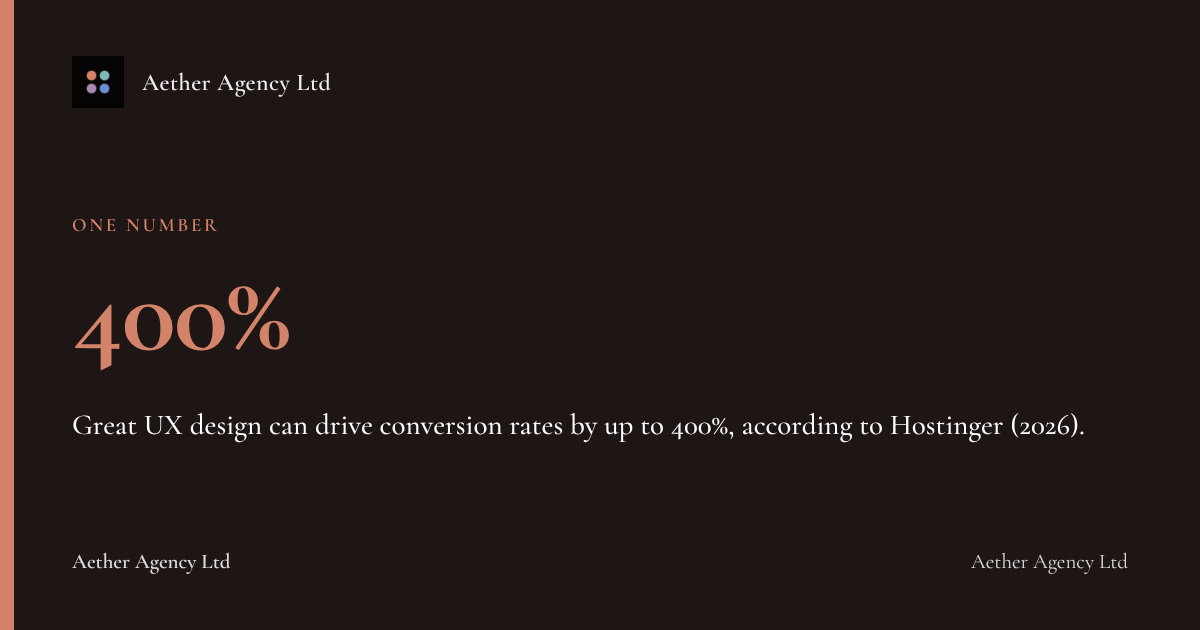
- Great UX design can drive conversion rates by up to 400%, according to Hostinger (2026).
- A 1-second delay in page load time can lead to a 7% decrease in conversion rates, according to Linearity (2023).
- 75% of users judge a business's credibility based on its website design, according to Linearity (2023).
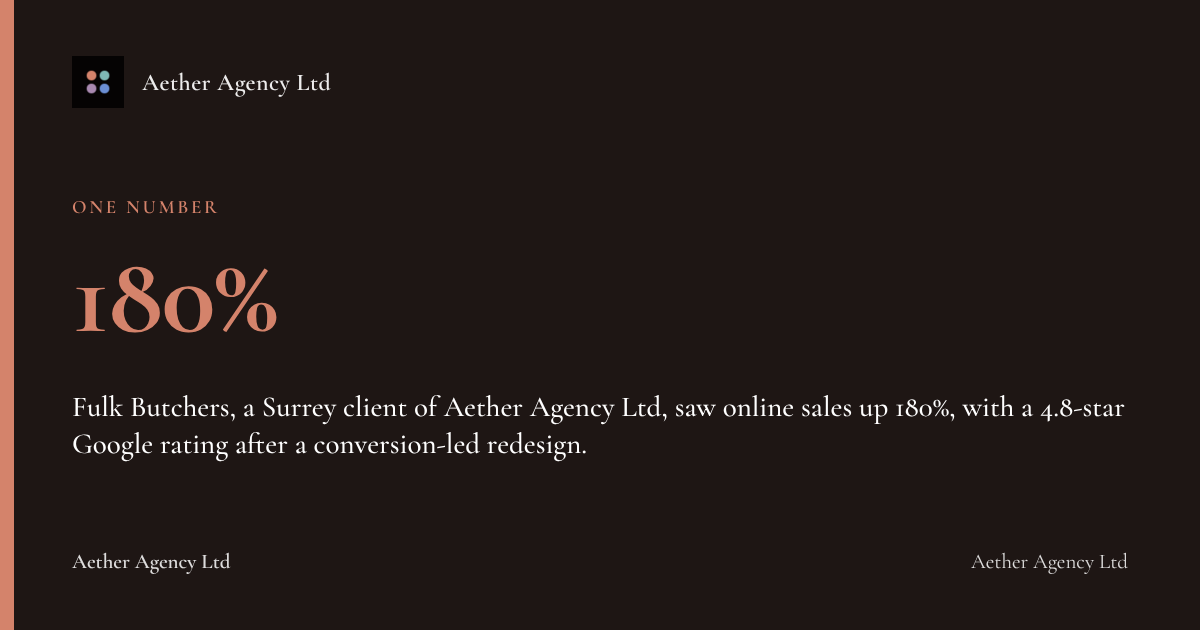
- Fulk Butchers, a Surrey client of Aether Agency Ltd, saw online sales up 180%, with a 4.8-star Google rating after a conversion-led redesign.
- Continuous user testing can increase conversion rates by up to 113%, according to Linearity (2023).
What Is Conversion-Focused Web Design?
Conversion-focused web design is an approach to building websites that prioritises measurable user actions — a form submission, a phone call, a completed purchase — above decorative or purely brand-led decisions. Standard web design often starts with a visual brief and works backwards; conversion-focused design starts with the business goal and works forwards, shaping layout, copy and navigation around the path a visitor needs to take.
The distinction matters because a website can look polished and still fail commercially. A homepage with beautiful photography but no clear call to action, buried contact details, or a five-step checkout will quietly bleed revenue regardless of how the brand looks.
75% of users judge a business's credibility based on its website design, according to Linearity (2023), which means design quality and conversion performance are rarely separate problems — they're the same problem viewed from two angles. Aether Agency Ltd treats every website build as a conversion exercise first and a design exercise second, because a site that doesn't convert isn't doing its job no matter how it photographs.
This is also where conversion-focused design overlaps with conversion rate optimisation (CRO) — the ongoing discipline of testing and refining a live site to lift its conversion rate over time. Design sets the foundation; CRO keeps improving on it after launch.
Core Principles That Make a Website Design Conversion-Focused
A conversion-focused website design rests on a small number of deliberate structural choices rather than a long list of trends. Page speed, a single clear call to action per page, trust signals, and mobile-first layout form the backbone of nearly every high-performing site.
Speed is the foundation. A 1-second delay in page load time can lead to a 7% decrease in conversion rates, according to Linearity (2023), and a Deloitte (via DesignForce) (2026) study found a 0.1-second improvement in site speed increased conversions by 8% and customer spending by 10% for retail sites. Retailers lose $2.6 billion annually due to slow websites, according to Hostinger (2026) — a figure that, while US-sourced, illustrates how directly load time ties to lost revenue globally.
Beyond speed, the principles that consistently move conversion rates include:
- One primary call to action per page — competing buttons dilute decision-making and reduce click-through.
- Social proof placed near the decision point — customer testimonials can increase conversions by 34%, according to Linearity (2023).
- Video on key landing pages — incorporating videos into landing pages can lead to a conversion boost of as much as 80%, according to Linearity (2023).
- Mobile-first layout — the majority of UK browsing now happens on a handset, so forms, buttons and navigation must work on a small screen before they work on a desktop.
- Minimal form friction — asking only for the information genuinely needed at each stage.
When Aether Agency Ltd rebuilt the online shop for Fulk Butchers, a Surrey butcher, the focus was exactly this combination of speed, trust signals and a simplified purchase path. The result: online sales up 180%, with a 4.8-star Google rating.
How Much Does Conversion-Focused Web Design Cost in the UK?
Conversion-focused web design in the UK typically costs between £3,000 and £8,000 for a small business site with CRO principles built in, rising to £25,000 or more for a complex e-commerce platform with bespoke integrations. Price depends on the number of pages, the complexity of the checkout or booking system, and how much custom testing and copywriting is included.
| Project type | Typical UK price range | What's usually included |
|---|---|---|
| Small lead-gen site (5-10 pages) | £3,000 – £8,000 | Core messaging, one primary CTA path, mobile optimisation, basic analytics |
| Mid-size service/B2B site | £8,000 – £15,000 | Multiple funnels, case studies, booking integration, on-page SEO |
| E-commerce (small to mid catalogue) | £10,000 – £25,000 | Product pages, checkout optimisation, payment gateway, speed tuning |
| Enterprise/bespoke e-commerce | £25,000+ | Custom development, personalisation, multi-market CRO, ongoing testing |
These ranges are illustrative and vary by agency, region and scope; always request a scoped quote rather than relying on a bracket. A DIY website builder can cost under £500 a year but rarely delivers the same structural conversion discipline that a scoped agency build provides, particularly once a business needs custom tracking or integrations.
Agency vs freelancer vs DIY builder
Choosing between a UK web design agency, a freelancer, and a DIY platform such as Squarespace or Wix is really a choice about how much conversion strategy, not just design, you need baked in from day one.
| Option | Best suited to | Trade-off |
|---|---|---|
| Agency | Businesses with clear growth targets and multiple funnels | Higher upfront cost, but strategy, copy, SEO and testing are integrated |
| Freelancer | Single-page or simple sites with a fixed, well-defined brief | Lower cost, but limited capacity for ongoing testing or multi-discipline input |
| DIY builder | Very early-stage businesses testing an idea | Cheapest and fastest, but conversion structure is left entirely to the owner |
An agency such as Aether Agency Ltd brings brand identity, website development and marketing together under one roof, which matters because a conversion-focused site depends on consistent messaging across all three.
Who Is Responsible for Ongoing Conversion Rate Optimisation After Launch?
Ongoing conversion rate optimisation is the shared responsibility of the website owner and whichever design partner built the site, and it should never be treated as a one-off task completed at launch. A website that isn't revisited after go-live will start to lose ground as user behaviour, competitor sites and Google's ranking signals all shift.
Continuous user testing can increase conversion rates by up to 113%, according to Linearity (2023) — a figure that underlines why CRO is a process, not a project. Shiva Manjunath, Experimentation Manager at Solo Brands, put it plainly: "Abundance of research doesn't remove a need for experimentation, in the same way that experimentation doesn't remove a need for research."
In practice, this responsibility usually splits three ways:
- The business owner monitors day-to-day enquiry quality and flags where leads feel mismatched to expectations.
- The design or marketing agency runs structured tests — headline variants, form length, CTA wording — and reports on statistical outcomes.
- Analytics tools (Google Analytics 4, heatmap software, session recordings) supply the data both parties act on.
Aether Agency Ltd's average client traffic growth of 3x reflects this combined approach of build-then-refine, where website development is paired with ongoing marketing rather than left static after launch.
What Metrics Should You Track to Measure Conversion Performance?
The metrics that matter most for a conversion-focused website are conversion rate itself, bounce rate, average session duration, and cost per lead or cost per acquisition where paid traffic is involved. Tracking the right combination tells you not just whether people are converting, but where they're dropping off if they aren't.
Core metrics worth setting up before launch:
- Conversion rate — the percentage of visitors completing the target action (purchase, form, call).
- Bounce rate — the share of visitors leaving without interacting, often a sign of mismatched expectations or slow load times.
- Average page load time — directly tied to conversion loss, as the Deloitte and Linearity data above shows.
- Funnel drop-off points — where in a multi-step checkout or form users abandon.
- Mobile vs desktop conversion split — essential given the dominance of mobile browsing in the UK.
For Priority First, Aether Agency Ltd tracked search clicks over matched 28-day windows via Google Search Console, recording a move from 260 to 380 clicks (+46%), with 13 commercial enquiries in the first month they could trace them. That kind of matched-window tracking is the standard Aether Agency Ltd applies when reporting genuine before-and-after performance, rather than vague claims of "more traffic."
What UK-Specific Legal Requirements Must a Conversion-Focused Website Meet?
A UK website must comply with data protection law, cookie consent rules and — increasingly — accessibility expectations, and getting these wrong can undermine conversions as much as it risks enforcement action. The UK General Data Protection Regulation (UK GDPR), enforced by the Information Commissioner's Office (ICO), governs how any form, newsletter sign-up or e-commerce checkout collects and stores personal data.
Cookie banners fall under the Privacy and Electronic Communications Regulations (PECR), also regulated by the ICO, which require genuine opt-in consent before non-essential tracking cookies load — a clunky or non-compliant banner can itself become a conversion barrier if it blocks the page or confuses visitors. The Equality Act 2010 also applies to website accessibility in the UK, meaning sites should reasonably accommodate users with disabilities; the Web Content Accessibility Guidelines (WCAG) 2.2, published by the World Wide Web Consortium (W3C), is the recognised technical standard most UK public and private sector sites now reference.
Public sector bodies have a specific duty under the Public Sector Bodies (Websites and Mobile Applications) Accessibility Regulations 2018, but private businesses increasingly adopt the same WCAG standard voluntarily, both for legal risk reduction and because accessible sites tend to convert better across a wider range of users. Building compliance in from the start — rather than retrofitting it — keeps a conversion-focused redesign from creating new friction it didn't have before.
Your conversion-focused web design checklist
- Define one primary conversion goal per page before any design work begins.
- Set a page load target under 2-3 seconds and test on real mobile connections.
- Place at least one customer testimonial or trust signal near every key decision point.
- Add a cookie consent banner compliant with PECR and the ICO's guidance.
- Audit core pages against WCAG 2.2 for accessibility.
- Set up Google Analytics 4 and a heatmap tool before launch, not after.
- Run a structured A/B test on your highest-traffic landing page within the first three months.
- Review funnel drop-off data monthly and brief your agency or developer on findings.
FAQ
What does conversion-focused web design mean?
Conversion-focused web design means building a website structure, layout and content around a specific user action — such as a purchase or enquiry — rather than around appearance alone. It treats every page as a step in a funnel rather than a standalone piece of visual design.
How long does it take to design and launch a conversion-focused website?
A small lead-generation website typically takes four to eight weeks from brief to launch, while a complex e-commerce build can take twelve to twenty weeks. Timelines depend on how much custom development, copywriting and testing is scoped into the project.
How does conversion-focused design differ for e-commerce versus B2B service sites?
E-commerce conversion design centres on product pages, checkout friction and payment trust signals, while B2B and lead-generation sites focus on case studies, clear enquiry forms and demonstrating credibility before a prospect ever picks up the phone. Both rely on the same underlying principles of speed, clarity and social proof, applied to different funnel shapes.
What tools are commonly used for A/B testing conversion performance?
Google Analytics 4, Google Optimize alternatives such as VWO, and heatmap or session-recording tools such as Hotjar are commonly used to test and analyse UK website conversion performance. These tools let businesses compare page variants and see exactly where visitors click, scroll or abandon a page.
What are the most common mistakes businesses make when designing for conversions?
The most common mistakes are cluttering a page with multiple competing calls to action, ignoring page speed, and launching without any post-launch testing plan. Many businesses also skip mobile testing, even though mobile traffic now represents the majority of UK website visits.
What should I check before and after launching a redesigned website?
Before launch, check load speed, mobile responsiveness, form functionality and accessibility compliance. After launch, compare conversion rate, bounce rate and funnel drop-off against your previous site's baseline over a matched time period, rather than relying on raw traffic numbers alone.
Is a DIY website builder enough for conversion-focused design?
A DIY website builder can work for a very early-stage business testing a simple offer, but it rarely provides the structural discipline, custom tracking or integrated strategy that a scoped agency build delivers. As a business grows, the gap between a template site and a conversion-engineered one tends to widen.
Building a Conversion-Focused Website with Aether Agency Ltd
Every principle covered in this guide — speed, trust signals, clear calls to action, accessibility, ongoing testing — is exactly what Aether Agency Ltd builds into every website development project from the first wireframe. Rather than treating conversion as an afterthought bolted on after launch, Aether Agency Ltd designs the funnel first and the visuals around it, the same approach that took Fulk Butchers to online sales up 180%, with a 4.8-star Google rating, and helped Priority First grow search clicks from 260 to 380 over matched 28-day windows.
Aether Agency Ltd has delivered 50+ projects with a team carrying 20+ years of combined experience, combining brand identity, website development and ongoing marketing so a new site doesn't just launch well but keeps converting.
If your current website looks the part but isn't turning visitors into enquiries or sales, get in touch with Aether Agency Ltd for a conversion-focused website development quote and find out what a properly scoped redesign could do for your numbers.
Related Reading
- Web Design Agency UK: Complete 2026 Guide & Pricing
- Web Design Guildford: What It Costs & Who to Hire
- SaaS Website Design Agency: UK Guide & Costs 2026
Add aether-agency.co.uk as a preferred source on Google
See How Your Brand Appears in AI Search
Aether AI monitors your visibility across ChatGPT, Perplexity, Google AI Overviews, and Claude in real time. Find out where you stand and what to fix.
Explore Aether AI