Last updated: 7 August 2026
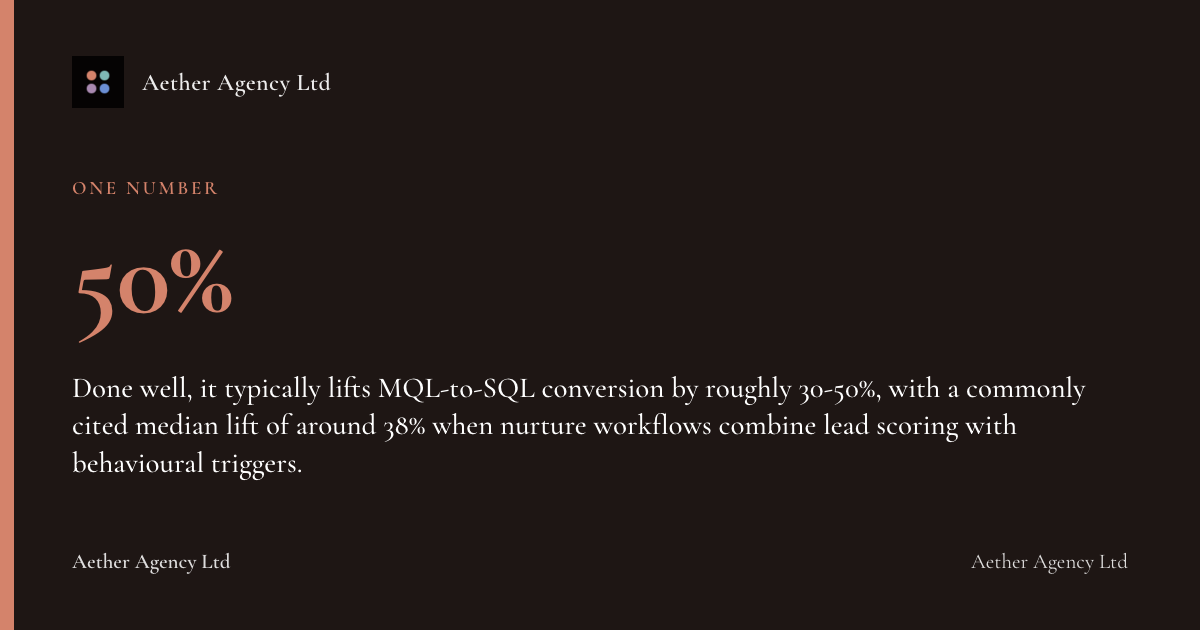
Quick answer: CRM (customer relationship management) and marketing automation integration connects your customer database with your campaign and nurture tools so lead data, scoring and lifecycle stages sync automatically. Done well, it typically lifts MQL-to-SQL conversion by roughly 30-50%, with a commonly cited median lift of around 38% when nurture workflows combine lead scoring with behavioural triggers.
Key Takeaways
- CRM and marketing automation integration means syncing your customer database with your campaign tools so lead scoring, lifecycle stages and attribution stay consistent across sales and marketing.
- Industry figures put the global CRM market at roughly £126.17 billion as of 2026, with the vast majority of companies with 10+ employees now running CRM software.
- Properly integrated systems have been associated with MQL-to-SQL conversion lifts of 30-50%, with a median cited figure of around 38% for nurture workflows using lead scoring and behavioural triggers.
- Poor data quality and low user adoption remain the two most common reasons CRM integration projects underdeliver, not the technology itself.
- A phased rollout — assessment, technical setup, testing, launch — typically takes 8-12 weeks depending on data quality and organisational readiness.
The global CRM market has reached a reported £126.17 billion in 2026, with the large majority of companies with 10+ employees now using CRM software, according to industry market-sizing estimates. Yet many UK businesses are still struggling to unlock the full potential of their marketing technology stack. The secret is usually the same: seamless integration between the CRM and the marketing automation platform, rather than two disconnected systems doing similar jobs badly.
At Aether Agency Ltd, we've helped British businesses rethink their marketing operations by tightening the connection between CRM and marketing automation. As of 2024-era industry benchmarking, companies with properly integrated systems have reported conversion rate increases in the 30-50% range, with top-quartile programmes cited as achieving returns as high as £8.71 for every pound invested.
But integration isn't just about connecting two systems — it's about creating a unified customer experience that drives revenue growth and operational efficiency. Let's explore how UK businesses can approach this integration in 2026.
What Is CRM and Marketing Automation Integration?
CRM and marketing automation integration is the technical and operational process of connecting a customer relationship management (CRM) system — the database that stores contact, deal and account records — with a marketing automation platform, which is software that runs automated email, lead-scoring and nurture campaigns. The distinguishing detail is data flow: instead of manually exporting spreadsheets between sales and marketing tools, integration keeps contact records, lifecycle stages and engagement history synchronised automatically in both directions.
In practice, this means a website form fill in the marketing platform instantly creates or updates a record in the CRM, a sales rep's call notes feed back into the marketing system's scoring model, and both teams work from a single source of truth rather than two separate spreadsheets of "the same" customer. Without this, lifecycle stages drift apart, lead routing slows down, attribution breaks, and closed-loop reporting — tracing a sale back to the marketing campaign that started it — becomes difficult or impossible.
Why CRM and Marketing Automation Integration Matters More Than Ever
CRM and marketing automation integration matters because today's buyers interact with a brand across many touchpoints — email, social, website, sales calls — before they ever make a purchase decision, and disconnected systems turn those interactions into fragments no one team can see in full. The result of poor integration is typically missed follow-ups, duplicated outreach and an inability to prove which marketing activity actually drove a sale.
You can also browse our full index of email, CRM and automation guides.
The pattern reported across industry sources is consistent:
- A large majority of companies are already using AI features within their CRM for automation and personalised customer interactions, according to industry surveys.
- CRM software is widely rated by users as their most "critical" sales or marketing tool, ahead of other categories in adoption surveys.
- The large majority of enterprise marketing teams, and a substantial share of mid-market B2B organisations, now run at least one marketing automation platform.
Without strong CRM integration, lifecycle stages drift, lead routing slows, attribution breaks, and closed-loop learning becomes difficult. Marketing automation systems tend to perform far better when account and contact data sync cleanly with sales workflows and downstream outcomes — a pattern reflected in commentary from industry analysts such as ALM Corp.
The integration challenge is particularly acute in the UK market, where UK GDPR (the UK General Data Protection Regulation, the legal framework governing personal data use) adds an extra layer of complexity to customer data management. British businesses must ensure their integrated systems maintain data privacy — in line with guidance from the Information Commissioner's Office (ICO) — whilst still delivering personalised experiences.
The Business Impact of Proper Integration
The business impact of proper CRM and marketing automation integration is a multiplier effect: instead of sales and marketing each seeing half the customer picture, both teams work from synchronised data that improves lead quality, shortens sales cycles and makes ROI measurable. Our experience at Aether Agency Ltd shows this compounding effect across the entire customer journey rather than in any single metric alone.
Revenue Attribution and ROI Measurement
Integrated systems provide visibility into the customer journey from first touch to closed deal. This visibility enables more accurate revenue attribution — the practice of tracing a closed sale back to the marketing activity that influenced it — which helps marketing teams demonstrate their contribution to business growth rather than relying on vanity metrics like open rates alone.
Key performance patterns reported across the industry include:
- Automation has been associated with MQL-to-SQL conversion lifts of 30-50%, with a median lift of around 38% cited where nurture workflows combine lead scoring with behavioural triggers. (MQL means "marketing qualified lead" — a contact marketing has judged ready for sales attention; SQL means "sales qualified lead" — a contact sales has accepted as worth actively pursuing.)
- Companies using CRM systems with generative AI features have reported being considerably more likely to exceed their sales goals than those without.
- A large share of marketers say they now automate their customer journey to some degree, spanning fully automated, mostly automated and partially automated setups.
Enhanced Lead Scoring and Qualification
Integration enables lead scoring models that combine marketing engagement data (email opens, website visits, content downloads) with sales intelligence (deal stage, past purchase history). This combination typically produces more accurate lead qualification and prioritisation than either data source used alone.
The gap between high-performing and low-performing marketing teams is often explained largely by CRM integration depth, lead scoring maturity, and how quickly teams adopt AI-assisted workflows inside their existing systems — a view echoed in commentary from Digital Applied.
Improved Sales and Marketing Alignment
Perhaps most importantly, integration breaks down silos between sales and marketing teams. Shared data and unified processes create alignment around common goals and metrics, replacing the finger-pointing that often follows disconnected reporting.
What Are the Common Integration Challenges — and How Do You Overcome Them?
The most common integration challenges are poor data quality, weak user adoption and underestimated technical complexity — not the software itself. Each of these is fixable with governance, training and, where needed, specialist support, but ignoring any one of them is enough to stall an otherwise well-planned integration.
Data Quality and Synchronisation Issues
Poor data quality is the enemy of effective integration. Duplicate records, inconsistent formatting, and incomplete information can derail even the best-planned integration effort.
The scale of the problem, as reported across industry sources:
- A substantial share of respondents identify effective use of AI features as a leading challenge in CRM implementation.
- Estimates suggest a wide range of CRM projects — commonly cited between 20-70% — fail to meet expectations, primarily due to poor user adoption, lack of integration with other tools, and general complexity of use.
Solutions include:
- Implementing data governance policies before integration begins
- Regular data audits and cleansing processes
- Establishing clear data entry standards across teams
- Using AI-powered data enrichment tools to fill gaps automatically
User Adoption and Change Management
Technology integration is only as good as the people using it. Poor user adoption is consistently cited as the leading cause of CRM project underperformance.
Best practices for driving adoption:
- Comprehensive training programmes for both sales and marketing teams
- Clear documentation of new processes and workflows
- Regular feedback sessions and system optimisation
- Demonstrating quick wins early to build momentum and buy-in
Technical Complexity and Resource Constraints
Many UK businesses lack the in-house technical resources to manage complex integrations — connecting APIs (application programming interfaces, the technical channels systems use to exchange data), mapping fields correctly, and maintaining sync rules over time. This is where partnering with specialists such as Aether Agency Ltd becomes valuable, particularly for teams who need the outcome without building an in-house integration function.
Platform Comparison: Leading CRM and Marketing Automation Integrations
Choosing the right combination of platforms is critical for integration success, since native and third-party integrations differ significantly in depth, setup effort and long-term flexibility. Here's how the leading options compare:
| Platform Combination | Integration Depth | Ease of Setup | UK Market Fit | Best For |
|---|---|---|---|---|
| HubSpot CRM + HubSpot Marketing | Native (Excellent) | Very Easy | High | SMEs, Growing Businesses |
| Salesforce + Pardot | Native (Excellent) | Moderate | High | Enterprise, Complex Sales |
| Pipedrive + Mailchimp | API-based (Good) | Easy | Medium | Small Businesses |
| Microsoft Dynamics + Marketo | Integration Platform (Good) | Complex | High | Large Enterprises |
| Zoho CRM + Zoho Campaigns | Native (Good) | Easy | Medium | Budget-Conscious SMEs |
Native Integrations vs Third-Party Solutions
Native integrations — where both CRM and marketing automation come from the same vendor — offer the deepest functionality but may lock you into a specific vendor ecosystem. Third-party integration platforms, which connect otherwise separate tools via APIs, provide more flexibility but can introduce additional complexity and cost to maintain.
Maximising customer engagement requires a unified approach, and CRM integrations are central to breaking down data silos between departments. For most organisations, some form of CRM has become effectively indispensable to running marketing and sales in step with one another, a point reinforced by analysis from Capterra.
Implementation Strategy: A Step-by-Step Approach
A successful CRM and marketing automation integration typically follows four phases over roughly 8-12 weeks: assessment and planning, technical setup, testing and optimisation, and launch with continuous improvement. Based on our experience at Aether Agency Ltd, here's a proven approach that scales from SME to enterprise deployments.
Phase 1: Assessment and Planning (Weeks 1-2)
- Audit existing systems and data quality
- Define integration objectives and success metrics
- Map current processes and identify improvement opportunities
- Select integration approach and technology stack
Phase 2: Technical Setup (Weeks 3-6)
- Configure API connections or native integrations
- Set up data synchronisation rules and field mapping
- Implement lead scoring and lifecycle stage definitions
- Create automated workflows and nurture sequences
Phase 3: Testing and Optimisation (Weeks 7-8)
- Conduct thorough testing with sample data
- Train sales and marketing teams on new processes
- Establish monitoring and reporting procedures
- Fine-tune workflows based on initial results
Phase 4: Launch and Continuous Improvement (Week 9+)
- Deploy to full production environment
- Monitor performance metrics and user adoption
- Regular optimisation based on data and feedback
- Expand automation capabilities over time
What Role Does AI Play in Modern CRM-Marketing Automation Integration?
AI's role in modern CRM-marketing automation integration is to move systems beyond static rule-based automation into predictive, adaptive decision-making — scoring leads, personalising content and adjusting customer journeys in real time based on behavioural data. In 2026, these capabilities have matured well beyond the basic "if this, then that" automation rules that defined the previous decade.
AI-Powered Features Transforming Integration
Predictive Lead Scoring: AI algorithms analyse historical data to predict which leads are most likely to convert, enabling more effective prioritisation and nurturing than manual scoring rules alone.
Dynamic Content Personalisation: Real-time AI personalisation adapts email content, website experiences, and sales outreach based on individual customer behaviour and preferences as they change.
Automated Journey Optimisation: Machine learning continuously optimises customer journeys, automatically adjusting touchpoints and timing based on performance data rather than a fixed schedule.
Intelligent Data Enrichment: AI-powered tools automatically enrich customer records with additional data points, improving segmentation and personalisation capabilities without manual research.
Implementing AI in Your Integration Strategy
For UK businesses looking to bring AI into their CRM-marketing automation integration:
- Start with data quality: AI outputs are only as reliable as the data they're trained on.
- Focus on specific use cases: Begin with high-impact, low-complexity AI applications rather than trying to automate everything at once.
- Ensure UK GDPR compliance: AI processing of personal data requires careful attention to the ICO's guidance on lawful processing and automated decision-making.
- Invest in team training: Your team needs to understand how to work alongside AI tools effectively, not just switch them on and hope.
If your business also sells online, it's worth reading how AI shopping assistants are reshaping ecommerce discovery, since the same customer data feeding your CRM increasingly informs how AI tools recommend products to shoppers.
Measuring Success: Key Performance Indicators
Success in CRM and marketing automation integration should be measured across three categories — marketing metrics, sales metrics and operational metrics — rather than any single number, since a healthy integration improves all three simultaneously. Here are the critical KPIs (key performance indicators) to track:
Marketing Metrics
- Lead quality scores and conversion rates from marketing qualified leads (MQLs) to sales qualified leads (SQLs)
- Campaign attribution and multi-touch revenue reporting
- Email engagement rates and marketing automation performance
- Customer acquisition cost (CAC) — what it costs to win a new customer — set against lifetime value (LTV) — the total revenue a customer generates over the relationship
Sales Metrics
- Sales cycle length and velocity improvements
- Win rates and average deal sizes
- Sales team productivity and activity levels
- Pipeline accuracy and forecasting reliability
Operational Metrics
- Data quality scores and duplicate record rates
- User adoption rates across sales and marketing teams
- System uptime and integration performance
- Time savings from automated processes
Regular monitoring of these metrics enables continuous optimisation and demonstrates the ROI of your integration investment to stakeholders who aren't in the weeds day to day.
Future-Proofing Your CRM and Marketing Automation Integration
Future-proofing a CRM and marketing automation integration means building in flexibility for emerging technology and tightening regulatory compliance now, rather than treating integration as a one-off project. As we progress through 2026, several trends are shaping where this discipline goes next.
Emerging Technologies
- Conversational AI and chatbot integration for real-time customer engagement
- Voice technology integration for hands-free CRM data entry and retrieval
- Augmented reality (AR) applications for enhanced sales presentations and customer experiences
- Blockchain technology for secure, transparent customer data management
Regulatory Considerations
UK businesses must stay ahead of evolving data privacy regulations under UK GDPR and guidance from the ICO. The integration of CRM and marketing automation systems should incorporate:
- Enhanced consent management capabilities
- Automated data retention and deletion processes
- Transparent data usage tracking and reporting
- Cross-border data transfer compliance mechanisms
Industry-Specific Adaptations
Different industries are developing specialised integration approaches:
- Financial services: Enhanced compliance and risk management features
- Healthcare: Patient privacy and consent management integration
- Retail: Omnichannel customer experience and inventory integration
- Professional services: Project-based CRM and billing system integration
As AI tools like ChatGPT and Google's AI Mode increasingly influence how customers discover and research businesses before they ever reach your CRM, it's worth understanding how to get your brand mentioned by ChatGPT, since the visibility work at the top of the funnel ultimately determines the quality of leads flowing into your integrated systems.
Your CRM and Marketing Automation Integration Checklist
Use this checklist to keep an integration project on track from planning through to launch:
- Audit your existing CRM and marketing automation data for duplicates, inconsistent formatting and gaps before connecting anything.
- Define clear integration objectives and success metrics (lead conversion, attribution accuracy, adoption rate) before choosing a platform.
- Choose native integration where possible, and only use third-party/API connectors where no native option exists for your platforms.
- Map fields and lifecycle stages between systems so "MQL", "SQL" and deal stages mean the same thing in both tools.
- Build data governance rules covering entry standards, deduplication and retention before go-live.
- Train both sales and marketing teams on the new workflows, not just the technical admins.
- Test with sample data first, then monitor sync accuracy and user adoption closely in the first 4-6 weeks post-launch.
- Review UK GDPR and ICO compliance for consent management and automated decision-making before processing live customer data.
FAQ
What are the key benefits of integrating CRM with marketing automation?
The key benefit is improved lead quality and conversion, with integration commonly associated with a 30-50% increase in MQL-to-SQL conversion rates. Beyond conversion, integration also delivers better revenue attribution and ROI measurement, stronger sales and marketing alignment, automated nurture workflows, and full customer journey visibility. Top-quartile programmes have reported returns as high as £8.71 for every pound invested.
How does CRM integration impact marketing ROI and revenue attribution?
CRM integration impacts ROI by giving marketing teams complete visibility into the customer journey from first touch to closed deal. This visibility enables accurate revenue attribution, allows teams to optimise campaigns based on actual revenue impact rather than surface-level engagement metrics, and supports more confident, data-driven budget decisions. Multi-touch attribution only becomes reliable once CRM and marketing automation data are properly synchronised.
What are the main challenges in implementing CRM and marketing automation integration?
The main challenges are poor data quality, low user adoption, and technical complexity. Estimates suggest a wide range of CRM projects — commonly cited between 20-70% — underdeliver, primarily due to weak adoption, insufficient integration with other tools, and general complexity of use. UK businesses also need to factor in UK GDPR compliance when managing customer data across integrated systems.
Which CRM and marketing automation platforms integrate best together?
HubSpot CRM with HubSpot Marketing offers the deepest native integration but keeps you within one vendor's ecosystem. Salesforce with Pardot provides strong enterprise-level integration with moderate setup complexity, while Pipedrive with Mailchimp offers a lighter, API-based option that's easier to implement for smaller teams. The best choice depends on your business size, budget and the complexity of your sales process.
How can businesses measure the success of CRM and marketing automation integration?
Success should be measured across three categories: marketing metrics (MQL-to-SQL conversion, campaign attribution, email engagement), sales metrics (sales cycle length, win rates, pipeline accuracy), and operational metrics (data quality scores, user adoption rates, time savings from automation). Regular monitoring of these KPIs enables continuous optimisation and gives stakeholders a clear view of ROI.
What role does AI play in CRM and marketing automation integration?
AI plays a growing role through predictive lead scoring, dynamic content personalisation, automated journey optimisation, and intelligent data enrichment. Industry surveys report that a large majority of companies now use AI features within their CRM, with AI-enabled companies considerably more likely to exceed their sales goals. By 2026, these capabilities have moved well beyond basic rule-based automation into genuinely predictive, adaptive systems.
How long does CRM and marketing automation integration typically take?
A phased implementation typically takes 8-12 weeks: assessment and planning (weeks 1-2), technical setup (weeks 3-6), testing and optimisation (weeks 7-8), and launch with continuous improvement from week 9 onward. The exact timeline varies based on system complexity, existing data quality, and how ready the organisation is for change — proper planning and expert guidance can meaningfully shorten this.
Getting Your Integration Live — With Content That Backs It Up
A CRM and marketing automation integration is only half the picture: once leads are flowing cleanly between systems, the content and campaigns feeding that pipeline still need to earn attention on Google, in AI answers, and in inboxes. This is where Aether Agency Ltd's work as a full-service creative studio — covering brand identity, website development and marketing built to get you found on Google, ChatGPT and Perplexity — connects directly back to your CRM investment: better-integrated data means better-targeted content, and better content means more qualified leads landing in that CRM in the first place.
As proof of what a properly structured content operation can do downstream of a clean tech stack, one of our clients saw search clicks rise from 251 to 321 (+28%) over a 28-day period after we restructured their published content, with average Google position improving from 20.7 to 12.8 for content published under our current structure. That's the same principle as CRM integration itself: better structure and cleaner data compound into measurably better results.
If you're integrating your CRM and marketing automation stack and want the content layer to match — from brand messaging through to pages built to get cited by AI search tools — get in touch with Aether Agency Ltd for a quote and we'll show you what a joined-up marketing operation could look like for your business.
Related Reading
- Marketing Automation Tools UK: Complete Guide for 2026
- Mailchimp vs ActiveCampaign: 2026 UK Marketing Automation Guide
- Customer Onboarding Automation Guide 2026 | Aether Agency
Add aether-agency.co.uk as a preferred source on Google
See How Your Brand Appears in AI Search
Aether AI monitors your visibility across ChatGPT, Perplexity, Google AI Overviews, and Claude in real time. Find out where you stand and what to fix.
Explore Aether AI