Last updated: 6 September 2026
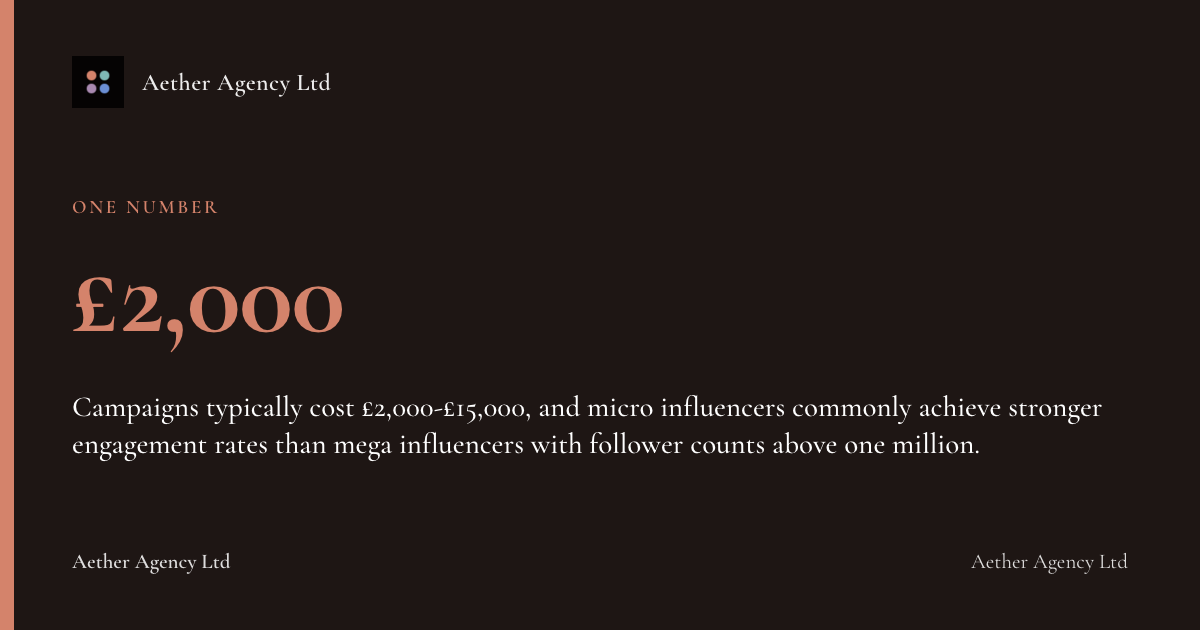
Micro influencer marketing agencies in the UK connect brands with creators who have 10,000-100,000 followers, managing creator discovery, vetting, campaign execution and performance tracking. Campaigns typically cost £2,000-£15,000, and micro influencers commonly achieve stronger engagement rates than mega influencers with follower counts above one million.
Key Takeaways
- Aether Agency Ltd defines a micro influencer marketing agency as a specialist that manages the full partnership lifecycle: creator discovery, vetting, negotiation, content approval and reporting.
- Micro influencer campaigns in the UK typically cost £2,000-£15,000 per project, or 15-25% of creator spend as a commission, or £2,500-£12,000 per month as a retainer.
- The Advertising Standards Authority (ASA) requires influencer content to disclose commercial relationships clearly, using terms such as #ad or #gifted, and continues to issue enforcement notices for non-compliance.
- A typical micro influencer campaign runs 8-12 weeks from initial briefing to final performance reporting.
- Nano influencers (1,000-10,000 followers) charge £50-£150 per post, often the lowest cost-per-engagement of any creator tier.
What Is a Micro Influencer Marketing Agency?
A micro influencer marketing agency is a specialist consultancy that connects brands with social media creators who have between 10,000 and 100,000 followers, managing the entire partnership lifecycle from strategy development through to campaign reporting. These agencies maintain databases of vetted creators across platforms including Instagram, TikTok, YouTube, and LinkedIn, matching brands with influencers whose audience demographics, engagement patterns, and content style align with campaign objectives. Many industry observers report that micro influencers tend to achieve higher engagement rates than macro influencers (accounts with 500,000-1 million followers), because their audiences perceive them as more authentic and accessible.
The UK market for specialist micro influencer agencies has grown in recent years. These agencies handle creator outreach, contract negotiation, content approval workflows, payment processing, and performance analytics, removing the operational burden from internal marketing teams. Most agencies charge either a percentage of media spend (typically 15-25%), a flat project fee (£2,000-£15,000), or a retainer model for ongoing partnerships.
A common industry view is that micro influencers offer brands something celebrity endorsements struggle to replicate: community trust built through regular, two-way interaction with followers who see the creator as a peer rather than a distant public figure. This dynamic is one reason marketing teams report stronger purchase intent from micro influencer content compared with traditional display advertising.
The regulatory landscape in the UK requires agencies to ensure all influencer content clearly discloses commercial relationships, following ASA (Advertising Standards Authority — the UK body responsible for regulating advertising content, including social media promotions) guidelines that mandate terms like #ad or #gifted appear prominently in posts. Agencies that fail to enforce compliance face reputational damage and potential legal action, with the ASA continuing to issue enforcement notices related to influencer disclosure. For a fuller breakdown of these obligations, see the UK Influencer Ad Disclosure Rules 2026: ASA Checklist & Fines.
Why Micro Influencers Outperform Traditional Advertising in 2026
Micro influencers commonly deliver stronger engagement than both celebrity endorsements and standard brand social posts, according to patterns widely reported across UK marketing teams. This performance gap exists largely because micro influencers cultivate highly engaged niche communities built on genuine interaction rather than passive consumption, in contrast to mega influencer accounts where comment threads are often dominated by generic reactions rather than substantive conversation.
The cost-effectiveness advantage is significant. Micro influencers typically charge £150-£500 per Instagram post, considerably less than macro influencers (£2,500-£10,000) or celebrity partnerships (which can run into six figures). When calculated on a cost-per-engagement basis, micro influencer content commonly delivers better value than macro influencer campaigns. For UK brands operating on constrained budgets, this efficiency allows them to work with multiple creators simultaneously, testing different audience segments and content approaches whilst maintaining financial discipline.
Conversion behaviour also favours micro influencer content. Merchants commonly report that customers referred through micro influencer content tend to convert at higher rates and return products less often than customers acquired through paid search or display advertising. This pattern is generally attributed to micro influencer audiences actively seeking product recommendations from creators they already trust, arriving at purchase decisions with clearer expectations about product features and benefits.
| Influencer Tier | Average Engagement Rate | Cost Per Post (UK) | Cost Per Engagement |
|---|---|---|---|
| Nano (1K-10K) | Highest of all tiers | £50-£150 | Lowest of all tiers |
| Micro (10K-100K) | Strong | £150-£500 | Low |
| Mid-tier (100K-500K) | Moderate | £500-£2,500 | Moderate |
| Macro (500K-1M) | Lower | £2,500-£10,000 | Higher |
| Mega (1M+) | Lowest of all tiers | £10,000-£100,000+ | Highest of all tiers |
The authenticity factor is widely cited in media literacy discussions: many UK adults, particularly younger age groups, report trusting product recommendations from micro influencers they follow more than they trust celebrity endorsements or traditional advertising. This trust often translates into action, with a meaningful share of consumers reporting they have purchased a product based specifically on a micro influencer recommendation.
How a Micro Influencer Marketing Agency Manages Your Campaign
A specialist micro influencer marketing agency orchestrates campaigns through a structured five-phase process that turns brand objectives into measurable creator partnerships. The process begins with strategic discovery, where the agency conducts stakeholder interviews to understand your brand positioning, target audience demographics, competitive landscape, and campaign KPIs (Key Performance Indicators — the specific, measurable targets a campaign is judged against, such as engagement rate or conversions). Agencies that invest meaningful time in this discovery phase tend to report higher client satisfaction and better performance against agreed targets.
Phase one: Creator discovery and vetting involves searching the agency's proprietary database and third-party platforms to identify influencers whose audience demographics, engagement patterns, content quality, and brand alignment match your requirements. Professional agencies use tools like Upfluence, AspireIQ, or Traackr to analyse potential creators across multiple dimensions: follower authenticity (identifying fake accounts and bot activity), audience demographics (age, location, interests), engagement quality (comment sentiment and conversation depth), and brand safety (past partnerships and content controversies). This vetting process typically shortlists 15-25 potential creators from an initial pool of 200-300 candidates.
Phase two: Outreach and negotiation sees the agency contact shortlisted creators with campaign briefs, negotiate deliverables and compensation, and manage contract execution. Experienced agencies maintain existing relationships with creators, considerably reducing outreach time compared to brands approaching influencers cold. Contracts specify content requirements (number of posts, platform mix, content themes), usage rights (duration, geographic scope, exclusivity clauses), payment terms (typically 50% upfront, 50% on approval), and disclosure requirements to ensure ASA compliance.
Phase three: Content development and approval involves briefing creators on campaign messaging whilst allowing creative freedom that maintains their authentic voice. The agency reviews draft content before publication, checking for brand alignment, disclosure compliance, and quality standards. Campaigns that allow creators substantial creative autonomy generally achieve higher engagement rates than heavily scripted partnerships, because audiences tend to detect and reject content that feels forced or inauthentic.
Phase four: Campaign execution and monitoring tracks content publication, engagement metrics, and audience sentiment in real-time. Agencies use social listening tools to monitor comments, identify trending conversations, and flag any negative sentiment requiring response. They also ensure creators meet contractual obligations around posting schedules, hashtag usage, and disclosure language.
Phase five: Reporting and optimisation delivers a performance analysis against agreed KPIs, including reach, engagement, website traffic, conversions, and ROI (Return on Investment). Professional agencies provide attribution data showing which creators drove which outcomes, enabling you to identify top performers for future partnerships and refine targeting for subsequent campaigns.
The Cost of Working with a Micro Influencer Marketing Agency in the UK
Micro influencer marketing agencies in the UK use three main pricing models: a percentage-of-spend commission, a flat project fee, or a monthly retainer. UK brands commonly spend several thousand pounds per quarter on micro influencer campaigns when working through an agency, spanning roughly £2,000 for small pilot campaigns to £50,000+ for always-on programmes involving dozens of creators.
The percentage-of-spend model charges 15-25% of total creator fees as the agency's commission. Under this structure, if you allocate £10,000 to pay creators for content, the agency fee would be £1,500-£2,500. This model aligns agency incentives with campaign scale and is most common for brands running ongoing influencer programmes. However, it can disadvantage brands working with nano and micro influencers who charge lower fees, as agencies may push towards more expensive creators to increase their commission.
The flat project fee model charges £2,000-£15,000 per campaign depending on complexity, creator count, and deliverables. A typical three-month campaign involving 8-12 micro influencers, content approval workflows, and performance reporting might cost £6,500-£9,500 in agency fees, plus the creator fees themselves (typically £3,000-£8,000 for the same creator count). This model provides cost certainty and works well for brands testing influencer marketing or running discrete seasonal campaigns.
The monthly retainer model charges £2,500-£12,000 per month for ongoing access to agency services, including strategy development, creator relationship management, content coordination, and monthly reporting. Retainer clients often receive more agency time per pound spent compared to project-based engagements, because the predictable revenue allows agencies to dedicate senior strategists and maintain deeper creator relationships on your behalf.
| Agency Service Level | Monthly Retainer | Project Fee Range | Typical Creator Count | Best For |
|---|---|---|---|---|
| Foundation | £2,500-£4,500 | £2,000-£4,000 | 3-5 micro influencers | Testing influencer marketing, small budgets |
| Growth | £5,000-£8,000 | £5,000-£9,000 | 6-12 micro influencers | Established brands scaling programmes |
| Enterprise | £9,000-£15,000 | £10,000-£25,000 | 15-30+ micro influencers | Multi-platform, always-on campaigns |
Additional costs to budget for include creator fees (£150-£500 per Instagram post for micro influencers), content usage rights (add 20-50% for extended usage beyond organic posting), product seeding (the cost of gifting products to creators for review), and paid amplification (boosting top-performing organic influencer content through paid social, typically adding to total campaign costs).
Ways to reduce costs without sacrificing results include focusing on nano influencers (1,000-10,000 followers) who charge £50-£150 per post whilst often delivering even higher engagement rates than micro influencers; negotiating product-only compensation for smaller creators building their portfolios; running longer-term ambassador programmes that reduce per-post costs through volume commitments; and handling content approval and relationship management in-house whilst using the agency only for creator discovery and vetting.
Choosing the Right Micro Influencer Marketing Agency for Your Brand
Selecting a micro influencer marketing agency means evaluating capabilities across six dimensions: creator database quality, platform expertise, measurement methodology, compliance protocols, vertical experience, and team communication. Brands that use a structured evaluation framework across these six areas tend to report higher satisfaction with their chosen agency than brands deciding primarily on cost or existing relationships.
Creator database quality and vetting processes form the foundation of agency value. Ask prospective agencies how many UK-based micro influencers they have vetted relationships with, what percentage of their database is actively engaged (versus cold contacts), and what tools they use to detect fake followers and engagement fraud. Professional agencies use platforms like HypeAuditor or Modash to verify that the large majority of a creator's audience consists of real accounts, and they maintain detailed profiles including past campaign performance, audience demographics, and content quality scores. It's worth requesting case studies showing how the agency identified the right creators for brands similar to yours.
Platform expertise and content specialisation matter because micro influencer dynamics vary dramatically across Instagram, TikTok, YouTube, and LinkedIn. An agency with deep Instagram expertise may struggle to deliver results on TikTok, where content formats, algorithm behaviour, and audience expectations differ fundamentally. Multi-platform influencer campaigns are increasingly common among UK brands, making cross-platform expertise increasingly valuable. Ask agencies what percentage of their campaigns run on each platform and request examples of content that performed well on your priority channels.
Measurement capabilities and attribution methodology determine whether you can accurately assess ROI and optimise future campaigns. Professional agencies provide granular tracking using UTM parameters (Urgent Tracking Module tags — short codes added to a URL that identify which campaign, creator or post drove a click), unique discount codes, and dedicated landing pages that attribute website traffic and conversions to specific creators and posts. Brands working with agencies that provide creator-level attribution tend to report considerably clearer ROI visibility than brands receiving only aggregate campaign metrics. Ask to see sample reports and confirm the agency can integrate with your existing analytics stack (Google Analytics, Shopify, HubSpot, etc.).
Regulatory compliance and brand safety protocols protect you from reputational damage and legal liability. The agency should demonstrate clear processes for ensuring ASA compliance, including content approval workflows that verify disclosure language, contracts that specify creator obligations around transparency, and ongoing monitoring to catch any posts that fail to meet standards. Disclosure violations often occur because brands and agencies fail to brief creators adequately or monitor content post-publication. Request copies of the agency's standard creator contracts and compliance checklists.
Industry experience and vertical expertise provide valuable context and benchmarks. An agency with deep experience in your sector (beauty, fashion, food, technology, financial services) understands competitive dynamics, knows which creators drive results, and can advise on realistic KPIs based on past campaigns. Brands working with agencies that have a track record of campaigns in their vertical tend to achieve better performance against targets than brands working with generalist agencies.
Chemistry and communication style determine day-to-day working relationships. Schedule calls with the specific team members who would manage your account (not just the new business director), assess their responsiveness and strategic thinking, and confirm their communication cadence matches your preferences. Brand-agency relationships that end prematurely often cite "communication breakdowns" as the primary reason, despite otherwise satisfactory campaign performance.
Your Micro Influencer Marketing Campaign Checklist
- Define clear, measurable campaign objectives tied to business outcomes (brand awareness, website traffic, product sales, email sign-ups) rather than vanity metrics, and establish specific KPI targets before creator outreach begins.
- Identify your ideal customer profile with demographic and psychographic precision, including age range, location, interests, pain points, and media consumption habits, to guide creator selection.
- Set a realistic budget that accounts for agency fees (15-25% of spend or £2,000-£15,000 per project), creator compensation (£150-£500 per post for micro influencers), product seeding costs, and paid amplification if required.
- Brief your agency thoroughly on brand guidelines, messaging priorities, competitor activity, past influencer partnerships (what worked and what didn't), and any content restrictions or sensitivities.
- Review and approve creator shortlists based on audience demographics, engagement quality, content style, and brand alignment rather than follower count alone, requesting audience insights reports for your top choices.
- Negotiate clear contracts that specify deliverables (post count, platform mix, content themes), usage rights (duration and scope), payment terms (typically 50% upfront), exclusivity clauses, and disclosure requirements.
- Allow creative freedom within your brand guidelines, giving creators substantial autonomy over content format, tone, and presentation to maintain authenticity with their audiences.
- Approve content promptly using a streamlined review process (ideally single-round approval within 48 hours) to respect creator schedules and maintain campaign momentum.
- Monitor campaign performance in real-time using UTM parameters, unique discount codes, and social listening tools to track reach, engagement, sentiment, traffic, and conversions.
- Analyse results rigorously at campaign conclusion, calculating ROI, identifying top-performing creators and content formats, and documenting learnings to inform future campaigns.
- Maintain creator relationships beyond individual campaigns by engaging with their content, providing feedback, and considering ambassador programmes for top performers to reduce outreach costs and improve results over time.
Frequently Asked Questions
How much does a micro influencer marketing agency cost in the UK?
Micro influencer marketing agencies in the UK charge £2,000-£15,000 per campaign as a project fee, 15-25% of total creator spend as commission, or £2,500-£12,000 per month for retainer-based relationships. UK brands commonly spend several thousand pounds per quarter on micro influencer campaigns including both agency fees and creator compensation. Total costs depend on campaign scope, creator count, platform mix, and whether you require additional services like paid amplification or extended content usage rights.
What's the difference between micro and macro influencers?
Micro influencers have 10,000-100,000 followers and generally generate higher average engagement rates, whilst macro influencers have 500,000-1 million followers and typically see lower engagement by comparison. Micro influencers charge £150-£500 per post compared to £2,500-£10,000 for macro influencers, and their audiences tend to perceive them as more authentic because they maintain genuine community interaction. Micro influencers excel at driving conversions and building brand affinity within niche audiences, whilst macro influencers provide broader reach for awareness campaigns.
How do I measure ROI from micro influencer campaigns?
Measure micro influencer ROI by tracking creator-specific metrics including reach (impressions and unique viewers), engagement (likes, comments, shares, saves), website traffic (using UTM parameters), conversions (using unique discount codes or dedicated landing pages), and customer lifetime value (CLV — the total revenue a business expects from a customer over the full relationship) for influencer-referred customers. Professional agencies provide attribution reporting that connects specific creators and posts to business outcomes, allowing you to calculate cost-per-acquisition and compare influencer performance against other marketing channels. Brands using creator-level attribution tend to report clearer ROI visibility than brands tracking only aggregate campaign metrics.
Do micro influencer campaigns comply with UK advertising regulations?
Micro influencer campaigns must comply with Advertising Standards Authority (ASA) guidelines requiring clear, upfront disclosure of commercial relationships using terms like #ad, #advert, or #sponsored in prominent positions within posts. The ASA continues to issue enforcement notices for influencer disclosure violations, with penalties for serious or repeat breaches. Professional agencies ensure compliance through creator contracts specifying disclosure requirements, content approval workflows that verify disclosure language before publication, and ongoing monitoring to catch any non-compliant posts. Brands remain legally liable for influencer content even when working through agencies, making robust compliance processes essential.
How long does a typical micro influencer campaign take?
A typical micro influencer campaign runs 8-12 weeks from initial briefing to final reporting, including 2-3 weeks for strategy development and creator discovery, 1-2 weeks for outreach and contract negotiation, 2-3 weeks for content creation and approval, 2-4 weeks for content publication and audience engagement, and 1-2 weeks for performance analysis and reporting. Brands that allow adequate time for campaign execution tend to achieve better performance against KPIs than rushed campaigns, because creators need adequate time to develop authentic content that resonates with their audiences.
Can small businesses afford to work with micro influencer marketing agencies?
Small businesses can access micro influencer marketing through agencies offering foundation-tier services at £2,500-£4,500 monthly retainers or £2,000-£4,000 project fees, working with 3-5 carefully selected creators who charge £150-£300 per post. Small e-commerce businesses investing modestly in micro influencer campaigns (including agency and creator fees) commonly report a strong return in attributed revenue within a few months. Alternative approaches include hiring nano influencers (1,000-10,000 followers) who charge £50-£150 per post, negotiating product-only compensation, or using self-service platforms like AspireIQ or Upfluence to manage creator relationships in-house whilst consulting agencies for strategy and vetting.
What industries benefit most from micro influencer marketing?
Beauty, fashion, food and beverage, travel, fitness, and consumer electronics tend to achieve strong ROI from micro influencer marketing, with engagement rates commonly reported as higher than other sectors. However, B2B brands in technology, financial services, and professional services increasingly use LinkedIn micro influencers to reach decision-makers, often at a lower cost-per-lead than traditional content syndication or paid search. The key success factor across industries is matching creator content style and audience demographics to your ideal customer profile rather than relying solely on industry vertical alignment.
Amplifying Your Brand Through Strategic Micro Influencer Partnerships with Aether Agency Ltd
Running a micro influencer campaign well means the content and creator relationships you build also need to be visible where people now search — not just on Instagram and TikTok, but in Google, ChatGPT, and Perplexity results. Aether Agency Ltd is a full-service creative studio covering brand identity, website development, and marketing designed to get brands found across those search surfaces, which means influencer-driven traffic can be connected to the same optimised landing pages and content strategy rather than treated as a separate channel.
As one proof point: Aether Agency Ltd's content published under its current structure achieves an average Google position of 12.8, compared with 20.7 for the same client sites' older pages, and a 0.41% click-through rate against 0.15% on those older pages. That gap illustrates why pairing creator campaigns with structured content and search optimisation, rather than running influencer marketing in isolation, tends to compound results over time — a principle also covered in AI Search Marketing in Professional Services | 2026 Guide.
Ready to launch a micro influencer campaign that connects to a broader search and content strategy? Contact Aether Agency Ltd for a strategy conversation covering creator partnership approaches and how campaign content can be structured to support your visibility on both traditional and AI-driven search platforms.
Related Reading
- UK Influencer Ad Disclosure Rules 2026: ASA Checklist & Fines
- Micro Influencer Marketing UK: Complete Guide for 2026
- GDPR Compliant Email Marketing Guide 2026 | Aether Agency
Add aether-agency.co.uk as a preferred source on Google
See How Your Brand Appears in AI Search
Aether AI monitors your visibility across ChatGPT, Perplexity, Google AI Overviews, and Claude in real time. Find out where you stand and what to fix.
Explore Aether AI