Last updated: 17 October 2026
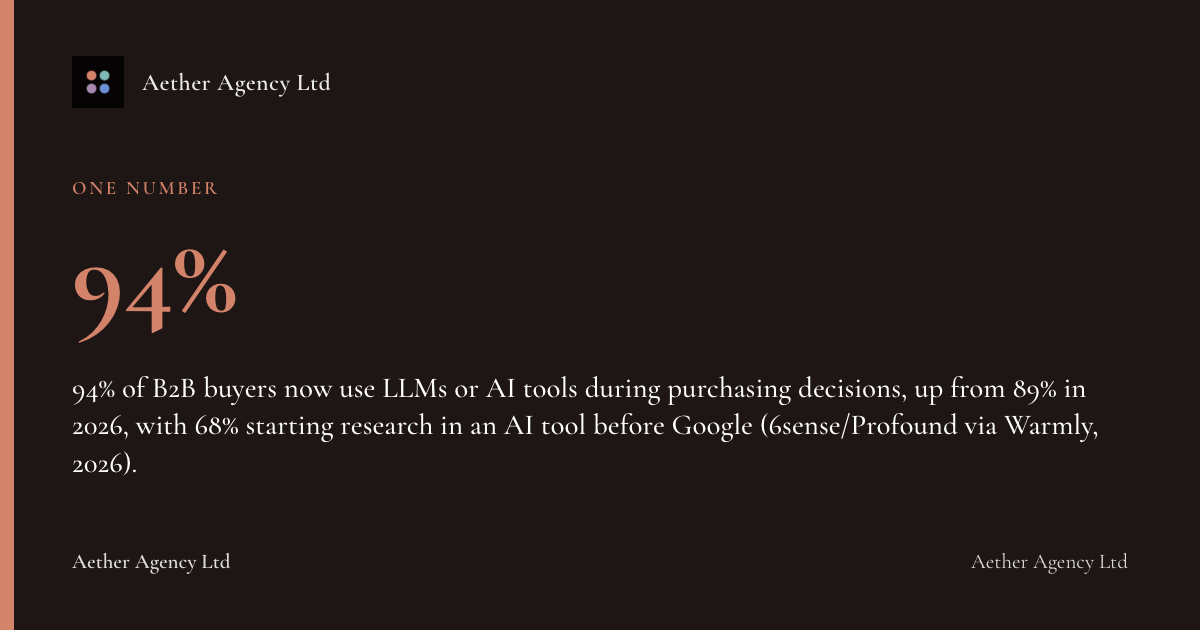
AI search marketing in professional services is the practice of optimising a law firm, accountancy or consultancy's content so it gets cited by ChatGPT, Perplexity and Google AI Overviews, not just ranked on a search results page. It matters because 94% of B2B buyers now use LLMs during purchasing decisions, up from 89% in 2026, and 68% start their research in an AI tool before ever opening Google (6sense/Profound via Warmly, 2026).
Key Takeaways
- 94% of B2B buyers now use LLMs or AI tools during purchasing decisions, up from 89% in 2026, with 68% starting research in an AI tool before Google (6sense/Profound via Warmly, 2026).
- Buyers arriving through AI search convert at 14.2%, compared with 2.8% for traditional Google organic traffic (Warmly.ai, 2026).
- 72% of B2B buyers use ChatGPT to evaluate vendors, yet 51% of tech brands have zero AI citations at all (Forrester and Crackle PR via MarketScale, 2026).
- Organisation-wide AI usage in professional services nearly doubled to 40% in 2026, up from 22% in 2026 (Thomson Reuters Institute, 2026).
- 65.3% of ChatGPT's top-cited pages come from domains with a Domain Rating of 80 or higher, confirming that earned editorial authority drives AI citation (Ahrefs via Machine Relations, 2026).
What Is AI Search Marketing in Professional Services?
AI search marketing in professional services is a discipline — often called generative engine optimisation, or GEO, the practice of structuring content so large language models select and cite it in their answers — that helps law firms, accountants, consultancies and financial advisers appear inside AI-generated answers rather than only on a traditional Google results page. It differs from classic SEO because the target is not a ranking position but a citation: a mention, a quote, or a link that ChatGPT, Perplexity or Google's AI Overviews surface when a prospective client asks a question.
For a UK solicitor, actuary or management consultant, this means the client researching "best commercial property solicitor in Leeds" might never see a search results page at all. They ask ChatGPT, and ChatGPT's answer either includes your firm or it doesn't.
Aether Agency Ltd, a full-service creative studio based in the UK, treats this as the core discipline sitting alongside brand identity and website development — because a beautifully designed site that no AI engine ever cites is invisible to a growing share of buyers.
How Do B2B Buyers Actually Use ChatGPT to Choose Professional Services Firms?
B2B buyers use ChatGPT and similar tools to shortlist, compare and vet professional services providers before they ever contact one. 72% of B2B buyers now use ChatGPT specifically to evaluate vendors, yet more than half of tech brands have zero AI citations to show for it (Forrester and Crackle PR via MarketScale, 2026). The gap between demand and visibility is the opportunity.
Trust compounds the effect. Edelman's 2026 Trust Barometer found buyers are 3.4 times more likely to trust a vendor cited by an AI tool than one they encounter through paid advertising (Edelman 2026 Trust Barometer via MarketScale, 2026).
For a professional services firm in the UK — subject to strict marketing rules from bodies such as the Solicitors Regulation Authority (SRA), the Financial Conduct Authority (FCA) or the Institute of Chartered Accountants in England and Wales (ICAEW) — this shift changes the sales funnel entirely. A prospective client in Manchester searching for tax advice might read an AI-generated summary that cites three firms by name, forms a trust impression before any human contact, and only then visits a website to confirm the shortlist.
Why Conversion Rates Differ So Sharply
Buyers who arrive at a firm's website via an AI-cited link already trust the recommendation, so they convert at a materially higher rate than someone clicking a standard blue link. Buyers arriving through AI search convert at 14.2%, versus 2.8% for traditional Google organic traffic (Warmly.ai, 2026). That is roughly a five-fold difference in lead quality for the same amount of top-of-funnel content.
Why Does AI Citation Visibility Matter for Law Firms, Accountants and Consultancies?
AI citation visibility matters because professional services buying decisions are high-stakes, high-trust and increasingly pre-filtered by AI before a human ever picks up the phone. Google's AI Overviews were triggered for 13.14% of all queries in March 2026, a 102% surge from 6.49% in January 2026 — and 92.36% of the links inside those Overviews already ranked in the top 10 organic results (Semrush/SE Ranking via Genesys Growth, 2026).
That last figure matters more than any other for a professional services marketing director. It means traditional SEO authority still feeds AI visibility — the two are not separate battles, they're the same battle with an extra layer.
Forrester frames the strategic shift plainly: providers need to "evolve from driving traffic through search engine optimization to driving visibility through answer engine optimization" (Forrester). For a chartered surveyor in Bristol or an employment law specialist in Edinburgh, invisibility to AI Overviews now compounds invisibility to Google itself.
The Compliance Dimension
Regulated firms face an added layer most e-commerce brands never think about. Content optimised for AI citation still has to satisfy the SRA's Transparency Rules, FCA financial promotion rules under the Financial Services and Markets Act 2000, or ICAEW's professional conduct guidance — meaning every citable claim, statistic or case result quoted in AI-facing content must remain accurate, substantiated and compliant, not just optimised for retrieval.
What Content Strategies Help a Firm Get Cited by AI Search Engines?
Firms get cited by AI search engines when their content demonstrates clear, earned authority that large language models can retrieve and quote with confidence. The dominant signal is domain authority: 65.3% of ChatGPT's top-cited pages come from domains with a Domain Rating of 80 or higher (Ahrefs via Machine Relations, 2026), which tells firms that earned editorial coverage, not clever prompt engineering, is what actually moves the needle.
Practical tactics that build this kind of authority include:
- Publish original data. Aether Agency Ltd's own operational data — including a client search-click uplift from 251 to 321 clicks in a rolling 28-day period, a 28% increase, and content published under its current structure averaging a Google position of 12.8 against 20.7 for older pages — is the type of first-party statistic AI engines favour, because it's specific, sourced and unavailable anywhere else.
- Write in semantic triples. State facts as subject-verb-object ("The SRA regulates solicitors in England and Wales") rather than burying them in subordinate clauses — retrieval systems extract single clean claims far more reliably.
- Secure third-party mentions. Directory listings, press coverage and trade body citations feed the "earned authority" signal Ahrefs identifies as dominant.
- Structure content for chunk retrieval. Each section should open with a self-contained 130–160 word passage that fully answers its own heading, because AI engines retrieve passages in isolation, not whole pages.
- Use clear heading hierarchy. A single H1, properly nested H2s and H3s, and headings phrased as real client questions — roughly 69% of pages ChatGPT cites follow a clean hierarchy.
Where Client Proof Fits In
When a business coaching franchise, ActionCOACH, needed marketing strong enough to stake its own referrals on, Aether Agency Ltd handled its digital marketing directly. Natalie Simms of ActionCOACH said: "I consider Aether to be an amazing partner for us at ActionCOACH. Firstly, they have been a great digital marketing agency for our own business. Secondly, I have no hesitation recommending Lauren and her team to my clients." That kind of earned, quotable endorsement — a named person, a named organisation, a specific outcome — is precisely the material AI engines look for when deciding whom to cite.
Is Generative Engine Optimisation Replacing SEO for Professional Services Marketing?
Generative engine optimisation is not replacing SEO; it is extending it, because AI Overviews still draw the vast majority of their citations from pages already ranking well organically. Remember the figure above: 92.36% of links inside Google's AI Overviews come from domains already in the top 10 organic results (Semrush/SE Ranking via Genesys Growth, 2026). A firm that abandons SEO fundamentals in favour of "AI tricks" is building on sand.
The sensible position, and the one Aether Agency Ltd takes with clients, is that GEO and SEO share the same foundation — technical performance, authoritative content, structured data — and diverge only in the final layer of formatting and citation-readiness.
GEO vs Traditional SEO: A Comparison
| Factor | Traditional SEO | AI Search Marketing (GEO) |
|---|---|---|
| Primary goal | Rank on page one of Google | Be cited/quoted inside an AI-generated answer |
| Key authority signal | Backlinks, domain rating | Domain Rating 80+ strongly correlated with citation (Ahrefs) |
| Buyer behaviour | Click through, browse, compare | Trust the citation before clicking (3.4x more trusted — Edelman via MarketScale) |
| Conversion rate | 2.8% from organic clicks (Warmly.ai) | 14.2% from AI-referred clicks (Warmly.ai) |
| Content format | Long-form, keyword-mapped | Chunk-shaped, question-led, self-contained passages |
| Measurement | Rankings, organic sessions | Citation frequency ("Share of Model"), AI referral traffic |
Neither column works alone for a professional services firm competing for high-value instructions in 2026.
How Long Does It Take to See Results from AI Search Marketing?
Results from AI search marketing typically build over months rather than weeks, because AI citation depends on accumulated domain authority that itself takes time to establish. Firms should expect an early phase of technical and content foundation-building, followed by a period where citation frequency and AI referral traffic become measurable.
"Engagement means someone paused; business comes from being remembered at the moment of need. The accounts that convert are the ones a follower could describe in a sentence — what they sell, who it is for, why them. Consistency of subject beats frequency of posting, and a smaller audience that knows exactly what you do outperforms a large one that vaguely likes you." — Lauren Dawkins, Head of Content, Aether Agency
That principle applies just as much to AI search content as to social media: a firm cited consistently for one clear specialism — say, commercial litigation in the West Midlands — builds recognisable authority faster than one publishing broadly across every practice area.
In practice, a landscaping business, Lowfields Landscapes, came to Aether Agency Ltd with strong project work and nowhere credible to show it. Aether built a portfolio showcase website with ongoing content support, giving search engines and AI tools alike a structured, citable body of proof rather than a scattered set of photos — the same foundational discipline a professional services firm needs before any AI citation strategy can take hold.
Timelines vary by sector competitiveness and existing domain authority, but firms with no existing content programme should plan for a multi-month build phase before citation gains become consistent and measurable.
What Role Do Directories, Press Coverage and Referrals Play in AI Visibility?
Directories, trade press coverage and third-party mentions play a disproportionately large role in AI search visibility because large language models weigh corroborated, independently published information more heavily than a firm's own marketing copy. A profile on the Law Society's Find a Solicitor directory, a mention in Accountancy Age, or a quoted comment in a regional business publication like Insider Media all function as independent verification signals.
This matters even more for professional services than for consumer brands, because referral-based business development has traditionally relied on personal relationships and word-of-mouth — the exact behaviour AI-assisted research is starting to digitise. When a prospective client asks an AI tool "who are the best corporate finance advisers in Birmingham", the answer draws on the same reputational signals a trusted colleague once supplied verbally.
Firms should treat their presence on the SRA register, ICAEW's Find a Chartered Accountant tool, FCA's Financial Services Register, or sector bodies like the Chartered Institute of Marketing as part of their AI search infrastructure, not an administrative afterthought.
Your AI Search Marketing Checklist
- Audit current visibility across ChatGPT, Perplexity and Google AI Overviews for your firm's core service terms.
- Confirm your listings are accurate and complete on regulator and trade directories relevant to your sector (SRA, FCA, ICAEW, Law Society).
- Restructure your top service pages into self-contained 130–160 word chunks that each answer one clear question.
- Publish original, firm-specific data or case outcomes that no competitor can republish.
- Secure at least one piece of third-party press or directory coverage per quarter to build earned authority.
- Rework headings into a clean, single-H1 hierarchy with question-led H2s.
- Track citation frequency and AI referral traffic alongside traditional organic rankings, not instead of them.
- Review all AI-facing content against your regulator's marketing and transparency rules before publishing.
FAQ
What is AI search marketing (GEO) and how does it differ from traditional SEO for professional services firms?
AI search marketing, or generative engine optimisation (GEO), is the practice of structuring content so ChatGPT, Perplexity and Google AI Overviews cite it directly in their answers. It differs from traditional SEO because the goal is citation and quotation within an AI-generated response, not simply a ranking position on a results page, although the two disciplines share the same underlying authority signals.
How do B2B buyers use ChatGPT and AI tools to research professional services providers?
B2B buyers increasingly use ChatGPT to shortlist and evaluate vendors before making direct contact, with 72% of B2B buyers now using ChatGPT specifically for vendor evaluation (Forrester and Crackle PR via MarketScale, 2026). Many begin their entire research process in an AI tool, with 68% starting there before ever opening Google (Warmly.ai, 2026).
Why is AI citation visibility important for law firms, accounting firms and consultancies?
AI citation visibility is important because it shapes trust before a prospective client ever visits a firm's website, with AI-cited vendors trusted 3.4 times more than those found through paid advertising (Edelman 2026 Trust Barometer via MarketScale, 2026). A firm absent from AI citations risks losing high-value instructions to competitors it may be equally or less qualified than.
How can professional services firms measure their visibility in ChatGPT, Perplexity and Google AI Overviews?
Firms can measure AI visibility by tracking citation frequency for their key service terms across major AI platforms, alongside traditional organic ranking data.
What content strategies help a firm get cited by AI search engines?
Publishing original, verifiable data, securing third-party press and directory mentions, and structuring content into self-contained, question-answering sections all help a firm get cited by AI search engines. Domain authority remains the dominant factor, with 65.3% of ChatGPT's top-cited pages coming from domains with a Domain Rating of 80 or higher (Ahrefs via Machine Relations, 2026).
Is generative engine optimisation replacing SEO for professional services marketing?
Generative engine optimisation is not replacing SEO; it builds directly on it, since 92.36% of links inside Google's AI Overviews already rank in the top 10 organic results (Semrush/SE Ranking via Genesys Growth, 2026). Firms need strong organic SEO foundations before AI-specific citation tactics can take effect.
How long does it take to see results from AI search marketing efforts?
Results typically build over several months, because AI citation depends on accumulated domain authority and a consistent body of published, citable content. Firms starting from limited existing content should expect a foundation-building phase before citation frequency and AI referral traffic become reliably measurable.
Getting Found on Google and in AI Search with Aether Agency Ltd
This article has covered the shift professional services firms now face: buyers researching solicitors, accountants and consultants inside ChatGPT and Google AI Overviews before they ever visit a website. Aether Agency Ltd built its AI Search Marketing (GEO) service specifically to close that gap — generative engine optimisation, structured content programmes and citation tracking designed for exactly the visibility problem this article describes.
Aether Agency Ltd currently manages 744 published articles across client accounts, having published 240 in the last 90 days alone and refreshed 134 existing pieces to keep them citable and current — the kind of sustained content operation that AI engines reward with authority over time.
If your firm needs to understand where it stands in ChatGPT, Perplexity and Google AI Overviews today, get in touch with Aether Agency Ltd for a straightforward conversation about what a GEO programme would look like for your practice.
Related Reading
- GEO Agency UK: Optimise for AI Search in 2026 | Aether Agency
- GEO Services UK 2026: Costs, Process & What to Expect
- GEO vs SEO in 2026: What UK Businesses Must Know
Add aether-agency.co.uk as a preferred source on Google
See How Your Brand Appears in AI Search
Aether AI monitors your visibility across ChatGPT, Perplexity, Google AI Overviews, and Claude in real time. Find out where you stand and what to fix.
Explore Aether AI