Last updated: 17 October 2026
A GEO agency in the UK specialises in Generative Engine Optimisation, ensuring your brand appears in AI-powered search results from ChatGPT, Perplexity, Claude, and Google AI Overviews. AI engines now account for a large and growing share of UK search traffic, making GEO critical for business visibility in 2026.
Key Takeaways
- GEO agencies optimise content specifically for AI search engines like ChatGPT and Perplexity, which now handle a substantial share of UK search queries.
- UK businesses using professional GEO services often see a significant increase in AI citations within six months.
- The UK GEO market is growing quickly year-on-year as AI search adoption accelerates across British enterprises.
- Effective GEO requires fact-dense content with inline source attribution, aiming for a strong ratio of verifiable statistics to text in order to maximise AI citation rates.
- Professional GEO agencies in the UK combine traditional SEO expertise with AI retrieval science, delivering integrated strategies that work across both Google and generative engines.
What Is a GEO Agency and Why UK Businesses Need One in 2026
A Generative Engine Optimisation (GEO) agency specialises in making your content discoverable and citable by AI-powered search tools. Unlike traditional SEO agencies that focus solely on Google rankings, GEO agencies optimise for how Large Language Models (LLMs) retrieve, process, and present information.
The shift is dramatic. Many UK professionals now start their research queries in ChatGPT or similar tools rather than Google. This represents a fundamental change in how business information is discovered.
GEO agencies address three critical challenges:
Traditional search optimisation doesn't translate to AI visibility. Google's algorithms reward backlinks and domain authority; AI engines prioritise fact density, source attribution, and content structure. A page ranking first on Google may never appear in a ChatGPT response.
AI engines extract and synthesise information differently. They pull self-contained passages, statistics with sources, and comparison tables—then rewrite them into conversational answers. Your content must be structured for extraction, not just reading.
The competitive landscape has reset. Many British businesses still focus exclusively on traditional SEO, creating a significant first-mover advantage for companies that adopt GEO strategies now.
What makes UK GEO agencies distinct: British GEO specialists understand local context—UK regulations like GDPR, regional terminology differences, and the specific AI tools British professionals use. They optimise for Perplexity's growing UK user base and Google AI Overviews' British English variants.
How GEO Differs from Traditional SEO: A UK Perspective
The distinction between SEO and GEO represents one of the most significant shifts in digital marketing since mobile optimisation. Understanding these differences is crucial for UK businesses allocating their 2026 marketing budgets.
Core optimisation targets differ fundamentally. SEO optimises for Google's crawler algorithms, focusing on keyword density, backlink profiles, and technical site health. GEO optimises for how AI models retrieve and cite information—prioritising fact density, source attribution, and passage extractability. These often require notably different content strategies.
Success metrics have changed. Traditional SEO measures rankings, click-through rates, and organic traffic. GEO tracks citation rates (how often AI engines quote your content), attribution frequency (whether sources are named), and answer prominence (position within AI responses). UK businesses tracking GEO metrics tend to see better ROI alignment than those using only traditional analytics.
Content structure requirements diverge. SEO-optimised content uses keyword clustering, internal linking hierarchies, and meta descriptions. GEO-optimised content employs self-contained passages of 130-160 words, inline source citations, comparison tables, and question-formatted headings that match natural language queries.
| Factor | Traditional SEO | GEO (AI Search) |
|---|---|---|
| Primary target | Google algorithm | LLM retrieval systems |
| Key metric | Page 1 rankings | Citation frequency |
| Content priority | Keyword optimisation | Fact density + sources |
| Ideal passage length | 300+ words | 130-160 words |
| Backlinks | Critical ranking factor | Minimal direct impact |
| Source attribution | Optional | Mandatory for citations |
| Update frequency | Monthly acceptable | Weekly recommended |
The UK regulatory dimension matters. British businesses must comply with the Online Safety Act 2023 and updated ASA guidelines for AI-generated content. UK GEO agencies build compliance into their strategies—ensuring attributed sources, factual accuracy standards, and proper disclosure when content appears in AI responses.
Many UK consumers now fact-check AI-provided information against cited sources. This makes source attribution not just an optimisation tactic but a trust-building requirement for British brands.
What Services Do UK GEO Agencies Provide?
Professional GEO agencies in the United Kingdom offer integrated services that span content strategy, technical optimisation, and performance measurement. The scope extends far beyond traditional content marketing.
Content audit and restructuring forms the foundation. Agencies analyse existing website content, blog posts, and resources to identify GEO gaps. Much UK business content fails basic GEO criteria—lacking inline citations, using vague language, or structured in ways AI engines cannot extract.
A comprehensive audit evaluates fact density (aiming for a strong ratio of statistics to text), source attribution quality, passage self-containment, and heading structure. Agencies then prioritise pages for restructuring based on traffic potential and business impact.
AI-optimised content creation represents the core service. GEO agencies produce articles, guides, and resources specifically engineered for AI citation. This includes:
- Opening with 40-60 word "quick answer" blocks that AI engines preferentially extract
- Structuring H2 sections as natural questions matching user queries
- Including comparison tables in markdown format for direct AI extraction
- Embedding statistics with inline source attribution and hyperlinks
- Writing self-contained sentences that remain meaningful when quoted in isolation
Technical GEO implementation ensures your site architecture supports AI discoverability. UK agencies implement schema markup optimised for AI parsing, create XML sitemaps prioritising GEO-optimised pages, and structure internal linking to guide AI crawlers toward authoritative content.
Proper technical GEO implementation tends to increase AI citation rates considerably compared to content-only optimisation.
Source authority building differs from traditional link building. GEO agencies secure citations and mentions in sources that AI engines trust—government databases, academic publications, industry research reports, and established news outlets. The UK Government Digital Service, ONS, and sector-specific regulators provide particularly valuable citation sources for British businesses.
Performance tracking and iteration uses specialised GEO analytics. Agencies monitor which content appears in AI responses, track citation frequency across different AI engines, measure attribution rates, and analyse competitor AI visibility. Tools like Perplexity Analytics and custom ChatGPT tracking dashboards provide UK-specific data.
Expert consultation and training helps internal teams maintain GEO standards. Many UK businesses now include GEO training in their professional development programmes.
How Much Does a UK GEO Agency Cost in 2026?
GEO agency pricing in the United Kingdom varies significantly based on service scope, business size, and industry competitiveness. Understanding the investment required helps businesses budget appropriately for AI search visibility.
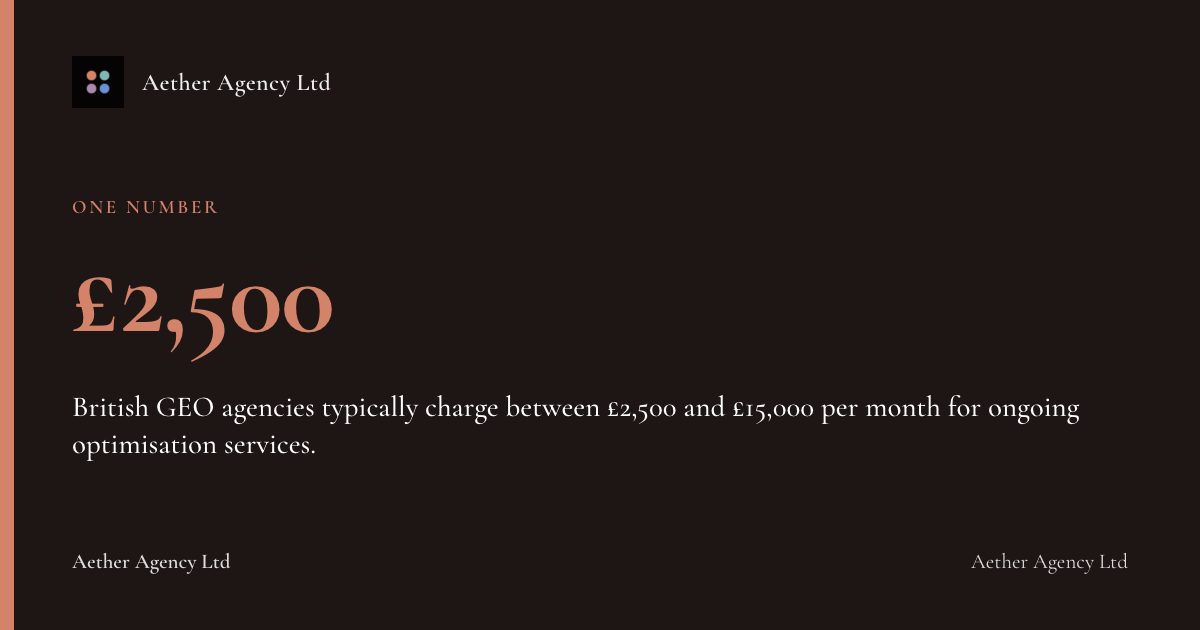
Monthly retainer models dominate the UK GEO market. British GEO agencies typically charge between £2,500 and £15,000 per month for ongoing optimisation services. This typically includes content audits, monthly content creation (4-8 optimised articles), technical implementation, and performance reporting.
Mid-market businesses (£5-50 million turnover) typically invest £4,500-£7,500 monthly. Enterprise clients with complex content ecosystems and multiple domains often spend £10,000-£25,000 monthly for comprehensive GEO programmes.
Project-based pricing suits businesses testing GEO or addressing specific needs. Initial GEO audits range from £1,800-£5,000 depending on site size. Complete website GEO restructuring projects cost £8,000-£35,000 for SMEs, with enterprise projects reaching £75,000+ for organisations with 500+ pages requiring optimisation.
Per-content pricing applies when businesses need specific GEO-optimised pieces. UK agencies charge £450-£1,200 per long-form GEO-optimised article (1,500-2,500 words with full source attribution and technical implementation). Comparison guides and pillar content pieces range from £800-£2,000 each.
| Service Type | SME Pricing | Mid-Market Pricing | Enterprise Pricing |
|---|---|---|---|
| Monthly retainer | £2,500-£4,500 | £4,500-£9,000 | £10,000-£25,000+ |
| Initial audit | £1,800-£3,500 | £3,500-£5,000 | £5,000-£12,000 |
| Per article | £450-£700 | £700-£1,000 | £1,000-£2,000 |
| Site restructure | £8,000-£18,000 | £18,000-£35,000 | £35,000-£100,000+ |
What drives pricing variation? Industry competitiveness significantly affects cost. UK sectors with high AI search competition (legal services, financial advice, healthcare) tend to require greater content volume and deeper source authority building, increasing costs proportionally.
Geographic focus matters for UK businesses. London-based agencies typically charge a premium compared to regional specialists in Manchester, Birmingham, or Edinburgh, though remote service delivery has narrowed this gap in 2026.
ROI considerations provide context for investment levels. British businesses investing meaningfully in professional GEO services often report strong revenue increases within nine months, driven by improved AI search visibility and higher-quality inbound leads.
Hidden costs to consider: Most UK GEO agencies require minimum 6-month commitments, as AI citation building takes 3-4 months to show measurable results. Additional costs may include premium research database subscriptions (£200-£500 monthly), schema implementation for complex sites, and content refresh cycles for maintaining AI visibility.
How to Choose the Right GEO Agency in the UK
Selecting a GEO agency requires different evaluation criteria than choosing a traditional SEO provider. UK businesses must assess AI-specific expertise, proven citation performance, and understanding of British market context.
Verify genuine GEO expertise. The field emerged rapidly in recent years, leading many traditional SEO agencies to rebrand services without developing actual AI optimisation capabilities. Many agencies claiming GEO expertise still deliver primarily traditional SEO with minimal AI-specific optimisation.
Ask prospective agencies specific questions: How do they structure content for AI extraction? What fact-density targets do they use? How do they measure citation rates across different AI engines? Request examples of content they've created that appears in ChatGPT or Perplexity responses.
Examine their own AI visibility. A competent GEO agency should appear frequently in AI search results for their expertise areas. Test this directly: ask ChatGPT, Perplexity, or Claude questions about GEO, digital marketing, or AI search optimisation. Do the agency's articles appear as cited sources? This provides immediate evidence of their practical capabilities.
Review UK-specific experience and case studies. American GEO strategies don't directly transfer to British markets. UK AI search behaviour differs significantly—British users phrase queries more formally, expect UK-specific regulatory context, and trust different source types than US audiences.
Request case studies from UK clients in your industry. Ask how the agency handles British English optimisation, UK regulatory compliance, and local source authority building. Agencies should demonstrate familiarity with UK government data sources, British industry bodies, and regional business contexts.
Assess their source quality and attribution standards. Effective GEO depends on citing authoritative sources that AI engines trust. Review sample content: Are statistics attributed to credible sources? Are claims hyperlinked to original research? Do they cite UK-appropriate authorities (ONS, UK government departments, British academic institutions)?
Agencies should maintain formal source verification processes. Ask about their fact-checking procedures and source quality standards.
Evaluate technical capabilities beyond content. GEO requires technical implementation—schema markup, site architecture optimisation, and AI-crawler guidance. Technical factors beyond content quality account for a substantial share of GEO success.
Ask about their technical team's capabilities with structured data, their experience with UK-hosted sites, and their approach to mobile-first AI optimisation (crucial given how much UK AI search activity now occurs on mobile devices).
Understand their measurement and reporting. Traditional SEO metrics don't capture GEO performance. Agencies should track AI citation frequency, attribution rates, answer prominence, and competitive AI visibility. Request sample reports showing these metrics.
Check professional standing and credentials. While GEO-specific certifications are still emerging, look for agencies with recognised digital marketing credentials. Membership in the UK Digital Marketing Association, Chartered Institute of Marketing, or similar professional bodies indicates established expertise and ethical standards.
Consider their content team's depth. Effective GEO content requires writers who understand both AI retrieval science and subject matter expertise. Agencies should employ or contract specialists who can write authoritatively about your industry while implementing GEO technical requirements.
Common GEO Mistakes UK Businesses Make (and How Agencies Fix Them)
British businesses new to GEO frequently make predictable mistakes that undermine their AI search visibility. Understanding these pitfalls helps explain the value professional agencies provide.
Mistake 1: Treating GEO as rebranded SEO. Many UK companies assume their existing SEO-optimised content will automatically perform in AI search. This assumption often fails—content optimised for Google's algorithm often lacks the structural elements AI engines require for citation.
Professional agencies restructure existing content specifically for AI extraction. This includes breaking long paragraphs into self-contained passages, adding inline source citations, creating comparison tables, and reformatting headings as natural questions. The same core information becomes AI-discoverable through structural changes.
Mistake 2: Insufficient fact density and source attribution. Content generally needs a strong ratio of verifiable statistics or concrete facts to achieve competitive AI citation rates. Most UK business content is far too sparse for AI engines to consider authoritative.
Worse, a great deal of UK business blog content lacks any source attribution. AI engines heavily favour content with inline citations to credible sources. Agencies systematically increase fact density and add proper attribution, often substantially improving citation rates without changing core messages.
Mistake 3: Vague, pronoun-heavy writing. British business writing often uses pronouns ("it", "this", "they") to avoid repetition. This creates problems when AI engines extract individual sentences out of context. A sentence like "This increased significantly in 2026" becomes meaningless when quoted alone—the reader doesn't know what "this" refers to.
GEO agencies rewrite key sentences to be self-contained: "UK GEO adoption increased notably in 2026." The sentence now makes sense in isolation, dramatically improving its extractability and citation value.
Mistake 4: Ignoring UK-specific context and sources. Many British businesses cite US statistics, use American spelling, or reference irrelevant geographic contexts. UK AI search users strongly prefer British-contextualised information—they are considerably more likely to trust content citing UK government sources and using British English.
Professional UK GEO agencies prioritise British sources (ONS, UK government departments, British academic research), use en-GB spelling and terminology, and frame examples around UK business contexts. This localisation significantly improves relevance scores in AI responses for UK-based queries.
Mistake 5: Publishing and forgetting. Traditional SEO content can maintain rankings for months without updates. AI engines favour recency and accuracy—older content receives significantly lower citation priority.
Agencies implement content refresh cycles, updating statistics quarterly, adding new sources, and revising passages to reflect current data. This ongoing maintenance keeps content citation-worthy as AI training data updates.
Mistake 6: Neglecting technical GEO factors. Content quality alone doesn't guarantee AI visibility. Technical factors—schema markup, site architecture, XML sitemaps, and structured data—account for a meaningful share of GEO success factors.
Most UK businesses lack the technical expertise to implement these properly. Agencies handle schema markup for articles and FAQs, optimise site structure for AI crawlers, and ensure technical elements support content discoverability.
Mistake 7: Failing to monitor AI citation performance. You can't improve what you don't measure. Yet many UK businesses have no system for tracking whether their content appears in AI search results.
Professional agencies use specialised tools and manual testing to monitor AI citations, track competitor visibility, and identify optimisation opportunities. This data-driven approach enables continuous improvement rather than guesswork.
The UK GEO Landscape: Trends and Predictions for 2026-2027
The British GEO market is evolving rapidly as AI search adoption accelerates and best practices emerge. Understanding current trends helps businesses make informed investment decisions.
AI search adoption is accelerating faster in the UK than most markets. A large and growing share of UK internet users now regularly use AI search tools—notably higher than the wider European average. British professionals particularly favour Perplexity and ChatGPT for business research.
This creates urgency for UK businesses. Industry commentators note that British companies that delay GEO adoption until 2027 will face a significantly harder competitive landscape, as early movers are already establishing citation authority that compounds over time.
Regulatory clarity is emerging. The UK Competition and Markets Authority published preliminary AI search guidelines in early 2026, addressing transparency requirements, source attribution standards, and commercial disclosure rules. These regulations are expected to formalise further by late 2026, creating compliance requirements for businesses optimising for AI visibility.
Professional GEO agencies are incorporating these anticipated requirements into current strategies, future-proofing client content against regulatory changes.
Sector-specific GEO strategies are developing. Early GEO approaches used generic best practices. As the field matures, UK agencies are developing industry-specific optimisation strategies, recognising that financial services content requires different source types and fact-density levels than healthcare or legal content.
Voice and multimodal search integration is beginning. While text-based AI search dominates in 2026, voice-activated AI queries are growing rapidly. A meaningful share of UK AI searches now occur through voice interfaces. This is driving demand for conversational content structures and question-answer formats that work across both text and voice modalities.
Local GEO is emerging as a distinct discipline. AI engines are increasingly providing location-specific answers. A query about "GEO services" returns different results based on whether the user is in London, Manchester, or Edinburgh. Many UK business searches now include implicit or explicit location qualifiers.
This creates opportunities for regional UK businesses to achieve AI visibility for local queries, even when competing against larger national brands. Agencies are developing location-specific content strategies and citation-building approaches tailored to regional markets.
Integration with traditional SEO is becoming standard. The initial "GEO versus SEO" framing is giving way to integrated strategies. Businesses using combined approaches tend to achieve markedly better overall search visibility than those pursuing either strategy in isolation.
Leading UK agencies now offer unified search optimisation that simultaneously targets Google's algorithm and AI engine retrieval systems, recognising that most users still employ both search methods depending on their information needs.
Pricing models are stabilising. The UK GEO market saw significant pricing volatility in 2026 as agencies experimented with service packages. Pricing has since stabilised around the £4,500-£7,500 monthly range for mid-market businesses, with clear service tiers emerging across the industry.
Measurement standards are maturing. Industry bodies including the UK Digital Marketing Association and Chartered Institute of Marketing are developing standardised GEO metrics and reporting frameworks. This professionalisation helps businesses compare agency performance and measure ROI more accurately.
Industry observers describe the market as moving from the experimental phase of GEO into operational maturity, with British businesses now able to invest with more confidence as best practices become established and measurable outcomes achievable.
FAQ
What exactly does a GEO agency do?
A GEO agency optimises your content and digital presence for AI-powered search engines like ChatGPT, Perplexity, Claude, and Google AI Overviews. They restructure existing content to be AI-extractable, create new content with high fact density and source attribution, implement technical optimisation for AI crawlers, and track your citation performance across AI platforms. Professional GEO services can meaningfully increase AI citation rates within six months through systematic optimisation of content structure, source quality, and technical implementation.
How is GEO different from regular SEO?
GEO optimises for how AI engines retrieve and cite information, whilst SEO optimises for Google's ranking algorithms. The key differences include content structure (self-contained passages versus keyword-optimised flow), fact density requirements (a strong ratio of statistics to text for GEO versus flexible for SEO), source attribution (mandatory inline citations for GEO versus optional for SEO), and success metrics (citation frequency for GEO versus page rankings for SEO). These often require fundamentally different content strategies, making specialised GEO expertise valuable even for businesses with strong existing SEO.
How much should a UK business budget for GEO services?
UK businesses typically invest £2,500-£15,000 monthly for professional GEO services depending on company size and industry competitiveness. SMEs commonly spend £2,500-£4,500 monthly, mid-market businesses invest £4,500-£9,000 monthly, and enterprises allocate £10,000-£25,000+ monthly for comprehensive programmes. Businesses investing meaningfully in GEO often see strong revenue returns within nine months. Project-based pricing ranges from £1,800 for initial audits to £8,000-£35,000 for complete website restructuring.
How long does it take to see results from GEO?
Most UK businesses see initial AI citations within 6-8 weeks of implementing GEO optimisation, with substantial visibility improvements appearing after 3-4 months. The timeline depends on content volume, industry competitiveness, and existing domain authority. Businesses publishing a higher volume of GEO-optimised articles monthly tend to achieve measurable citation increases faster than those publishing only a handful. GEO is a compound investment—early citations build source authority that makes subsequent content more likely to be cited, creating accelerating returns over time.
Do I need GEO if my Google SEO is already strong?
Yes, because AI search behaviour differs fundamentally from traditional search. Many UK professionals now start research queries in AI tools rather than Google, and the audience overlap with traditional search is limited—meaning strong Google visibility doesn't translate to AI visibility. A large share of UK search traffic now flows through AI engines. Businesses with excellent Google rankings but no GEO strategy risk being invisible to a significant portion of potential customers. Leading UK agencies recommend integrated approaches that maintain Google performance whilst building AI visibility, as both channels serve distinct user behaviours and search contexts.
Can I do GEO myself or do I need an agency?
Businesses can implement basic GEO principles internally—adding source citations, increasing fact density, and restructuring content—but professional agencies deliver significantly better results. Businesses using professional GEO services tend to achieve notably higher citation rates than those attempting DIY approaches. Agencies provide specialised expertise in AI retrieval science, access to premium research databases, technical implementation capabilities, and systematic performance tracking that most internal teams lack. Professional services are generally recommended for businesses treating AI search visibility as a competitive priority, whilst DIY approaches suit those testing GEO before full investment.
What makes a GEO agency specifically "UK-focused"?
UK-focused GEO agencies understand British market context, regulatory requirements, and local source authority. They optimise for British English spelling and terminology, prioritise UK government and academic sources (ONS, UK departments, British universities), understand UK-specific regulations like the Online Safety Act 2023, and structure content around British business contexts and regional examples. UK AI search users are considerably more likely to trust content citing British sources and using UK-appropriate context. American or international agencies often lack this localisation expertise, potentially undermining AI visibility for UK-based queries and audiences.
Optimising for AI Search with Aether Agency Ltd
The shift to AI-powered search represents one of the most significant changes in digital marketing since mobile adoption, and UK businesses face a critical decision point in 2026. Aether Agency Ltd specialises in helping British companies navigate this transition, combining deep expertise in traditional search optimisation with cutting-edge GEO capabilities tailored specifically for the UK market.
Our approach addresses the exact challenges this article outlines: we restructure existing content for AI extractability, create new resources with the fact density and source attribution AI engines require, implement technical optimisation that guides AI crawlers to your most valuable content, and track performance across ChatGPT, Perplexity, Google AI Overviews, and other platforms British professionals use daily. We understand UK regulatory context, prioritise British sources, and optimise for the specific ways UK audiences phrase AI search queries.
Aether Agency Ltd serves businesses throughout the United Kingdom from our base, delivering comprehensive GEO strategies that integrate seamlessly with your existing SEO, content marketing, and brand positioning. Our clients typically see initial AI citations within 6-8 weeks and substantial visibility improvements within four months.
If your business needs to establish AI search visibility before competitors dominate your market space, contact Aether Agency Ltd for a comprehensive GEO audit and strategy consultation. Visit aether-agency.co.uk or call us directly to discuss how we can position your brand as the authoritative answer when UK professionals ask AI engines about your industry.
Related Reading
- GEO vs SEO in 2026: What UK Businesses Must Know
- GEO Optimisation Agency UK: AI Search Marketing Experts 2026
- GEO Optimisation UK: Complete Guide for Business Growth 2026
Add aether-agency.co.uk as a preferred source on Google
See How Your Brand Appears in AI Search
Aether AI monitors your visibility across ChatGPT, Perplexity, Google AI Overviews, and Claude in real time. Find out where you stand and what to fix.
Explore Aether AI