Last updated: 26 October 2026
Old branded stock after a rebrand means any uniform, packaging, signage or printed material still carrying a company's former identity once a new brand goes live. UK businesses typically choose between internal reuse, donation, liquidation, recycling or destruction, and the right route depends on trademark exposure, stock volume and how publicly the material is seen. Acting within weeks of launch, rather than leaving pallets in a warehouse, limits both cost and legal risk.
Key Takeaways
- UK businesses put around 33,000 tonnes of corporate clothing into circulation every year, much of which becomes redundant overnight when a rebrand lands (WRAP, Textiles Market Situation Report 2024, cited by Avena).
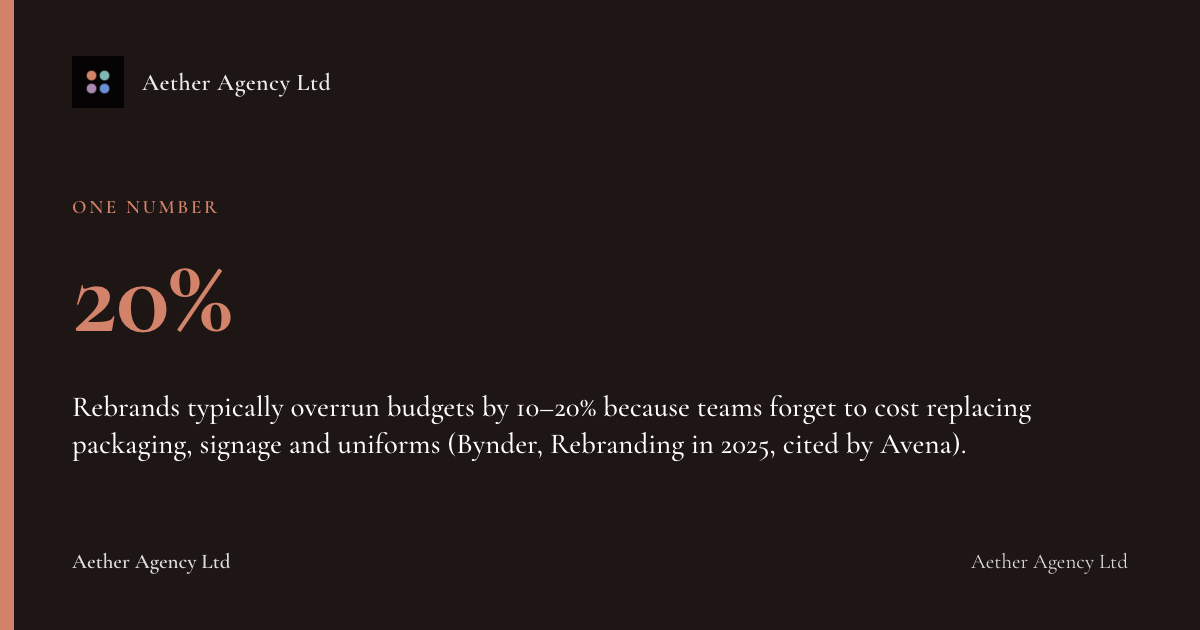
- Rebrands typically overrun budgets by 10–20% because teams forget to cost replacing packaging, signage and uniforms (Bynder, Rebranding in 2025, cited by Avena).
- Only a small share of corporate workwear is recycled effectively in the UK, meaning most old-branded apparel needs a deliberate disposal plan, not a skip (WRAP, cited by Streamline).
- 85% of textiles never get recycled, so throwing old-branded apparel in general waste after a rebrand usually sends it straight to landfill (ASI Promo for the Planet research, cited by Custom Ink).
- Aether Agency Ltd advises that customer-facing branded items — packaging, signage, business cards — carry far higher trademark and confusion risk than stock kept purely for internal staff use.
What Counts as Old Branded Stock After a Rebrand?
Old branded stock is any physical item — uniforms, packaging, signage, stationery, vehicle livery, promotional merchandise — still displaying a company's previous logo, name or colour scheme after a new identity has launched. It sits in warehouses, stockrooms, vans and supplier chains, often forgotten until someone asks why a delivery driver is still wearing the old polo shirt.
The scale is bigger than most finance directors expect. UK businesses put roughly 33,000 tonnes of corporate clothing into circulation annually, and a large share of that becomes obsolete the moment a rebrand goes live, according to WRAP's Textiles Market Situation Report 2024, cited by Avena. Add packaging runs, printed signage, vehicle decals and promotional giveaways, and a mid-sized business can easily be sitting on several pallets of now-redundant material.
This is also why rebrand budgets so often slip. Projects typically overrun by 10–20% because teams price the new identity — logo, website, brand guidelines — but forget the cost of replacing physical stock still carrying the old one, according to Bynder's Rebranding in 2025 report, cited by Avena. At Aether Agency Ltd, old-stock disposal is built into the brand identity planning stage precisely because it's an afterthought elsewhere.
Legal and Trademark Implications of Selling Old Branded Stock
Selling or distributing stock carrying a retired trademark can breach the terms of a trademark assignment, franchise agreement or company sale contract, and can mislead customers about who they're buying from. Under the Trade Marks Act 1994, a business generally retains rights to use its own old mark on stock it already owns, but problems arise the moment that stock implies an ongoing association with a brand, supplier or certification that no longer applies.
Three scenarios create real exposure. First, if the rebrand follows a merger or acquisition and the old mark is now owned by a different legal entity, continuing to sell stock bearing it can constitute trademark infringement. Second, if old packaging references a certification, address or regulatory claim that's changed — a common issue for food and drink brands governed by Food Standards Agency labelling rules — selling it on risks a compliance breach, not just a branding one. Third, reselling old-branded stock through third-party marketplaces (eBay, Facebook Marketplace, trade liquidators) without controlling the listing can create consumer confusion the Advertising Standards Authority or Trading Standards could later query.
The safest approach is to get sign-off from whoever holds IP responsibility — usually legal counsel or a company secretary — before any sale, donation or third-party transfer of stock bearing the old mark. A rebrand that isn't legally "closed off" on the old identity leaves a business exposed long after the new logo is live.
Can Old Branded Stock Be Used Internally Without Legal Risk?
Internal-only use of old branded stock — staff uniforms worn in a warehouse, stationery used for internal memos, tote bags for internal storage — carries materially lower legal risk than public-facing use, because there's no customer-facing confusion about which brand a person is dealing with. The key distinction regulators and courts look at is public exposure, not ownership.
A business generally remains free to:
- Use old-branded uniforms for warehouse or back-office staff with no customer contact
- Repurpose old stationery, notepads and internal signage for internal-only communications
- Keep old branded packaging materials (boxes, tape) for internal stock transfers, not customer shipments
Risk returns the moment that stock becomes visible to the public — a delivery driver in an old-logo jacket, a reception area still displaying the old signage, or customer invoices printed on old letterhead. Aether Agency Ltd typically advises clients to set a hard internal cut-off date, usually tied to the public launch date, after which no old-branded item appears anywhere a customer, supplier or journalist might see it.
How to Find UK Charities That Accept Branded Stock Donations
UK charities and reuse organisations will often accept old branded stock, particularly clothing, provided the items are de-labelled or clearly marked as surplus stock rather than counterfeit current-season goods. Donation avoids landfill, supports the circular economy WRAP tracks nationally, and gives a rebrand a genuine sustainability story — provided the claim stands up to scrutiny.
That caveat matters. 63% of UK consumers who prioritise sustainability distrust companies' environmental claims, according to Brand Finance's From Purpose to Purchase report, so a donation needs to be real and documented, not a line in a press release. Practical routes include:
- National charities with clothing reuse schemes — organisations such as the British Heart Foundation and Oxfam accept bulk corporate clothing donations, though bulk logistics are usually arranged separately from high-street drop-off.
- Specialist branded merchandise redistributors — SwagCycle worked with Facebook when it rebranded to Meta and needed to donate 20,000 outdated branded items, according to SwagCycle, cited by CreativeMC, showing the scale even a single large rebrand can generate.
- Local community groups and schools — often happy to take uniforms, stationery and promotional items for non-commercial use where old branding carries no confusion risk.
- Overseas aid and development charities — many accept bulk textile donations for redistribution, though exporters should check destination-country import rules before shipping.
De-branding or de-labelling corporate-wear before donation is increasingly viable; WRAP has researched de-labelling techniques specifically to make corporate clothing reusable once the original branding is removed, supporting the reuse economy rather than diverting items to landfill.
Disposal Options Compared: Donation, Recycling, Liquidation or Destruction
Choosing between donation, recycling, liquidation and destruction depends on volume, brand sensitivity and whether the stock has any recoverable value. None of the four is automatically "correct" — the right choice depends on what the stock is and who might see it.
| Option | Best for | Typical cost impact | Brand risk |
|---|---|---|---|
| Donation | Uniforms, stationery, low-risk merchandise | Low cost, sometimes a modest collection fee | Low, if de-labelled or clearly surplus |
| Recycling | Textiles, paper packaging, signage materials | Recycling/collection fees, often charged per kg or per pallet | Very low |
| Liquidation | Large stock volumes with resale value | Liquidators typically take a commission or buy at a steep discount | Medium — resold stock can resurface publicly |
| Destruction | Sensitive packaging, counterfeit-risk items, confidential signage | Highest cost — shredding/incineration fees plus a destruction certificate | Lowest |
Liquidation needs the most care. Selling surplus old-branded stock to a liquidator who then resells it publicly can recreate exactly the confusion a rebrand was meant to end, so any liquidation agreement should specify where and how the stock can be resold, or require de-branding first.
The national picture shows how skewed UK textile handling already is. Roughly 1.45 million tonnes of used textiles were generated in the UK in 2022, of which around 276,000 tonnes were resold, 650,000 tonnes diverted to reuse or recycling, and 421,600 tonnes exported, according to WRAP's Textiles Market Situation Report 2024. Meanwhile, around 727.7 kilotonnes of UK textiles were discarded to landfill or incineration, with 546.4 kilotonnes going into household residual waste bins — about 4.2% of general waste — according to the same WRAP report. A rebrand that defaults to "bin it" adds directly to that landfill figure.
Tax Treatment of Writing Off or Donating Old Branded Stock
Writing off obsolete branded stock for UK tax purposes generally means reducing its value to nil or to net realisable value in the accounts, which reduces taxable profit in the period the write-off occurs. HMRC expects stock to be valued at the lower of cost or net realisable value under UK GAAP, so stock that's genuinely unsellable because it carries a retired brand can usually be written down, provided the business can evidence the loss.
Donating stock to a registered charity can also be tax-efficient. Many businesses donate goods rather than destroy them specifically because a documented charitable donation supports both the write-off and the sustainability narrative a rebrand often wants to tell. Any write-off or donation decision should go through finance and be properly evidenced — a photograph, a destruction certificate, or a signed donation receipt — because HMRC can query stock movements during an inspection.
This is a decision for finance, not marketing, even though marketing usually spots the problem first. Aether Agency Ltd typically flags the old-stock question to a client's finance team as soon as a rebrand timeline is confirmed, rather than leaving it until launch week.
Common Mistakes Businesses Make With Old Branded Stock
The most frequent mistake is treating old-stock disposal as a marketing afterthought rather than a cross-functional project involving legal, finance and operations. A rebrand touches brand identity, but the stock itself is a legal, tax and logistics problem too, and businesses that assign it to one department alone usually miss something.
Common errors include:
- No hard cut-off date — old stock keeps circulating for months because nobody set a deadline for its removal from customer-facing use.
- Skipping legal sign-off before resale — stock gets liquidated or sold on without checking the trademark assignment terms.
- No destruction or donation records — finance can't evidence the write-off if HMRC asks, and marketing can't prove the sustainability claim if challenged.
- Ignoring third parties — franchisees, distributors and retailers holding old stock get forgotten, and old branding resurfaces publicly months later.
- Binning stock that could be donated — given that only a small share of corporate workwear is recycled effectively in the UK, according to WRAP, cited by Streamline, landfill is rarely the only option, just the default one.
- Underestimating the volume — teams plan for head-office stock and forget vans, satellite sites and storage units.
"They brief the site they want to look at instead of the site their customer needs to act on. Every page should have one job — answer, reassure, or convert — and a visitor should never have to work out what you sell or what to do next. Beautiful and unclear loses to plain and obvious every single time." — Lauren Dawkins, Head of Content, Aether Agency
That same discipline applies to old stock: a rebrand plan should state exactly what happens to every item carrying the old identity, not leave it as a loose end once the new website is live. When Aether Agency Ltd rebranded Renton Dance Studio, transforming its identity, website and social presence from traditional to modernised, the stock question — old signage, old printed material — was part of the same planning conversation as the new brand itself, not a separate afterthought.
Your Old Branded Stock Disposal Checklist
- Set a hard cut-off date for all customer-facing use of the old brand, tied to the public launch date.
- Get legal sign-off before selling, donating or liquidating any stock carrying the old trademark.
- Audit every location holding stock — warehouses, vans, retail sites, franchisees and third-party distributors.
- Separate customer-facing stock (packaging, signage, business cards) from internal-only stock (back-office uniforms, internal stationery).
- Contact charities or redistributors for de-labelled donation before considering landfill.
- Instruct finance to document the write-off or donation for HMRC evidence purposes.
- Specify resale and de-branding terms in any liquidation agreement.
- Keep destruction certificates or donation receipts on file for at least the standard six-year HMRC record-keeping period.
FAQ
What should a business do with old-logo merchandise after a rebrand?
A business should audit volumes first, then route low-risk items (uniforms, stationery) to donation or recycling and reserve destruction for customer-facing packaging or signage carrying trademark or confidentiality risk. Legal sign-off should happen before any sale or donation.
Can a company still sell products with the old branding after a rebrand?
Generally yes, provided the business still owns the trademark and the sale doesn't mislead customers about certification, ownership or current trading status. Where the rebrand follows a merger, acquisition or trademark sale, legal advice is essential before any resale.
Is it legal to donate branded stock after a company rebrand?
Yes, donating old branded stock is legal in the UK provided it doesn't breach a trademark assignment or create public confusion, and de-labelling before donation reduces risk further. Charities and redistribution specialists such as SwagCycle regularly handle large-scale corporate donations of exactly this kind.
How do you write off obsolete branded inventory for UK tax purposes?
Obsolete stock is typically written down to net realisable value under UK GAAP, reducing taxable profit in that accounting period, with HMRC expecting documented evidence of the loss. A photograph, destruction certificate or donation receipt should support the write-off in case of an inspection.
Should old branded uniforms be destroyed or recycled after a rebrand?
Recycling or donation is preferable to destruction in most cases, since only a small share of corporate workwear is currently recycled effectively in the UK, leaving significant room to divert uniforms away from landfill. Destruction should be reserved for uniforms carrying confidential or security-sensitive branding.
How long can a business keep using old packaging after a rebrand?
There's no fixed legal deadline, but best practice is a short, defined transition window — often a matter of weeks — after which no old-branded packaging should reach customers. Internal stock can be used longer provided it never becomes customer-facing.
Who is responsible for managing old branded stock after a rebrand?
Responsibility should be shared across marketing, operations, finance and legal, since the decision involves trademark risk, tax treatment and physical logistics simultaneously. Treating it as a marketing-only task is one of the most common reasons old stock lingers for months after launch.
Planning a rebrand with Aether Agency Ltd
Old branded stock is one of the most predictable, yet most commonly overlooked, costs of any rebrand, and it's exactly the kind of detail Aether Agency Ltd builds into the planning stage rather than treating as a loose end. A brand identity project at Aether Agency Ltd covers naming, identity systems and guidelines built to survive every channel — which means the conversation about old signage, packaging and uniforms happens before launch day, not after.
Aether Agency Ltd has delivered 50+ projects, drawing on more than 20 years of combined team experience across brand, website and marketing work for growing UK businesses. If a rebrand is on the horizon and the question of what happens to the old stock hasn't been answered yet, get in touch with Aether Agency Ltd to talk through a Brand Identity project that accounts for the transition properly from day one.
Related Reading
- How to Rebrand After a Merger: A UK Timeline for 2026
- What Are the Risks of Rebranding? | Aether Agency
- SEO Agency UK: What It Costs and What Actually Works (2026)
Add aether-agency.co.uk as a preferred source on Google
See How Your Brand Appears in AI Search
Aether AI monitors your visibility across ChatGPT, Perplexity, Google AI Overviews, and Claude in real time. Find out where you stand and what to fix.
Explore Aether AI