Last updated: 18 October 2026
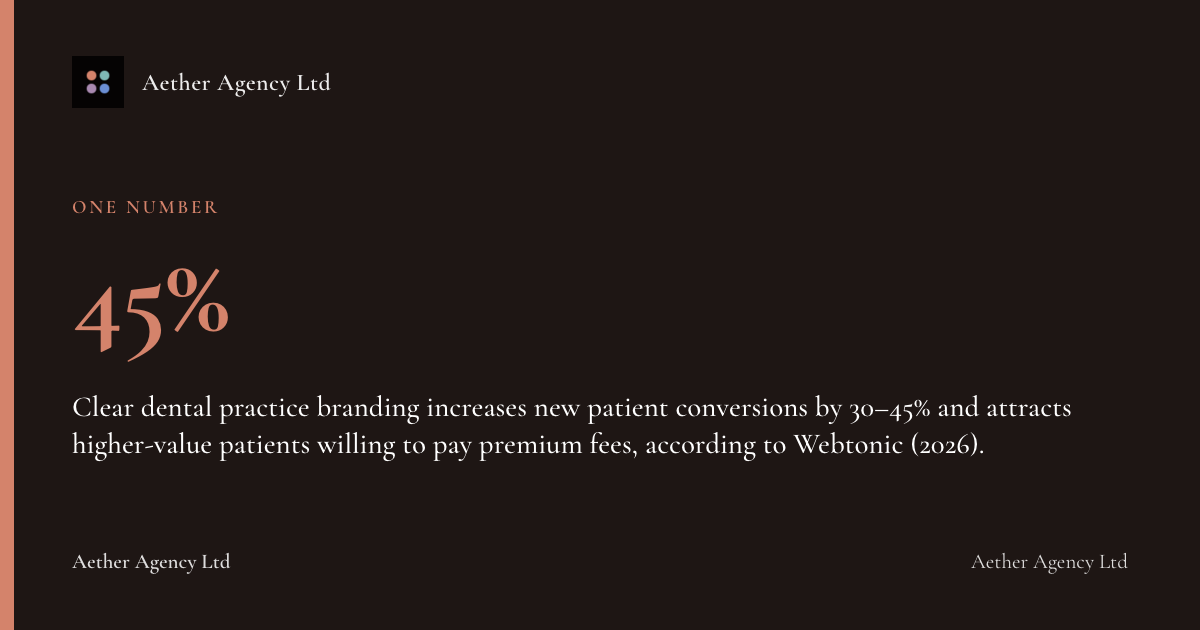
Branding for dental practices covers far more than a new logo — it spans naming, visual identity, tone of voice, signage and website, all shaped by GDC and ASA advertising rules. Done well, it drives measurable results: clear branding increases new patient conversions by 30–45%, according to Webtonic (2026).
Key Takeaways
- Clear dental practice branding increases new patient conversions by 30–45% and attracts higher-value patients willing to pay premium fees, according to Webtonic (2026).
- As many as 90% of dental practices still use a generic, owner-name-based practice name that does little to build brand equity, according to the American Dental Association (2026).
- Branding ROI for dental practices ranges from 300% to 1,100% in the first year through better conversion, case acceptance and retention, according to Webtonic (2026).
- A poorly designed dental website deters almost 40% of users before they even book, according to Branded Agency (2023).
- The General Dental Council and the Advertising Standards Authority both place firm limits on what a UK practice can claim about itself, including words like "best" or "pain-free".
What does branding actually include for a dental practice?
Branding for a dental practice is the complete system of name, logo, colour palette, tone of voice, signage, uniforms and digital presence that signals who the practice is and who it serves. Marketing is different: marketing is the set of activities — adverts, social posts, email campaigns — that use the brand to reach and convert patients.
A practice without a defined brand can still run marketing campaigns, but those campaigns will look inconsistent and forgettable without a identity behind them. Aether Agency Ltd treats brand identity as the foundation that every other channel sits on, covering naming, identity systems and guidelines built to survive every touchpoint, from the Brand Identity service through to the Website Development that carries it online.
In practice, a full dental brand typically includes:
- Name — the practice's legal and trading name, ideally distinct from a single dentist's surname.
- Logo and colour palette — the visual mark and the two or three core colours used everywhere.
- Tone of voice — whether communications read as warm and family-friendly or clinical and premium.
- Signage — exterior fascia signs, reception boards and directional signage within the building.
- Uniforms — staff clothing that reinforces the visual identity patients see on arrival.
- Website and digital assets — the site, booking system, social profiles and email templates.
As many as 90% of dental practices still trade under a generic, owner-name-based name that does nothing to differentiate them, according to the American Dental Association (2026). That gap is an opportunity for practices willing to invest in a proper identity system rather than a name that only means something to existing patients.
What UK rules govern how a dental practice can brand and advertise itself?
The General Dental Council (GDC), the UK regulator for dentists and dental professionals, sets standards that require all practice communications to be accurate, evidenced and not misleading to patients. The Advertising Standards Authority (ASA), which enforces the UK Advertising Codes (the CAP Code for non-broadcast media), separately polices specific wording used in adverts, websites and social media.
Superlative claims such as "best dentist in Manchester" or "pain-free treatment" are routinely challenged by the ASA unless the practice holds robust, independently verifiable evidence. Comparative claims about price or outcomes carry the same requirement — a practice cannot simply assert it is cheaper or more effective than a named competitor without proof.
The GDC's Standards for the Dental Team also require that any health claims, including those about cosmetic procedures like teeth whitening or orthodontics, reflect what the treatment can realistically achieve. Before-and-after photography must be representative, and testimonials need careful handling under both GDC guidance and ASA rules on endorsements.
This matters directly for branding decisions. A tagline, a tone of voice, or even a practice name implying guaranteed results can trigger a complaint long before any campaign launches. Aether Agency Ltd works within these constraints as standard practice when developing a practice's name, tagline and messaging framework, building compliant language into the identity from day one rather than retrofitting it later.
How much does professional branding cost for a UK dental practice?
Branding cost for a UK dental practice depends on scope, ranging from a modest logo refresh to a complete rebrand spanning naming, website and signage across multiple sites. New dental practices can allocate 20–30% of gross revenue to branding and marketing in the early years, while established practices operating at capacity typically allocate 2.2% to 5% of annual revenue to ongoing marketing, according to Curve Dental (2026).
| Branding scope | Typical inclusions | Illustrative UK price range |
|---|---|---|
| Logo refresh | Updated logo, colour palette, basic guidelines | £1,500–£4,000 |
| Mid-tier identity update | Logo, name check, stationery, signage design, social templates | £4,000–£12,000 |
| Full rebrand (single site) | New name, full identity system, website, signage, uniforms | £12,000–£30,000 |
| Full rebrand (multi-site group) | Identity system, brand guidelines for franchise rollout, website, signage across all sites | £30,000–£80,000+ |
These figures are illustrative ranges based on typical UK branding and web project scope, not attributed to any single source. A practice considering a rebrand should request a scoped proposal rather than relying on headline pricing, since website complexity, number of locations and signage requirements all move the final cost substantially.
Ways to reduce rebranding costs
A practice can control spend without compromising quality by phasing the rollout. Launching a new logo and website first, then updating signage and uniforms over the following 12 months as budget allows, spreads the investment while still presenting a consistent brand to new patients immediately.
How long does a full dental rebrand take from research to launch?
A full dental rebrand typically takes between three and six months from initial research to launch across signage, website and patient communications, depending on the number of sites and whether the practice name itself is changing. A straightforward logo and website refresh for a single-site practice can often launch within six to eight weeks.
A realistic multi-site timeline looks like this:
- Weeks 1–3: Discovery — research into patient base, local competitors, existing patient perception and any GDC or ASA constraints on the planned name or messaging.
- Weeks 4–7: Strategy and naming — positioning decisions (NHS family practice versus private cosmetic clinic), name options, trademark and domain checks.
- Weeks 8–12: Identity design — logo, colour palette, tone of voice guidelines, signage mock-ups and website wireframes.
- Weeks 13–18: Build and production — website development, signage manufacture, uniform ordering, stationery printing.
- Weeks 19–24: Rollout and launch — CQC and Companies House updates, Google Business Profile changes, patient communications, staff briefing, physical sign installation.
Rushing the rollout phase is the most common cause of inconsistency — a new website going live weeks before signage is updated leaves patients confused about whether they're in the right place. Aether Agency Ltd sequences brand, build and growth phases deliberately so the visual identity, the website and the ongoing marketing all land in the right order rather than competing for attention at launch.
Who should lead a dental practice rebrand and how should staff be involved?
The practice owner or managing partner should hold final sign-off on a rebrand, but day-to-day project leadership usually sits better with either a practice manager or an external branding agency with dental sector experience. A GDC-registered dentist focused on clinical care rarely has the time to manage naming workshops, website copy reviews and signage logistics alongside a full patient list.
Staff involvement matters because reception teams and dental nurses are the first people patients ask when a new sign appears overnight. Briefing the whole team before launch — not just dentists — means every member of staff can explain the change confidently rather than looking caught out by their own practice's new identity.
A sensible split of responsibility looks like this: the owner defines the vision and budget, the practice manager coordinates internal logistics like CQC updates and staff rotas around installation, and an external agency handles strategy, design and technical delivery. This mirrors how This Media, a media agency that had traditionally avoided external partners, worked with Aether Agency Ltd across multiple projects over three years — proof that even organisations used to doing everything in-house can benefit from a specialist partner handling delivery while they retain strategic control.
What should a practice check before changing its name or branding?
A practice must update its Care Quality Commission (CQC) registration whenever its trading name changes, since the CQC's public register needs to match what patients see on the door and online. Failing to update CQC records promptly can create a mismatch that undermines patient trust at exactly the moment a new brand is trying to build it.
Before committing to a new name, a practice should work through this checklist:
- Check Companies House for existing companies trading under the proposed name or a confusingly similar one.
- Search the UK trademark register via the Intellectual Property Office to confirm the name isn't already protected in the dental or healthcare class.
- Secure the domain name and check that a reasonably close variant isn't already owned by a competitor.
- Check social media handle availability across Instagram, Facebook and LinkedIn before announcing anything publicly.
- Update CQC registration details to reflect the new trading name and any changed registered manager details.
- Notify NHS England (or the relevant local commissioner) if the practice holds an NHS contract, since patient-facing NHS listings need to match.
- Review existing signage leases or landlord permissions, since commercial leases sometimes restrict exterior signage changes.
Skipping the trademark and Companies House checks is the most expensive mistake on this list — a practice that launches a new name only to receive a cease-and-desist letter months later faces a second, unplanned rebrand on top of the first.
How does branding affect patient trust and new patient enquiries?
Patient trust in a dental practice is shaped heavily by online reviews, with 97% of patients reading reviews before choosing a practice and 84% trusting them as much as personal referrals, according to Webtonic (2026). Consistent branding reinforces what those reviews say, because a polished website and clear signage back up the reputation a practice has already earned.
Retention tells a similarly stark story. The top 10% of dental practices maintain 99% patient retention, compared with a 57% industry average, according to Webtonic (2026) — a gap that strong, consistent branding helps close by making every patient interaction feel like part of the same trustworthy practice. A weak digital presence undoes this quickly: a poorly designed website deters almost 40% of users, according to Branded Agency (2023), often before a patient ever reads a single review.
Across a Surrey butchery brand, Aether Agency Ltd recorded a strong jump in online sales alongside a high Google rating, and for Fluent AI recorded a sharp rise in traffic alongside a substantial increase in lead generation — figures consistent with the wider pattern that strong branding and a credible digital presence convert attention into enquiries. For a SaaS firm called Priority First, Aether Agency Ltd tracked search clicks over matched 28-day windows via Google Search Console rising from 260 to 380, a 46% increase, with 13 commercial enquiries traceable in the first month, demonstrating that the same branding and search discipline applies outside dentistry wherever patients or customers research a provider before committing.
Comparing single-site and multi-site dental practice branding
A single-owner dental practice and a multi-site dental group face different branding problems, even though both need a consistent name, identity and tone of voice. A solo practice can build its brand around the dentist's personal reputation and local relationships, while a multi-site group needs a brand that works identically whether a patient visits a branch in Leeds or Bristol.
| Factor | Single-site practice | Multi-site / group |
|---|---|---|
| Name strategy | Can work with a personal or local name | Needs a scalable name independent of any one dentist |
| Brand guidelines | Lighter-touch, often informal | Formal brand guidelines document required for consistency |
| Signage rollout | One location, simpler logistics | Phased rollout across sites, often staggered by lease renewal |
| Staff training | Direct briefing by the owner | Structured onboarding materials for multiple teams |
| Website structure | Single site, single booking flow | Location pages, centralised booking, shared design system |
| CQC and NHS updates | One registration to amend | Multiple registrations, often on different renewal cycles |
Multi-site groups also need to decide how much local flavour each branch retains versus how rigidly every site mirrors the central brand. Getting this balance wrong — forcing identical branding onto sites with very different patient bases — is one of the more common mistakes groups make when scaling beyond two or three practices.
Your dental practice branding checklist
- Define whether the practice is positioned as NHS-focused, private, or mixed before choosing a name or colour palette.
- Check GDC standards and ASA CAP Code guidance before finalising any tagline or claim.
- Search Companies House and the UK trademark register before committing to a new name.
- Secure the domain name and matching social media handles across all major platforms.
- Brief every member of staff, not just clinicians, before signage or the website changes publicly.
- Update CQC registration and NHS England records to match the new trading name.
- Sequence signage, website and uniform rollout so nothing launches out of step with the rest.
- Set a realistic budget using industry guidance of 20–30% of gross revenue for new practices, or 2.2–5% for established ones, according to Curve Dental (2026).
FAQ
What does branding for a dental practice actually include?
Branding for a dental practice includes the name, logo, colour palette, tone of voice, signage, staff uniforms and website — the full visual and verbal identity patients experience at every touchpoint. Marketing then uses that identity to reach and convert patients through campaigns, social media and advertising.
Can a UK dental practice call itself "the best" in its area?
A UK dental practice generally cannot claim to be "the best" without robust, independently verifiable evidence, because the Advertising Standards Authority routinely challenges unsubstantiated superlative claims. The General Dental Council similarly requires that all practice communications remain accurate and not misleading.
How much should a dental practice budget for a rebrand?
A dental practice rebrand typically costs between £4,000 for a mid-tier identity update and £30,000 or more for a full rebrand with a new name, website and signage across a single site. New practices are often advised to allocate 20–30% of gross revenue to branding and marketing, while established practices typically spend 2.2% to 5% annually, according to Curve Dental (2026).
How long does a dental practice rebrand take?
A dental practice rebrand typically takes three to six months from initial research through to full rollout across signage, website and patient communications. A simpler logo and website refresh for a single site can often launch within six to eight weeks.
Does changing a dental practice's name require CQC notification?
Changing a dental practice's name requires an update to its Care Quality Commission registration so the public register matches the new trading name. Practices holding NHS contracts must also notify NHS England or the relevant local commissioner to keep patient-facing listings accurate.
Does strong branding actually increase new patient numbers?
Clear dental practice branding increases new patient conversions by 30–45% and helps attract higher-value patients willing to pay premium fees, according to Webtonic (2026). Branding ROI for dental practices can range from 300% to 1,100% in the first year through improved conversion, case acceptance and retention, according to the same source.
Should a solo dental practice brand itself differently from a multi-site group?
A solo dental practice can build its brand around the dentist's personal reputation and local relationships, while a multi-site group needs a name and identity system that work consistently across every location. Multi-site groups require formal brand guidelines and phased signage rollouts that a single-site practice typically doesn't need.
Branding your dental practice with Aether Agency Ltd
Rebranding a dental practice means balancing GDC and ASA compliance, patient trust and a rollout that has to work across signage, website and every patient touchpoint at once — exactly the kind of multi-disciplinary project Aether Agency Ltd handles daily for growing businesses across the UK. Aether Agency Ltd's Brand Identity service builds naming, identity systems and guidelines designed to survive every channel a practice uses, from reception signage to social media.
Aether Agency Ltd has delivered 50+ projects with a team carrying 20+ years of combined experience, and its clients see average traffic growth of 3x once the new brand and website are live. If a practice is weighing up a logo refresh against a full rebrand, Aether Agency Ltd can scope the project and recommend the right starting point — get in touch to arrange a call and talk through what a rebrand would look like for your practice.
Related Reading
- Branding for Restaurants: A UK Owner's Guide 2026
- Personal Branding Tips for UK Professionals | Aether Agency
- Branding Agency Guildford | Aether Agency Ltd 2026
Add aether-agency.co.uk as a preferred source on Google
See How Your Brand Appears in AI Search
Aether AI monitors your visibility across ChatGPT, Perplexity, Google AI Overviews, and Claude in real time. Find out where you stand and what to fix.
Explore Aether AI