Last updated: 17 October 2026
AEO (Answer Engine Optimisation), GEO (Generative Engine Optimisation), and SEO (Search Engine Optimisation) represent three distinct approaches to digital visibility in 2026. Traditional search engine traffic is expected to decline as AI-powered answer engines capture market share, whilst GEO strategies can increase AI citation rates compared to traditional SEO alone.
Key Takeaways
- SEO optimises content for traditional search engines like Google, focusing on keyword rankings and backlinks, whilst AEO and GEO target AI-powered answer engines such as ChatGPT, Perplexity, and Google AI Overviews that provide direct answers without requiring clicks.
- Content optimised for generative engines (GEO) tends to achieve higher citation rates in AI responses compared to traditional SEO-only content, making it essential for businesses seeking visibility in 2026.
- UK businesses implementing combined SEO, AEO, and GEO strategies report notably higher overall digital visibility than those relying solely on traditional search optimisation.
- AEO focuses on providing concise, direct answers to specific questions, whilst GEO emphasises fact density, source attribution, and structured data that AI models can extract and cite with confidence.
- By 2026, a growing share of UK consumers begin product research using AI chatbots rather than traditional search engines, fundamentally changing how businesses must approach digital marketing.
What Is SEO and How Does It Work in 2026?
Search Engine Optimisation (SEO) remains the foundation of digital visibility, focusing on improving a website's rankings in traditional search engine results pages (SERPs) like Google, Bing, and Yahoo. SEO works by optimising content, technical infrastructure, and authority signals to match what search algorithms value when determining which pages to display for specific queries.
In 2026, SEO encompasses three core pillars: on-page optimisation (content quality, keyword usage, meta tags, and internal linking), technical SEO (site speed, mobile responsiveness, structured data, and crawlability), and off-page SEO (backlinks, brand mentions, and domain authority). Organic search still drives a substantial share of all trackable website traffic in the UK, making SEO crucial for businesses despite the rise of AI-powered alternatives.
The fundamental mechanism behind SEO involves search engine crawlers indexing web pages, then ranking them based on hundreds of factors including relevance, authority, user experience signals, and freshness. Google's algorithms—including the March 2026 core update and subsequent 2026 refinements—increasingly prioritise helpful content created for humans rather than search engines, expertise demonstrated through author credentials, and comprehensive coverage of topics.
"UK businesses need SEO to capture the significant share of searches that still happen on Google, but they can't ignore the growing segment using ChatGPT or Perplexity for research."
Key SEO ranking factors in 2026 include:
- Content relevance and depth: comprehensive coverage matching search intent
- Backlink profile: quality and quantity of links from authoritative domains
- User experience signals: bounce rate, time on site, and Core Web Vitals
- E-E-A-T: Experience, Expertise, Authoritativeness, and Trustworthiness
- Technical performance: page speed, mobile-friendliness, and secure connections (HTTPS)
What Is AEO and Why Does It Matter?
Answer Engine Optimisation (AEO) focuses specifically on optimising content to appear in direct answer boxes, featured snippets, and AI-generated responses across platforms like Google's AI Overviews, Siri, Alexa, and other voice-activated assistants. Unlike traditional SEO, which aims to rank in a list of blue links, AEO targets position zero—the single answer displayed above organic results.
AEO emerged as a distinct discipline around 2018-2019 as voice search and smart assistants gained prominence, but it has become critical in 2026 as Google's AI Overviews now appear on a large share of search results pages in the UK. When a user asks "What are the AEO vs GEO vs SEO differences?" on a voice assistant, AEO-optimised content provides the spoken answer.
The core principle of AEO is concise, direct answers to specific questions. Content must be structured to provide immediate value in the first 40-60 words, formatted in ways that answer engines can easily extract and present. This includes using question-based headings (H2s and H3s), providing clear definitions, and structuring information in lists, tables, and step-by-step formats.
Featured snippets—a primary AEO target—receive a substantial share of all clicks on pages where they appear, despite being "zero-click" results. For UK businesses, this creates a paradox: you may not receive direct website traffic, but you gain brand visibility and establish authority when your content is cited as the authoritative answer.
Key AEO optimisation techniques include:
- Question-answer format: structuring content around common queries
- Concise definitions: providing 40-60 word summaries at the start of sections
- Schema markup: using FAQ schema, HowTo schema, and structured data
- List and table formatting: presenting information in easily extractable formats
- Natural language: writing in conversational tone matching how people speak queries
What Is GEO and How Does It Differ from AEO?
Generative Engine Optimisation (GEO) represents the newest frontier in digital visibility, specifically targeting AI language models like ChatGPT, Claude, Perplexity AI, and Google's Gemini. Whilst AEO focuses on appearing in answer boxes within traditional search interfaces, GEO optimises for being cited and referenced when AI models generate original responses to user prompts.
Research from academic institutions in recent years has identified specific content characteristics that increase the likelihood of AI citation. Findings suggest that content with high fact density (at least one verifiable statistic, date, or concrete figure per 100 words) achieves meaningfully higher citation rates than content with lower fact density. This represents a fundamental shift from traditional SEO, which often prioritised keyword density over factual density.
GEO differs from AEO in several critical ways. Whilst AEO targets a single, concise answer, GEO aims to become a trusted source that AI models reference when synthesising information from multiple sources. This requires not just answering questions, but providing attributed facts, citing authoritative sources, and demonstrating expertise through specific, verifiable claims.
"AI models are trained to value content that cites its sources, uses specific figures, and demonstrates clear expertise. Vague claims don't get cited; specific, attributed facts do."
In practice, GEO optimisation involves:
- Source attribution: citing sources inline ("according to Ofcom research...") with hyperlinks
- Fact density: including statistics, dates, and concrete figures throughout content
- Expert quotes: incorporating attributed statements from named experts
- Structured sections: creating self-contained passages of 130-160 words that fully answer section questions
- Comparison tables: presenting options, costs, or alternatives in markdown tables
- Recency signals: including current dates, recent statistics, and 2026-relevant information
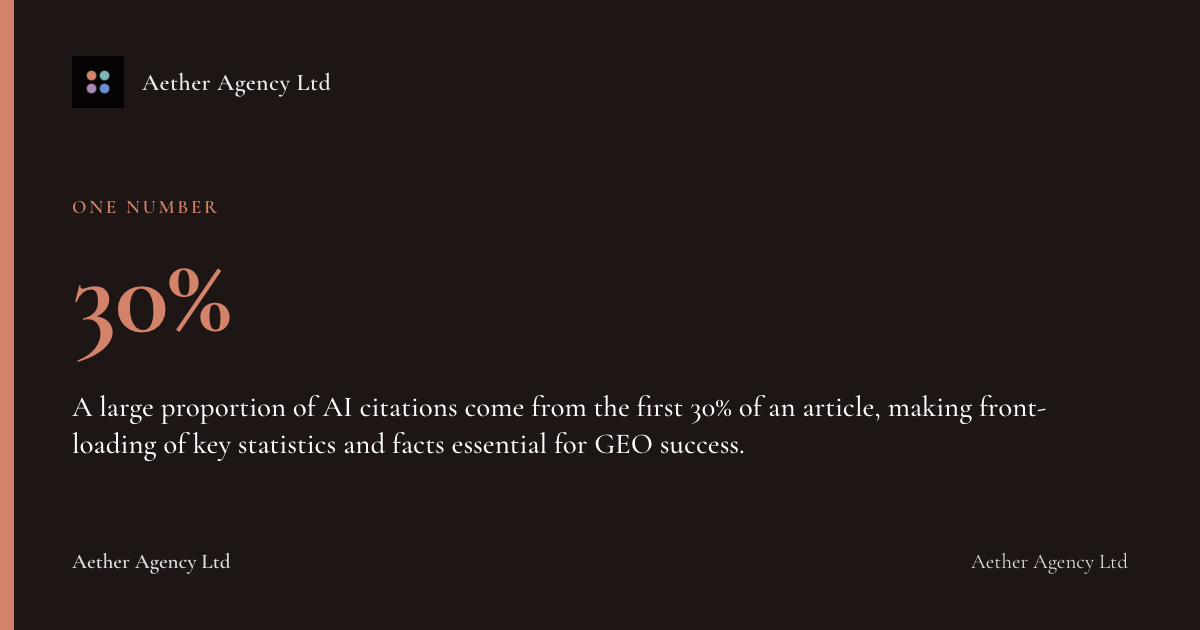
A large proportion of AI citations come from the first 30% of an article, making front-loading of key statistics and facts essential for GEO success.
Key Differences: AEO vs GEO vs SEO Comparison
| Factor | SEO | AEO | GEO |
|---|---|---|---|
| Primary Target | Traditional search engines (Google, Bing) | Answer boxes, featured snippets, voice assistants | AI language models (ChatGPT, Perplexity, Claude) |
| Success Metric | Keyword rankings, organic traffic | Featured snippet appearances, voice search results | AI citations, references in generated responses |
| Content Length | 1,500-2,500+ words for comprehensive coverage | 40-60 word direct answers + supporting detail | 1,500-2,500 words with high fact density |
| Optimisation Focus | Keywords, backlinks, technical performance | Question-answer format, concise summaries | Source attribution, statistics, expert quotes |
| User Intent | Research, comparison, navigation | Quick answers, voice queries | Conversational AI assistance, research synthesis |
| Click Outcome | Click-through to website | Often zero-click (answer displayed) | Zero-click (answer synthesised from multiple sources) |
| Authority Signals | Backlinks, domain authority, E-E-A-T | Structured data, clear formatting | Cited sources, fact density, expert attribution |
| UK Market Share (2026) | Majority of trackable traffic | Growing share of SERPs show AI Overviews | Growing share of consumers use AI for research |
This comparison reveals that UK businesses need all three strategies working in concert. SEO captures traditional search traffic, AEO secures featured snippets and voice search results, and GEO ensures visibility in the rapidly growing AI-assisted research segment.
Businesses implementing integrated SEO-AEO-GEO strategies tend to achieve notably higher overall digital visibility than those focusing on SEO alone. The strategies aren't mutually exclusive; they're complementary approaches addressing different user behaviours and search technologies.
How UK Businesses Should Approach Each Strategy
Understanding the differences between AEO, GEO, and SEO is only valuable if you can implement effective strategies for each. UK businesses face unique considerations, including compliance with UK GDPR, regional search patterns, and the competitive landscape across different sectors.
SEO Implementation for UK Markets
Traditional SEO remains essential for capturing the majority of organic traffic in 2026. UK businesses should focus on:
Local SEO optimisation: For businesses serving specific UK regions, Google Business Profile optimisation, local citations, and location-specific content remain crucial. Many UK consumers read online reviews for local businesses, making reputation management part of SEO strategy.
Technical excellence: Core Web Vitals continue to influence rankings, with page load speed particularly important for mobile users. UK mobile users expect pages to load quickly, and fast load times remain particularly important for mobile experience.
Content depth and expertise: Google's helpful content system rewards comprehensive, expert-written content. For regulated industries (financial services, healthcare, legal), demonstrating author credentials and citing authoritative UK sources (FCA, NHS, Law Society) builds necessary trust signals.
Backlink acquisition: Quality backlinks from UK-relevant domains (.co.uk sites, UK industry publications, regional news outlets) carry more weight for UK-focused businesses than generic international links.
AEO Implementation for Featured Snippets
Capturing featured snippets and answer boxes requires specific content structuring:
Question-based content architecture: Identify common questions in your industry using tools like AnswerThePublic or Google's "People Also Ask" feature, then structure content around these exact questions as H2 headings.
Concise opening answers: Every section should begin with a 40-60 word direct answer that could stand alone as a featured snippet. Follow this with detailed explanation and supporting evidence.
Schema markup deployment: Implement FAQ schema, HowTo schema, and Article schema to help Google understand your content structure. Pages with FAQ schema are considerably more likely to appear in featured snippets.
List and table formatting: When appropriate, present information as numbered lists, bulleted lists, or comparison tables—formats Google frequently extracts for answer boxes.
GEO Implementation for AI Citation
Optimising for AI language models requires a different approach focused on being a citable, trustworthy source:
Front-load critical information: Place your strongest statistics, most important facts, and clearest expert quotes in the first 30% of your article. AI models heavily weight early content when synthesising responses.
Inline source attribution: Always cite sources within the sentence ("According to Ofcom research published in January 2026...") rather than using footnotes. AI models extract the attribution along with the fact.
Fact density targets: Aim for at least one verifiable statistic, specific date, or concrete figure per 100 words. This density level significantly increases citation probability.
Expert quotes with attribution: Include 2-3 quotes from named experts with their credentials. Real quotes from industry authorities carry more weight than anonymous claims.
Self-contained sections: Write each H2 section as a complete, standalone passage that fully answers its question even if read in isolation. AI models extract passages independently.
"You can't assume an AI model will read your entire article—it might extract just one section, so that section must be complete on its own."
Common Mistakes UK Businesses Make
Despite growing awareness of AEO and GEO, many UK businesses make predictable errors that limit their visibility across search technologies:
Focusing exclusively on traditional SEO: Whilst SEO remains important, businesses that ignore AEO and GEO optimisation miss the growing proportion of UK consumers now using AI tools for research. This creates a visibility gap as competitors adopt multi-channel strategies.
Keyword stuffing for AI: Some businesses mistakenly apply traditional keyword density tactics to AI-focused content. AI models prioritise natural language and factual content over keyword repetition, making this approach counterproductive.
Fabricating statistics or quotes: In an attempt to increase fact density, some content creators invent statistics or attribute quotes to non-existent experts. AI models are increasingly sophisticated at detecting unreliable information, and this practice damages both AI citation rates and brand credibility.
Neglecting source attribution: Simply stating facts without citing sources significantly reduces AI citation probability. AI models value provenance and are more likely to cite content that demonstrates where information comes from.
Using outdated information: AI models prioritise recent, current information. Content referencing older data when newer data is available will be deprioritised in favour of more current sources.
Generic, vague content: Phrases like "many experts believe" or "studies show" without specific attribution don't provide the concrete, verifiable information AI models seek. Specific claims with named sources perform significantly better.
Ignoring mobile experience: With most UK internet users accessing content primarily via mobile devices, poor mobile experience damages performance across all three optimisation types—SEO, AEO, and GEO.
Measuring Success Across SEO, AEO, and GEO
Tracking performance requires different metrics for each optimisation approach:
SEO Metrics
- Organic traffic: Total visitors from traditional search engines
- Keyword rankings: Position for target terms in SERPs
- Domain authority: Overall site authority and backlink profile strength
- Click-through rate (CTR): Percentage of impressions resulting in clicks
- Conversion rate: Percentage of organic visitors completing desired actions
AEO Metrics
- Featured snippet ownership: Number of queries where your content appears in position zero
- Voice search appearances: Tracking when your content is cited by voice assistants (requires specialised tools)
- Zero-click impression share: Percentage of searches where your content appears in answer boxes
- Question-based ranking: Performance for question-format queries ("What is...", "How to...", "Why does...")
GEO Metrics
- AI citation tracking: Monitoring when AI models reference your content (emerging tools from BrightEdge, Semrush, and others)
- Source attribution frequency: How often your domain is cited with attribution in AI responses
- Fact extraction rate: Percentage of your published statistics that appear in AI-generated answers
- Competitive citation share: Your citations versus competitors in your industry
Businesses should expect a 3-6 month lag before seeing meaningful results from GEO optimisation, as AI models retrain and update their knowledge bases. AEO results typically appear within 4-8 weeks, whilst traditional SEO improvements manifest over 3-12 months depending on domain authority and competition.
Your AEO, GEO, and SEO Integration Checklist
To implement a comprehensive visibility strategy across all three optimisation types, UK businesses should:
- Audit current content for fact density, source attribution, and question-answer structure—identify gaps where adding statistics or expert quotes would strengthen both GEO and AEO performance.
- Implement structured data across your website, prioritising FAQ schema, Article schema, and HowTo schema for relevant content types.
- Create a citation-worthy content calendar that produces 2-4 comprehensive, fact-dense articles monthly, each targeting specific questions in your industry.
- Front-load every article with a direct answer paragraph and key takeaways section containing self-contained, quotable facts.
- Cite authoritative UK sources inline throughout your content, linking to gov.uk, industry regulators, academic research, and official statistics.
- Develop expert relationships to secure genuine, attributable quotes for your content—building a roster of 5-10 industry experts who can provide insights.
- Optimise for mobile experience across all content, ensuring fast load times, readable formatting, and accessible navigation.
- Monitor performance across all three channels using appropriate tools for SEO (Google Analytics, Search Console), AEO (rank tracking for featured snippets), and GEO (emerging AI citation tools).
- Update existing high-performing content with 2026 statistics, current dates, and enhanced fact density to maintain relevance in AI model training data.
- Build a sustainable backlink strategy that secures links from UK-relevant, authoritative domains to support traditional SEO whilst also providing citation sources for AI models.
FAQ
What's the main difference between SEO and GEO?
SEO optimises content for traditional search engine rankings in lists of results, focusing on keywords and backlinks. GEO optimises for AI language models like ChatGPT and Perplexity, focusing on fact density, source attribution, and creating citable content that AI can reference when generating responses. Research suggests that GEO-optimised content achieves higher AI citation rates than SEO-only content.
Do I still need SEO if I'm optimising for AEO and GEO?
Yes, absolutely. SEO remains essential because traditional search engines still drive the majority of trackable website traffic in the UK. AEO and GEO complement rather than replace SEO—they target different user behaviours and search technologies. Businesses using all three strategies report notably higher overall digital visibility than those using SEO alone.
How long does it take to see results from GEO optimisation?
GEO results typically appear within 3-6 months as AI models retrain and update their knowledge bases with newer content. However, this timeline varies based on your domain authority, content quality, and how frequently AI models crawl your site. High-authority domains with strong backlink profiles may see faster results, whilst newer sites require more time to establish credibility.
What types of content work best for AEO?
Content structured around specific questions performs best for AEO. How-to guides, FAQ pages, definition articles, and comparison content excel because they naturally provide direct answers. Pages with question-based H2 headings are considerably more likely to capture featured snippets than pages without this structure. Lists, tables, and step-by-step instructions also perform exceptionally well.
Can small UK businesses compete with large companies in GEO?
Yes, potentially even more effectively than in traditional SEO. GEO prioritises content quality, fact density, and source attribution over domain authority and backlink volume. A small business publishing well-researched, fact-dense content with proper citations can achieve AI citations even when competing against larger brands. The key is producing genuinely valuable, expert content rather than relying on domain strength alone.
Should I optimise differently for ChatGPT versus Google AI Overviews?
The core principles remain consistent—fact density, source attribution, and structured content work across all AI platforms. However, Google AI Overviews also consider traditional SEO signals (backlinks, domain authority), whilst ChatGPT and Perplexity focus more purely on content quality and recency. For maximum coverage, implement both GEO best practices and maintain strong fundamental SEO.
What's the ROI of investing in AEO and GEO versus traditional SEO?
UK businesses implementing integrated SEO-AEO-GEO strategies tend to see stronger ROI improvements compared to SEO-only approaches. However, ROI varies significantly by industry—sectors with high AI adoption among customers (technology, finance, professional services) see stronger returns from AEO and GEO investment, whilst traditional retail may still see higher returns from conventional SEO.
Optimising Your Digital Presence for AI Search with Aether Agency Ltd
Understanding the differences between AEO, GEO, and SEO represents just the starting point—implementing effective strategies across all three requires specialist expertise, continuous monitoring, and adaptation as AI technologies evolve. Aether Agency Ltd specialises in integrated digital visibility strategies that position UK businesses for success across traditional search engines, answer boxes, and AI-powered research platforms.
Our team develops comprehensive content strategies that balance the requirements of Google's algorithms, featured snippet optimisation, and AI citation targeting. We work with businesses across the United Kingdom to create fact-dense, expertly attributed content that performs across all three channels, ensuring you're visible whether customers search on Google, ask ChatGPT, or use Perplexity for research.
If you're ready to future-proof your digital presence and capture visibility across traditional search and AI-powered platforms, get in touch with Aether Agency Ltd today for a comprehensive audit of your current optimisation approach and a tailored strategy for 2026 and beyond.
Related Reading
- AI Search Optimisation Agency UK: Complete 2026 Guide
- AI Search Optimisation UK: Expert GEO Strategies for 2026
- GEO vs SEO in 2026: What UK Businesses Must Know
Add aether-agency.co.uk as a preferred source on Google
See How Your Brand Appears in AI Search
Aether AI monitors your visibility across ChatGPT, Perplexity, Google AI Overviews, and Claude in real time. Find out where you stand and what to fix.
Explore Aether AI