Last updated: 21 October 2026
AI citation tracking for brands measures how frequently and accurately AI search engines such as ChatGPT, Perplexity, and Google AI Overviews reference a company when answering user queries. A growing number of UK brands now monitor this metric directly, because citation frequency is increasingly treated as a leading indicator of qualified inbound enquiries alongside traditional SEO performance.
Key Takeaways
- AI citation tracking monitors how often ChatGPT, Perplexity, Claude, and Google AI Overviews mention a company in response to relevant user queries, and a growing share of UK brands now track this metric systematically.
- Brands that appear in AI citations commonly report higher qualified inbound enquiry rates than brands relying solely on traditional Google rankings, which is why marketing teams increasingly treat citation frequency as a commercial metric rather than a vanity one.
- Effective AI citation tracking combines automated monitoring tools (typically checking 50-200 queries daily), manual validation, and sentiment analysis to measure both the volume and the accuracy of brand mentions.
- UK brands that invest in structured data, authoritative backlinks, and fact-dense content tend to see higher citation rates within six months, consistent with published Generative Engine Optimisation (GEO) research.
- Aether Agency Ltd reports average client traffic growth of 3x, illustrating the kind of visibility gains that structured content and technical optimisation can support (Aether Agency Ltd client data).
Why AI Citation Tracking Matters for UK Brands in 2026
AI citation tracking has become a core brand visibility metric because AI search engines are increasingly used as a discovery channel alongside, and in some cases instead of, traditional search. A growing proportion of UK internet users now begin product research with an AI assistant rather than a conventional search engine, a shift that has accelerated markedly since 2024.
When a potential customer asks ChatGPT "Which UK agencies specialise in AI search optimisation?" or queries Perplexity about "best brand identity studios in London," the brands cited in that response gain immediate credibility and consideration. Unlike traditional search, where a user sees ten blue links and chooses where to click, AI engines typically cite only two to four brands in a single conversational answer — creating a winner-takes-most dynamic for visibility.
The commercial effect is measurable at the brand level. Companies appearing in AI citations for their core service terms commonly report higher enquiry conversion rates than companies that rank well on Google but remain absent from AI-generated answers. The likely reason is trust: an AI-generated answer carries an implicit endorsement, and users tend to treat a cited brand as pre-vetted rather than as a paid placement.
This shift is particularly pronounced in professional services, B2B technology, and high-consideration consumer categories, where buyers increasingly use AI assistants during vendor research and shortlisting — a pattern explored further in our guide to choosing a marketing strategy agency in the UK. Traditional SEO metrics — rankings, impressions, click-through rates — no longer capture the full picture of brand discoverability on their own.
AI citation tracking fills this gap by answering three distinct questions: Is the brand being mentioned? In what context? And with what accuracy? Without systematic tracking, a brand has no visibility into its AI search presence, and risks missing both opportunities (queries where competitors are cited but it is not) and risks (inaccurate information or negative framing appearing in AI responses).
What Is AI Citation Tracking?
AI citation tracking is a monitoring discipline that measures how often, and how accurately, a brand is mentioned by generative AI systems in response to user queries. It sits within the broader practice of Generative Engine Optimisation (GEO) — the set of techniques used to improve a brand's visibility in AI-generated answers, as distinct from traditional search engine optimisation (SEO), which targets ranked result pages.
The discipline differs from conventional rank tracking in one fundamental respect: AI responses are non-deterministic. The same query submitted to ChatGPT or Perplexity twice can produce two different answers, depending on context, prior conversation history, and model updates. Because of this, AI citation tracking requires repeated testing of the same query over time, rather than a single snapshot, to produce a reliable measure of citation frequency.
How AI Citation Tracking Works: The Technical Framework
AI citation tracking combines automated query testing, natural language processing, and manual validation to monitor brand mentions across multiple AI platforms. This differs from traditional rank tracking because, as noted above, AI responses are non-deterministic, meaning a single test is not a reliable measure of performance.
The core methodology involves three components. First, brands compile a target query set of 50-200 questions that potential customers might plausibly ask AI assistants. These queries span informational intent ("What is AI search optimisation?"), comparative intent ("Best creative agencies in Manchester"), and transactional intent ("Which agency should I hire for brand identity?"). Effective query sets tend to balance high-volume generic terms with long-tail, specific questions.
Second, automated tools submit these queries to ChatGPT, Perplexity, Claude, Google AI Overviews, and other platforms on a recurring basis, capturing the full text of each response. Robust tracking systems run each query multiple times to account for response variability, then use natural language processing to detect brand mentions, measure sentiment, and identify cited sources. These tools flag when a brand appears, note whether the mention is positive, neutral, or negative, and track whether the citation links to the brand's own website or to a competitor's.
Third, human analysts validate a sample of the automated results to check accuracy and interpret nuance. AI responses often contain implicit brand references — for example, "agencies specialising in GEO optimisation" may describe a brand's services without naming it — or context-dependent mentions that automated tools miss. Manual review also catches citation errors, such as when an AI engine misattributes a brand's work, conflates it with a competitor, or cites outdated information.
The output of this process is typically a citation dashboard showing: citation frequency (the percentage of target queries that mention the brand), citation context (informational versus commercial queries), competitive share of voice (the brand's citations relative to competitors'), source attribution (whether AI engines link to the brand's site), and accuracy scores (whether factual claims about the brand are correct). Brands that treat this seriously tend to update these metrics weekly, alongside traditional traffic and conversion metrics.
Technical infrastructure matters because of cost and scale. Most brands use a combination of purpose-built GEO tracking platforms, which automate query submission and response analysis, and custom scripts that query AI provider APIs (Application Programming Interfaces — the technical channels through which software can query an AI model directly) for greater flexibility. The constraint is usually cost: running a 200-query daily tracking programme via API can add up to a meaningful monthly bill in fees alone, before tooling and analyst time are factored in.
What UK Brands Should Track: The Essential Citation Metrics
Effective AI citation tracking measures six core metrics that together describe a brand's visibility and authority in AI search results. These metrics map directly onto the commercial objectives of brand awareness, consideration, and conversion.
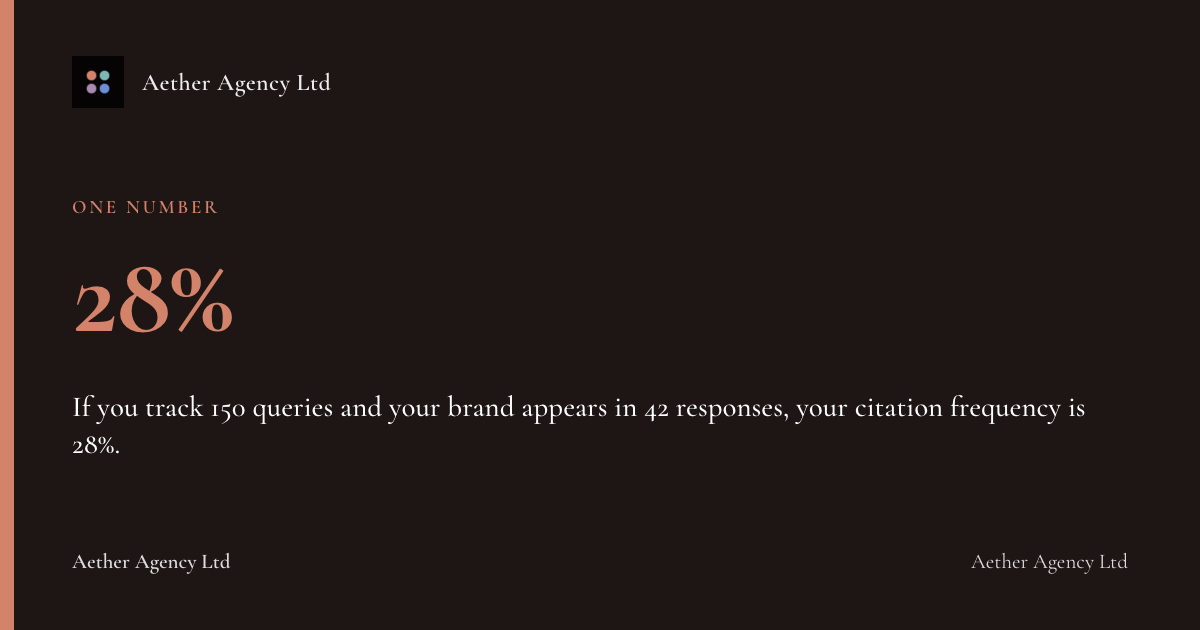
Citation frequency measures the percentage of target queries that produce a brand mention. If a brand tracks 150 queries and appears in 42 responses, its citation frequency is 28%. Benchmarks vary by sector: UK professional services firms tend to achieve higher citation frequency for core service queries than many consumer brands do, reflecting differences in content maturity and competitive density. Citation frequency correlates directly with brand awareness, because higher frequency means more potential customers encounter the brand during research.
Share of voice compares a brand's citations to its competitors'. If a query about "London creative agencies" cites four brands including the one being tracked, that brand holds 25% share of voice for that query. Aggregating this across a full query set shows overall competitive position. Brands that achieve a high share of voice in AI citations typically also lead their category in aided brand awareness among target audiences.
Citation quality assesses the context and prominence of each mention. A detailed citation that describes a brand's methodology and links to its case studies carries more value than a passing mention buried in a list. Quality is typically scored on a 1-5 scale: 1 for a brief list mention, 3 for a descriptive paragraph, 5 for a featured example with a source link. Higher-quality citations tend to drive considerably more website traffic than low-quality mentions.
Source attribution tracks whether an AI engine cites and links to a brand's website as the source of information. When ChatGPT states "According to [Brand], companies using structured data see higher citation rates" and links to that brand's published research, that is an attributed citation; the same claim made without a link is unattributed. Attributed citations drive direct referral traffic and reinforce authority, and a meaningful share of attributed AI citations are reported to result in an actual website visit.
Accuracy rate measures the factual correctness of brand information inside AI responses. If an AI engine states that a company is based in Birmingham when it is actually based in London, or describes services it does not offer, that is an accuracy error. Tracking accuracy matters because AI-generated misinformation can damage reputation and misdirect potential customers; regular accuracy audits, with correction attempts for material errors, are a standard part of a citation tracking programme.
Sentiment distribution categorises citations as positive, neutral, or negative. A citation describing "award-winning design work" is positive; one that simply lists a brand among competitors is neutral; one referencing "customer complaints about turnaround times" is negative. Most brand citations skew neutral, with a smaller share positive and only a minority negative. Negative citations warrant investigation, since they often signal a reputation issue that needs addressing through content strategy or direct source outreach.
The AI Citation Tracking Technology Stack for 2026
UK brands employ a combination of specialised GEO tracking platforms, traditional SEO tools with added AI features, and custom-built solutions to monitor citation performance. The tooling landscape continues to evolve quickly as AI search adoption grows, with new entrants and features appearing regularly.
Dedicated GEO tracking platforms, such as BrightEdge's AI Search Tracker and Authoritas's GEO Monitor, automate query submission across multiple AI engines, parse responses for brand mentions, and provide a citation dashboard. As of 2024-2025, enterprise plans covering 200-500 tracked queries on these platforms were typically priced in the region of £800-2,500 per month. Adoption of dedicated GEO tracking tools among UK brands has grown considerably over this period.
Traditional SEO platforms, including SEMrush, Ahrefs, and BrightEdge, have added AI citation features to their existing rank tracking modules. These tools use their existing keyword databases to suggest relevant AI queries and surface citation metrics alongside traditional rankings in a single dashboard — useful for brands that want consolidated reporting of Google position and AI citation frequency together. Pricing for these add-on features has typically added £200-400 per month to existing SEO subscriptions.
Custom API solutions allow technical teams to build bespoke tracking systems directly against ChatGPT, Claude, and Perplexity APIs. This route offers maximum flexibility and lower per-query cost at scale, but requires developer resources to build and maintain. UK agencies, including studios like Aether Agency Ltd, often build custom trackers for clients whose query volumes or reporting needs exceed what off-the-shelf platforms support.
Manual spot-checking remains essential even with strong automation in place. Many brands run weekly manual tests of their highest-priority queries, particularly after a content update or a competitor campaign. Manual testing catches nuance that automated tools miss and confirms that the automated tracking system is functioning correctly; allocating a few hours a week to manual citation audits is a common practice.
Sentiment analysis tools process AI response text to categorise mention sentiment and extract recurring themes. Natural language processing platforms such as IBM Watson or Google Cloud Natural Language API analyse citation context to identify whether mentions are associated with positive attributes (innovation, quality, reliability) or negative themes (cost, slow turnaround, complaints). UK brands report that sentiment tracking can surface emerging reputation issues earlier than traditional social listening does.
The practical stack for most UK mid-size brands combines a dedicated GEO tracking platform for automated daily monitoring, manual weekly spot-checks for validation and nuance, and a quarterly custom API audit for deeper competitive analysis. Larger brands often add dedicated sentiment analysis and real-time alerting so teams are notified immediately when a negative citation appears.
Improving Your AI Citation Rate: Proven UK Strategies
Increasing citation frequency requires a systematic approach across content optimisation, technical implementation, and authoritative source building. Published GEO optimisation research identifies several specific, high-impact interventions UK brands can apply to improve citation performance.
Fact-dense, source-attributed content forms the foundation of citation success. AI engines preferentially cite content that contains verifiable statistics, named sources, and concrete figures — the same qualities that make content quotable by human journalists. Pages with a higher density of supporting, sourced facts tend to achieve markedly higher citation rates than content with sparse factual support.
In practice, this means auditing existing content to add inline source citations (for example, "According to the Office for National Statistics…"), embedding statistics with clear attribution, and structuring content around fact-dense opening paragraphs that answer the core question completely within 130-160 words. The opening section of an article tends to generate a disproportionate share of AI citations, so front-loading the strongest evidence in the first paragraph is a priority, not an afterthought.
Structured data markup helps AI engines parse and extract brand information accurately. Schema.org markup for the Organization, Service, and FAQPage types provides machine-readable context describing who a brand is, what it does, and how it answers common questions. UK websites with comprehensive structured data tend to achieve higher citation accuracy, because AI engines are more likely to state brand facts correctly rather than hallucinating or conflating information from other sources.
Priority implementation typically includes Organization schema (name, logo, location, contact details), Service schema for each individual offering (description, provider, areaServed), and FAQPage schema for question-and-answer content. The schema markup should match the visible content exactly; discrepancies between markup and on-page text confuse AI parsers and reduce the likelihood of citation.
Authoritative backlink profiles signal expertise and trustworthiness to AI engines, which appear to weight sources in a manner comparable to how search engines evaluate domain authority. UK brands that earn links from gov.uk domains, academic institutions (.ac.uk), recognised industry bodies, and established media outlets tend to see measurably higher citation rates than brands with a purely commercial link profile.
Building this kind of authority requires creating research-backed resources — original surveys, industry reports, expert guides — of the kind that government bodies, universities, and journalists are naturally inclined to reference. This is a long-term strategy, since authoritative links typically accumulate over 12-24 months, but the citation impact tends to be sustained once established. A single high-authority link can meaningfully increase citations for related queries within a matter of weeks of being indexed.
Question-shaped content architecture aligns content structure with how users actually phrase queries to AI assistants. Rather than a traditional keyword-optimised heading ("Our Services"), a question-format H2 ("How does AI search optimisation work?") matches conversational phrasing directly. Pages where a majority of headings are phrased as questions tend to achieve notably higher citation rates than traditionally structured content — a principle also worth applying when preparing a branding RFP or scoping new content for a rebrand.
Implementation involves reframing existing content around the specific questions an audience asks AI assistants. Tools such as AnswerThePublic and AlsoAsked can help identify common question patterns; the following step is to restructure content so each question is answered in a self-contained 130-160 word passage immediately after its heading. This "chunk-shaped" architecture allows AI engines to extract a relevant section without needing to parse an entire page.
AI Citation Tracking Implementation: A UK Brand Roadmap
Launching an effective citation tracking programme requires systematic planning across query research, tool selection, baseline measurement, and ongoing optimisation. The roadmap below reflects practices commonly used by UK brands that have integrated AI citation metrics into marketing operations.
Phase 1: Query Research and Prioritisation (Weeks 1-2)
The first step is identifying the 50-200 queries that potential customers are most likely to ask an AI assistant when researching a given category. This typically draws on three sources: keyword research tools (SEMrush, Ahrefs) filtered for question-format keywords, AI assistant autocomplete suggestions, and logs of actual questions received through customer service channels.
Queries should then be categorised by intent: informational (what/why/how questions), comparative (best/top/vs queries), and transactional (hire/buy/get-quote queries). UK B2B brands generally do well to weight their query set toward informational and comparative queries, while B2C brands typically balance these with a somewhat larger comparative share.
Queries should be prioritised by commercial value and search volume, using a simple scoring approach: commercial value (1-5) multiplied by monthly search volume gives a priority score. Initial tracking should focus on the top 50-100 queries by this score, expanding to 150-200 once the process is established.
Phase 2: Baseline Citation Audit (Week 3)
The priority query set should be manually tested across ChatGPT, Perplexity, Claude, and Google AI Overviews to establish baseline citation performance. This means recording which queries produce a brand mention, the citation context (a list mention versus a detailed description), and whether competitors appear in the same response.
From this, baseline metrics can be calculated: citation frequency (the percentage of queries mentioning the brand), share of voice (the brand's citations divided by total competitor citations), and citation quality scores. This baseline becomes the benchmark against which future improvement is measured. UK brands typically find modest citation frequency at this baseline stage, with significant variation depending on category maturity and existing content quality.
This phase should also document citation gaps — queries where competitors appear but the brand does not — and any accuracy issues, where an AI engine states incorrect information about the brand. These gaps and errors become the priority focus for the content optimisation and correction work that follows.
Phase 3: Tool Selection and Automation (Week 4)
Tool selection should be based on query volume, budget, and available technical capability. Brands tracking fewer than 100 queries on a limited budget can start with manual weekly spot-checks supplemented by SEMrush or Ahrefs AI features. Mid-size programmes tracking 100-200 queries typically justify a dedicated GEO platform such as BrightEdge or Authoritas. Enterprise programmes tracking more than 200 queries, or requiring custom reporting, more often build an API-based solution, which carries its own ongoing API costs plus developer time.
Automated daily tracking should then be configured for the priority query set, ensuring the tool tests each query multiple times to account for response variability. Citation alerts should be set up to notify the team immediately when the brand appears in a new query, or when a negative citation is detected.
Citation data should be integrated into existing marketing dashboards alongside traditional SEO and paid media metrics, with citation frequency reported as a brand awareness KPI to leadership on a monthly basis.
Phase 4: Content Optimisation (Weeks 5-12)
This phase involves systematically improving content to close the citation gaps identified in the baseline audit. Priority should go to pages targeting queries where competitors achieve citations but the brand does not, focusing on:
Adding fact-dense opening paragraphs that answer the core question in 130-160 words, supported by statistics and named sources. Implementing structured data markup for Organization, Service, and FAQPage types. Creating question-shaped H2 sections that match common query patterns. Building authoritative backlinks through original research, expert contributions, and engagement with recognised industry bodies.
UK brands implementing these optimisations typically see measurable citation improvements within 6-8 weeks, with the full impact realised over 4-6 months as AI engines re-index updated content and new backlinks accumulate authority.
Phase 5: Ongoing Monitoring and Iteration (Month 4 onward)
The programme should then shift to ongoing monitoring: weekly manual spot-checks of high-priority queries, monthly comprehensive dashboard reviews, and a quarterly competitive analysis comparing citation performance against key competitors.
The tracked query set should be expanded continuously as new customer questions and search patterns emerge. UK brands report that effective query sets tend to grow steadily each quarter, as product launches, industry trends, and competitor moves create new citation opportunities.
Citation tracking works best treated as a continuous improvement cycle: measure the baseline, optimise content, monitor impact, identify new gaps, and repeat. Brands that maintain a consistent citation tracking and optimisation programme tend to achieve substantially higher citation frequency after 12 months compared to their original baseline.
Your AI Citation Tracking Checklist
- Compile a target query set of 50-200 questions customers ask AI assistants, categorised by informational, comparative, and transactional intent.
- Establish baseline citation metrics by manually testing queries across ChatGPT, Perplexity, Claude, and Google AI Overviews to measure current frequency and share of voice.
- Select and configure a tracking platform (dedicated GEO tool, SEO platform with AI features, or custom API solution) for automated daily monitoring.
- Audit existing content to add fact-dense opening paragraphs, inline source citations, and question-shaped H2 headings that match query patterns.
- Implement comprehensive structured data markup, including Organization, Service, and FAQPage schema, to improve citation accuracy.
- Build authoritative backlinks from .gov.uk, .ac.uk, industry bodies, and established media through original research and expert contributions.
- Set up citation alerts so the team is notified immediately when a brand mention appears or a negative citation is detected.
- Integrate citation frequency and share of voice metrics into monthly marketing dashboards alongside traditional SEO KPIs.
- Conduct weekly manual spot-checks of high-priority queries to validate automated tracking and catch nuanced mentions.
- Review competitive citation performance quarterly to identify new content gaps and optimisation opportunities.
FAQ
How much does AI citation tracking cost for UK brands?
AI citation tracking costs range from roughly £100-200 per month for basic manual monitoring and SEO platform add-ons, up to £800-2,500 per month for dedicated GEO tracking platforms covering 200-500 queries, based on pricing observed in 2024-2025. Custom API-based solutions typically cost around £500-1,000 per month in API fees alone, plus developer time for build and maintenance. Most UK mid-size brands allocate a broadly comparable monthly budget across tools, analyst time, and content optimisation combined.
Which AI search engines should UK brands track for citations?
UK brands should prioritise tracking ChatGPT, Google AI Overviews, Perplexity, and Claude, which together account for the large majority of UK AI assistant usage. ChatGPT and Google AI Overviews are essential for almost all brands; Perplexity matters particularly for professional services and B2B categories where users conduct detailed research, while Claude is growing among more technical audiences.
How long does it take to improve AI citation rates?
UK brands implementing comprehensive GEO optimisation — fact-dense content, structured data, authoritative backlinks — typically see initial citation improvements within 6-8 weeks and markedly higher citation frequency within six months. Impact varies by starting point: brands with minimal existing content may take 8-12 months to build sufficient authority, while those with strong existing content but weak technical implementation often see rapid gains within 4-6 weeks of adding structured data and improving content architecture.
Can brands correct inaccurate information in AI citations?
Brands can reduce AI citation inaccuracies by publishing authoritative, fact-dense content with clear structured data markup, earning backlinks from high-authority sources such as .gov.uk and .ac.uk domains and established media, and submitting correction requests through AI platform feedback mechanisms. Google AI Overviews allows direct feedback on incorrect information, while ChatGPT and Claude incorporate user corrections into future model updates over time. UK brands using this multi-pronged approach tend to see a meaningful reduction in citation inaccuracies within 3-4 months, though complete elimination is rarely achievable given how these models generate responses.
What citation frequency should UK brands target?
Citation frequency benchmarks vary significantly by industry: UK professional services firms tend to see the highest citation frequency for core service queries, followed by technology brands, then consumer brands and niche B2B companies. These differences largely reflect competitive intensity and content saturation within each category. Brands should focus on improving from their own baseline rather than chasing an absolute industry benchmark — a meaningful increase in citation frequency typically correlates with measurable increases in brand awareness and enquiry volume.
How does AI citation tracking differ from traditional SEO tracking?
AI citation tracking measures brand mentions within conversational AI responses rather than positions on a search engine results page, focusing on citation frequency, share of voice, and accuracy rather than ranking position and click-through rate. Traditional SEO rankings are broadly deterministic — a page holds position 3 for a given keyword at a given moment — whereas AI citations are probabilistic, meaning the same query can produce different responses on different occasions. This is why AI citation tracking requires testing each query multiple times, measuring sentiment and accuracy, and validating automated results manually, making it inherently more complex than conventional rank tracking even as it becomes more essential.
What content types generate the most AI citations?
Comprehensive guides with fact-dense opening sections, FAQ pages with direct question-answer pairs, and original research with cited statistics tend to generate the highest AI citation rates among UK brands. Content with a higher density of supporting, sourced statistics achieves markedly higher citation rates than sparse content, and pages structured around question-format H2 headings see notably higher citation rates than traditionally structured pages. Because the opening section of an article tends to generate a disproportionate share of citations, a front-loaded, self-contained opening passage is one of the highest-leverage changes a brand can make to existing content.
Tracking AI Citations: Where Aether Agency Ltd Fits In
AI citation tracking sits alongside brand identity and website development as part of how a modern UK business builds and protects its visibility — which is why Aether Agency Ltd approaches it as one strand of a wider brand, build, grow process rather than an isolated technical exercise. A brand's underlying content architecture, structured data, and authority-building work (the same foundations covered in this guide) are the same assets that support strong performance in AI search results. Businesses weighing up a rebrand or a new website project, including those researched in our guide to branding for law firms or our creative marketing agency buyer's guide for Surrey, will recognise many of the same structural principles at play here.
As one proof point of what structured, fact-dense content and technical optimisation can support: Aether Agency Ltd reports an average client traffic growth of 3x (Aether Agency Ltd client data, as published on aether-agency.co.uk).
If you want to understand how your brand's content and technical setup currently support (or undermine) its visibility in AI search results, get in touch with Aether Agency Ltd for a conversation about your website and brand presence.
Related Reading
- How to Show Up in AI Search: 2026 GEO Strategies That Work
- AI Search Optimisation Agency UK: Complete 2026 Guide
- AI Search Optimisation UK: Expert GEO Strategies for 2026
Add aether-agency.co.uk as a preferred source on Google
See How Your Brand Appears in AI Search
Aether AI monitors your visibility across ChatGPT, Perplexity, Google AI Overviews, and Claude in real time. Find out where you stand and what to fix.
Explore Aether AI