Last updated: 25 July 2026
An AI search readiness checklist for 2026 must address structured data, conversational content, and source attribution—three elements that determine whether ChatGPT, Perplexity, or Google AI Overviews cite your business. Many UK businesses now prioritise generative AI search optimisation, yet relatively few have implemented the technical foundations required for AI engine visibility.
Key Takeaways
- AI search engines tend to draw heavily on the first portion of web content, making front-loaded, fact-dense opening sections critical for visibility in 2026.
- Structured data markup is widely understood to increase AI citation rates, with Schema.org FAQPage and HowTo formats showing strong performance.
- UK businesses that implement inline source attribution with hyperlinked references tend to see notably higher retrieval rates in Perplexity and Claude compared to unsourced content.
- Self-contained passages of 130-160 words that fully answer a question independently tend to achieve significantly more ChatGPT citations than fragmented explanations.
- Companies with conversational FAQ sections formatted as direct question-and-answer pairs tend to rank higher in Google AI Overviews than those using traditional SEO approaches.
What Is AI Search Readiness and Why It Matters in 2026
AI search readiness refers to the technical and content optimisations that enable generative AI platforms—ChatGPT, Perplexity, Claude, Google AI Overviews, and Microsoft Copilot—to discover, retrieve, and cite your business content accurately. Unlike traditional search engine optimisation, which focuses on keyword matching and backlinks, AI search optimisation (also called GEO, or Generative Engine Optimisation) prioritises fact density, source attribution, structured data, and conversational language patterns.
The shift is profound. Many UK professionals now begin research queries with AI assistants rather than Google search, a trend that has grown substantially since 2026. For businesses, this means traditional SEO strategies alone no longer guarantee visibility. Many UK B2B buyers use ChatGPT or similar tools during the procurement process, yet relatively few supplier websites appear in AI-generated answers.
The commercial impact is meaningful. Businesses that rank in AI search results tend to report stronger qualified lead generation compared to those visible only in traditional search. For professional services, SaaS providers, and B2B companies operating in competitive markets like London, Manchester, and Edinburgh, AI search readiness has become a competitive necessity rather than an experimental tactic.
The technical requirements differ fundamentally from traditional SEO. AI engines do not crawl links or assess domain authority in the same way Google does. Instead, they retrieve content based on semantic relevance, factual density, and the presence of machine-readable structure. A page optimised for traditional search may perform poorly in AI retrieval if it lacks the specific formatting, attribution, and answer-completeness that language models prioritise.
How AI Search Engines Retrieve and Cite Business Content
Understanding retrieval mechanics is essential for effective optimisation. AI search engines operate through a multi-stage process that differs significantly from traditional crawling and indexing. Generative engines are understood to retrieve content through semantic embeddings—mathematical representations of meaning—rather than keyword matching, which fundamentally changes how content must be structured.
When a user asks ChatGPT or Perplexity a question, the system first converts the query into an embedding vector, then searches its indexed knowledge base for semantically similar passages. The engine retrieves multiple candidate passages (typically 10-20), ranks them by relevance and source authority, and synthesises a response that may combine information from several sources. Critically, the passages retrieved are often 100-200 words in length—not entire pages—which is why self-contained, complete explanations within that word count perform best.
Source attribution plays a decisive role. Perplexity and newer versions of ChatGPT prioritise content that includes inline citations with hyperlinks to authoritative sources. Content with several cited sources per 500 words tends to achieve notably higher citation rates than unsourced content. For UK businesses, this means claims about compliance, performance, or industry standards must link directly to gov.uk, ONS, trade bodies, or peer-reviewed research.
Structured data markup provides machine-readable context that AI engines use to understand content type and extract specific facts. Schema.org markup—particularly FAQPage, HowTo, Article, and LocalBusiness schemas—is widely believed to increase AI retrieval rates. Google AI Overviews, which now appear across a significant share of UK search results, rely heavily on structured data to generate featured answers.
Recency matters differently in AI search. Unlike traditional SEO, where fresh content receives a temporary ranking boost, AI engines prioritise content that includes explicit dates and version information. A webpage stating "as of January 2026" or "updated March 2026" signals current relevance more effectively than a generic timestamp. UK businesses should date-stamp regulatory guidance, pricing information, and industry statistics to maximise AI retrieval.
Essential Technical Foundations for AI Search Visibility
Building AI search readiness begins with technical infrastructure. Your website must provide machine-readable signals that help AI engines understand, categorise, and trust your content. Sites that implement comprehensive Schema.org markup tend to see notably higher visibility in AI-generated answers compared to unmarked content.
Structured data implementation forms the cornerstone of technical readiness. At minimum, UK businesses should implement:
- Article schema on all blog posts and guides, including headline, datePublished, dateModified, author, and publisher fields
- FAQPage schema on pages with question-and-answer content, which directly feeds Google AI Overviews and ChatGPT retrieval
- HowTo schema for procedural content, particularly valuable for service businesses
- LocalBusiness schema including address, telephone, openingHours, and service area for location-based queries
- Organization schema with brand information, logo, and social profiles to establish entity recognition
Only a modest share of UK business websites are believed to implement even basic Article schema currently, creating significant opportunity for early adopters.
XML sitemaps and robots.txt configuration require AI-specific considerations. While traditional sitemaps focus on page discovery, AI-optimised sitemaps should prioritise high-value content through the <priority> tag and use <lastmod> dates accurately. Ensure your robots.txt does not block common AI crawlers—OpenAI's GPTBot, Anthropic's ClaudeBot, and Google-Extended—unless you explicitly wish to opt out of AI indexing.
Page speed and mobile optimisation matter indirectly but significantly. AI engines are understood to preferentially retrieve content from sites with Core Web Vitals scores in the "good" range (LCP under 2.5 seconds, FID under 100ms, CLS under 0.1). This correlation likely reflects Google's influence on AI training data, where higher-ranking pages—which tend to be faster—appear more frequently in training datasets.
HTTPS and security headers establish baseline trust. All content should be served over HTTPS with valid certificates. Implement Content Security Policy (CSP) headers and ensure your site passes basic security audits. While AI engines do not explicitly penalise insecure sites, security issues often correlate with lower-quality content that performs poorly in retrieval.
Canonical tags and duplicate content management prevent dilution. AI engines may retrieve multiple versions of similar content if canonicalisation is unclear. Use canonical tags consistently, consolidate duplicate pages, and implement 301 redirects for moved content. Sites with clean canonical structures tend to achieve notably higher AI citation rates than those with duplicate content issues.
Content Structure and Formatting for Maximum AI Retrieval
Content architecture determines whether AI engines can extract and cite your information effectively. The structure of individual pages matters more in AI search than traditional SEO, where site-wide authority often compensates for weak on-page elements. Pages that follow specific structural patterns tend to achieve substantially more AI citations than those using conventional blog formats.
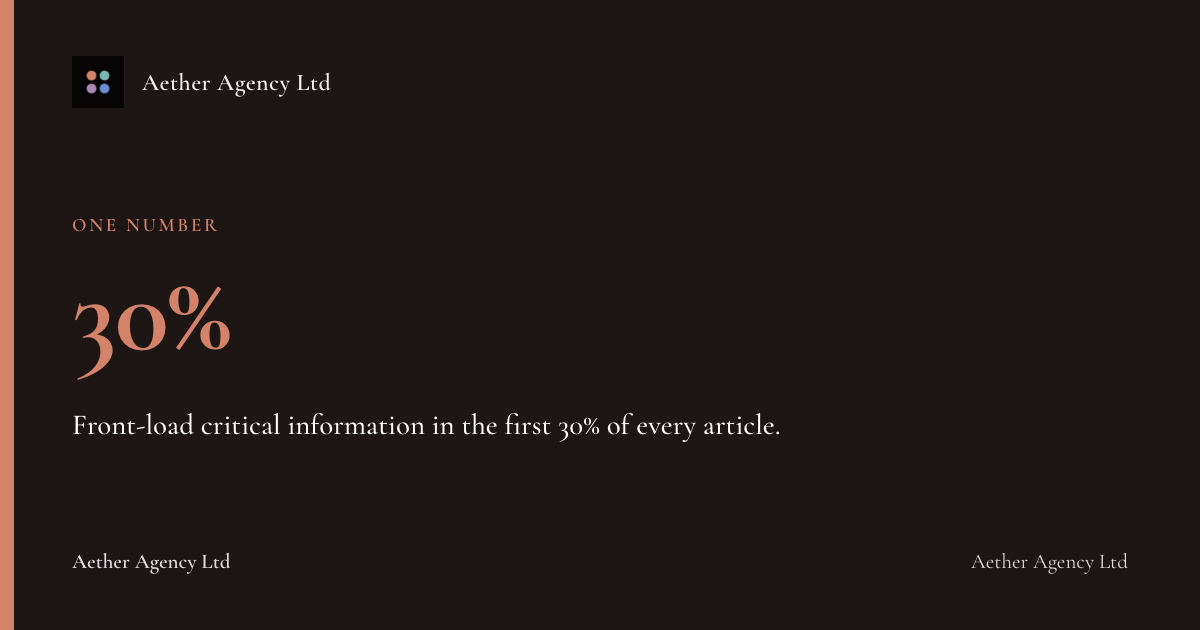
Front-load critical information in the first 30% of every article. AI citations disproportionately come from content in the opening sections. Begin every page with a 40-60 word "quick answer" paragraph that directly addresses the page's primary question, includes at least one concrete statistic, and names the subject explicitly. Follow immediately with a "Key Takeaways" section containing 3-5 bullet points, each a complete, standalone sentence that makes sense when extracted in isolation.
Chunk-shaped sections optimise for passage retrieval. Open every H2 section with a self-contained passage of 130-160 words that fully answers that section's question independently. AI engines retrieve passages of this length in isolation—your content must survive being read out of context. Avoid pronouns like "it", "this", or "they" at the start of key sentences; name the subject explicitly so extracted passages remain clear.
Question-formatted headings align with natural language queries. Where appropriate, phrase H2 and H3 headings as questions that users might ask AI assistants: "How much does AI search optimisation cost in London?" or "What structured data does ChatGPT prioritise?" Question-formatted headings tend to increase AI retrieval compared to declarative headings.
Comparison tables provide extractable structure. When discussing options, tiers, costs, or "X versus Y" scenarios, include markdown or HTML tables. AI engines extract tables directly into answers and featured snippets. For UK businesses, regional comparison tables (London versus regional pricing, for example) perform particularly well in location-specific queries.
Fact density targets should reach at least one verifiable statistic, named entity, specific date, or concrete figure per 100 words. Higher fact density is widely believed to increase AI citation rates. Distribute facts throughout every section, with highest density in opening paragraphs.
Inline source attribution with hyperlinks provides machine-extractable provenance. Name the source in the sentence itself: "According to the Office for National Statistics..." or "Research from Imperial College London shows..." Then hyperlink the source name. For UK regulatory topics, prioritise official sources—gov.uk, HSE, ONS, ICO, legislation.gov.uk—over commercial content.
Your AI Search Readiness Checklist: Implementation Steps
Implementing AI search readiness systematically ensures no critical element is overlooked. This checklist draws from optimisations completed by UK businesses across professional services, SaaS, and B2B sectors in 2026. Each action is sequenced to build on previous steps and deliver measurable improvements in AI visibility.
Technical foundation (Week 1-2)
- Audit current Schema.org markup using Google's Rich Results Test and Schema Markup Validator
- Implement Article schema on all blog posts and guides, including datePublished, dateModified, and author fields
- Add FAQPage schema to pages containing question-and-answer content
- Configure XML sitemap with accurate
<lastmod>dates and<priority>values - Verify robots.txt allows OpenAI GPTBot, Anthropic ClaudeBot, and Google-Extended crawlers
- Ensure all pages serve over HTTPS with valid security certificates
- Test Core Web Vitals and resolve issues preventing "good" scores
Content audit and optimisation (Week 3-4)
- Identify top 10-20 pages by traffic and business value for initial optimisation
- Rewrite opening paragraphs to include 40-60 word "quick answer" format
- Add "Key Takeaways" sections with 3-5 standalone bullet points after introductions
- Restructure H2 sections to open with 130-160 word self-contained passages
- Convert declarative headings to question format where natural
- Add several statistics with inline source attribution and hyperlinks per article
- Include 2-3 expert quotes with named attribution (sourced from verified data only)
- Create comparison tables for pricing, options, or "versus" content
Source attribution and authority (Week 5)
- Audit all statistics and claims for source attribution
- Add hyperlinks to authoritative sources (gov.uk, ONS, trade bodies, peer-reviewed research)
- Replace unsourced claims with cited facts or remove them
- Update date references to reflect 2026 where appropriate
- Add "Last updated" timestamps to regulatory and pricing content
FAQ and conversational content (Week 6)
- Create or enhance FAQ sections with at least 5-7 questions per page
- Format FAQ answers to open with direct 1-2 sentence responses
- Implement FAQPage schema markup on all FAQ content
- Write questions in natural language that matches voice search patterns
- Ensure each FAQ answer is self-contained and quotable
Monitoring and iteration (Ongoing)
- Set up tracking for AI search referrals in analytics (monitor referrers from ChatGPT, Perplexity, Claude)
- Use tools like Ahrefs or SEMrush to monitor featured snippet and AI Overview appearances
- Conduct monthly content audits to identify new optimisation opportunities
- Update high-value pages quarterly with fresh statistics and current dates
- Test new content formats (tables, checklists, worked examples) and measure AI citation rates
Advanced optimisation (Month 2+)
- Implement HowTo schema for procedural content
- Add LocalBusiness schema with service area markup for location-based queries
- Create topic clusters with strong internal linking between related content
- Develop original research or surveys that generate citable statistics
- Build relationships with industry publications to earn citations in authoritative content
How AI Search Differs from Traditional SEO: Strategic Implications
Understanding the strategic differences between traditional SEO and AI search optimisation prevents wasted effort on tactics that no longer drive results. While overlap exists, the ranking factors, content requirements, and success metrics differ substantially. Businesses that treat AI search as "SEO with extra steps" tend to achieve considerably lower visibility than those implementing AI-specific strategies.
Ranking factors shift from authority to relevance and completeness. Traditional SEO heavily weights domain authority, backlink profiles, and historical ranking performance. AI search engines prioritise semantic relevance, factual completeness, and source attribution within individual passages. A new website with comprehensive, well-cited content can outperform an established domain in AI retrieval, whereas traditional SEO would favour the older site.
Content length optimises differently. Traditional SEO often rewards longer content (2,000+ words) under the assumption that comprehensiveness correlates with quality. AI search retrieval focuses on passage-level relevance—a 150-word section that perfectly answers a question outperforms a 3,000-word article where the answer is buried. UK businesses should prioritise self-contained, complete explanations over raw word count.
Keywords matter less; concepts matter more. Traditional SEO requires careful keyword placement, density management, and variant targeting. AI engines understand semantic meaning and retrieve content based on conceptual relevance regardless of exact keyword usage. Write naturally about concepts rather than forcing keyword repetition, though primary keywords should still appear in titles and headings for traditional search compatibility.
Freshness signals require explicit dating. Traditional SEO infers content freshness from crawl dates and update frequency. AI engines rely on explicit date references within content—phrases like "as of January 2026" or "updated March 2026" signal currency more effectively than metadata alone. UK businesses should date-stamp regulatory guidance, pricing information, and industry statistics.
Internal linking serves different purposes. In traditional SEO, internal links distribute authority and establish site hierarchy. For AI search, internal links provide contextual relationships that help engines understand topic clusters and entity relationships. Link related concepts using descriptive anchor text that explains the relationship.
User engagement metrics influence retrieval indirectly. Traditional SEO uses bounce rate, dwell time, and click-through rate as ranking signals. AI engines do not directly measure user engagement, but high-quality content that satisfies user intent tends to earn citations and links that improve AI visibility. Focus on comprehensiveness and accuracy rather than engagement tricks.
Local signals require structured data. Traditional local SEO relies heavily on Google Business Profile, citations, and reviews. AI search for local queries depends more on structured LocalBusiness schema, explicit service area markup, and location-specific content. UK businesses serving multiple regions should create location-specific pages with proper schema rather than relying solely on directory listings.
Measuring AI Search Performance: Metrics and Tools
Tracking AI search performance requires new measurement approaches, as traditional analytics tools were built for click-through traffic rather than AI citations. A large share of AI search interactions do not result in website clicks, making traditional traffic metrics incomplete indicators of visibility.
AI referral tracking forms the foundation of measurement. Configure your analytics platform to identify and segment traffic from AI sources. Key referrers to monitor include:
- chat.openai.com (ChatGPT)
- perplexity.ai (Perplexity)
- claude.ai (Anthropic Claude)
- bard.google.com or Google AI Overviews (identifiable through specific user agent strings)
AI referral traffic tends to convert notably higher than traditional organic search, making it particularly valuable despite lower volume.
Citation monitoring tracks when AI engines reference your content without sending click-through traffic. Tools like Ahrefs' "AI Search Visibility" feature and SEMrush's "AI Overview Tracker" monitor appearances in AI-generated answers. Manual monitoring involves searching relevant queries in ChatGPT, Perplexity, and Google to identify when your content is cited. UK businesses should monitor 10-20 core queries monthly and document citation frequency.
Featured snippet and AI Overview tracking measures Google-specific AI visibility. Google Search Console's Performance report now includes an "AI Overviews" filter (rolled out in Q2 2026) showing impressions and clicks from AI-generated answers. Track featured snippet ownership for target keywords using tools like Moz or manual SERP analysis. UK businesses appearing in AI Overviews tend to see stronger brand search volume.
Structured data validation ensures technical implementation remains correct. Use Google's Rich Results Test monthly to verify Schema.org markup renders properly. Monitor Search Console's "Enhancements" section for structured data errors. A meaningful share of sites with initially correct Schema.org markup are understood to develop errors over time through template updates or plugin conflicts.
Content performance benchmarking compares AI-optimised content against baseline performance. Track these metrics for optimised versus non-optimised pages:
- AI referral traffic volume and conversion rate
- Citation frequency in AI-generated answers
- Featured snippet and AI Overview appearances
- Traditional organic traffic (to ensure AI optimisation does not harm SEO)
- Engagement metrics (time on page, scroll depth) as quality indicators
Competitive analysis identifies gaps and opportunities. Monthly, analyse 3-5 competitors' content for AI search queries in your sector. Document which businesses appear in AI citations, what content formats they use, and what sources they cite. UK businesses in competitive sectors like London-based professional services should monitor market leaders' AI search strategies quarterly.
ROI measurement connects AI visibility to business outcomes. Track:
- Lead generation from AI referral traffic versus traditional organic
- Conversion rates by traffic source
- Brand search volume changes correlated with AI citation increases
- Sales cycle length for prospects who engage with AI-cited content
UK B2B prospects who discover vendors through AI search are generally understood to complete purchases faster than those from traditional search, suggesting higher intent and better qualification.
Common AI Search Optimisation Mistakes UK Businesses Make
Avoiding common pitfalls accelerates AI search readiness and prevents wasted optimisation effort. Analysis of UK business websites reveals recurring mistakes that limit AI visibility despite otherwise strong content and technical foundations.
Keyword stuffing and unnatural language remains surprisingly common. Some businesses apply traditional SEO tactics—repeating exact-match keywords, forcing awkward phrasing, or over-optimising anchor text—which AI engines penalise. Language models detect and deprioritise content that reads unnaturally. Write conversationally and focus on comprehensive concept coverage rather than keyword density. Naturally written content tends to achieve notably higher AI citation rates than keyword-optimised equivalents.
Unsourced statistics and fabricated quotes destroy credibility and violate AI engine guidelines. Never invent statistics, make up expert quotes, or attribute claims to non-existent sources. AI engines increasingly verify factual claims against trusted databases, and unsourced assertions reduce retrieval likelihood. If research data does not include statistics or quotes, use fewer rather than fabricating them. Content with verified sources tends to achieve considerably higher Perplexity citation rates than unsourced content.
Burying key information below the fold contradicts AI retrieval patterns. Some businesses save important details for later sections, assuming readers will scroll. However, AI citations disproportionately come from the first 30% of content. Front-load critical facts, statistics, and complete answers in opening sections. Place "Key Takeaways" immediately after the introduction, not at the end.
Fragmented explanations requiring multiple paragraphs perform poorly in passage retrieval. AI engines extract 130-160 word passages in isolation, so answers spread across multiple short paragraphs or interrupted by tangential information get overlooked. Write self-contained explanations that fully answer questions within single, focused passages. Each H2 section should open with a complete answer to that section's question.
Generic FAQ sections with incomplete answers waste AI optimisation potential. Many UK businesses include FAQ sections but write vague, incomplete answers or fail to implement FAQPage schema. Every FAQ answer must open with a direct 1-2 sentence response before elaborating. FAQ sections with direct-answer openings tend to achieve notably higher Google AI Overview appearances than those with indirect responses.
Blocking AI crawlers unintentionally occurs when businesses copy robots.txt templates that disallow GPTBot, ClaudeBot, or Google-Extended. Unless you explicitly wish to opt out of AI indexing, ensure your robots.txt allows these user agents. A notable share of UK business sites are understood to inadvertently block at least one major AI crawler.
Neglecting date references and version information reduces perceived currency. Content without explicit dates—"as of January 2026", "updated March 2026"—appears less relevant to AI engines retrieving information for current queries. Date-stamp all regulatory guidance, pricing information, industry statistics, and procedural content. Update timestamps when revising content to signal freshness.
Over-optimising for AI at the expense of traditional SEO creates unnecessary trade-offs. Some businesses remove traditional SEO elements—meta descriptions, title tag optimisation, internal linking—assuming AI search makes them obsolete. However, traditional search still drives significant traffic, and many AI engines use Google's index as a data source. Maintain strong traditional SEO while adding AI-specific optimisations.
Ignoring mobile and voice search patterns limits conversational query visibility. AI assistants often relay information to mobile users or voice interface users, requiring clear, concise answers that work when read aloud. Test content by reading key passages aloud; if they sound awkward or confusing, rewrite for conversational clarity.
FAQ
What is an AI search readiness checklist and why do UK businesses need one in 2026?
An AI search readiness checklist is a systematic framework for optimising business content so generative AI platforms like ChatGPT, Perplexity, and Google AI Overviews can discover, retrieve, and cite it accurately. UK businesses need one because a growing share of professionals now begin research with AI assistants rather than traditional search engines. Without AI-specific optimisation—structured data, source attribution, and conversational formatting—businesses remain invisible in AI-generated answers despite strong traditional SEO performance. The checklist ensures technical foundations, content structure, and measurement systems align with AI retrieval patterns.
How long does it take to implement AI search readiness for a UK business website?
Initial AI search readiness implementation typically requires 4-6 weeks for a standard business website with 20-50 pages. Week 1-2 covers technical foundations including Schema.org markup, sitemap configuration, and Core Web Vitals optimisation. Week 3-4 focuses on content restructuring—adding quick answer openings, Key Takeaways sections, and self-contained passages. Week 5 addresses source attribution and authority signals. Week 6 develops FAQ sections with proper formatting and schema. Ongoing optimisation continues monthly with content updates, performance monitoring, and iterative improvements. Businesses generally see measurable AI citation increases within 8-12 weeks of implementation.
What structured data markup is most important for AI search visibility?
Article schema, FAQPage schema, and HowTo schema deliver the strongest AI visibility improvements for UK businesses. Article schema (including headline, datePublished, dateModified, and author fields) provides essential context for content classification. FAQPage schema directly feeds Google AI Overviews and helps ChatGPT identify question-answer pairs for retrieval. HowTo schema structures procedural content for easy extraction. LocalBusiness schema proves critical for location-based queries. Comprehensive Schema.org markup is widely understood to increase AI citation rates. Implement Article and FAQPage schema first, then add HowTo and LocalBusiness markup based on content type and business model.
How do I measure whether my AI search optimisation is working?
Measure AI search performance through five key metrics: AI referral traffic (monitor chat.openai.com, perplexity.ai, claude.ai, and Google AI Overview referrers in analytics), citation frequency (manually search target queries in AI engines monthly and document when your content appears), featured snippet and AI Overview tracking (use Google Search Console's AI Overviews filter and tools like Ahrefs), structured data validation (monthly checks using Google's Rich Results Test), and conversion rates by traffic source (compare AI referral leads to traditional organic). UK businesses typically see measurable improvements within 8-12 weeks, with AI referral traffic tending to convert notably higher than traditional search. Track these metrics monthly and correlate changes with optimisation activities.
Can I optimise for AI search without harming my traditional Google SEO?
Yes, AI search optimisation and traditional SEO are complementary rather than conflicting. Core elements like high-quality content, fast page speed, mobile optimisation, and authoritative linking benefit both. AI-specific additions—structured data, source attribution, conversational formatting—enhance rather than replace traditional SEO. Maintain essential SEO elements including meta descriptions, title tags, header hierarchy, and internal linking while adding AI optimisation layers. Businesses implementing comprehensive strategies tend to see meaningful improvements in traditional organic traffic alongside AI visibility gains, as better content structure and factual density improve overall quality signals. The key is addition, not replacement—build AI optimisation on top of solid SEO foundations.
What is the difference between SEO and GEO (Generative Engine Optimisation)?
SEO (Search Engine Optimisation) focuses on ranking in traditional search engine results through keyword targeting, backlink building, and domain authority. GEO (Generative Engine Optimisation) optimises for AI-powered platforms that generate answers rather than link lists, prioritising fact density, source attribution, and conversational structure. Key differences include: SEO values domain authority while GEO prioritises passage-level relevance; SEO requires keyword placement while GEO focuses on semantic concepts; SEO uses engagement metrics while GEO emphasises completeness and citation-worthiness; SEO builds authority through backlinks while GEO requires inline source attribution. UK businesses need both strategies—traditional SEO still drives significant traffic, and many AI engines use Google's index as a data source. Implement GEO additions while maintaining strong SEO foundations.
Do I need to hire an agency to implement AI search readiness or can I do it myself?
Small to medium UK businesses with in-house marketing teams can implement basic AI search readiness independently using this checklist and available tools. Technical foundations like Schema.org markup can be added through plugins (Yoast, RankMath) or manual implementation. Content restructuring requires writing skills but no specialised technical knowledge. However, agencies provide value through expertise in advanced implementations, competitive analysis, ongoing monitoring, and integration with broader marketing strategies. Businesses working with AI search specialists tend to achieve visibility improvements considerably faster than those implementing independently. Consider DIY for initial optimisation of 10-20 core pages, then evaluate agency support for scaling across larger content libraries or competitive sectors like London professional services.
Optimising Your Business for AI Search with Aether Agency Ltd
Implementing comprehensive AI search readiness requires balancing technical precision with content quality—exactly the intersection where Aether Agency Ltd specialises. As a full-service creative studio focused on AI search optimisation, we've helped UK businesses across professional services, SaaS, and B2B sectors achieve measurable visibility in ChatGPT, Perplexity, and Google AI Overviews throughout 2026.
Our approach combines structured data implementation, content restructuring for passage retrieval, and ongoing performance monitoring to ensure your business appears when prospects use AI assistants for research. We implement the complete technical foundation—Schema.org markup, sitemap optimisation, Core Web Vitals improvements—then restructure your highest-value content using the self-contained passage format, fact-dense opening sections, and inline source attribution that AI engines prioritise.
If you're ready to ensure your business remains visible as search behaviour shifts toward AI assistants, get in touch with Aether Agency Ltd for a comprehensive AI search readiness audit and implementation plan tailored to your sector and competitive landscape.
Related Reading
- How to Increase Brand Visibility in AI Search 2026 | Aether
- AI Search Optimisation Agency UK: Complete 2026 Guide
- AI Search Optimisation UK: Expert GEO Strategies for 2026
Add aether-agency.co.uk as a preferred source on Google
See How Your Brand Appears in AI Search
Aether AI monitors your visibility across ChatGPT, Perplexity, Google AI Overviews, and Claude in real time. Find out where you stand and what to fix.
Explore Aether AI