Last updated: 25 October 2026
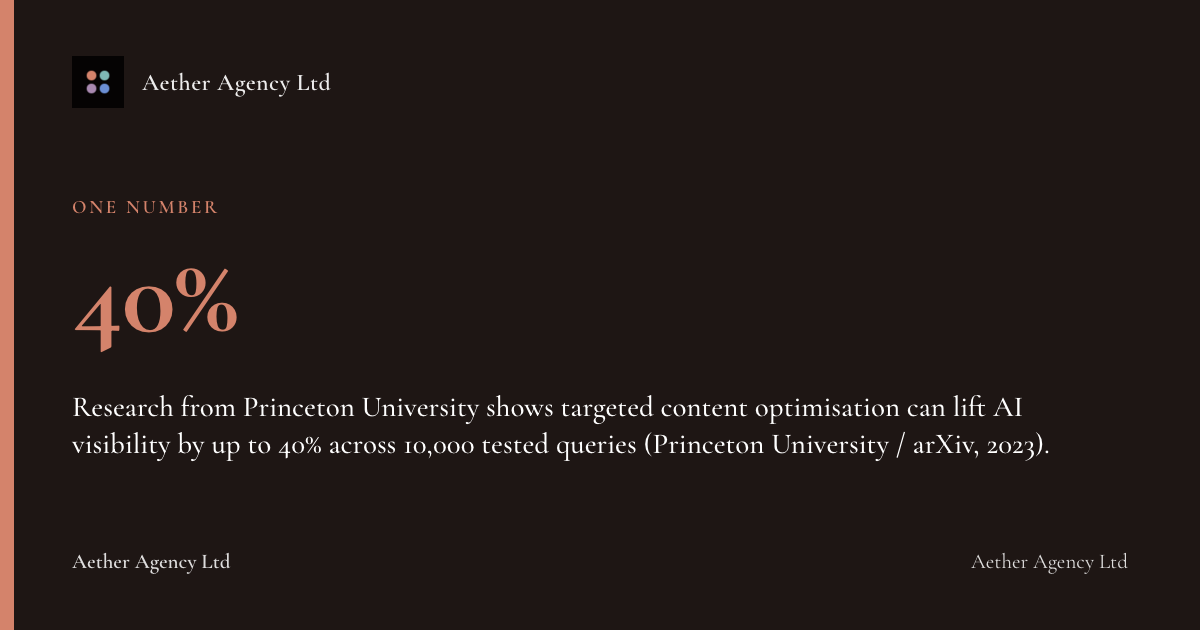
GEO providers are agencies that optimise a business's website and content so it gets cited by AI systems such as ChatGPT, Perplexity and Google AI Overviews, rather than just ranked in traditional blue-link search results. Research from Princeton University shows targeted content optimisation can lift AI visibility by up to 40% across 10,000 tested queries (Princeton University / arXiv, 2023).
Key Takeaways
- GEO providers optimise content specifically for citation by generative AI engines like ChatGPT, Perplexity and Google AI Overviews, distinct from traditional SEO agencies.
- Princeton's GEO-bench study of roughly 10,000 queries found targeted content optimisation can boost AI visibility by 22 to 41% (Blck Alpaca analysis of the Princeton GEO study, 2026).
- Gartner predicts traditional search engine volume will fall 25% by 2026 as AI chatbots and virtual agents absorb query share (Gartner, 2026).
- Adding statistics to a page improves its AI citation visibility by 41%, the single largest lift measured among nine tested optimisation strategies (Princeton GEO study, summarised by Sunil Pratap Singh, 2023).
- Pages sitting around position 5 in Google saw a 115% visibility improvement from GEO work, an effect researchers call the "Equalizer Effect" because it benefits mid-ranked pages more than top performers (Blck Alpaca analysis of the Princeton GEO study, 2026).
What Is a GEO Provider?
A GEO provider is a specialist agency that optimises websites, content and technical infrastructure so generative AI tools — ChatGPT, Perplexity, Google AI Overviews and Microsoft Copilot — cite and reference the business rather than a competitor. GEO stands for Generative Engine Optimisation, a term first coined in a 2023 academic paper from researchers at Princeton, Georgia Tech, IIT Delhi and the Allen Institute for AI. Unlike a traditional SEO agency, which focuses purely on Google rankings and organic click-throughs, a GEO provider builds content structured for extraction: clear definitions, cited statistics, well-organised headings and answerable questions that an AI model can lift into a generated response.
This distinction matters because user behaviour has already shifted. Nearly 65% of users now engage with zero-click search or conversational AI tools instead of traditional link-based search (Power Digital Marketing, 2026), and one in ten US internet users now turns to generative AI first for online search (Mainstreethost, 2026). A UK business ignoring this shift risks becoming invisible in exactly the channel where its customers are increasingly starting their research.
GEO vs SEO vs AEO: What's the Difference?
Search engine optimisation, or SEO, is the practice of improving a website's ranking position in traditional search engine results pages like Google. Answer engine optimisation, or AEO, focuses narrowly on featured snippets and voice assistant answers. GEO providers sit across both disciplines but add a third layer: structuring content so a large language model can parse, trust and cite it when generating a conversational answer, rather than simply ranking a link.
The overlap is real — clean technical SEO, fast page speed and authoritative backlinks still matter to all three. But a genuine GEO provider goes further, thinking about citation-worthiness, source attribution and how an AI model decides which page to quote from among dozens it has crawled.
Why Are UK Businesses Turning to GEO Providers Now?
UK businesses are turning to GEO providers because traditional organic search traffic is visibly declining while AI-driven discovery grows. Google search traffic to publishers fell 33% globally in the year to November 2025, with US publishers hit even harder at minus 38% (Reuters Institute / Chartbeat 2026 report, 2026). Gartner's Vice President Analyst has put this shift plainly.
"Generative AI (GenAI) solutions are becoming substitute answer engines, replacing user queries that previously may have been executed in traditional search engines," said Alan Antin, Vice President Analyst at Gartner. He has also noted that "organic and paid search are vital channels for tech marketers seeking to reach awareness and demand generation goals" — meaning businesses cannot simply abandon search marketing, they must adapt it.
For UK sectors like professional services, hospitality and retail — all heavily reliant on local discovery — this is not a distant trend but a current operational risk. A law firm in Leeds or an estate agent in Bristol that only optimises for Google's traditional ten blue links is already missing the growing share of prospective clients asking ChatGPT or Perplexity for recommendations.
The "Equalizer Effect": Why Mid-Ranked Pages Benefit Most
One of the more striking findings from the Princeton GEO-bench research is what analysts call the "Equalizer Effect." Pages ranked around position 5 in Google saw a 115% visibility improvement from GEO optimisation — a far bigger jump than top-ranked pages achieved (Blck Alpaca analysis of the Princeton GEO study, 2026).
This matters enormously for small and mid-sized UK businesses that can't outspend national competitors on backlinks and domain authority. A well-optimised page sitting mid-table on Google can leapfrog into AI answer citations without needing to win the traditional ranking race first.
What Services Do GEO Providers Actually Offer?
GEO providers typically offer a bundle of services spanning content strategy, technical structuring, citation tracking and ongoing monitoring across multiple AI platforms. Most reputable agencies bundle these into a programme rather than a one-off project, because generative engines re-crawl and re-evaluate content continuously.
Core services generally include:
- Content audits identifying which existing pages are being cited by AI tools and which are invisible.
- Structural rewrites that add clear definitions, headings and self-contained answer passages an AI model can extract.
- Statistics and data integration — since adding statistics to content improves AI citation visibility by 41%, the largest single lift measured among nine strategies tested in the Princeton study (Sunil Pratap Singh's summary of the Princeton GEO study, 2023).
- Technical schema markup (Article, FAQPage, Organization schema) that helps AI crawlers parse page structure.
- Citation tracking across ChatGPT, Perplexity, Google AI Overviews and Copilot to measure whether the business is actually being mentioned.
- Brand and entity building, since AI models favour sources they can independently verify as authoritative and consistently described across the web.
Aether Agency Ltd's own content operation reflects this shift in practice. Under its current content structure, published client articles achieve an average Google position of 12.8, compared with 20.7 for the same sites' older pages, and a click-through rate of 0.41% against 0.15% previously — figures drawn from Aether Agency Ltd's own operational data as of August 2026. That's the practical output of applying GEO-informed structure, not just theory.
GEO Provider Services Compared
| Service Area | Traditional SEO Agency | GEO Provider | AI Search Marketing Specialist |
|---|---|---|---|
| Primary goal | Google ranking position | AI citation and mention | Both Google and AI visibility |
| Content focus | Keyword density, backlinks | Extractable, statistic-rich passages | Structured content across channels |
| Measurement | Ranking position, organic clicks | Citation frequency across AI tools | Search Console + citation tracking |
| Typical output | Blog posts, landing pages | Definitional content, FAQ schema | Full content programmes |
| Platforms covered | Google, Bing | ChatGPT, Perplexity, Gemini, Copilot | All of the above combined |
How Much Do GEO Providers Cost in the UK?
GEO provider costs in the UK vary widely depending on scope, from a few hundred pounds for a one-off content audit to several thousand pounds a month for an ongoing programme spanning content, technical work and citation tracking. There is no single published industry benchmark, so businesses should treat any provider's headline price as a starting point for negotiation rather than a fixed rate card.
As an illustrative guide, a typical range might look like this:
| Service Scope | Illustrative Monthly Range | What's Usually Included |
|---|---|---|
| Basic GEO audit (one-off) | £500–£1,500 | Content gap analysis, citation baseline |
| Ongoing content programme | £1,000–£3,500/month | Regular content publication, structural optimisation |
| Full GEO + SEO retainer | £2,500–£6,000+/month | Content, technical SEO, citation tracking, reporting |
Two worked examples, illustrative only:
A small professional services firm in Manchester running a basic monthly content programme might expect to pay in the region of £1,200–£2,000 a month for four to six optimised articles plus a quarterly citation report. A larger retail or hospitality brand wanting full GEO and SEO integration across dozens of location pages could realistically be looking at £4,000–£6,000 a month once technical schema work and ongoing tracking are included.
Ways to Reduce GEO Costs
- Start with an audit rather than a full retainer, so spend is directed only at pages that need structural rework.
- Refresh existing content instead of commissioning everything new — Aether Agency Ltd has refreshed and republished 134 existing client articles to date rather than starting from scratch each time.
- Bundle GEO with existing SEO or content work to avoid paying twice for research and strategy.
- Prioritise high-traffic pages first, since the Equalizer Effect suggests mid-ranked pages offer the best return on optimisation spend.
Alternatives to a Full GEO Retainer
Not every business needs a full monthly programme immediately. A one-off content audit, an in-house training session on GEO principles, or a lighter-touch quarterly review can all deliver partial benefit at lower cost, particularly for smaller businesses testing the water before committing to ongoing spend.
How Do You Choose a Reliable GEO Provider?
Choosing a reliable GEO provider means checking for evidence of actual citation results, transparent methodology, and genuine understanding of how generative engines select sources — not just a rebranded SEO pitch. The market has grown quickly since 2023, and with that growth has come a wave of agencies simply relabelling existing SEO packages as "GEO services" without changing the underlying work.
Ask what they would change about a page for generative search and a real provider mentions structure, attribution and clarity of claims. If the answer is just keywords again, nothing has actually changed."
Questions worth asking any prospective GEO provider:
- Which AI platforms do you actively track — ChatGPT, Perplexity, Gemini, Copilot?
- Can you show a before-and-after example of AI citation improvement?
- How do you measure success beyond Google Search Console data?
- Does your process include adding verifiable statistics and named sources to content?
- How do you handle schema markup for Article and FAQPage types?
- What's your reporting cadence, and what does a report actually contain?
In-House GEO vs Outsourced Provider
Businesses face a genuine trade-off between building GEO capability in-house and outsourcing to a specialist agency. Building in-house gives full control and institutional knowledge but requires staff time to stay current with fast-changing AI crawler behaviour and platform updates — a significant ask for most marketing teams already stretched thin. Outsourcing to a dedicated GEO provider brings established methodology and cross-client learning immediately, though it requires trusting an external partner with brand voice and messaging.
For most small and mid-sized UK businesses without a dedicated in-house content team, outsourcing at least the initial audit and strategy phase tends to be the more practical starting point, with capability potentially brought in-house later once the approach is proven.
Which Industries Benefit Most From GEO Providers?
Industries with high-consideration purchases and complex customer questions tend to benefit most from GEO provider work, because these are exactly the queries generative AI tools are best suited to answering conversationally. Professional services (legal, accountancy, financial advice), healthcare, home improvement, and B2B software are all sectors where prospective customers frequently ask detailed, comparative questions — precisely the format ChatGPT and Perplexity handle well.
Local service businesses also stand to gain, since AI tools increasingly handle "best X near me" style queries conversationally rather than returning a simple map pack. A plumbing and heating company, for example, benefits from clear, well-structured service pages that an AI model can confidently cite when a user asks for a recommendation in their area.
This is precisely the kind of practical marketing support Aether Agency Ltd has delivered for First1Right, a UK plumbing and heating company. Ben Tull of First1Right said: "Aether Agency have been instrumental in the progress of our business. Lauren and her team are so professional and always on hand to assist us with any question we may have. Ellie is a social media wizard and has helped us tremendously in launching our campaigns." That kind of ongoing, hands-on marketing partnership — not a one-off project — is what most trades and service businesses actually need to stay visible.
Your GEO Provider Checklist
- Confirm which AI platforms the provider tracks — ChatGPT, Perplexity, Gemini and Copilot, not just Google.
- Ask for a before-and-after citation example from an existing client.
- Check the provider adds verifiable statistics and named sources to content, not just keywords.
- Verify the provider uses proper heading hierarchy and schema markup (Article, FAQPage) on delivered content.
- Request a clear reporting format that shows citation tracking, not just Google Search Console screenshots.
- Ask how existing content will be refreshed versus rewritten from scratch.
- Clarify pricing structure upfront — audit, retainer, or hybrid — before signing any agreement.
- Check the provider understands the difference between SEO, AEO and GEO and can explain it without jargon.
FAQ
What is a GEO provider?
A GEO provider is an agency that optimises websites and content specifically so generative AI tools like ChatGPT, Perplexity and Google AI Overviews cite the business in their answers. This differs from traditional SEO, which focuses purely on ranking position in Google's standard search results.
How is GEO different from traditional SEO?
GEO focuses on making content extractable and citable by AI language models, while SEO focuses on ranking position and organic click-through in traditional search engines. Princeton's GEO-bench research found targeted content optimisation can boost AI visibility by 22 to 41%, a distinct outcome from standard ranking improvements (Blck Alpaca analysis of the Princeton GEO study, 2026).
How much do GEO providers charge in the UK?
GEO provider pricing varies widely, from roughly £500–£1,500 for a one-off audit to £2,500–£6,000+ a month for a full content and tracking retainer. These are illustrative ranges only, since no single published industry rate card currently exists.
Do I still need SEO if I invest in GEO?
Yes, SEO and GEO work together rather than replacing one another, since technical fundamentals like site speed, mobile usability and backlinks still influence both traditional rankings and AI trust signals. A genuine GEO provider builds on solid SEO foundations rather than discarding them.
Which AI platforms should a GEO provider track?
A competent GEO provider should track citation performance across ChatGPT, Perplexity, Google AI Overviews and Microsoft Copilot at minimum, since these are the dominant generative search tools UK consumers currently use. Ask any prospective provider exactly which platforms their reporting covers before signing an agreement.
How long does it take to see results from GEO work?
Results timelines vary by provider and starting point, but content structural changes can influence AI citation relatively quickly since generative engines re-crawl content more frequently than traditional search indexes update. A realistic expectation is an initial citation improvement within the first few months, with sustained gains building over six to twelve months of consistent work.
What red flags suggest a GEO provider isn't credible?
Red flags include vague answers about which AI platforms they track, an inability to explain the difference between SEO and GEO beyond terminology, and reporting limited to Google Search Console data alone. If a provider's proposed changes are simply more keywords rather than structure, statistics and clearer attribution, treat that as a warning sign.
Getting Found on Google and AI Search with Aether Agency Ltd
Every business reading this guide is grappling with the same underlying problem: the search landscape has split into two parallel systems, traditional Google rankings and generative AI citations, and most marketing set-ups were only ever built for the first one. Aether Agency Ltd's AI Search Marketing (GEO) service was built specifically to close that gap, combining generative engine optimisation, structured content programmes and citation tracking so clients get found on Google, ChatGPT and Perplexity alike.
Aether Agency Ltd currently manages 744 published articles across client accounts, with 240 published in the last 90 days alone as of August 2026 — a scale of ongoing content operation that reflects exactly the kind of continuous, structured programme this article describes rather than a one-off project. One client, Priority First, saw search clicks rise from 251 to 321 over a 28-day period following this approach, a 28% increase based on Aether Agency Ltd's own verified Search Console data.
If your business is ready to find out where it currently stands with AI search visibility, get in touch with Aether Agency Ltd for a conversation about what a GEO audit would look like for your website.
Related Reading
- GEO Agency UK: Optimise for AI Search in 2026 | Aether Agency
- GEO vs SEO in 2026: What UK Businesses Must Know
- Best GEO Agency UK 2026: Expert Guide | Aether Agency
Add aether-agency.co.uk as a preferred source on Google
See How Your Brand Appears in AI Search
Aether AI monitors your visibility across ChatGPT, Perplexity, Google AI Overviews, and Claude in real time. Find out where you stand and what to fix.
Explore Aether AI