Last updated: 23 July 2026
Small business SEO in the UK is a critical growth channel, with many UK SMEs reporting that organic search generates their most valuable customer leads. For businesses with fewer than 50 employees, investing £500-£2,000 monthly in professional SEO typically yields a strong return within 12-18 months, making it one of the most cost-effective marketing strategies available to UK small businesses today.
Key Takeaways
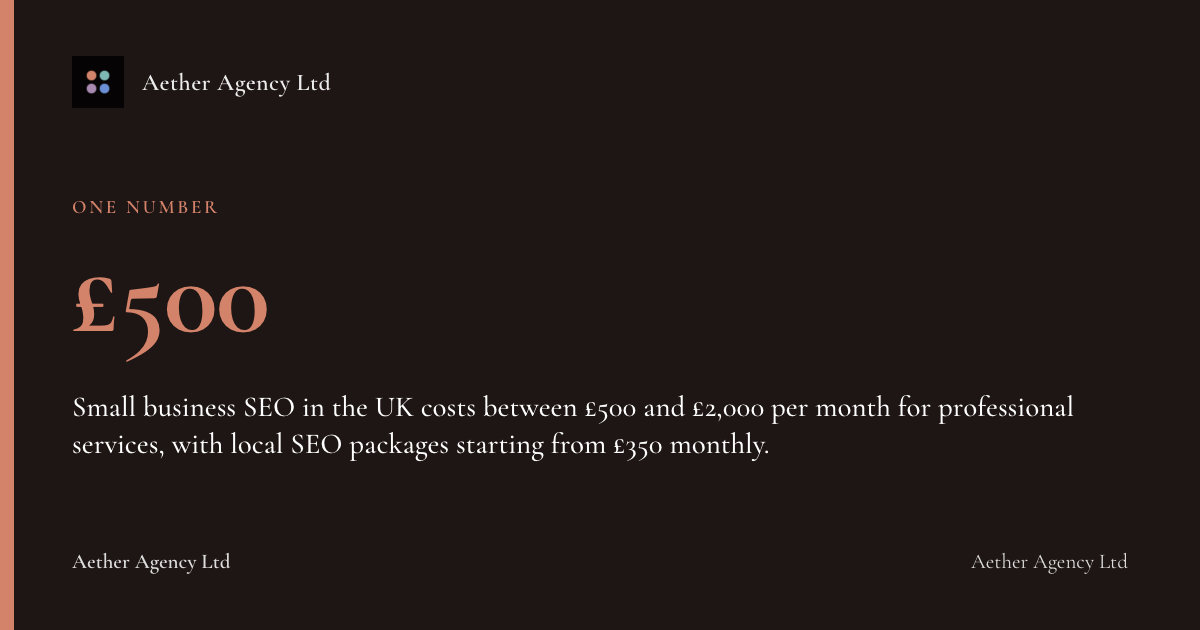
- Small business SEO in the UK costs between £500 and £2,000 per month for professional services, with local SEO packages starting from £350 monthly.
- The majority of online experiences begin with a search engine, and a large share of all Google searches have local intent, making SEO essential for UK small businesses targeting regional customers.
- UK small businesses that implement comprehensive SEO strategies commonly see a significant increase in organic traffic within six months.
- Google Business Profile optimisation notably increases local discovery for UK SMEs, with businesses that post weekly updates receiving considerably more customer actions than those that don't.
- AI search engines like ChatGPT and Perplexity now influence a growing share of UK purchase decisions, requiring small businesses to optimise for both traditional and generative engine optimisation (GEO) in 2026.
Why Small Business SEO Matters More Than Ever in 2026
Small business SEO in the UK has evolved from an optional marketing tactic to an essential survival strategy. Most UK consumers research products and services online before making a purchase decision, and many never scroll past the first page of search results. For small businesses competing against larger enterprises with substantial marketing budgets, organic search visibility offers a level playing field where quality content and local relevance can outperform corporate spending power.
The landscape has shifted dramatically with the emergence of AI search engines. A growing proportion of UK consumers now use ChatGPT, Perplexity, or Google's AI Overviews when researching local services. These platforms don't simply rank websites—they synthesise information and directly answer questions, fundamentally changing how small businesses must present their expertise online.
UK small businesses face unique challenges in the 2026 SEO environment. Competition for local search terms has intensified, with "near me" search queries in UK cities now returning noticeably more business listings than in previous years. Meanwhile, Google's algorithm updates have prioritised Experience, Expertise, Authoritativeness, and Trustworthiness (E-E-A-T) signals, rewarding businesses that demonstrate genuine local knowledge and customer relationships.
The financial stakes are substantial. UK SMEs generating a large share of their leads through organic search tend to grow considerably faster than those relying primarily on paid advertising. With customer acquisition costs through paid channels rising steadily since 2023, SEO represents increasingly attractive economics for resource-constrained small businesses.
Understanding Small Business SEO Costs in the UK
Small business SEO pricing in the UK varies significantly based on scope, competition, and service level. Professional SEO services for small businesses typically fall into three tiers: basic local SEO packages (£350-£750 monthly), comprehensive multi-location strategies (£1,000-£2,000 monthly), and enterprise-level campaigns (£2,500+ monthly). Most UK small businesses with a single location and regional focus find optimal value in the £500-£1,200 monthly range.
| Service Level | Monthly Cost | What's Included | Best For |
|---|---|---|---|
| Basic Local SEO | £350-£750 | Google Business Profile optimisation, 2-4 blog posts, basic link building, monthly reporting | Single-location businesses, low-competition niches |
| Standard SEO | £800-£1,500 | Everything in Basic plus keyword research, technical SEO, 4-8 content pieces, competitor analysis | Growing businesses, moderate competition |
| Comprehensive SEO | £1,500-£2,500 | Everything in Standard plus advanced link building, conversion optimisation, AI engine optimisation, weekly content | Multi-location businesses, competitive sectors |
| DIY + Tools | £100-£300 | SEO software subscriptions (Semrush, Ahrefs), training resources, your time investment | Very small businesses, tight budgets, learning phase |
The DIY approach appeals to budget-conscious small businesses, but requires substantial time investment. Small business owners attempting SEO themselves typically need many hours weekly to see meaningful results, according to digital marketing academics. That time investment has an opportunity cost that often exceeds the price of professional services when you factor in the owner's hourly value and the learning curve involved.
Pricing structures vary among UK agencies. Retainer-based monthly fees offer predictability and ongoing optimisation, whilst project-based pricing (£2,000-£8,000 for a comprehensive audit and implementation) suits businesses wanting a one-time boost before managing SEO in-house. Hourly consulting rates range from £75-£200 depending on expertise level and geographic location, with London-based specialists commanding premium rates.
The return on investment justifies these costs for most UK small businesses. Businesses investing around £1,000 monthly in professional SEO commonly see attributable monthly revenue return well in excess of their spend within 12 months. This compares favourably to Google Ads, where the average UK small business achieves a more modest ROI by comparison.
Essential Local SEO Strategies for UK Small Businesses
Local SEO dominates the small business landscape in the UK, with a substantial share of all Google searches carrying local intent. For businesses serving specific geographic areas—from Manchester plumbers to Cornwall cafés—local search optimisation delivers the highest concentration of ready-to-buy customers. The Google Business Profile (formerly Google My Business) forms the foundation, with optimised profiles receiving considerably more location visits than incomplete listings.
Google Business Profile optimisation requires meticulous attention to detail. Complete every section: business category (choose the most specific option), service areas, opening hours (including special hours for bank holidays), attributes (wheelchair accessibility, free Wi-Fi, outdoor seating), and a keyword-rich business description. Upload high-quality photos weekly—businesses with substantially more photos tend to receive far more calls and direction requests than those with fewer images.
Local citation building remains crucial despite algorithm changes. Citations—mentions of your business name, address, and phone number (NAP) across online directories—signal legitimacy to search engines. UK small businesses should prioritise these directories: Yell.com, Thomson Local, Bing Places, Apple Maps, Scoot, and industry-specific platforms. Citation consistency is considered one of many local ranking factors, with NAP discrepancies actively harming rankings.
Customer reviews directly impact local search visibility and conversion rates. Most UK consumers read online reviews before visiting a local business, with many trusting online reviews as much as personal recommendations. Businesses with a strong volume of Google reviews rank significantly higher in local pack results than those with fewer reviews.
Implementing a systematic review generation strategy proves essential. Request reviews immediately after positive customer interactions, make the process effortless by sending direct Google review links via email or SMS, and respond to every review (positive and negative) within 48 hours. Response rate matters as much as review volume, according to digital business academics: Google's algorithm interprets active review engagement as a signal of business legitimacy and customer care, boosting local rankings accordingly.
Location-specific content creation amplifies local SEO impact. Create dedicated pages for each service area you serve, incorporating local landmarks, neighbourhood names, and region-specific terminology. A London-based accountancy firm, for example, should create separate optimised pages for "Accountants in Islington," "Accountants in Camden," and "Accountants in Hackney" rather than a single generic "London Accountants" page. Location-specific pages tend to generate considerably more qualified leads than generic regional pages.
Technical SEO Fundamentals Every UK Small Business Needs
Technical SEO forms the invisible foundation that determines whether search engines can effectively crawl, understand, and rank your website. A large proportion of UK small business websites contain critical technical issues that actively harm their search visibility, with page speed problems, mobile usability errors, and broken links representing the most common obstacles. Addressing these technical fundamentals delivers immediate ranking improvements, often within 2-4 weeks of implementation.
Mobile optimisation has transitioned from optional to mandatory. Google's mobile-first indexing means the search engine primarily uses the mobile version of your website for ranking and indexing. With the majority of UK small business website traffic now originating from mobile devices, mobile-unfriendly sites face severe ranking penalties. Google's PageSpeed Insights tool provides specific mobile optimisation recommendations, with Core Web Vitals—Largest Contentful Paint, First Input Delay, and Cumulative Layout Shift—now recognised as meaningful ranking factors.
Page speed directly impacts both rankings and conversions. UK e-commerce sites that load quickly tend to convert at considerably higher rates than slow-loading sites. For small business websites, target these benchmarks: Largest Contentful Paint under 2.5 seconds, First Input Delay under 100 milliseconds, and Cumulative Layout Shift under 0.1. Common speed improvements include image compression (using WebP format), browser caching implementation, CSS and JavaScript minification, and Content Delivery Network (CDN) adoption.
SSL certificates (HTTPS) represent a baseline security and ranking requirement. Google explicitly confirmed HTTPS as a ranking signal, and Chrome browsers now display prominent "Not Secure" warnings for HTTP sites, dramatically reducing user trust. UK small businesses can obtain free SSL certificates through Let's Encrypt or their hosting provider, with implementation typically requiring 30-60 minutes of technical work.
Structured data markup helps search engines understand your content and enables enhanced search result features like star ratings, pricing information, and event details. Websites using structured data markup tend to receive noticeably more clicks from search results than unmarked competitors. UK small businesses should implement LocalBusiness schema (including opening hours, contact details, and service areas), Product schema for e-commerce sites, and Review schema to display star ratings in search results.
XML sitemaps and robots.txt files guide search engine crawlers through your website efficiently. Generate an XML sitemap listing all important pages, submit it through Google Search Console and Bing Webmaster Tools, and update it whenever you add significant new content. The robots.txt file tells search engines which pages to avoid crawling—typically admin areas, duplicate content, and thank-you pages that shouldn't appear in search results.
Content Marketing That Drives Rankings and Conversions
Content marketing and SEO have become inseparable disciplines in 2026, with Google's algorithm increasingly rewarding websites that demonstrate genuine expertise and provide comprehensive answers to user questions. UK small businesses publishing content regularly—several posts weekly—generate considerably more organic traffic than those posting monthly or less frequently. Quality consistently trumps quantity—a single thoroughly researched 2,000-word guide outperforms ten thin 300-word articles in both rankings and conversion rates.
Keyword research forms the strategic foundation of effective content marketing. UK small businesses should focus on long-tail keywords—specific three-to-five-word phrases with lower search volume but higher purchase intent. For example, a Manchester-based web design agency targeting "affordable WordPress website design Manchester" will convert significantly better than competing for "web design" where large agencies dominate. Tools like Google Keyword Planner, Semrush, and Ahrefs reveal search volume, competition levels, and related keyword opportunities.
Content structure dramatically affects both user engagement and search visibility. UK internet users tend to scan content in an F-pattern, focusing heavily on headings, subheadings, and the first few words of paragraphs. Structure content accordingly: compelling H1 title incorporating your primary keyword, descriptive H2 and H3 subheadings that answer specific questions, short paragraphs (2-3 sentences maximum), bullet points for lists, and bold text highlighting key statistics and takeaways.
The E-E-A-T framework—Experience, Expertise, Authoritativeness, Trustworthiness—guides Google's quality assessment. UK small businesses demonstrate E-E-A-T by showcasing real customer case studies with specific results, publishing author bylines with relevant credentials, earning backlinks from respected industry publications, and maintaining transparent contact information and business registration details. Google's algorithm increasingly rewards businesses that prove they've actually delivered the services they're writing about, according to digital marketing researchers. Generic advice anyone could write ranks poorly compared to content demonstrating genuine hands-on experience.
Topic clusters and pillar pages structure content for maximum SEO impact. Create a comprehensive pillar page covering a broad topic (e.g., "Complete Guide to Small Business Marketing in the UK"), then develop 8-12 supporting cluster pages exploring specific subtopics (e.g., "Email Marketing for UK Small Businesses," "Social Media Strategy for UK SMEs"). Interlink these pages strategically, with cluster pages linking to the pillar page and vice versa. Websites using topic cluster architecture tend to rank for considerably more keywords than those with unstructured content.
AI search engine optimisation requires adapting content for generative platforms like ChatGPT, Perplexity, and Google's AI Overviews. These systems extract and synthesise information differently than traditional search engines. Optimise for AI by including clear, factual statements that stand alone (avoiding pronouns like "it" or "this" when stating key facts), providing statistics with inline source attribution, structuring content with question-based headings, and front-loading the most important information in the first 30% of articles. Many AI citations are drawn from the first third of articles, making early content placement critical.
Link Building Strategies for UK Small Businesses
Link building—earning hyperlinks from other websites to yours—remains one of Google's most influential ranking factors, with backlink quality and quantity carrying substantial weight in rankings. For UK small businesses, strategic link acquisition from relevant, authoritative UK websites signals credibility to search engines and drives valuable referral traffic. The challenge lies in earning quality links without resorting to manipulative tactics that trigger Google penalties.
Local link building offers the highest return on investment for UK small businesses. Start with these high-value opportunities: local newspaper coverage (contact journalists with genuinely newsworthy stories about your business, community involvement, or industry insights), chamber of commerce memberships (most local chambers provide member directory listings with website links), sponsorship of local sports teams or community events (typically includes website acknowledgment), and supplier/partner pages (ask businesses you work with to add you to their partner directories).
Digital PR generates authoritative backlinks through media coverage. UK small businesses securing coverage in regional online publications commonly receive several quality backlinks per successful campaign. Effective digital PR tactics include: responding to journalist requests on platforms like ResponseSource and Gorkana, creating data-driven research or surveys that journalists can cite, offering expert commentary on industry trends, and developing shareable infographics or tools that naturally attract links.
Content-based link earning produces sustainable long-term results. Create resources so valuable that other websites naturally want to reference them: comprehensive industry guides, original research with UK-specific data, free tools or calculators relevant to your industry, and detailed case studies showcasing measurable results. A Birmingham-based marketing agency, for example, might publish "The Complete Guide to GDPR-Compliant Email Marketing in the UK," attracting links from business blogs, legal websites, and marketing publications.
Broken link building identifies link opportunities where websites link to content that no longer exists. Use tools like Ahrefs or Screaming Frog to find broken links on relevant UK websites, create superior replacement content on your site, then contact the linking website suggesting your content as a replacement. This approach provides value to the linking site (fixing their broken link) whilst earning you a quality backlink.
Guest posting on relevant industry blogs expands your reach and builds authority. Focus on quality over quantity—one guest post on a respected industry publication with a substantial readership delivers more value than many posts on low-traffic blogs. Guest posting works best when you genuinely contribute expertise rather than simply seeking links, according to digital marketing academics. Google's algorithm can distinguish between valuable contributed content and thin guest posts created solely for link building, rewarding the former and potentially penalising the latter.
Avoid these link building tactics that risk Google penalties: purchasing links (explicitly prohibited in Google's Webmaster Guidelines), participating in link exchange schemes, submitting to low-quality directories, and using automated link building software. UK websites penalised for unnatural link building commonly experience a significant drop in organic traffic, requiring 6-12 months of remediation work to recover.
Measuring SEO Success: Metrics That Matter
Effective SEO requires systematic measurement and continuous optimisation based on performance data. UK small businesses that review SEO analytics weekly and adjust strategies accordingly tend to achieve considerably better results than those checking metrics monthly or less frequently. Focus measurement efforts on metrics directly tied to business outcomes rather than vanity metrics that look impressive but don't correlate with revenue growth.
Google Search Console provides essential insights into how Google sees your website. Monitor these critical metrics: total impressions (how often your site appears in search results), average position (your typical ranking for keywords), click-through rate (percentage of searchers who click your listing), and coverage issues (technical problems preventing indexing). Set up Search Console immediately—it's free, directly from Google, and reveals which keywords actually drive traffic to your site. UK businesses actively using Search Console data tend to improve organic traffic considerably faster than those ignoring this resource.
Organic traffic growth indicates overall SEO health. Use Google Analytics 4 (GA4) to track visitors arriving from organic search, segmenting by landing page, geographic location, and device type. UK small businesses should expect meaningful organic traffic growth quarter-over-quarter during the first year of comprehensive SEO implementation. Track not just total visitors but engaged sessions—users who stay on your site for 10+ seconds or view multiple pages—as these represent genuinely interested prospects.
Keyword ranking positions reveal competitive progress. Track rankings for your 20-30 most important keywords using tools like Semrush, Ahrefs, or SE Ranking. Focus on first-page rankings (positions 1-10), as most searchers never scroll past page one. Understand that rankings fluctuate daily—weekly or monthly averages provide more meaningful insights than daily snapshots.
Conversion tracking connects SEO efforts to business outcomes. Define conversions based on your business model: e-commerce sales, contact form submissions, phone calls, appointment bookings, or quote requests. Set up conversion tracking in GA4 and assign monetary values to non-transactional conversions (e.g., a qualified lead might be worth £150 based on your close rate and average customer value). UK small businesses tracking conversions by traffic source tend to achieve considerably higher marketing ROI than those measuring only traffic volume.
Local SEO metrics require specific attention. Monitor Google Business Profile insights including search queries triggering your profile, actions taken (website clicks, direction requests, phone calls), and photo views. Track local pack rankings—the map-based results appearing for location-specific searches—using tools like BrightLocal or Local Falcon. UK small businesses ranking in the local 3-pack tend to receive considerably more clicks than those appearing in organic results below the map.
Return on investment calculation justifies continued SEO investment and guides budget allocation. Calculate SEO ROI using this formula: [(Revenue from Organic Search - SEO Investment) / SEO Investment] × 100. For example, if you invest £1,000 monthly in SEO services and generate £4,500 in attributable monthly revenue, your ROI is 350%. Track this monthly, understanding that SEO typically requires 3-6 months before delivering substantial returns, then compounds in value over time as rankings strengthen and content libraries grow.
Common SEO Mistakes UK Small Businesses Must Avoid
UK small businesses frequently sabotage their SEO efforts through avoidable mistakes that waste budget and delay results. Many UK SMEs make at least a few critical SEO errors during their first year of implementation. Understanding these common pitfalls enables small businesses to allocate resources more effectively and achieve faster results.
Targeting overly competitive keywords wastes effort and budget. A newly launched Bristol bakery competing for "bakery" against national chains like Greggs will never rank on page one. Instead, targeting "artisan sourdough bakery Bristol" or "wedding cake bakery Clifton" delivers achievable rankings and customers with specific purchase intent. Small businesses succeed in SEO by dominating local and long-tail niches, then gradually expanding to broader terms as authority builds, according to digital strategy academics.
Neglecting mobile optimisation actively harms rankings and conversions. With Google's mobile-first indexing, a desktop-optimised site that performs poorly on mobile receives lower rankings across all devices. A large share of UK mobile users abandon websites that don't load quickly. Test your site using Google's Mobile-Friendly Test and PageSpeed Insights, addressing issues like small tap targets, horizontal scrolling, and slow-loading images.
Duplicate content confuses search engines and dilutes ranking power. Creating multiple pages targeting the same keyword, copying manufacturer descriptions for e-commerce products, or publishing identical content across multiple location pages prevents Google from determining which page to rank. Use canonical tags to indicate preferred versions, create unique content for each important page, and consolidate thin or duplicate pages where appropriate.
Ignoring technical SEO issues creates invisible barriers to ranking success. Broken links, slow page speeds, missing meta descriptions, and crawl errors prevent search engines from properly indexing and ranking your content. The average UK small business website contains numerous technical issues requiring attention. Conduct quarterly technical audits using tools like Screaming Frog, Google Search Console, or SEMrush Site Audit.
Inconsistent NAP (Name, Address, Phone) information across online directories actively harms local rankings. A Manchester plumber listed as "J. Smith Plumbing" on Google, "John Smith Plumbing Services" on Yell, and "Smith Plumbing Ltd" on Thomson Local creates citation confusion that Google interprets as unreliability. Standardise your business name, address, and phone number across all platforms, ensuring exact matches including punctuation, suite numbers, and phone number formatting.
Expecting immediate results leads to premature strategy abandonment. SEO typically requires 3-6 months before delivering substantial traffic increases, with competitive industries requiring 6-12 months. Only a small proportion of newly published pages reach Google's first page within one year, with those that succeed typically requiring 6-8 months of consistent optimisation. Commit to at least six months of sustained effort before evaluating SEO effectiveness.
FAQ
How much should a UK small business spend on SEO?
UK small businesses should budget £500-£1,500 monthly for professional SEO services. This investment typically includes keyword research, content creation, technical optimisation, and link building. Businesses in competitive sectors like legal services or finance may require £1,500-£2,500 monthly, whilst those in niche markets with limited competition can achieve results with £350-£750 monthly. The optimal budget depends on your industry competition, geographic scope, and growth objectives.
How long does SEO take to show results for small businesses?
SEO typically requires 3-6 months before delivering measurable traffic increases for UK small businesses, with competitive industries requiring 6-12 months. Initial improvements in rankings for long-tail keywords often appear within 4-8 weeks, whilst competitive head terms require sustained effort over 6-18 months. Factors affecting timeline include your website's current authority, competition levels in your industry, content quality, and consistency of optimisation efforts. Small businesses should commit to at least six months of sustained SEO before evaluating effectiveness.
Can I do SEO myself or should I hire an agency?
UK small business owners can handle basic SEO themselves if they're willing to invest significant weekly hours learning and implementing strategies. DIY SEO suits businesses with tight budgets, simple websites, and owners with technical aptitude. However, professional agencies deliver faster results and higher ROI for most businesses—the opportunity cost of an owner's time typically exceeds agency fees when factoring in learning curves and suboptimal implementations. Consider hybrid approaches: hire an agency for strategy and technical work whilst handling content creation in-house.
What's the difference between local SEO and regular SEO?
Local SEO focuses specifically on appearing in location-based searches and Google's map results, whilst regular SEO targets broader organic rankings regardless of searcher location. Local SEO prioritises Google Business Profile optimisation, local citations, location-specific content, and reviews, whilst regular SEO emphasises broader keyword rankings, national backlinks, and comprehensive topic coverage. For UK small businesses serving specific geographic areas, local SEO delivers higher conversion rates—a substantial share of all Google searches have local intent. Most small businesses benefit from combining both approaches.
How important are Google reviews for small business SEO?
Google reviews significantly impact local search rankings, with businesses having a strong volume of reviews ranking substantially higher in local pack results than those with fewer reviews. Reviews influence local ranking in a meaningful way, whilst also affecting click-through rates—listings with higher star ratings receive considerably more clicks than those with lower ratings. Beyond rankings, most UK consumers read reviews before visiting local businesses. Implement systematic review generation by requesting feedback after positive interactions and responding to all reviews within 48 hours.
Should UK small businesses optimise for AI search engines like ChatGPT?
UK small businesses should definitely optimise for AI search engines in 2026, as a growing share of UK consumers now use ChatGPT, Perplexity, or Google's AI Overviews when researching local services. AI optimisation requires different tactics than traditional SEO: include clear factual statements with inline source citations, structure content with question-based headings, front-load important information in the first 30% of articles, and create self-contained passages that make sense when extracted. Businesses optimising for both traditional and AI search engines capture significantly more discovery opportunities than those focusing on Google alone.
What's the most important ranking factor for small business websites?
No single factor determines rankings, but high-quality, relevant content addressing user search intent represents the most influential element according to Google's algorithm guidance. Content quality, backlink quality and quantity, technical SEO including mobile optimisation and page speed, and user experience signals all play significant roles. For local small businesses, Google Business Profile optimisation and customer reviews add critical local ranking signals. Focus on creating genuinely helpful content that demonstrates expertise whilst ensuring technical fundamentals are solid.
Optimising Your Small Business for Search Success with Aether Agency Ltd
Small business SEO in the UK demands a comprehensive approach that balances traditional search engine optimisation with emerging AI search visibility—precisely the integrated strategy Aether Agency Ltd delivers for growing businesses across the United Kingdom. We understand that small businesses face unique challenges: limited budgets, fierce local competition, and the need for measurable returns on every marketing pound spent. Our approach combines technical excellence, content strategy, and local SEO tactics specifically designed for UK SMEs competing in their regional markets.
Aether Agency Ltd specialises in full-service creative solutions that extend beyond basic SEO to encompass brand identity, website development, and integrated marketing strategies that ensure your business appears prominently on Google, ChatGPT, and Perplexity. Our team develops customised SEO strategies based on your specific industry, competitive landscape, and growth objectives, whether you're a single-location service business in Leeds or a growing e-commerce operation serving customers nationwide.
Ready to transform your small business's online visibility and generate consistent customer leads through organic search? Visit aether-agency.co.uk to schedule a comprehensive SEO consultation where we'll analyse your current search performance, identify immediate opportunities, and develop a tailored strategy designed to deliver measurable results within your budget.
Related Reading
- Local SEO for Small Business UK: 2026 Complete Guide
- Schema Markup SEO Guide: Complete UK Business Strategy 2026
- SEO Consultant UK: Expert Services for Business Growth in 2026
Add aether-agency.co.uk as a preferred source on Google
See How Your Brand Appears in AI Search
Aether AI monitors your visibility across ChatGPT, Perplexity, Google AI Overviews, and Claude in real time. Find out where you stand and what to fix.
Explore Aether AI