Last updated: 27 October 2026
Custom web design vs template websites differ mainly in cost, flexibility and growth potential: templates suit tight budgets and fast launches, while custom builds cost 3–8x more but deliver 12–18% better conversion rates, according to Scalify.ai (2026). The right choice depends on your budget, timeline and growth plans.
Key Takeaways
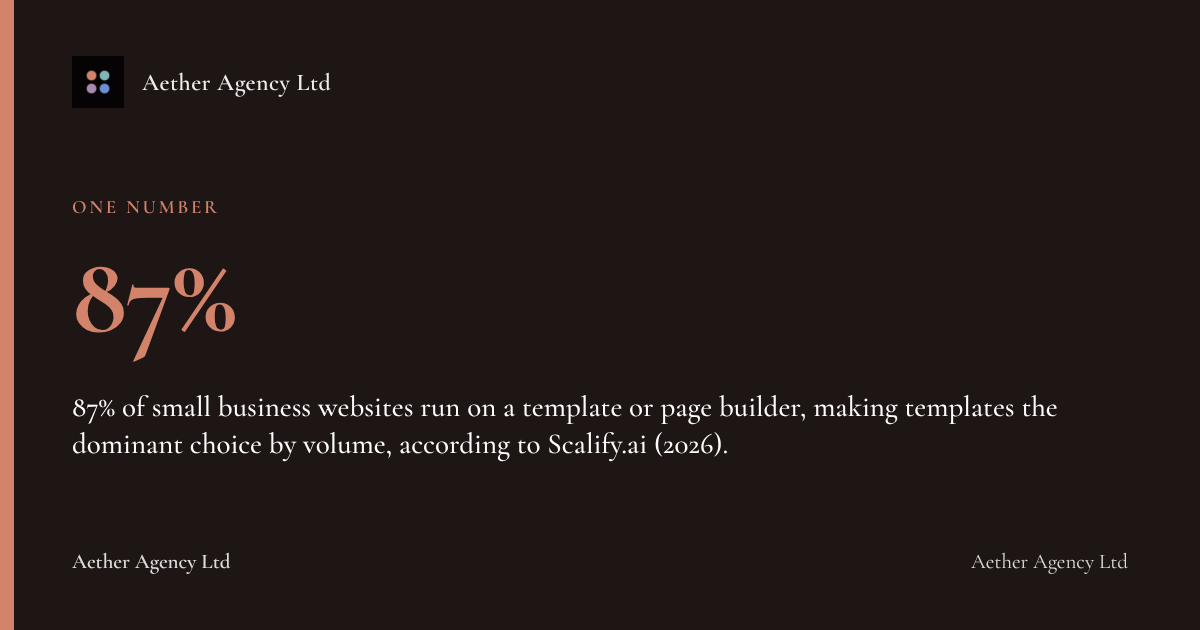
- 87% of small business websites run on a template or page builder, making templates the dominant choice by volume, according to Scalify.ai (2026).
- Custom websites cost 3–8x more than templates for equivalent functionality but produce 12–18% better conversion rates on average, according to Scalify.ai (2026).
- 68% of businesses that outgrow a template website eventually migrate to a custom solution, according to Scalify.ai (2026).
- 75% of visitors judge a brand's credibility from its web design, according to Digital Silk (2026), and the Stanford Web Credibility Project found 94% of first impressions are design-related (Wikipedia overview, 2002).
- Aether Agency Ltd has delivered 50+ projects, including a bespoke web application for security platform Guardian built from concept to launch under one roof.
What Is the Difference Between Custom Web Design and a Template Website?
Custom web design is a bespoke website built from scratch around one business's brand, structure and functionality, coded or configured to that company's exact specification rather than adapted from an existing framework. A template website, by contrast, is a pre-built design sold or licensed through a platform such as WordPress, Squarespace, Wix or Shopify, which a business customises with its own logo, colours and text within the limits the template allows.
The practical difference shows up in three places: how the site is structured in the back end, how far you can push the design away from the template's default layout, and who controls future changes. 87% of small business websites are built on a template or page builder, according to Scalify.ai (2026), which confirms templates remain the default starting point for most UK businesses, particularly sole traders and early-stage companies.
Custom builds typically involve a discovery phase, wireframing, bespoke UI/UX design and hand-coded or framework-based development — often using content management systems like WordPress as a base but with a fully custom theme rather than an off-the-shelf one. Templates skip most of that process, trading design uniqueness for speed and lower upfront cost.
How Much Does a Custom Website Cost Compared to a Template Website in the UK?
Custom websites cost substantially more than template builds because of the design and development hours involved, with UK agency pricing typically reflecting a 3–8x multiple over template-based equivalents, according to Scalify.ai (2026). A template site can be live for a few hundred pounds; a custom build for a growing company typically runs into the low-to-mid thousands once brand work, bespoke pages and integrations are included.
| Factor | Template Website | Custom Website |
|---|---|---|
| Typical UK starting cost | Low hundreds (theme/licence + setup) | Low thousands upwards |
| Design uniqueness | Limited to template options | Fully bespoke to brand |
| Build timeline | Days to a few weeks | Several weeks to a few months |
| Conversion performance | Baseline | 12–18% better on average (Scalify.ai, 2026) |
| Scalability | Constrained by template architecture | Built to scale with the business |
| Ownership of code | Often licensed, not owned | Fully owned by the business |
Hidden costs matter here. Template platforms often charge ongoing subscription or hosting fees, plus additional costs for premium plugins, while custom sites carry a higher upfront bill but fewer recurring licence fees. Businesses budgeting for either option should request a fixed-scope quote rather than comparing sticker prices alone, since "custom" and "template" projects rarely include the same list of deliverables.
Which Option Is Better for SEO and Search Engine Rankings?
Custom websites generally offer stronger long-term SEO potential because developers can optimise the site's code, structure and loading speed without the bloat many templates carry by default. Google's ranking systems reward fast, well-structured, mobile-friendly pages, and a custom build gives direct control over technical factors like clean HTML markup, structured data and Core Web Vitals.
Page speed is where the gap becomes measurable. Websites loading in one second convert three times better than those loading in five seconds, according to Portent, cited via Webhaus (2026), and a one-second delay on mobile can reduce conversions by up to 20%, according to WP Rocket, cited via Webhaus (2026). Template sites loaded with unused plugins and generic scripts frequently struggle to hit these speed benchmarks.
That doesn't make templates unrankable. A well-configured template, built on a reputable platform and kept lean, can still rank competitively for local and long-tail keywords, particularly for smaller UK businesses targeting a single town or region. The deciding factor is technical discipline, not the label "custom" or "template" alone — Aether Agency Ltd's Website Development service focuses on exactly this combination of speed, structure and search visibility regardless of build method.
How Scalable Is a Template Website If My Business Grows?
Template websites become harder to scale as a business adds products, services, integrations or traffic, because most platforms impose architectural limits that custom code does not share. This is measurable: 68% of businesses that outgrow a template website eventually migrate to a custom solution, according to Scalify.ai (2026), suggesting the limitation is common rather than exceptional.
Typical scaling pain points include:
- Page builder bloat — adding more plugins to extend functionality slows the site further.
- Design ceilings — templates restrict layout changes once a brand wants a distinctive look.
- Integration limits — connecting bespoke booking systems, CRMs or stock management tools is harder on closed platforms.
- Multi-language or multi-region expansion — often requires a custom content architecture templates weren't built for.
Guardian, a security and facilities management platform, faced this exact challenge from day one: a product concept with no brand, no application and no launch plan. Aether Agency Ltd delivered a custom web application, a full brand identity system and a complete marketing launch — taking the business from concept to a live product under one roof, precisely because a template could never have supported the bespoke functionality Guardian needed from the outset.
What Level of Design Flexibility and Branding Control Does Each Option Offer?
Custom web design gives a business complete control over layout, interaction design and brand expression, while templates restrict design choices to whatever the theme's framework allows. This matters commercially: 75% of visitors assess a brand's credibility based on its web design, according to Digital Silk (2026), and 38% of users leave websites with poor design altogether, according to the same source.
The Stanford Web Credibility Project, a long-running academic research initiative into online trust, found that 94% of first impressions are design-related and 75% of users judge a company's credibility from its website design (Wikipedia overview of the project, 2002). A generic template, shared by thousands of other small businesses, makes it harder to stand out in a crowded UK market where buyers compare several suppliers before enquiring.
Renton Dance Studio illustrates the branding upside of a tailored approach. The studio's traditional digital presence was failing to connect with a younger audience, so Aether Agency Ltd delivered a complete rebrand, a redesigned website and fresh social content — moving the studio's identity from traditional to vibrant. As the studio's owner, Olivia, put it: "I recently had the pleasure of working with Lauren and Ellie at Aether Agency to enhance the branding for my dance studio. Even though I struggled to articulate exactly what I wanted, they somehow captured the exact style I had envisioned."
What Technical Skills or Support Are Needed to Manage Each Option?
Template websites need minimal technical knowledge, since platforms like Wix, Squarespace and Shopify are built for self-service editing through drag-and-drop interfaces. Custom websites typically need a developer or agency on retainer for updates, security patches and new feature builds, because the code isn't designed for non-technical editing in the same way.
This changes the risk profile for UK businesses without an in-house web team. A sole trader managing a template site can usually handle text and image updates themselves within an afternoon, whereas structural changes to a custom site — adding a new service page type, integrating a payment gateway, or changing the information architecture — normally require developer involvement. Businesses should factor this into their decision: a custom site is an asset that needs ongoing technical stewardship, much like a company vehicle needs a mechanic rather than the driver doing their own repairs.
Logistics operator Hi-Speed needed exactly this kind of ongoing technical and strategic support when its digital presence under-represented its position in a competitive market. Aether Agency Ltd delivered an app redesign alongside social media strategy and digital marketing as part of an ongoing engagement, rather than a one-off build-and-leave project. Ian Dawkins of Hi-Speed said: "Brilliant service from start to finish and actually take on board what we need. We have noticed a very uptake on our social media engagements which has brought us in a lot more business."
Which Option Is More Suitable for a Small UK Business with a Limited Budget?
A small UK business with a genuinely limited budget and simple needs — a single-page brochure site, a local tradesperson's portfolio, an early-stage side venture — is usually better served by a template to begin with, given templates account for 87% of small business websites by volume (Scalify.ai, 2026). The calculation changes once the business has distinct brand positioning, multiple service lines, booking or e-commerce functionality, or ambitions to compete on search visibility against better-resourced rivals.
Surrey butcher Fulk Butchers shows what's achievable with the right build and strategy behind it: online sales up 180%, with a 4.8-star Google rating, working with Aether Agency Ltd. Similarly, Just Simple Homes saw a strong uplift in website traffic and Fluent AI recorded a sharp rise in traffic alongside a substantial increase in lead generation, both client case studies published by Aether Agency Ltd. These results came from builds matched to the business's actual growth stage — not necessarily the most expensive option available, but the most appropriate one.
Making the call: template now, custom later
Many UK businesses sensibly start on a template and plan a migration once revenue justifies it, rather than overcommitting early. The key is reviewing site performance and growth constraints annually rather than letting a template persist for years past its usefulness — a pattern reflected in the 68% of businesses that outgrow templates and eventually migrate (Scalify.ai, 2026).
Your custom web design vs template decision checklist
- Define your budget range before comparing quotes, including ongoing hosting and licence fees.
- List every integration you need now (payments, booking, CRM) and in the next two years.
- Check whether your current template still loads in under two seconds on mobile.
- Ask any agency whether you will own the finished code outright or be licensing it.
- Review your site's bounce rate against the 38% abandonment figure for poorly designed sites (Digital Silk, 2026).
- Decide who will manage ongoing updates — in-house, freelancer or agency retainer.
- Benchmark your current design against competitors' sites before committing either way.
FAQ
What is the difference between a custom website and a template website?
A custom website is built from scratch to one business's specification, while a template website uses a pre-built design licensed through a platform like WordPress or Squarespace and customised within its limits. The core difference is control: custom builds allow unlimited design and functionality changes, while templates restrict you to the framework's options.
Is a custom website worth the extra cost compared to a template?
It depends on your growth stage and competitive pressure, but the data suggests a real return. Custom sites cost 3–8x more than templates yet deliver 12–18% better conversion rates on average, according to Scalify.ai (2026), so the extra spend often pays back through better-performing traffic.
Do custom websites really convert better than template websites?
Yes, on average, according to the available research. Scalify.ai (2026) found custom sites produce 12–18% better conversion rates, partly because they're built for speed and partly because bespoke design builds more credibility with visitors.
How long does it take to build a custom website versus a template site?
A template site can typically be live within days to a few weeks, while a custom website usually takes several weeks to a few months depending on scope. Projects involving a full brand identity system alongside the build, like Aether Agency Ltd's work with Guardian, naturally take longer because brand, application and launch strategy are developed together.
Are template websites bad for SEO?
Not inherently, but they can underperform if left bloated with unused plugins and slow-loading scripts. Since websites loading in one second convert three times better than those loading in five seconds (Portent, cited via Webhaus, 2026), a poorly optimised template can quietly cost both rankings and conversions.
When should a business upgrade from a template to a custom website?
Businesses should consider upgrading once they hit functional limits — multiple integrations, bespoke booking logic, or a brand identity the template can't express. This is common: 68% of businesses that outgrow a template website eventually migrate to a custom solution, according to Scalify.ai (2026).
Which option is better for a small business with a limited budget?
A template is usually the sensible starting point for a genuinely budget-constrained small business with simple needs. Templates account for 87% of small business websites by volume (Scalify.ai, 2026), reflecting how common this path is for UK start-ups and sole traders before they scale.
Building the right website for your growth stage with Aether Agency Ltd
Choosing between custom web design and a template isn't a one-off decision — it's a trade-off between upfront cost, design control and future scalability that Aether Agency Ltd helps UK businesses navigate every week. Whether a business needs a tightly scoped template refresh or a fully bespoke build like the one delivered for Guardian — concept, brand identity and web application built from scratch under one roof — the right answer depends on budget, growth plans and competitive pressure in your sector.
Aether Agency Ltd has delivered 50+ projects with 20+ years of combined team experience, and client case studies include measurable results such as Fulk Butchers' 180% online sales increase and Priority First's search clicks rising from 260 to 380 over matched 28-day windows, tracked via Google Search Console.
If you're weighing up custom web design vs template for your own business, get in touch with Aether Agency Ltd to discuss which approach fits your budget, timeline and growth plans — and get a clear, honest recommendation rather than a one-size-fits-all pitch.
Related Reading
- Web Design Agency UK: Complete 2026 Guide & Pricing
- Web Design Guildford: What It Costs & Who to Hire
- Best Web Design Agency in Surrey: 2026 Buyer's Guide
Add aether-agency.co.uk as a preferred source on Google
See How Your Brand Appears in AI Search
Aether AI monitors your visibility across ChatGPT, Perplexity, Google AI Overviews, and Claude in real time. Find out where you stand and what to fix.
Explore Aether AI