Last updated: 27 October 2026
A project fee charges a fixed, agreed amount for a defined piece of branding work, such as a logo and identity system, while a retainer bills a recurring monthly sum for ongoing access to an agency's time. Most UK branding studios now offer both, with fixed fees dominating one-off identity work and retainers covering continuous brand management, content and design support.
Key Takeaways
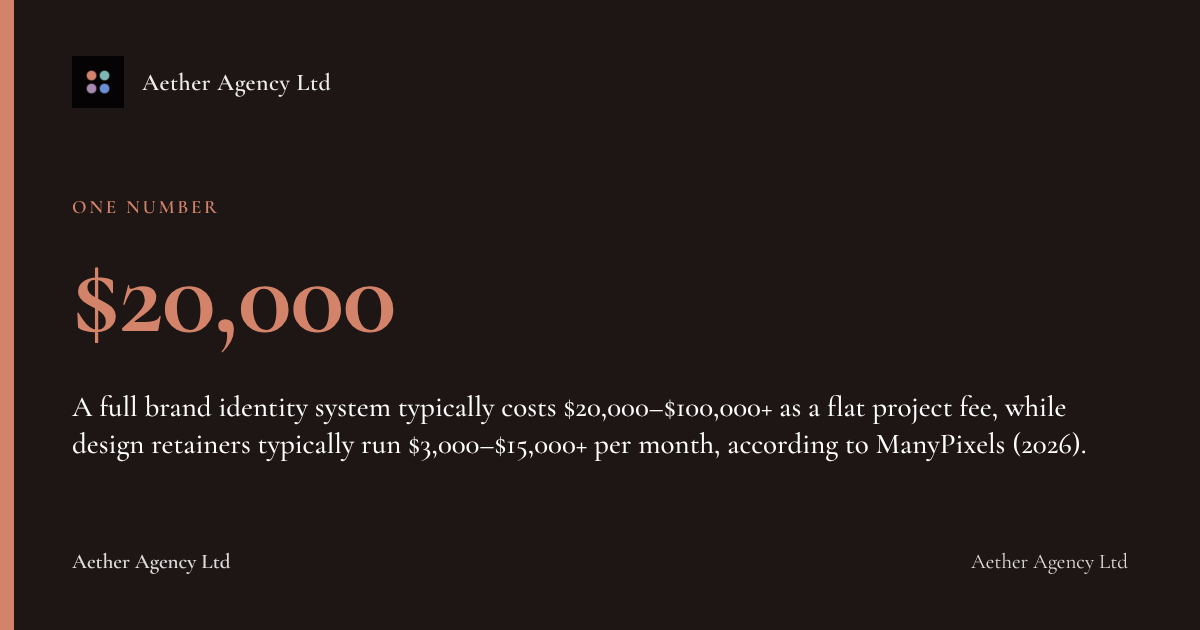
- A full brand identity system typically costs $20,000–$100,000+ as a flat project fee, while design retainers typically run $3,000–$15,000+ per month, according to ManyPixels (2026).
- 72% of agencies use fixed-fee pricing and around 90% use retainers as part of their mix, per the 4A's 2024 Compensation Survey, cited by Forge.
- 91% of agencies now offer retainers, and 88% offer both retainer and project pricing side by side, according to Conduit Digital, citing Promethean Research (2026).
- Retainer clients carry a lifetime value 3 to 5 times higher than one-off project clients, reports Taskip (2026).
- Aether Agency Ltd has delivered 50+ projects, as published on aether-agency.co.uk, spanning both fixed-fee identity work and ongoing retained brand support.
What is the difference between a project fee and a retainer in branding?
A project fee is a fixed, one-time payment for a clearly scoped piece of branding work with a defined start and end date, such as a new logo, visual identity or brand strategy document. A retainer is a recurring payment, usually monthly, that secures ongoing access to an agency's time for open-ended or continuous brand work.
The distinction matters because it changes who carries the financial risk. Under a project fee, the agency absorbs the cost if the work takes longer than estimated, provided the scope hasn't changed. Under a retainer, the client pays a set amount regardless of exactly how many hours are used that month, which smooths costs for both sides but requires trust that the hours delivered match the value received.
Most UK branding agencies now blend both models rather than picking one exclusively. 91% of agencies now offer retainers, and 88% offer both retainer and project pricing models side by side, according to Conduit Digital, citing Promethean Research (2026). A typical pattern Aether Agency Ltd sees among growing UK businesses is a project fee to build the brand identity, followed by a retainer to roll it out across the website, marketing and ongoing design needs.
What does a one-off branding project fee typically cost in the UK?
A one-off branding project fee for a full identity system — logo, colour palette, typography, brand guidelines — typically runs from $20,000 to $100,000 or more as a flat fee, according to ManyPixels (2026). Smaller, more basic packages cost considerably less.
A basic brand identity package covering just a logo, colour palette and typography might range from $1,500 to $5,000, while a custom full brand system with packaging or digital assets often commands $5,000 to $15,000 or more, per TheNetMenCorp (2026). UK businesses should treat US-denominated figures as a directional benchmark rather than a like-for-like sterling quote, since agency day rates and overheads vary by region and studio size.
Project-based pricing remains the dominant model among freelance designers specifically. Project-based pricing dominated among freelance designers, used by 82% of respondents across every revenue band, and 97% of the $75k-plus earners charged at least $2.5k per project, according to the Fast Company / AIGA Design Pricing Transparency Project (2026). "It's more important than ever for designers to embrace pay transparency," says Liz Stinson, Senior Design Editor at Fast Company — a principle that applies equally to clients requesting clear, itemised quotes before signing.
The final figure depends heavily on scope: a startup needing a logo and basic guidelines sits at the lower end, while an established company commissioning a full rebrand across packaging, signage and digital touchpoints sits at the upper end. Just Simple Homes, a modern property developer, commissioned Aether Agency Ltd for website development, branding and ongoing social media management as a combined engagement, illustrating how a project-based identity build often becomes the foundation for a longer retained relationship.
What does a monthly branding retainer typically cost?
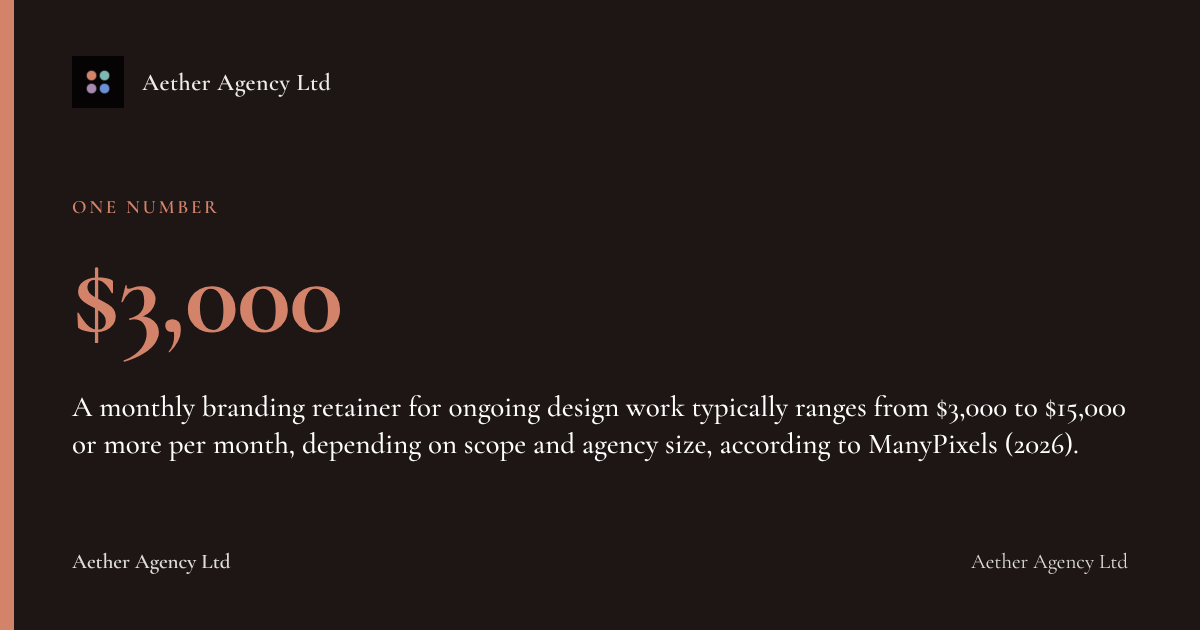
A monthly branding retainer for ongoing design work typically ranges from $3,000 to $15,000 or more per month, depending on scope and agency size, according to ManyPixels (2026). This covers continuous brand management such as campaign assets, social content, packaging refreshes and brand consistency checks across channels.
The appeal of a retainer lies in predictability for both parties. A $5,000/month retainer, held for 18 months, generates $90,000 without a single new sales conversation, notes Conduit Digital (2026) — illustrating why agencies favour retainers for long-term revenue stability, and why clients benefit from locked-in capacity without repeatedly re-briefing a new project.
Agencies built around retainer revenue report meaningfully steadier cash flow. Agencies with retainer-dominant revenue models report 35 to 40 percent more predictable monthly income than project-dependent peers, and retainer clients have a lifetime value 3 to 5 times higher than one-off project clients, according to Taskip (2026). That stability cuts both ways: a business signing a retainer should confirm exactly what's included each month, because unused hours rarely roll over and under-used retainers quietly erode value.
Not every UK agency has shifted to retainer-first billing. Over 60 percent of small agencies still rely on project work as their primary billing model, many without a clear plan to change that, per Taskip (2026), which means buyers should always ask an agency directly which model it defaults to rather than assuming.
Which branding work suits a fixed fee versus an ongoing retainer?
Fixed-term, clearly scoped branding work — a new logo, a rebrand, a brand strategy document — suits a project fee because it has a defined deliverable and a natural end point. Open-ended, continuous work — ongoing content design, campaign rollout, brand governance across a growing channel mix — suits a retainer because the need doesn't stop on a fixed date.
| Work type | Best model | Typical UK range | Why |
|---|---|---|---|
| Logo and visual identity | Project fee | $1,500–$15,000+ | Defined deliverable, clear end date |
| Full rebrand (identity + guidelines + collateral) | Project fee | $20,000–$100,000+ | Large scope, finite milestones |
| Website development to match new brand | Project fee or hybrid | Agreed per brief | Build phase has a launch date |
| Ongoing social media and content design | Retainer | $3,000–$15,000+/month | Continuous output, no fixed end |
| Brand consistency management across teams | Retainer | $3,000–$15,000+/month | Governance is ongoing by nature |
| AI search and content marketing | Retainer | Agreed per scope | Rankings and citations compound over time |
Figures are illustrative UK/US benchmark ranges drawn from the cited research; always request a written quote for your specific brief.
The 72% of agencies using fixed-fee pricing and roughly 90% using retainers as part of their mix, per the 4A's 2024 Compensation Survey (2026), shows that most serious agencies don't force clients into one model — they match the pricing structure to the nature of the work. ActionCOACH, a business coaching franchise, engaged Aether Agency Ltd for ongoing digital marketing handled well enough that the franchise now refers its own coaching clients to the agency — a relationship built on continuous retained delivery rather than a single project.
What should a branding contract include to prevent scope creep?
A branding statement of work should name every deliverable, the number of revision rounds included, the exact timeline, and what counts as "out of scope" before any work begins. Scope creep — the gradual, unapproved expansion of a project's original brief — is the single most common cause of disputes between clients and branding agencies.
Harvard's Program on Negotiation distinguishes between input-based contracts (paying for time) and output-based contracts (paying for defined deliverables), noting that output-based agreements give both sides clearer boundaries — guidance directly relevant to structuring a branding statement of work, via Harvard Program on Negotiation.
A robust branding contract or SOW should specify:
- The exact deliverables (e.g. "primary logo, secondary logo, colour palette, two typefaces, 20-page brand guidelines document")
- The number of concept directions and revision rounds included before extra charges apply
- A fixed timeline with named milestones and sign-off points
- What triggers a change order — any request outside the listed deliverables
- Payment schedule tied to milestones, not just calendar dates
- Ownership and usage rights for final assets
- Cancellation and kill-fee terms if the project stops early
NetSuite's guidance on marketing retainers notes that retainers are unsuitable for work with a defined end date, such as a one-off brand refresh — reinforcing that matching the contract type to the nature of the work, via NetSuite, is itself a safeguard against scope confusion. A retainer agreement needs equally clear terms: a defined monthly hour or deliverable allowance, what happens when that allowance is exceeded, and how unused capacity is treated.
Who owns the brand assets and intellectual property under each model?
Ownership of final brand assets — the logo files, guidelines and source designs — should transfer to the client only once the agency has received full payment, regardless of whether the engagement was billed as a project fee or a retainer. This is a standard UK contract term and should never be assumed; it must be written into the agreement explicitly.
Under a project fee, intellectual property transfer is usually a single clean event: full payment on completion triggers full ownership of the agreed deliverables. Under a retainer, ownership can be more complex because work is continuous — a business should confirm whether assets created mid-retainer (a campaign design, a packaging variant) transfer immediately on creation or only at contract end.
UK businesses should also check:
- Whether stock imagery, licensed fonts or third-party assets used in the brand carry separate licensing terms that survive after the contract ends
- Whether the agency retains the right to display the work in its own portfolio
- Whether source files (editable design files, not just exported logos) are included in the handover
- What happens to IP ownership if a retainer is cancelled mid-month with unpaid work in progress
Getting this wrong is costly: a business that pays a deposit but not the final invoice may legally have no right to use the finished brand at all. Confirming IP terms in writing before work starts protects both the client and the agency.
What should a business check before signing a retainer agreement?
A business should check the notice period, minimum contract term, and exactly what's included in the monthly fee before signing any branding retainer. These three terms determine how much flexibility and financial exposure the business carries if priorities change.
Key questions to ask before signing:
- What is the minimum term? Many UK agency retainers run a minimum of three to six months before either party can exit.
- What is the notice period to cancel? Thirty days' written notice is a common standard, but some agencies require 60 or 90 days.
- What exactly is included each month? Ask for a specific allowance — hours, deliverables, or both — rather than a vague "ongoing support" clause.
- Do unused hours roll over? Most retainers do not carry unused capacity into the next month, so clarify this upfront.
- How is additional work outside the retainer billed? Confirm the hourly or day rate that applies once the monthly allowance is exhausted.
- Is there a buyout or exit clause? Check what it costs to end the retainer early if the relationship isn't working.
This Media, a media agency that has traditionally avoided partnering with external agencies, worked with Aether Agency Ltd across various projects over more than three years — a relationship sustained because the terms and delivery held up over repeated engagements, not because of a single locked-in contract. That's the real test of a good retainer: it earns renewal on results, not on a punitive exit clause.
How do you decide between a project fee and a retainer for your business?
A small business commissioning a single, finite deliverable — a new logo before launch, a rebrand ahead of a funding round — should choose a project fee, because it caps spend and matches a one-off need. A growing business with continuous brand, content or marketing needs should choose a retainer, because it secures ongoing capacity without repeatedly re-briefing a new project each time.
In practice: Just Simple Homes needed more than a single deliverable — the property developer required website development, branding and ongoing social media management together, which Aether Agency Ltd delivered as a blended engagement rather than a single fixed-fee job. The result was site traffic up 85%, with properties sold off the back of the new presence, a published client outcome that reflects what sustained, retained brand work can achieve beyond a one-time identity handover.
Smaller businesses with tight, defined budgets generally find project fees easier to plan around, since the full cost is known before work starts. Larger companies with ongoing marketing operations, multiple product lines or frequent campaign activity tend to find retainers more cost-effective over time, because retainer clients carry a lifetime value 3 to 5 times higher than one-off project clients, according to Taskip (2026) — a figure that reflects the compounding value of sustained agency relationships rather than repeated one-off negotiations.
Your branding pricing model checklist
- Define every deliverable in writing before agreeing a fee or retainer
- Confirm the number of revision rounds included in a fixed project fee
- Ask for the exact monthly allowance — hours or deliverables — in any retainer
- Check the minimum term and notice period before signing a retainer
- Clarify IP and asset ownership, and when it legally transfers to you
- Confirm the rate for work that falls outside the agreed scope or allowance
- Ask whether unused retainer hours roll over or are lost each month
- Request a written statement of work, not just a verbal agreement or quote email
FAQ
Is a retainer always more expensive than a project fee?
Not necessarily — a retainer spreads cost over time and suits ongoing work, while a project fee is a one-off payment for a finite deliverable. Over a long engagement, a retainer can cost more in total than a single project fee, but it buys continuous capacity rather than a single output.
Which pricing model is better for a full rebrand?
A full rebrand with defined deliverables — new logo, guidelines, collateral — is almost always better suited to a project fee, because it has a clear start, end and scope. A retainer makes more sense once the rebrand is complete and the business needs ongoing brand management, content or campaign support.
Can a branding engagement switch from a project fee to a retainer later?
Yes — this is a common and sensible pattern in UK branding engagements. A business typically commissions a fixed-fee identity project first, then moves to a retainer once the brand needs ongoing design, marketing or website support to maintain momentum.
What should be included in a branding retainer agreement to avoid disputes?
A branding retainer agreement should specify the exact monthly hour or deliverable allowance, the notice period to cancel, the rate for work beyond the allowance, and what happens to unused capacity each month. Leaving any of these vague is the most common cause of later disagreement.
Who bears the risk of cost overruns in project-based versus retainer pricing?
Under a project fee, the agency typically absorbs the cost of overruns provided the scope hasn't changed by the client. Under a retainer, the client bears the ongoing cost regardless of exact hours used, which is why clarity on monthly inclusions matters so much.
When should a business choose project-based pricing over a retainer for branding?
A business should choose project-based pricing when it needs a single, well-defined deliverable with a fixed end date, such as a new identity ahead of a product launch. A retainer suits businesses with continuous, open-ended brand or marketing needs rather than a single finite task.
Do UK branding agencies charge VAT on project fees and retainers in the same way?
Most UK-registered agencies charge VAT at the standard rate on both project fees and retainers, since VAT treatment depends on the agency's VAT registration status rather than the pricing model itself. Businesses should always request a VAT-inclusive quote and confirm the agency's VAT registration number before signing either type of agreement.
Deciding on a branding model with Aether Agency Ltd
Choosing between a project fee and a retainer shouldn't feel like a guessing game, and it's the first question Aether Agency Ltd works through with every new branding enquiry. Whether a business needs a single, fixed-fee identity build or an ongoing retained relationship covering brand, website and marketing, the right structure depends entirely on the shape of the work ahead.
Aether Agency Ltd has delivered 50+ projects, as published on aether-agency.co.uk, across both models — from one-off identity systems to long-term retained partnerships like the one sustained with This Media over more than three years. That range of experience means the advice on which pricing structure suits a specific business comes from direct delivery, not theory.
If you're weighing up a fixed-fee rebrand against an ongoing retainer, get in touch with Aether Agency Ltd's Brand Identity team for a straightforward quote built around your actual scope of work.
Related Reading
- UK GEO Retainer Pricing for Luxury Brands 2026
- How Branding Affects AI Search Visibility (2026)
- The Minimalist Branding Trend: When Less Truly Is More
Add aether-agency.co.uk as a preferred source on Google
See How Your Brand Appears in AI Search
Aether AI monitors your visibility across ChatGPT, Perplexity, Google AI Overviews, and Claude in real time. Find out where you stand and what to fix.
Explore Aether AI