Last updated: 27 October 2026
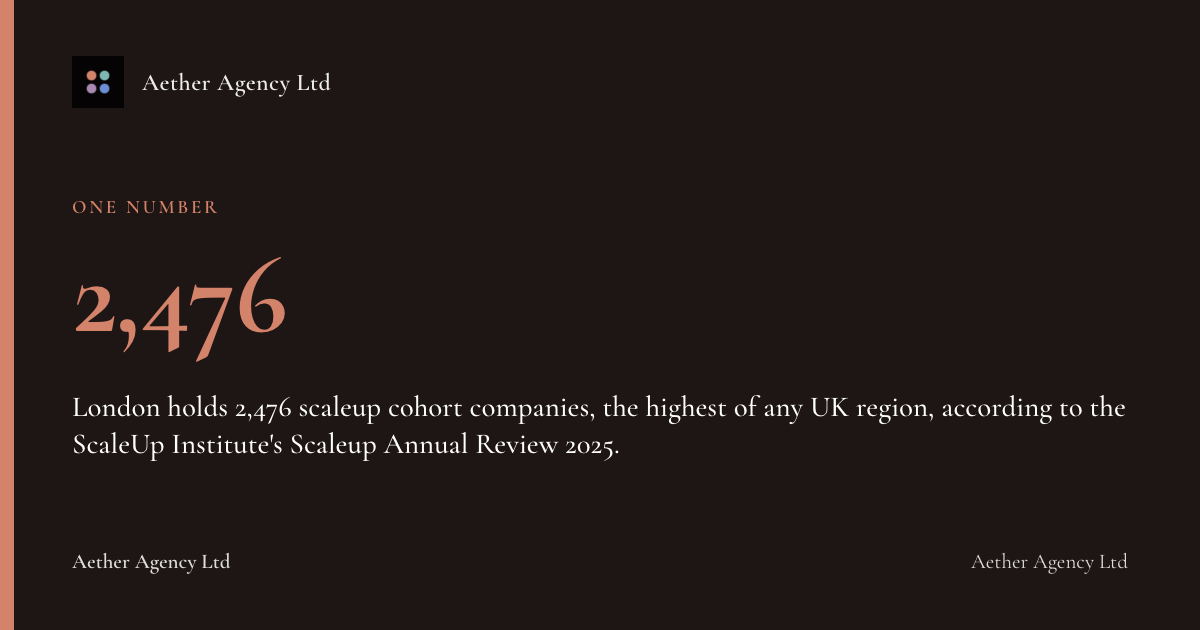
A data-driven marketing strategy for London scale-ups means replacing founder gut-feel with structured measurement — tracking acquisition channels, customer lifetime value and campaign ROI through a CRM and analytics stack. London holds 2,476 scaleup cohort companies, the highest of any UK region, according to the ScaleUp Institute's Scaleup Annual Review 2025.
Key Takeaways
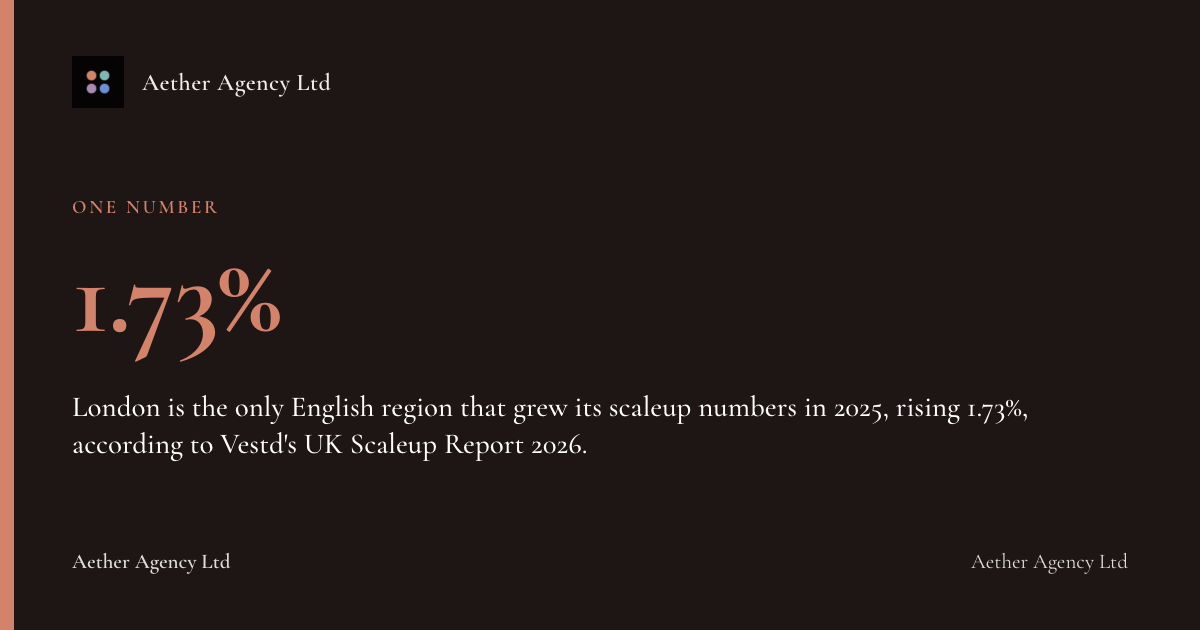
- London is the only English region that grew its scaleup numbers in 2025, rising 1.73%, according to Vestd's UK Scaleup Report 2026.
- Scale-ups make up just 1% of UK SME firms but generate 22% of all SME turnover, according to West of England Combined Authority Growth Hub, citing Scaleup Institute data.
- UK small businesses typically spend between 7% and 16.8% of annual revenue on marketing, depending on growth stage, according to Whito's synthesis of Gartner and Deloitte CMO Survey data.
- Search and online display now account for 83% of UK ad spend, within a £46.9 billion market that grew 10.1% in 2025, according to AA/WARC.
- Aether Agency Ltd has delivered 50+ projects, as published on aether-agency.co.uk, including measurable traffic and lead-generation gains for growth-stage clients.
What Does Data-Driven Marketing Actually Mean for a Scale-Up?
Data-driven marketing is an approach that uses measurable customer and campaign data — rather than opinion or precedent — to decide where budget goes and which messages run. For a scale-up, that means every channel from Google Ads to email nurture sequences gets judged against trackable outcomes: cost per lead, conversion rate, customer lifetime value.
This matters more at scale-up stage than at either end of the growth curve. A two-person startup can survive on instinct because the stakes are small and the founder talks to every customer personally.
A London scale-up with 20, 50 or 150 staff cannot. Decisions now affect real budget, real headcount and a board that expects answers, not anecdotes.
Scale-ups occupy an unusual economic position that makes this discipline non-negotiable. They represent just 1% of UK SME firms and 8% of SME employment, yet they generate 22% of all SME turnover, according to the West of England Combined Authority Growth Hub, citing Scaleup Institute data. That outsized contribution comes with outsized scrutiny — investors, boards and lenders all want proof that marketing spend converts into pipeline, not just brand awareness.
In practice, data-driven marketing at this stage covers three things: a single source of customer truth (usually a CRM such as HubSpot or Salesforce), consistent tracking across paid and organic channels via Google Analytics 4 and Google Search Console, and a reporting cadence that ties spend directly to revenue. Without all three, "data-driven" is just a slogan on a slide deck.
What Are the First Steps to Build a Data-Driven Marketing Strategy from Scratch?
The first step in building a data-driven marketing strategy is auditing what data already exists before buying any new tool. Most scale-ups have more usable data than they realise — scattered across Stripe, a CRM, Google Analytics and a support inbox — and the audit simply maps it.
Step one is defining the three or four metrics that actually matter to the board: customer acquisition cost, lifetime value, monthly recurring revenue growth, or pipeline velocity, depending on the business model. Step two is consolidating tracking — installing Google Analytics 4 consistently across the website and app, connecting Google Search Console, and making sure UTM parameters tag every campaign link so spend can be traced back to source.
Step three is choosing a CRM that becomes the single source of truth for customer and prospect data, rather than leaving sales in spreadsheets and marketing in a separate tool. Step four is setting a baseline: three months of consistent data before making any strategic pivot, because reacting to a single good or bad week produces noise, not signal.
Lauren Dawkins, Head of Content at Aether Agency, makes a related point about demand data specifically: "Start from the searches you are already being shown for, not from a tool's volume estimates. Search Console is measured demand — real people, real queries, no guesswork. Volume tools tell you what the whole market types; your own impression data tells you which of those battles you are actually invited to fight. The second list is shorter and far more honest."
That principle extends beyond keyword research. A scale-up's own CRM, analytics and support data are more honest than any third-party benchmark, because they describe the customers the business actually has, not an industry average.
Which Marketing Analytics Tools and Platforms Suit London Scale-Ups?
Marketing analytics tools for London scale-ups fall into four categories: web analytics, CRM, attribution and reporting, and the right stack depends on budget and team size rather than company age alone. Google Analytics 4 and Google Search Console form the free baseline that almost every scale-up should run from day one.
Beyond that baseline, choices diverge based on sales motion and headcount.
| Category | Typical tools | Best suited to |
|---|---|---|
| Web analytics | Google Analytics 4, Google Search Console | All scale-ups, free |
| CRM | HubSpot, Salesforce, Pipedrive | B2B with a sales team |
| Attribution | HubSpot reporting, Google Ads conversion tracking, Dreamdata | Multi-channel paid spend |
| Email/lifecycle | Klaviyo, HubSpot, Mailchimp | B2C and subscription models |
| SEO & GEO tracking | Google Search Console, Ahrefs, Semrush | Organic-led growth |
London scale-ups operating B2B models typically need a CRM before they need an attribution platform, because sales cycles are longer and pipeline visibility matters more than last-click data. B2C and e-commerce scale-ups tend to prioritise email and lifecycle tools instead, since repeat purchase behaviour is the primary growth lever.
For Fulk Butchers, a Surrey-based client, Aether Agency Ltd's digital marketing work contributed to online sales up 180%, alongside a 4.8-star Google rating. For Fluent AI, the same disciplined approach to tracking and content delivered traffic up 3x and lead generation up 250%, as published in Aether Agency Ltd's client case studies. Neither result comes from a single tool — it comes from consistent measurement across the stack.
How Much Does Data-Driven Marketing Infrastructure Cost to Set Up?
Setting up data-driven marketing infrastructure for a London scale-up typically costs between a few hundred pounds a month for free-tier tools plus staff time, and several thousand pounds monthly once a CRM, paid media and agency support are added. UK small businesses typically spend between 7% and 16.8% of annual revenue on marketing overall, according to Whito's synthesis of Gartner CMO Survey and Deloitte CMO Survey data, with the higher end of that range more common at earlier growth stages when brand-building spend is heaviest.
The infrastructure itself is rarely the biggest cost; the ongoing management and content production usually is.
A realistic breakdown for a London scale-up with 20-80 staff:
- Analytics and tracking: £0-£200/month (Google Analytics 4 and Search Console are free; a paid SEO tool like Ahrefs or Semrush adds £80-£200/month)
- CRM: £0-£1,500/month depending on seats and tier (HubSpot and Salesforce scale sharply with headcount)
- Paid media spend: highly variable, but UK advertising spend overall grew 10.1% to £46.9 billion in 2025, with search and online display accounting for 83% of UK ad spend, according to AA/WARC
- Agency or in-house strategy support: typically several thousand pounds a month, depending on scope
Market-wide sentiment on budget direction is currently positive. The IPA Bellwether Report recorded a net balance of +6.9% of UK companies revising marketing budgets upwards in Q2 2026, with events spending leading the growth, according to the IPA Bellwether Report. That suggests scale-ups budgeting for data infrastructure now are moving with the market, not against it.
What UK GDPR and Data Protection Rules Apply to Marketing Data?
UK GDPR is the data protection law that governs how any business collects, stores and uses personal data for marketing, and it applies to every London scale-up regardless of size. The regulator is the Information Commissioner's Office (ICO), and it sets out core principles including lawfulness, purpose limitation, data minimisation and accountability.
For direct marketing specifically, the Privacy and Electronic Communications Regulations (PECR) sit alongside UK GDPR and govern email, SMS and telephone marketing. The ICO's own guidance on marketing and data protection sets out that most consumer email marketing requires clear, opt-in consent, while business-to-business marketing has slightly more flexibility under the "soft opt-in" rules — but only where the recipient's details were collected in the course of a sale or negotiation and every message offers an easy opt-out.
Practical compliance steps for a London scale-up include:
- Recording a lawful basis for every category of data collected (consent, legitimate interest or contract)
- Running a cookie consent banner that genuinely blocks tracking scripts until a visitor opts in
- Keeping an auditable consent record for every marketing contact, not just a tick-box
- Honouring unsubscribe and data deletion requests within statutory timeframes
- Appointing a named person accountable for data protection decisions, even if a full Data Protection Officer is not legally required
The ICO can issue significant fines for breaches, and reputational damage in a tight London business community often costs more than the penalty itself. Treating GDPR compliance as a marketing enabler rather than a legal chore tends to produce cleaner data anyway, because consented contacts engage better than purchased or scraped lists.
Who Should Own the Data-Driven Marketing Strategy Inside a Scale-Up?
Ownership of a data-driven marketing strategy should sit with a single accountable leader — typically a Head of Marketing or Marketing Director — who reports metrics to the board, rather than being split across founders, sales and an agency with no single point of accountability. Diffuse ownership is one of the most common reasons scale-ups stall on this transition.
In the earliest scale-up phase, that leader is often still the founder or a generalist operator wearing multiple hats. As the business grows past roughly 30-50 staff, most London scale-ups bring in a dedicated marketing hire or lean more heavily on a specialist agency partner to build the infrastructure properly.
ActionCOACH's relationship with Aether Agency Ltd illustrates how that ownership question gets resolved in practice. Natalie Simms of ActionCOACH put it directly: "I consider Aether to be an amazing partner for us at ActionCOACH. Firstly, they have been a great digital marketing agency for our own business. Secondly, I have no hesitation recommending Lauren and her team to my clients." The coaching franchise trusted its own marketing to Aether Agency Ltd first, then extended that trust to its client referrals — a sign that clear external ownership can work as well as an in-house hire, provided accountability is unambiguous.
Whichever model a scale-up chooses, three things should never be split across departments: the CRM data, the reporting dashboard, and the final call on budget reallocation.
How Do London Scale-Ups Differ from Startups and Enterprises Elsewhere in the UK?
London scale-ups face a different data-driven marketing landscape than both earlier-stage startups and enterprises based elsewhere in the UK, largely because of market density and cost. London holds the highest concentration of scaleups in England and was the only English region to see growth in 2025, with numbers rising 1.73%, according to Vestd's UK Scaleup Report 2026.
That concentration — 2,476 scaleup cohort companies against the South East's 1,536, per the ScaleUp Institute — means London scale-ups compete for the same talent pool, the same investors and often the same keywords as dozens of rivals within a few postcodes. Paid acquisition costs in London tend to run higher than regional UK averages because of this density, which pushes data-driven scale-ups toward organic search, content and AI search marketing sooner than a Manchester or Bristol equivalent might need to.
Compared with enterprises, London scale-ups have far less historical data to model from and far smaller teams to interpret it. An enterprise might run a dedicated data science function; a 40-person scale-up usually needs one hire or an agency partner to do the equivalent work faster and leaner.
Nationally, scale-ups overall accounted for £1.45 trillion of UK business output in 2024, according to techUK's London Tech Week 2026 coverage — a scale of economic contribution that makes getting the marketing data foundation right a national, not just local, priority. Yet the UK scale-up population as a whole has shrunk two years running, from a peak of 129,080 in 2023 to 128,760 in 2025, according to Vestd's analysis of ONS data — a reminder that growth stalls are common, and disciplined data-driven marketing is one of the few controllable levers against it.
What Mistakes Do Scale-Ups Commonly Make With Data-Driven Marketing?
The most common mistake scale-ups make is tracking vanity metrics — website visits, social followers, impressions — instead of metrics tied directly to revenue, such as cost per qualified lead or customer lifetime value. A dashboard full of green arrows means nothing to a board if none of those arrows connect to pipeline.
Other recurring mistakes include:
- Buying tools before defining the strategy, resulting in a CRM nobody updates and an analytics suite nobody reads
- Changing campaigns too fast, reacting to single-week fluctuations instead of waiting for statistically meaningful trends
- Letting data live in silos, with sales, marketing and finance each holding a different version of the truth
- Ignoring organic and AI search channels, over-indexing on paid media because its ROI is easier to see in the short term
- Treating GDPR compliance as an afterthought, then discovering a purchased list is unusable or risks an ICO complaint
Swygge's experience with Aether Agency Ltd shows what the alternative looks like. The premium cocktail delivery brand needed a complete social media strategy and marketing asset creation programme — not a scattergun of one-off campaigns — and Emily Broad of Swygge described the result plainly: "Aether Agency are friendly, professional, creative and forward thinking. We use them for our business Swygge, and we love working with them. They make everything so easy and can take a brief and run with it." A structured programme, built once and measured consistently, avoided the stop-start pattern that undermines so many scale-up marketing efforts.
Your data-driven marketing strategy checklist
- Audit every existing data source — CRM, Stripe, Google Analytics, support inbox — before buying new tools
- Install Google Analytics 4 and Google Search Console consistently across every website property
- Choose one CRM as the single source of truth for customer and pipeline data
- Tag every campaign link with UTM parameters so spend traces back to source
- Record a documented lawful basis for every category of marketing data collected, per ICO guidance
- Assign one named owner accountable for the marketing data strategy and board reporting
- Set a three-month baseline period before making major budget reallocations
- Review cost per qualified lead and customer lifetime value monthly, not just impressions and clicks
FAQ
What does data-driven marketing mean in practice for a scale-up?
Data-driven marketing means using measurable customer and campaign data to guide budget and messaging decisions, rather than founder instinct or precedent. For a London scale-up this typically means a CRM, consistent Google Analytics 4 tracking, and a reporting cadence tied to revenue metrics like cost per lead and lifetime value.
How long does it take to see measurable results from a data-driven marketing strategy?
Most scale-ups need a minimum three-month baseline before meaningful trends emerge, with clearer ROI signals typically visible from six months onward. Organic and AI search gains often take longer to compound than paid media results, which can show directional data within weeks.
How much should a London scale-up budget for data-driven marketing?
UK small businesses typically spend between 7% and 16.8% of annual revenue on marketing, according to Whito's synthesis of Gartner and Deloitte CMO Survey data, with the figure varying by growth stage and revenue band. Infrastructure costs like analytics tools are usually a small fraction of this; CRM licensing, content production and paid media spend make up the bulk.
Do London scale-ups need consent to email prospects under UK GDPR?
Yes, in most consumer cases explicit opt-in consent is required under PECR, while B2B marketing has a narrower "soft opt-in" exception where details were collected during a sale and every email offers an opt-out. The ICO's guidance on marketing and data protection sets out the exact conditions that apply.
Who should own marketing data strategy in a growing business?
A single accountable leader — usually a Head of Marketing, Marketing Director, or an external agency partner with a clear mandate — should own the CRM, reporting dashboard and budget decisions. Splitting ownership across founders, sales and marketing without one final decision-maker is one of the most common reasons scale-ups stall.
What tools do London scale-ups actually need to get started?
Google Analytics 4 and Google Search Console form the essential free baseline for every scale-up. Beyond that, a CRM such as HubSpot, Salesforce or Pipedrive becomes necessary once a dedicated sales process exists, with email/lifecycle tools like Klaviyo more relevant for B2C and subscription businesses.
How is marketing different for London scale-ups compared with startups or enterprises?
London scale-ups compete in the UK's densest scale-up market — 2,476 cohort companies according to the ScaleUp Institute — which drives up paid acquisition costs and pushes earlier investment in organic and AI search. Compared with enterprises, scale-ups have smaller teams and less historical data, making focused tooling and clear ownership more important than scale of resource.
Building Your Data-Driven Marketing Foundation With Aether Agency Ltd
This article has covered the infrastructure, ownership and compliance questions every London scale-up faces when moving beyond founder-led marketing guesswork. Aether Agency Ltd works with growing businesses at exactly this inflection point, building the brand, website and marketing foundations that make data-driven decisions possible in the first place.
Aether Agency Ltd has delivered 50+ projects as published on aether-agency.co.uk, drawing on 20+ years of combined team experience to help scale-ups move from scattered tracking to a measurable, board-ready marketing programme. Clients working with Aether Agency Ltd have seen average client traffic growth of 3x, as published on aether-agency.co.uk, by pairing disciplined analytics with content built to perform in both Google and AI search results.
If your scale-up needs a marketing strategy built on real data rather than instinct, get in touch with Aether Agency Ltd to discuss AI Search Marketing (GEO) and find out what a structured, measurable approach could look like for your business.
Related Reading
- Web Design Guildford: What It Costs & Who to Hire
- Best Web Design Agency in Surrey: 2026 Buyer's Guide
- Content Marketing Strategy UK: 2026 Guide for Business Growth
Add aether-agency.co.uk as a preferred source on Google
See How Your Brand Appears in AI Search
Aether AI monitors your visibility across ChatGPT, Perplexity, Google AI Overviews, and Claude in real time. Find out where you stand and what to fix.
Explore Aether AI