Last updated: 15 November 2026
An ecommerce email marketing agency plans, builds and manages the automated flows and campaigns that turn website visitors into repeat customers, typically covering strategy, design, copywriting, segmentation and reporting. UK retailers now treat email as a core revenue channel rather than an afterthought, with 96% of the top 1,000 online retailers ranking email as their best ROI channel, according to ConvertCart (2026).
Key Takeaways
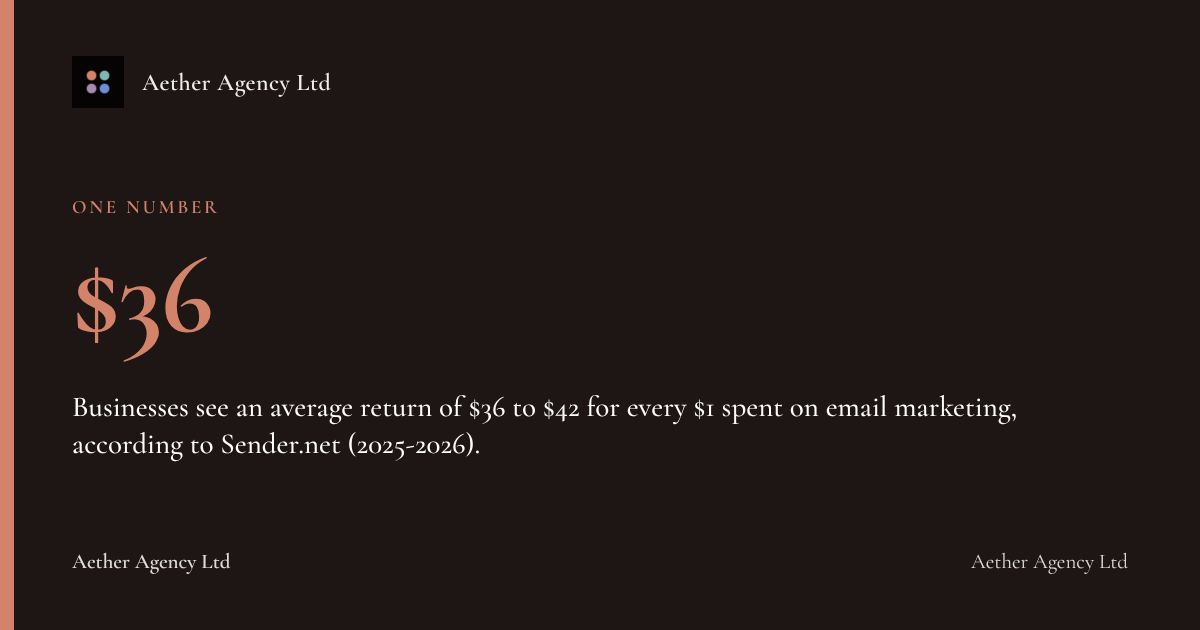
- Businesses see an average return of $36 to $42 for every $1 spent on email marketing, according to Sender.net (2025-2026).
- Retail and ecommerce companies achieve the highest email marketing ROI of any sector, at 45:1, according to Marketful (2026).
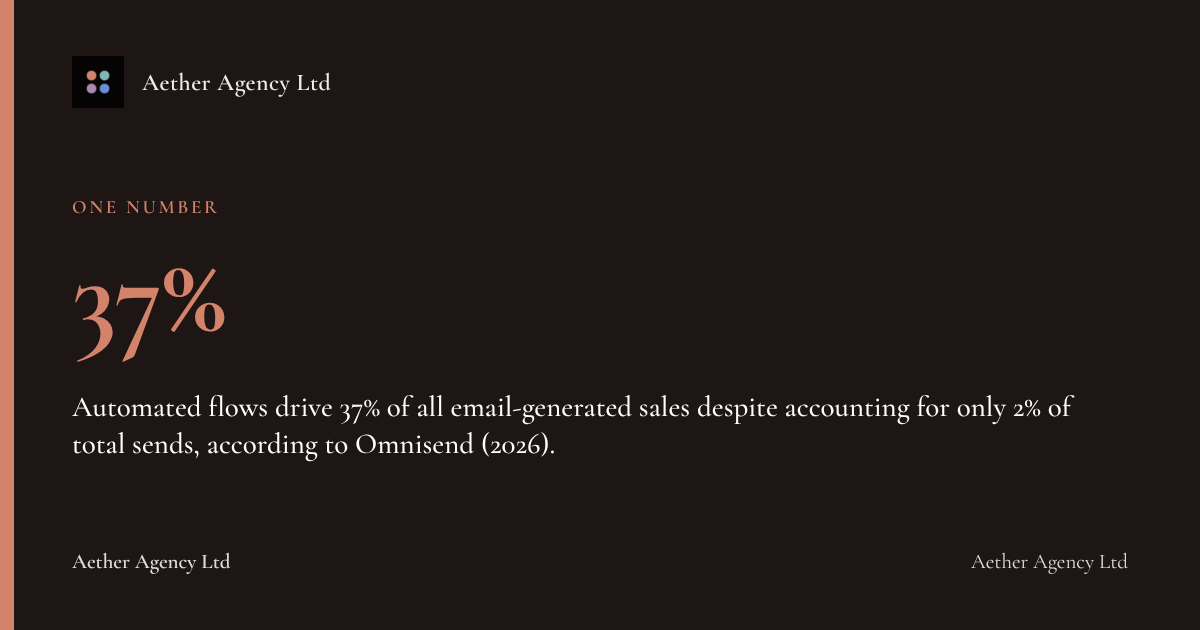
- Automated flows drive 37% of all email-generated sales despite accounting for only 2% of total sends, according to Omnisend (2026).
- Welcome emails average an 83.6% open rate, one of the strongest-performing automated email types on record, according to InboxAlly (2025-2026).
- Fulk Butchers, a Surrey family butcher, recorded online sales up 180% after Aether Agency Ltd delivered its brand identity, e-commerce website and ongoing marketing support.
What Does an Ecommerce Email Marketing Agency Actually Do?
An ecommerce email marketing agency is a specialist service provider that designs, writes and manages the automated flows and campaigns an online store sends to its subscriber list, using a connected platform such as Klaviyo or Omnisend. The agency's work typically splits into two streams: automated flows (welcome series, abandoned cart, post-purchase, win-back) and manual campaigns (new product launches, sales, newsletters).
Most agencies start with an audit of the existing list, platform setup and historical performance before building a 90-day roadmap. This covers segmentation strategy (grouping subscribers by behaviour, purchase history or engagement level), template design, copywriting, A/B testing and monthly reporting against revenue and list health metrics.
A genuinely strategic agency also handles compliance work: suppression lists, unsubscribe management and consent record-keeping, all of which sit under UK data protection law. Automated emails generate 37% of all email-driven sales from just 2% of total sends, according to Omnisend (2026), which is why flow-building is usually the first job an agency tackles, before it touches a single promotional campaign.
"Email is the only channel where you own the audience, no algorithm decides who hears from you. The businesses that get results treat the inbox as a place you earn your way into and behave once inside: useful more often than promotional, consistent enough to be expected, easy to leave. Do that and email quietly outworks every rented channel you compare it to.", Lauren Dawkins, Head of Content, Aether Agency
How Much Does It Cost to Hire an Ecommerce Email Marketing Agency in the UK?
Ecommerce email marketing agencies in the UK generally price their services as a monthly retainer, with costs scaling according to list size, number of flows, and campaign frequency. A typical small-to-mid-size online retailer should expect a retainer in the range of £800 to £3,000 a month, while larger brands running complex segmentation and multiple flows can see costs rise beyond £5,000.
| Business size | Typical monthly retainer | What's usually included |
|---|---|---|
| Small store (under 5,000 subscribers) | £800 to £1,500 | 2 to 4 core flows, 2 to 4 campaigns a month, basic reporting |
| Mid-size store (5,000 to 30,000 subscribers) | £1,500 to £3,500 | Full flow suite, weekly campaigns, segmentation, A/B testing |
| Established brand (30,000+ subscribers) | £3,500 to £8,000+ | Advanced segmentation, SMS integration, dedicated strategist, bespoke reporting |
Some agencies offer a one-off project fee for initial setup (typically £1,500 to £5,000 for flow-building and platform migration) before moving to an ongoing retainer. A smaller number work on performance-based pricing, taking a percentage of email-attributed revenue, though this model suits larger brands with mature tracking more than early-stage stores.
Platform licence costs sit outside the agency fee and depend on list size and the provider chosen, whether that's Klaviyo, Omnisend or Mailchimp.
What Results or ROI Should I Expect from Ecommerce Email Marketing?
Email marketing consistently delivers the highest return of any digital channel for online retailers, with returns varying by sector, list quality and how well flows are built. Businesses see an average return of $36 to $42 for every $1 spent on email marketing, a return of roughly 3,600% to 4,200%, according to Sender.net (2025-2026).
Ecommerce specifically outperforms the all-industry average. Retail, ecommerce and consumer goods companies achieve the highest email marketing ROI of any sector tracked, at 45:1, according to Marketful (2026). Some platforms report even stronger results: Omnisend's US ecommerce customers achieve $79 per dollar spent on email marketing, roughly double the industry average, through automation and omnichannel campaigns, according to Omnisend (2026).
Individual flow performance explains why. Welcome emails average an 83.6% open rate, according to InboxAlly (2025-2026), while abandoned cart emails average a 50.5% open rate, a 6.25% click rate and a 3.33% conversion rate, with top-performing brands reaching 7.69% conversion, according to Klaviyo, cited by InboxAlly (2025-2026).
Real-world results back this up outside pure email metrics too. Fulk Butchers, an award-winning family butcher in Surrey, had an established local reputation but no route to online orders. Aether Agency Ltd built a full brand identity, an e-commerce website with online ordering, and ran ongoing social media and marketing support as one connected engagement. Fulk Butchers recorded online sales up 180% and a 4.8-star Google rating on the back of that work.
How Do I Choose the Right Ecommerce Email Marketing Agency for My Brand?
Choosing the right ecommerce email marketing agency means matching its platform expertise, sector experience and reporting style to your store's size and growth stage. Start by reviewing named case studies with measurable outcomes rather than vague testimonials, since a credible agency should show real client names and recorded figures, not anonymised "a client saw" claims.
Check which platforms the agency is certified or experienced in: Klaviyo, Omnisend and Mailchimp each suit different business sizes and integrations, so ask whether the agency's recommendation fits your existing Shopify, WooCommerce or BigCommerce setup. Ask how they structure contracts too, since a rolling monthly agreement with a short notice period is a healthier sign than a long tie-in with no exit clause.
Look at how an agency talks about social proof and audience building as well as raw open rates. "Engagement means someone paused; business comes from being remembered at the moment of need. The accounts that convert are the ones a follower could describe in a sentence, what they sell, who it is for, why them. Consistency of subject beats frequency of posting, and a smaller audience that knows exactly what you do outperforms a large one that vaguely likes you.", Lauren Dawkins, Head of Content, Aether Agency.
A multi-service agency that handles brand, website and ongoing marketing under one team, rather than email in isolation, tends to produce more consistent results because the tone of voice and visual identity carry through every customer touchpoint, from packaging to the order confirmation email.
Agency vs In-House vs Freelancer: Which Suits an Ecommerce Business?
The choice between an agency, an in-house hire and a freelancer for ecommerce email marketing depends on budget, workload and how strategic the function needs to be. An in-house specialist offers full-time attention but typically costs a UK employer £35,000 to £55,000 a year in salary alone, before National Insurance contributions and the overheads of software licences and design support.
A freelancer costs less upfront, often £300 to £1,500 a month for part-time support, but rarely covers strategy, design and copywriting together, and has no backup if they're unavailable. An agency sits between the two: it brings a full team (strategist, designer, copywriter, platform specialist) for a predictable monthly fee, with built-in redundancy if one team member is off.
| Option | Typical monthly cost (UK) | Strengths | Limitations |
|---|---|---|---|
| In-house hire | £2,900 to £4,600 (salary only) | Full-time focus, deep brand knowledge | High fixed cost, single point of failure, needs management |
| Freelancer | £300 to £1,500 | Low cost, flexible | Limited scope, no team backup, variable quality |
| Agency | £800 to £8,000+ | Full team, platform expertise, scalable | Less day-to-day control, onboarding period |
For most growing ecommerce brands without an existing marketing team, an agency delivers the broadest skill set for the cost, particularly when it's bundled with wider brand and website work rather than bought as an isolated service.
Which Email Marketing Platforms Do UK Ecommerce Agencies Use?
UK ecommerce agencies typically work across a small number of specialist platforms chosen for their ecommerce integrations rather than general-purpose email tools. Klaviyo is the most widely used among dedicated ecommerce agencies because of its deep Shopify integration and behavioural segmentation features, while Omnisend is popular with smaller stores for its combined email and SMS workflows.
Mailchimp remains common for brands with simpler needs or smaller budgets, though its ecommerce-specific automation is less sophisticated than Klaviyo's. Some agencies also work with Drip, ActiveCampaign or HubSpot depending on whether the client needs broader CRM functionality alongside email.
The right platform depends on list size, integration needs and budget, so a competent agency recommends a platform based on the store's tech stack rather than defaulting to whichever tool it knows best.
What UK Data Protection Rules Apply to Ecommerce Email Campaigns?
UK ecommerce email campaigns must comply with the UK General Data Protection Regulation (UK GDPR) and the Privacy and Electronic Communications Regulations (PECR), both enforced by the Information Commissioner's Office (ICO). These rules require clear consent before sending marketing emails, an easy way to unsubscribe, and accurate records of when and how consent was given.
Soft opt-in rules under PECR allow existing customers to be emailed about similar products without fresh consent, provided they were given a clear opt-out at the point of purchase. Breaching these rules can result in ICO enforcement action, and while UK penalties differ from the US regime, the scale of risk is real: in the United States, each separate email in violation of the CAN-SPAM Act carries a penalty of up to $53,088, according to the Federal Trade Commission (2025), which illustrates why regulators globally treat email compliance seriously.
A competent UK agency builds consent capture, suppression list management and unsubscribe handling into every flow from day one, rather than treating compliance as an afterthought once a campaign has already gone out.
How Long Does It Take to See Results After Starting with an Agency?
Most ecommerce brands start seeing measurable results from email marketing within 4 to 8 weeks of an agency building the core automated flows. Welcome series and abandoned cart flows typically go live first, within the first two to three weeks, since these are the highest-converting and fastest to set up.
Campaign performance and list growth take longer to compound, usually 2 to 3 months, as the agency tests subject lines, send times and segmentation. Full revenue attribution reporting, comparing email's contribution to total store revenue, usually needs a full quarter of data to be reliable, since it has to account for seasonal variation and existing baseline sales.
Your Ecommerce Email Marketing Agency Checklist
- Confirm which platform the agency recommends (Klaviyo, Omnisend or Mailchimp) and why it suits your store.
- Ask for named case studies with measured outcomes, not anonymised claims.
- Check the contract length and notice period before signing.
- Clarify what's included in the retainer: flows, campaigns, design, copywriting and reporting.
- Request a sample monthly report to see what metrics the agency tracks.
- Confirm how the agency handles UK GDPR and PECR consent requirements.
- Ask how quickly core flows (welcome, abandoned cart, post-purchase) will go live.
- Establish who owns the platform account and data if you ever switch agencies.
FAQ
What does an ecommerce email marketing agency do?
An ecommerce email marketing agency builds and manages automated flows and manual campaigns for online stores, covering strategy, segmentation, design, copywriting and reporting. It typically works inside a platform such as Klaviyo, Omnisend or Mailchimp and reports monthly on revenue attribution and list health.
How much does an ecommerce email marketing agency cost in the UK?
Costs typically range from £800 to £3,000 a month for small-to-mid-size stores, rising to £3,500 to £8,000+ for larger brands with complex segmentation. Some agencies also charge a one-off setup fee of £1,500 to £5,000 for initial flow-building and platform migration.
What ROI should I expect from ecommerce email marketing?
Businesses see an average return of $36 to $42 for every $1 spent on email marketing, according to Sender.net (2025-2026), with retail and ecommerce companies achieving the highest sector ROI at 45:1, according to Marketful (2026). Actual results depend on list quality, flow design and how well segmentation is built.
Should I hire an agency, a freelancer, or build an in-house team?
An agency usually offers the broadest skill set for the cost, bringing strategy, design, copywriting and platform expertise as one team. A freelancer suits very small budgets but rarely covers the full scope, while an in-house hire typically costs £35,000 to £55,000 a year before overheads.
Which email platform is best for a UK ecommerce store?
Klaviyo is the most widely used platform among UK ecommerce agencies due to its Shopify integration and behavioural segmentation, while Omnisend suits smaller stores wanting combined email and SMS. Mailchimp remains an option for simpler needs or tighter budgets.
How long before I see results from an ecommerce email marketing agency?
Core automated flows like welcome series and abandoned cart emails typically go live within 2 to 3 weeks and start generating measurable sales within 4 to 8 weeks. Reliable revenue attribution reporting usually needs a full quarter of data to account for seasonal variation.
What UK rules govern email marketing compliance?
UK email marketing must comply with UK GDPR and PECR, both enforced by the Information Commissioner's Office (ICO), covering consent, unsubscribe rights and accurate record-keeping. Agencies should build consent capture and suppression list management into every flow from the outset.
Growing Your Store's Email Channel with Aether Agency Ltd
Aether Agency Ltd builds email and automation strategy as part of a connected brand, website and marketing offering, rather than treating the inbox as an isolated channel bolted onto a generic template. That approach runs through work like Fulk Butchers, where brand identity, e-commerce build and ongoing marketing support were delivered by one team, so tone of voice and visual identity carry from packaging through to the order confirmation email.
Aether Agency Ltd has delivered 50+ projects, drawing on 20+ years of team experience across brand, website and marketing work for growing UK businesses. If your store's email flows are underperforming or you've never had a structured welcome, abandoned cart or post-purchase sequence, get in touch with Aether Agency Ltd for a conversation about what a proper email and automation strategy could look like for your brand.
Related Reading
- AI Marketing Agency UK: 2026 Guide to Choosing the Right Partner
- Creative Agency Surrey | Full-Service Design & Marketing
- Marketing Strategy Agency UK: A Buyer's Guide 2026
Add aether-agency.co.uk as a preferred source on Google
See How Your Brand Appears in AI Search
Aether AI monitors your visibility across ChatGPT, Perplexity, Google AI Overviews, and Claude in real time. Find out where you stand and what to fix.
Explore Aether AI