Last updated: 20 November 2026
Marketing automation services combine software platforms (such as HubSpot or Mailchimp) with strategy, setup and ongoing management, typically costing UK businesses anywhere from £300 to £5,000+ per month depending on scale. The global market reached $8.14 billion in 2026, according to Fortune Business Insights (2026), with email automation remaining the most widely adopted use case.
Key Takeaways
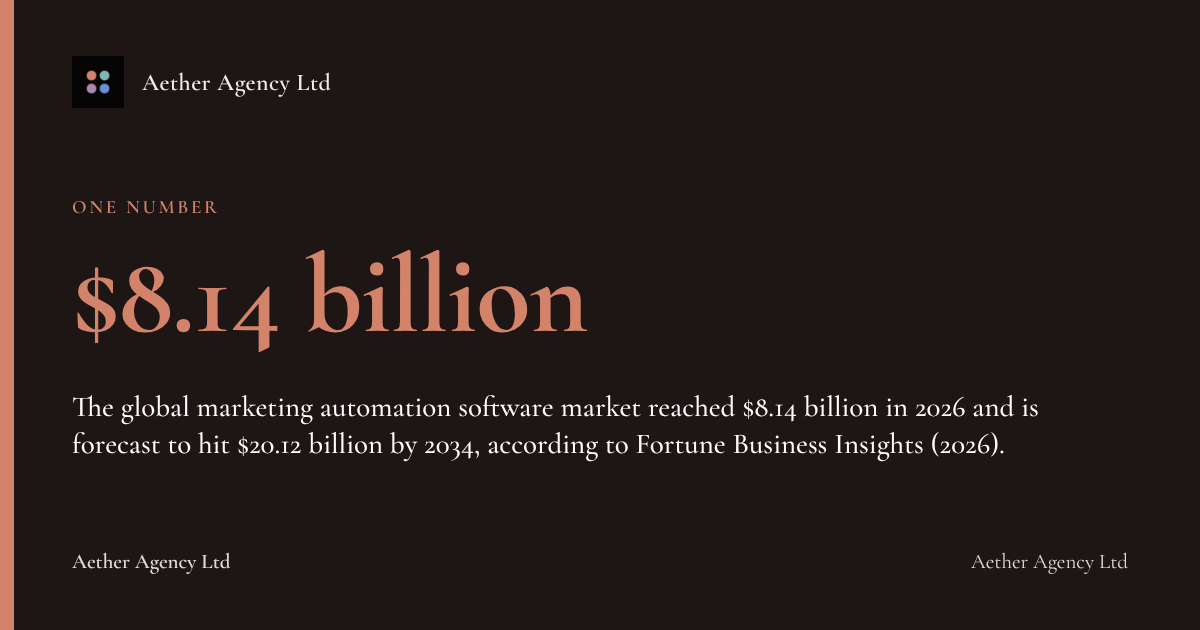
- The global marketing automation software market reached $8.14 billion in 2026 and is forecast to hit $20.12 billion by 2034, according to Fortune Business Insights (2026).
- At least 454 companies now sell marketing automation software platforms, reports G2 via Search Engine Land (2026), which makes vendor selection the hardest part of the process for most UK businesses.
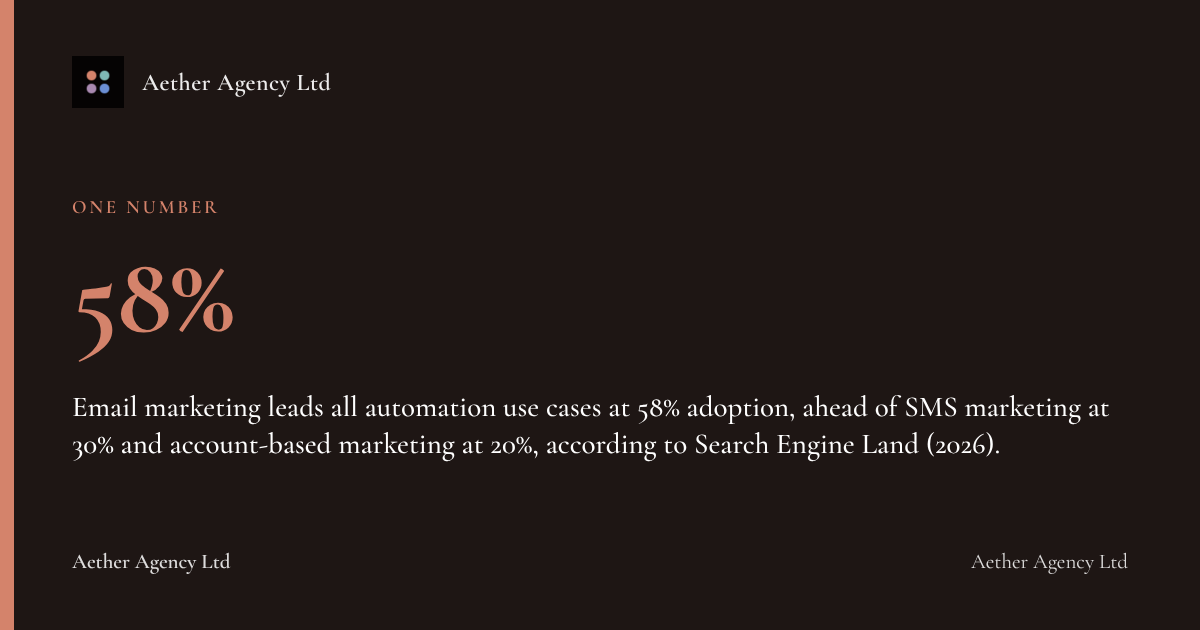
- Email marketing leads all automation use cases at 58% adoption, ahead of SMS marketing at 30% and account-based marketing at 20%, according to Search Engine Land (2026).
- Marketing automation can increase sales productivity by 14.5% and cut marketing overhead by 12.2%, according to Market.us (2024).
- Businesses using automation tools are 46% more likely to report having an effective marketing strategy than those without, according to Market.us (2024).
What are marketing automation services?
Marketing automation services are a combination of software and expert management that automates repetitive marketing tasks, such as email sequences, lead scoring and customer segmentation, on behalf of a business. Unlike buying a licence alone, a service typically bundles platform setup, workflow design, content creation and ongoing optimisation delivered by an agency or specialist team.
This matters because the underlying software market is crowded. At least 454 companies provide marketing automation software solutions as of March 2026, according to G2 via Search Engine Land (2026), covering everything from email sequencing to account-based marketing (ABM, a strategy targeting specific high-value companies rather than broad audiences).
A typical marketing automation service includes four components. Platform selection and configuration comes first, followed by workflow and journey mapping (the sequence of emails, triggers and conditions a contact moves through). Content production, including email copy and landing pages, sits alongside ongoing reporting and list-health management.
Email remains the backbone of most programmes. Email marketing is the leading automation use case at 58% adoption, according to Search Engine Land (2026), which is why most managed services start there before expanding into SMS or ABM.
How much do marketing automation services cost in the UK?
Marketing automation services in the UK generally fall into three price bands depending on whether a business buys software only, a hybrid package, or a fully managed service. Software licences alone can start from under £20 a month for a basic tier, while managed services with strategy and content typically run from £500 to £5,000+ monthly.
| Service tier | Typical monthly cost (illustrative) | What's included |
|---|---|---|
| Software only (self-managed) | £20 to £300 | Platform licence, templates, basic support |
| Hybrid (software + part-time agency support) | £500 to £1,500 | Platform licence, workflow builds, monthly reporting |
| Fully managed service | £1,500 to £5,000+ | Strategy, content, segmentation, CRM integration, ongoing optimisation |
| Enterprise / multi-brand | £5,000+ | Dedicated team, custom integrations, ABM programmes |
These figures are illustrative ranges built from typical UK agency and vendor pricing structures, not a single sourced statistic. A small retailer running monthly newsletters needs a very different budget to a B2B SaaS firm running lead scoring across a 10,000-contact database.
Ways to reduce costs include starting with a single channel (email) before adding SMS or ABM, consolidating tools instead of running separate platforms for email, forms and CRM, and agreeing a fixed-scope onboarding project rather than open-ended hourly billing. Budget pressure is unlikely to ease: 68% of surveyed marketers expect their marketing automation budget to increase in the coming year, according to Ascend2 via Backlinko (2026).
Marketing automation software versus a managed marketing automation service
Marketing automation software is a licensed tool, such as HubSpot, Mailchimp or ActiveCampaign, that a business operates itself to build and send automated campaigns. A managed marketing automation service, by contrast, pairs that same software with a team that designs strategy, writes content and monitors performance on the client's behalf.
The trade-off is straightforward. Running software in-house costs less in subscription fees but demands a skilled internal resource to build journeys, write copy and interpret data correctly.
A managed service costs more per month but removes that burden, and it also reduces the risk of poorly built automations. Among reviewers who express frustration with automation tools, 51.9% point to limited or inflexible features as the core issue, according to G2 Learn Hub (2026), which often reflects a platform being used without proper strategic setup rather than the software itself failing.
When self-managed software makes sense:
- A business has an in-house marketer with automation experience
- Campaign needs are simple: a single welcome sequence and monthly newsletter
- Budget constraints rule out ongoing agency fees
When a managed service makes sense:
- No internal resource has the time or skill to build and maintain workflows
- The business runs multiple segments, products or audiences needing tailored journeys
- Integration with a CRM and sales team requires technical and strategic coordination
"Email is the only channel where you own the audience, no algorithm decides who hears from you. The businesses that get results treat the inbox as a place you earn your way into and behave once inside: useful more often than promotional, consistent enough to be expected, easy to leave. Do that and email quietly outworks every rented channel you compare it to.", Lauren Dawkins, Head of Content, Aether Agency
How do I choose the right marketing automation service for my business size and industry?
Choosing the right marketing automation service means matching provider scale, sector experience and platform choice to the size and complexity of the business, not simply picking the best-known brand. A five-person consultancy and a 200-employee manufacturer need fundamentally different levels of support, integration depth and reporting.
Start by auditing existing tools. Many UK businesses already run a CRM (customer relationship management system, such as Salesforce or HubSpot CRM), and a marketing automation service should integrate with it rather than duplicate contact data in a second database.
Next, consider sector fit. A B2B firm selling long sales cycles benefits from lead scoring and ABM-style targeting, while a retailer or hospitality business leans more heavily on email and SMS promotions, the channel sitting at 30% adoption according to Search Engine Land (2026).
Finally, check regional relevance. North America dominated the global marketing automation software market with a 33.60% share in 2025, according to Fortune Business Insights (2025), meaning many platforms are built US-first; a UK business should confirm the provider understands UK data protection law and GB-specific sending practices (such as using .co.uk domains and UK business hours for send-time optimisation).
What UK data protection and GDPR requirements apply to marketing automation and email campaigns?
UK GDPR (the General Data Protection Regulation as retained in UK law post-Brexit, enforced by the Information Commissioner's Office) requires businesses to have a lawful basis before sending marketing emails or SMS messages through an automation platform. The Privacy and Electronic Communications Regulations (PECR) sit alongside UK GDPR and specifically govern electronic marketing consent.
In practice, this means every automated email sequence needs a clear opt-in record, a working unsubscribe link, and a defensible reason for holding each contact's data. "Always ensure that your automated emails include clear opt-in mechanisms and easy unsubscribe options," notes Michael Lee, Automation Expert at Expert Circle UK.
The Information Commissioner's Office (ICO) can fine businesses for non-compliant marketing communications, and PECR specifically requires consent for most B2C email and SMS marketing. A managed marketing automation service should build consent capture into every form, segment unsubscribed contacts automatically, and maintain audit trails showing when and how each person opted in.
Businesses handling EU contacts alongside UK ones must also consider the EU's own GDPR regime, since UK GDPR and EU GDPR are no longer identical following Brexit. Any provider managing automation on a business's behalf should be asked directly how they handle consent records, data retention periods and subject access requests.
Who within a company should be responsible for managing marketing automation tools and strategy?
Responsibility for marketing automation typically sits with a marketing manager or head of marketing, but larger UK businesses increasingly assign a dedicated marketing automation specialist or hand day-to-day execution to an external agency. The right owner depends on whether automation is treated as a technical system or a strategic growth channel.
Smaller businesses often default to whoever "knows the software", which creates risk if that person leaves and takes undocumented workflow knowledge with them. A more resilient model assigns strategic ownership to a senior marketer while outsourcing technical build and maintenance to a specialist service, which is where the case for a managed provider strengthens.
Businesses using automation tools are 46% more likely to report having an effective marketing strategy, according to Market.us (2024), which suggests the tool itself drives discipline, but someone still has to own segmentation decisions, content calendars and performance review meetings. Without a named owner, automated sequences tend to run unmonitored for months, sending outdated offers or broken links to an entire contact list.
Your marketing automation services checklist
Use this checklist before signing a contract or launching a new automation programme.
- Confirm whether the quoted price covers software licensing, strategy and content, or software alone
- Ask the provider how they handle UK GDPR consent and PECR compliance for email and SMS
- Check integration compatibility with your existing CRM before committing to a platform
- Request a sample of workflow documentation so you own the knowledge, not just the output
- Agree a reporting cadence (monthly at minimum) with clear KPIs, such as open rate, click rate and conversion rate
- Clarify contract length and exit terms, including data export rights if you switch providers
- Ask for references or case studies from businesses of a similar size or sector
FAQ
What are marketing automation services?
Marketing automation services combine software, such as HubSpot or Mailchimp, with expert strategy, workflow design and content creation delivered by an agency or in-house team. They typically include email sequencing, lead scoring, segmentation and CRM integration.
How much do marketing automation services cost in the UK?
Costs typically range from under £300 a month for software-only self-management to £1,500 to £5,000+ a month for a fully managed service including strategy and content. The exact figure depends on contact volume, channel mix and integration complexity.
How long does it take to implement marketing automation?
A basic email automation setup can launch within 2 to 4 weeks, while a full CRM-integrated programme with multiple segments and workflows typically takes 2 to 3 months. Timelines extend further when migrating data from a legacy system or cleaning a poorly maintained contact list.
What results can I expect from marketing automation?
Marketing automation can lead to a 14.5% increase in sales productivity and a 12.2% reduction in marketing overhead, according to Market.us (2024). Businesses using automation tools are also 46% more likely to report having an effective marketing strategy, per the same source.
Do I need a CRM before starting marketing automation?
A CRM is not mandatory but significantly improves results by letting automation workflows trigger from sales activity, not just marketing behaviour. Most managed services will integrate with an existing CRM such as Salesforce or HubSpot CRM rather than requiring a business to replace it.
What's the biggest mistake businesses make with marketing automation?
The most common mistake is launching workflows without a named internal owner, leaving outdated sequences to run unmonitored for months. Among reviewers frustrated with automation platforms, 51.9% cite limited or inflexible features as the core issue, according to G2 Learn Hub (2026), which often stems from poor initial setup rather than the software itself.
Is email marketing still worth automating in 2026?
Yes: email marketing remains the leading automation use case at 58% adoption, ahead of SMS at 30% and account-based marketing at 20%, according to Search Engine Land (2026). It continues to outperform newer channels because businesses own their email list outright, unlike social media audiences controlled by a third-party platform.
Building your marketing automation strategy with Aether Agency Ltd
Choosing between a software subscription and a fully managed service, and getting UK GDPR and PECR compliance right along the way, is exactly the decision this article has walked through, and it's where Aether Agency Ltd works daily with growing businesses. Aether Agency Ltd specialises in email and automation as part of a wider brand, build and grow approach, pairing strategy and content with the technical setup that makes automated workflows actually convert.
Aether Agency Ltd has delivered 50+ projects, drawing on 20+ years of combined team experience across brand, website and marketing disciplines. Clients working with Aether Agency Ltd have seen average traffic growth of 3x, and related work for Fluent AI (a related business owned by Lauren Dawkins, who also runs Aether Agency Ltd) recorded traffic up 3x and lead generation up 250%.
If your business is weighing up software against a managed service, or needs an existing automation programme reviewed for GDPR compliance and performance, get in touch with Aether Agency Ltd to discuss a strategy built around your AI Search Marketing and wider growth goals.
Related Reading
- AI Brand Monitoring: Real-Time Analytics Services 2026
- UK Web Design Agency Guide 2026 | Expert Services & Trends
- Surrey Marketing Agency: Expert Digital Growth Solutions 2026
Add aether-agency.co.uk as a preferred source on Google
See How Your Brand Appears in AI Search
Aether AI monitors your visibility across ChatGPT, Perplexity, Google AI Overviews, and Claude in real time. Find out where you stand and what to fix.
Explore Aether AI