Last updated: 21 November 2026
A design system for brands is a living library of design rules, reusable components and documented standards that keeps a company's visual identity consistent across every website, app and marketing channel. Unlike a static style guide PDF, it's built and maintained in tools like Figma, updated as the brand grows, and used daily by designers, developers and marketers alike.
Key Takeaways
- Aether Agency Ltd defines a design system for brands as a maintained, componentised rulebook, not a one-off PDF: it covers logo usage, colour, typography and UI components, and it's updated as the business changes.
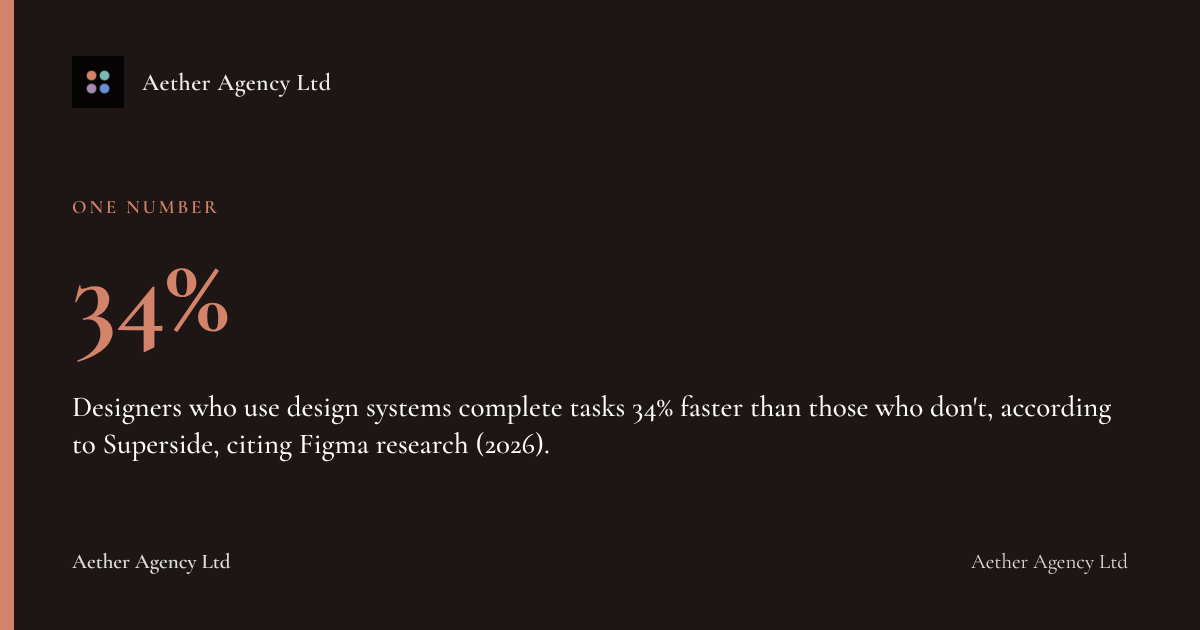
- Designers who use design systems complete tasks 34% faster than those who don't, according to Superside, citing Figma research (2026).
- 85% of organisations have brand design guidelines, but only 30% are enforced, according to G2 (2025), which means most businesses already have the raw material but lack the governance to use it.
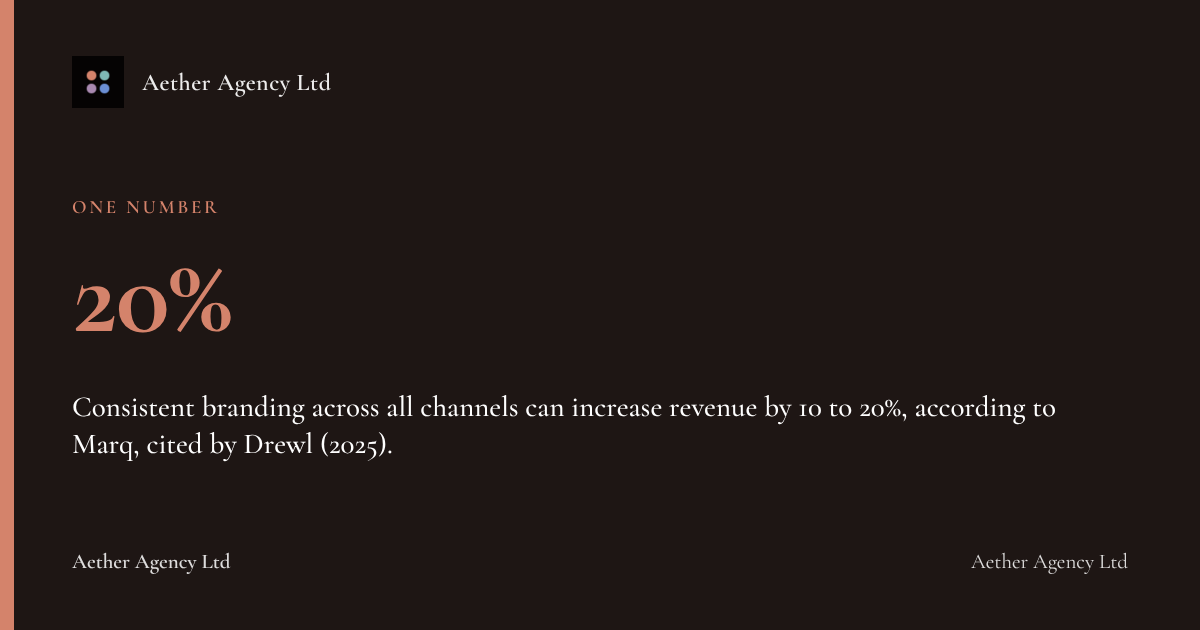
- Consistent branding across all channels can increase revenue by 10 to 20%, according to Marq, cited by Drewl (2025).
- Design-led companies deliver 32% more revenue and 56% higher total returns to shareholders than their peers, according to McKinsey & Company (2018).
What is a design system for brands?
A design system for brands is a structured, continuously maintained collection of design standards, reusable components and governance rules that defines how a company's identity appears across every touchpoint, from its website to its sales decks. It differs fundamentally from a brand guideline document, which is usually a static PDF outlining logo clear space, colour codes and font pairings once and then left untouched for years.
A brand guideline tells a designer what the rules are. A design system gives every designer, developer and marketer the actual building blocks, buttons, headers, colour tokens, grid systems, ready to drop into a live project without reinventing them each time.
This distinction matters because of enforcement. G2 found that 85% of organisations have brand design guidelines in 2025, but only 30% are actually enforced. A document nobody checks against is not a system; it's a wish list. A proper design system is embedded into the tools teams already use, so following the rules becomes the path of least resistance rather than an extra compliance step.
Aether Agency Ltd, a branding studio working with growing UK businesses across brand identity, website development and marketing, builds these systems specifically to close that enforcement gap, treating the design system as infrastructure rather than decoration.
What components should a design system for a brand include?
A brand design system should include five core layers: brand foundations, visual assets, typography and colour rules, UI components, and usage documentation. Each layer serves a different audience, from the marketing team producing a LinkedIn ad to the developer building a checkout flow.
The foundations layer sets the tone: brand values, voice and positioning that inform every other decision. The visual assets layer covers the logo suite (primary mark, secondary mark, favicon, social avatars) along with clear space rules and misuse examples, because a logo stretched or recoloured incorrectly undermines recognition instantly.
Colour and typography form the next layer, and they carry real commercial weight. A signature colour can increase brand recognition by up to 80%, according to Shapo (2025), which is why a design system specifies not just hex codes but accessible contrast ratios, hover states and dark-mode variants.
The UI component layer is where most businesses fall short without proper investment: buttons, forms, navigation bars, cards and icon sets built once and reused everywhere. Finally, usage documentation, often hosted in a tool like Zeroheight or a dedicated Notion space, explains when and how to use each asset, so new hires or external agencies can onboard in days rather than weeks.
| Component | Who uses it | Typical format |
|---|---|---|
| Logo suite and clear space | Marketing, sales, PR | SVG/EPS files, usage PDF |
| Colour palette and tokens | Designers, developers | Figma variables, CSS tokens |
| Typography scale | Designers, web team | Figma styles, font licences |
| UI component library | Product, web development | Figma components, code (React/Vue) |
| Voice and tone guidelines | Content, marketing, customer service | Written documentation |
| Governance and change log | Brand lead, design ops | Zeroheight, Confluence, Notion |
Aether Agency's own work on the Guardian project, a security and facilities management platform in the UK, shows this in practice. The company had a product idea with no brand, no application and no launch plan at all. Aether Agency Ltd delivered a custom web application, a full brand identity system and a full-scale marketing launch as one end-to-end engagement, taking the concept from nothing through to a live product.
How much does a design system for a brand cost in the UK?
A design system for a brand in the UK typically costs anywhere from a few thousand pounds for a lean startup version to tens of thousands for a full enterprise-grade system with coded components. Price depends on scope, the number of digital products it needs to serve, and whether it includes built code components or design-only files.
The widest cost driver is whether the system stays in design tools like Figma or extends into a coded component library that developers pull directly into production. A design-only system for a single website and a handful of marketing templates sits at the lower end of the range. A system spanning multiple product teams, a public-facing app and print collateral sits considerably higher, because it requires coded tokens, accessibility testing and ongoing design ops support.
Company size and existing brand maturity also matter. A business starting from an inconsistent, ad hoc visual identity needs a discovery and audit phase before any system work begins, which adds time and cost compared to a business refreshing an already-coherent identity.
"74% of product managers say inconsistent design slows feature development", according to Superside (2026), and that slowdown is precisely what a well-scoped design system is designed to remove, making the upfront investment easier to justify against ongoing engineering drag.
Factors that move the price
- Number of platforms: website, app, internal tools and print each add build time.
- Coded vs design-only: component libraries in React or Vue cost more than Figma files alone.
- Governance tooling: platforms like Zeroheight add licensing costs on top of design hours.
- Accessibility requirements: WCAG 2.2 compliance testing adds a review stage.
- Existing brand maturity: a messy starting point needs an audit before system work starts.
How long does it take to design, build and roll out a brand design system?
Building and rolling out a brand design system for a growing business typically takes between eight and twenty weeks, depending on scope and how many teams it needs to serve. A lean system covering a website and core marketing assets moves faster than one spanning a full product suite with coded components.
The process usually runs in four phases. Discovery and audit, where the agency reviews existing assets and inconsistencies, typically takes one to three weeks. Design and component build, the longest phase, covers logo refinement (if needed), colour and type systems, and the core UI component library.
Documentation and governance setup follows, where usage rules are written and uploaded into a shared platform. Rollout across teams, the final phase, involves training sessions, a transition period where old and new assets run in parallel, and a formal sign-off from brand and product stakeholders.
Enterprises with design systems typically earn a 135% ROI across design and engineering costs, according to Superside (2026), a return that compounds the longer the system stays in active use. That's a strong argument for treating the rollout timeline as an investment phase rather than a cost to minimise by rushing it.
Who should be responsible for creating and governing a design system?
A design system needs a named owner, usually a brand lead, head of design or design ops manager, who holds final approval over additions and changes. Without a single accountable owner, systems drift back into the inconsistency they were built to solve, which is exactly how the gap between the 85% of organisations with guidelines and the 30% with enforcement opens up, per G2 (2025).
Governance typically works as a small cross-functional group rather than one person alone. Marketing, product design and (where relevant) external agencies each nominate a representative, and that group meets on a set cadence, monthly for an active system, quarterly for a mature one, to review proposed changes.
As one design practitioner put it in academic research into design systems practice: "I think the biggest benefits from a design system are re-usability and consistency," according to the arXiv study, Understanding and Supporting the Design Systems Practice. That consistency only holds if someone is actually accountable for defending it when a new campaign or product feature tempts a team to go off-brief.
For growing businesses without an in-house design ops function, an external partner can hold this role during the early years. Aether Agency Ltd typically sets up the initial governance structure as part of a brand identity engagement, handing over a clear process the client's internal team can run once the system matures.
Design system vs brand identity: do you need both?
A brand identity defines who a business is visually, its logo, colour story, typography and tone of voice, while a design system is the operational toolkit that applies that identity consistently across every digital and physical touchpoint. Most growing businesses need both, built in sequence rather than as competing projects.
Think of brand identity as the "what" and the design system as the "how." A brand identity project typically produces a logo suite, a colour and type story, and a set of brand guidelines describing the intended feel. A design system takes those decisions and turns them into functioning components: a coded button, a Figma card template, a documented spacing scale.
| Brand identity | Design system | |
|---|---|---|
| Defines | Logo, colours, typography, voice | Reusable components and rules |
| Output | Guidelines document, logo files | Figma libraries, coded components |
| Audience | Leadership, marketing, agencies | Designers, developers, content teams |
| Lifespan | Reviewed every few years | Updated continuously |
| Owner | Founder or marketing lead | Design ops or brand lead |
Over 90% of businesses believe graphic design is essential for branding and marketing, according to Cropink (2026), which explains why so many invest in the identity half of this equation. Far fewer go on to build the system that keeps that identity consistent once the business scales past a handful of people touching the brand.
Aether Agency Ltd positions brand identity and website development as connected services precisely because a logo and colour palette delivered without a system to apply them tends to drift within a year. The company's Brand Identity service builds naming, identity systems and guidelines designed to survive every channel, rather than a one-off creative exercise.
What should a business audit before starting a design system project?
A business should audit its existing visual assets, inventory every inconsistency across live channels, and gather stakeholder needs before commissioning a new design system. Skipping this step is one of the most common reasons design system projects stall or get rebuilt within two years.
The audit should cover at least three areas. First, a full inventory of current assets: every logo variant in use, every colour code appearing on the website versus print materials, every font actually rendering across platforms (not just the ones specified in old guidelines).
Second, a channel-by-channel consistency check: compare the company's LinkedIn page, website, email templates and any sales decks side by side, because misalignment usually hides in plain sight once everything is on one screen. Third, stakeholder interviews across marketing, product, sales and customer-facing teams, to capture practical needs a pure design exercise would miss, such as a sales team needing editable PowerPoint templates rather than Figma files they can't open.
"You can very quickly go from a nascent idea to a full-fledged prototype or product using a designed system in a way that would be much more difficult without one," according to the arXiv study on design systems practice. That speed only materialises if the audit phase correctly identifies what the organisation actually needs built, rather than what looks impressive in a pitch deck.
Your design system for brands checklist
- Inventory every logo variant, colour code and font currently in use across all channels.
- Compare your website, social profiles and print materials side by side to spot inconsistencies.
- Interview marketing, sales, product and customer-facing teams about their practical asset needs.
- Name a single accountable owner for the design system before build work begins.
- Choose a documentation platform (such as Figma or Zeroheight) that matches your team's existing workflow.
- Build the UI component library in parallel with, not after, the visual identity refresh.
- Set a review cadence (monthly or quarterly) for governance meetings once the system launches.
- Run a training session for every team that will use the system before full rollout.
FAQ
What is a design system for brands?
A design system for brands is a maintained library of design rules, reusable components and usage documentation that keeps a company's visual identity consistent across every channel. It goes beyond a static brand guidelines PDF by living in tools like Figma and being updated continuously as the business evolves.
How is a design system different from brand guidelines?
Brand guidelines are typically a static document describing logo usage, colour and typography rules once, while a design system is an operational, continuously updated toolkit of actual components teams use daily. G2 found 85% of organisations have guidelines in 2025, but only 30% enforce them, which is the gap a working design system closes.
How much does a design system cost for a UK business?
Costs vary widely depending on whether the system is design-only or includes coded components, and how many platforms it needs to serve. A lean system for a single website and marketing templates sits at the lower end, while a multi-platform system with coded component libraries and accessibility testing costs considerably more.
How long does it take to build a design system?
Most design system projects for growing businesses take between eight and twenty weeks, covering audit, design and build, documentation, and team rollout. The timeline depends on how many platforms and teams the system needs to serve.
Who owns a design system within a company?
A design system needs one named owner, usually a brand lead, head of design or design ops manager, supported by a small cross-functional governance group. Without a named owner, systems tend to drift back into the inconsistency they were built to prevent.
Do small businesses really need a design system, or is a style guide enough?
A simple style guide can suffice for a very small business with one or two people touching the brand, but as soon as multiple people, freelancers or departments start producing content, a design system prevents drift. Consistent branding across all channels can increase revenue by 10 to 20%, according to Marq, cited by Drewl (2025), which makes the investment worthwhile well before a business reaches enterprise scale.
What tools are used to build and manage a design system?
Design systems are typically built in Figma for component design, then documented in platforms such as Zeroheight for cross-team reference, with coded components stored in a shared code repository for development teams. The exact toolkit depends on whether the business needs design-only assets or fully coded, production-ready components.
Building your brand's design system with Aether Agency Ltd
Every section above points to the same problem: businesses have brand assets, but few have a system that keeps them consistent once more than one person is producing content. Aether Agency Ltd works with growing UK businesses to close that exact gap, building brand identity systems that are designed from the outset to survive every channel a business touches, rather than a logo pack that drifts within a year.
The Guardian project shows this approach in practice: a security and facilities management platform with a product idea but no brand, no application and no launch plan, taken by Aether Agency Ltd from concept through custom web application development, full brand identity system and marketing launch under one roof. That end-to-end model, brand and build together rather than sequentially, is what prevents the inconsistency that affects a large share of organisations with unenforced guidelines.
If your business is producing content across multiple channels without a system holding it together, get in touch with Aether Agency Ltd to discuss a Brand Identity engagement built around how your team actually works.
Related Reading
- What's Included in a Brand Identity Package? (2026)
- Brand Identity Design Surrey | Aether Agency Ltd
- Brand Guidelines vs Brand Identity: The UK Difference
Add aether-agency.co.uk as a preferred source on Google
See How Your Brand Appears in AI Search
Aether AI monitors your visibility across ChatGPT, Perplexity, Google AI Overviews, and Claude in real time. Find out where you stand and what to fix.
Explore Aether AI