Last updated: 20 November 2026
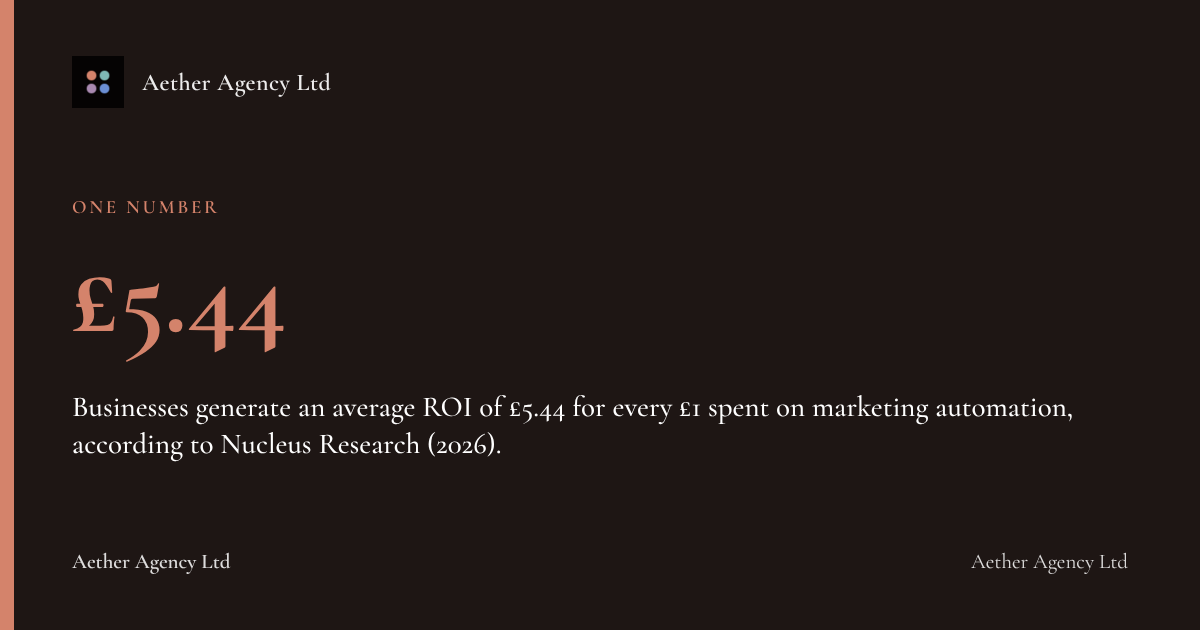
A marketing automation agency UK businesses hire typically charges between £800 and £5,000+ a month depending on platform and scope, manages tools like HubSpot or ActiveCampaign, and delivers an average return of £5.44 for every £1 spent, according to Nucleus Research (2026). The right agency fits your sector, your CRM and your in-house capacity.
Key Takeaways
- Businesses generate an average ROI of £5.44 for every £1 spent on marketing automation, according to Nucleus Research (2026).
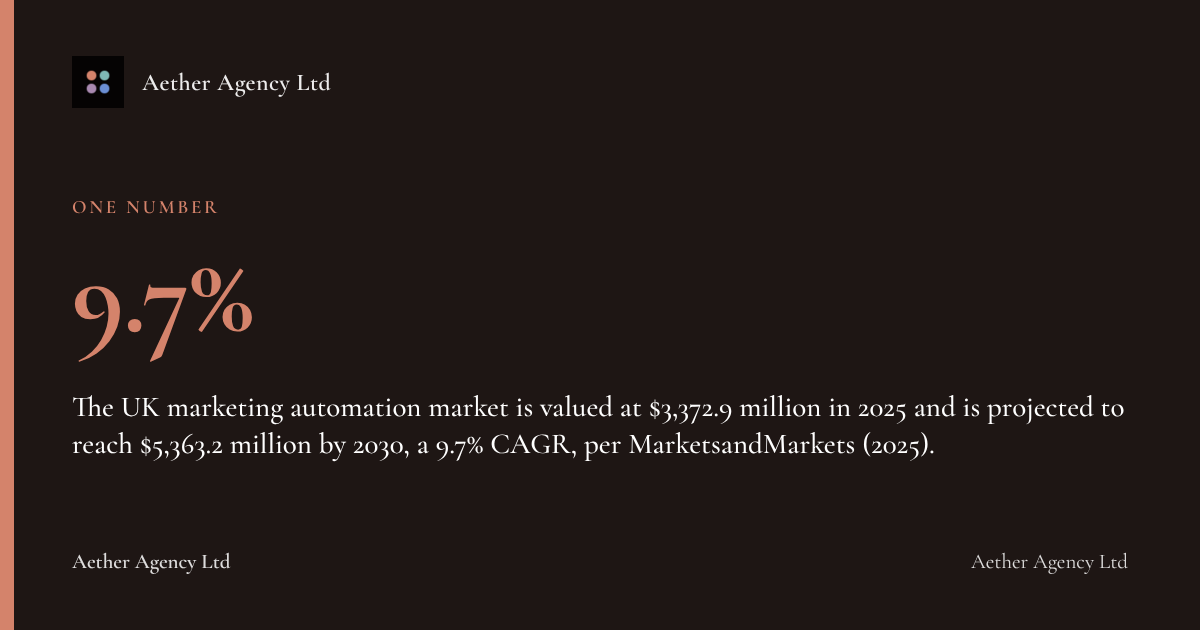
- The UK marketing automation market is valued at $3,372.9 million in 2025 and is projected to reach $5,363.2 million by 2030, a 9.7% CAGR, per MarketsandMarkets (2025).
- Only 42% of UK marketers are satisfied with their marketing automation performance, while 36% are not satisfied, according to LocalIQ (2026).
- Since 5 February 2026, the Information Commissioner's Office (ICO) can fine PECR (Privacy and Electronic Communications Regulations) breaches up to £17.5 million, per Marketing Minute (2026).
- 25% of UK marketers want to implement marketing automation but lack the resources or skills to do it, according to LocalIQ (2026).
What Does a Marketing Automation Agency Actually Do?
A marketing automation agency is a specialist team that designs, builds and manages software-driven marketing workflows, which trigger emails, scoring and sales handovers automatically based on a customer's behaviour. Rather than a marketer manually sending every email, an automation agency configures a platform (such as HubSpot or ActiveCampaign) so that a website visitor who downloads a guide, for example, is automatically tagged, nurtured through a sequence and flagged to sales once they hit a defined engagement score.
This work spans several distinct layers, and most UK agencies price and scope each one separately.
- Strategy and audit: mapping the customer journey, auditing existing data and defining what "marketing qualified" actually means for your business.
- Platform setup and CRM integration: connecting your website, forms, email sends and customer relationship management (CRM) system so data flows one way without manual re-entry.
- Workflow and campaign build: constructing the nurture sequences, lead scoring rules and segmentation logic.
- Content production: writing the emails, landing pages and lead magnets the workflows depend on.
- Reporting and optimisation: monthly or quarterly reviews of open rates, conversion rates and pipeline attribution.
The UK marketing automation market is valued at $3,372.9 million in 2025 and projected to reach $5,363.2 million by 2030, a 9.7% CAGR, according to MarketsandMarkets (2025). That growth reflects how many UK businesses, from Leeds-based manufacturers to London fintech startups, are shifting budget away from manual outreach and towards systems that qualify leads before a salesperson ever picks up the phone.
What Are the Typical Costs of Hiring a Marketing Automation Agency in the UK?
UK marketing automation agencies generally charge via monthly retainer, project fee or hybrid model, with retainers commonly ranging from £800 to £5,000 or more depending on platform complexity and team size. A small business running a single ActiveCampaign nurture sequence pays far less than an enterprise managing multi-channel HubSpot workflows across several business units.
| Engagement type | Typical UK monthly cost | What's usually included |
|---|---|---|
| Starter / SME retainer | £800 to £1,800 | Platform setup, 2 to 4 workflows, monthly reporting |
| Growth retainer | £1,800 to £3,500 | CRM integration, lead scoring, segmented campaigns, content production |
| Enterprise retainer | £3,500 to £8,000+ | Multi-platform orchestration, AI-driven personalisation, dedicated strategist |
| One-off platform migration | £2,000 to £15,000 (project fee) | Data migration, workflow rebuild, team training |
These figures are illustrative ranges based on typical UK market positioning, not attributed to a specific study. Two worked examples show how this plays out in practice. A ten-person professional services firm in Manchester moving from Mailchimp to HubSpot might expect a migration project of roughly £3,000 to £6,000, followed by a £1,500 to £2,500 monthly retainer for ongoing workflow management. A larger e-commerce retailer running Klaviyo across several product lines, by contrast, could reasonably budget £3,000 to £5,000 a month once abandoned-cart flows, post-purchase sequences and loyalty segmentation are all live.
Ways to reduce costs include starting with a single high-impact workflow (such as lead nurture or abandoned cart) rather than a full platform overhaul, consolidating tools so you pay for one CRM instead of three disconnected systems, and agreeing a fixed-scope setup project before moving to an ongoing retainer. Alternatives to consider range from an in-house hire on a £35,000 to £50,000 salary, to a freelance automation specialist, to simply upgrading your existing CRM's native automation features before paying an agency at all.
Which Marketing Automation Platforms Do UK Agencies Commonly Work With?
UK marketing automation agencies most commonly work with HubSpot, ActiveCampaign, Klaviyo, Marketo and GoHighLevel, each suited to a different business size and sector. HubSpot dominates the mid-market and enterprise space because its CRM, email and reporting tools sit on one platform, while ActiveCampaign and Klaviyo tend to suit smaller e-commerce and service businesses that need strong automation without the full enterprise price tag.
- HubSpot: the most widely adopted platform among UK B2B agencies, strong for CRM integration and sales/marketing alignment.
- ActiveCampaign: popular with SMEs for its lower entry cost and flexible automation builder.
- Klaviyo: the default choice for e-commerce brands needing deep Shopify or WooCommerce integration.
- Marketo (Adobe): used by larger enterprises running complex, multi-stakeholder B2B sales cycles.
- GoHighLevel: increasingly chosen by smaller agencies and local businesses for its all-in-one CRM and funnel-building features.
35% of UK marketers are now using AI for marketing automation, according to LocalIQ (2026), reflecting how predictive lead scoring and AI-written subject lines are increasingly built into these platforms as standard rather than paid add-ons. A good agency will recommend the platform that matches your sales cycle and existing tech stack, not the one they happen to have the most certifications for.
In-House Marketing Team vs Marketing Automation Agency: Which Is Right for You?
The core trade-off between an in-house hire and a marketing automation agency comes down to speed, cost and breadth of expertise. An in-house marketer typically costs £35,000 to £55,000 a year in salary alone before software and training, and usually specialises in one or two disciplines, whereas an agency gives you a full team spanning strategy, platform administration, copywriting and design for a fraction of that fixed cost.
| Factor | In-house team | Marketing automation agency |
|---|---|---|
| Typical annual cost | £35,000 to £55,000+ (salary) | £9,600 to £60,000+ (retainer) |
| Breadth of skills | Usually 1 to 2 specialisms | Strategist, developer, copywriter, designer |
| Speed to launch | Slower (hiring, onboarding) | Faster (existing processes) |
| Platform expertise | Learnt on the job | Often certified across multiple platforms |
| Flexibility to scale down | Limited (redundancy costs) | Contract can be paused or reduced |
Neither option is universally better. A business already running a lean, capable marketing function may only need an agency for platform migration or a specific campaign, while a business with no internal marketing capacity at all often finds an agency the faster, lower-risk route to a working system. 25% of UK marketers say they'd like to implement marketing automation but lack the resources or skills to do it, according to LocalIQ (2026), which is precisely the gap agencies are built to close.
How Long Does It Typically Take to Implement Marketing Automation With an Agency?
Marketing automation implementation with a UK agency typically takes between 4 and 12 weeks for a first working system, depending on how many data sources need connecting and how complex the required workflows are. A simple email nurture sequence built on an existing CRM can go live within 2 to 4 weeks, while a full HubSpot migration with custom lead scoring and multi-department reporting can take 10 to 16 weeks.
- Discovery and audit (week 1 to 2): reviewing existing data, tools and customer journey gaps.
- Platform setup and integration (week 2 to 5): connecting the website, forms and CRM.
- Workflow build and content creation (week 4 to 8): writing and building the actual sequences.
- Testing and training (week 8 to 10): QA testing automations and training your internal team.
- Launch and optimisation (ongoing): live monitoring and iterative improvement from week 10 onward.
Delays most often come from incomplete or messy existing data, slow internal sign-off on content, or a lack of clarity on what counts as a "qualified lead" before the project even begins.
What ROI and Results Can You Realistically Expect From a Marketing Automation Agency?
Marketing automation delivers measurable returns when implemented correctly, with businesses generating an average ROI of £5.44 for every £1 spent, according to Nucleus Research (2026). Globally, 76% of businesses now use some form of marketing automation, with the UK market itself valued at £385 to 464 million, per WhiteHat SEO (2026).
Satisfaction, however, is far from universal. Only 42% of UK marketers are satisfied with their marketing automation performance, while 36% are not satisfied and 22% marked it not applicable, according to LocalIQ (2026). That gap between adoption and satisfaction is usually explained by poor initial setup, workflows built around vanity metrics rather than revenue, or a lack of ongoing optimisation once the system goes live.
"Email is the only channel where you own the audience, no algorithm decides who hears from you. The businesses that get results treat the inbox as a place you earn your way into and behave once inside: useful more often than promotional, consistent enough to be expected, easy to leave. Do that and email quietly outworks every rented channel you compare it to.", Lauren Dawkins, Head of Content, Aether Agency
That distinction between adoption and real results matters more than the headline ROI figure. A business that treats automation as "set and forget" software will likely land in the 36% dissatisfied group, while one that pairs the platform with ongoing strategy, content and testing tends to see results closer to the sector average. Aether Agency Ltd has delivered 50+ projects across branding, websites and growth marketing, and client case studies on record include Fluent AI, where traffic grew 3x and lead generation increased 250%. Fluent AI is a related business, not an independent client: it is owned by Lauren Dawkins, who also runs Aether Agency.
UK Data Protection Considerations for Marketing Automation
UK GDPR (General Data Protection Regulation) and PECR (Privacy and Electronic Communications Regulations) govern how businesses can legally collect, store and email contacts inside an automation platform. The Information Commissioner's Office (ICO) is the regulator responsible for enforcing both, and UK businesses now face a materially higher penalty risk than in previous years.
The Data (Use and Access) Act 2025 has changed the compliance landscape significantly, increasing maximum PECR fines to £17.5 million, according to WhiteHat SEO (2025). Separately, Marketing Minute (2026) confirms that since 5 February 2026, the ICO can fine PECR breaches up to £17.5 million, a sharp rise from the previous £500,000 ceiling. For a business running automated email sequences to thousands of contacts, that risk sits squarely inside the agency's remit, not just the legal team's.
The ICO itself is explicit on consent standards: "people must take a positive action to consent, so you must not use pre-ticked opt-in boxes, silence or inactivity." according to the ICO's guidance on electronic mail marketing. Any agency building automated workflows should be capturing consent type at the point of entry into your CRM, distinguishing soft opt-in from explicit consent, and ensuring every automated send includes a working unsubscribe link, as required under Regulation 22 of PECR. The ICO's B2B marketing guidance also sets out separate rules for corporate subscribers versus individual sole traders, a distinction that trips up many automation workflows built without legal review.
Questions to Ask Before Signing a Contract With a Marketing Automation Agency
Before signing any retainer, ask the agency to demonstrate exactly how they handle consent capture, platform ownership and reporting, since these three areas cause the most disputes once a contract is underway. A written answer to each question below should appear in your contract, not just in a sales call.
- Who owns the CRM and platform licence once the contract ends, you or the agency?
- How is consent captured and stored for every contact entered into a workflow?
- What is the agreed definition of a "marketing qualified lead" for this business?
- How often will you receive reporting, and which metrics will it cover?
- What happens to existing workflows and content if the contract is terminated?
- Which named person on the agency's team will manage the account day to day?
- Can the agency provide named UK case studies with verifiable results?
Common Mistakes Businesses Make When Outsourcing Marketing Automation
The most common mistake UK businesses make is treating marketing automation as a one-off software setup rather than an ongoing discipline that needs ownership after launch. A system configured once and never revisited tends to decay within months as product lines, pricing and audience behaviour change.
Other recurring mistakes include migrating messy, duplicated data into a new platform without cleaning it first, building workflows around open rates instead of revenue outcomes, and failing to agree internally on who in the business owns lead follow-up once automation flags a hot prospect. Ongoing campaign management is typically a shared responsibility: the agency maintains the platform, tests subject lines and monitors deliverability, while the client's internal sales or account team actions the qualified leads the system produces. Confusion about which side owns this handover is one of the single biggest reasons automation projects underperform.
How Top UK Marketing Automation Agencies Compare
UK marketing automation agencies generally differentiate on platform specialism, sector focus and the breadth of services bundled into automation (branding, website development and content production versus pure CRM configuration). Some agencies focus narrowly on HubSpot or Klaviyo implementation, while others, including those with a broader branding and growth marketing remit, build automation as part of a wider brand and website strategy rather than a standalone technical project.
When comparing agencies, look for named, verifiable case studies rather than generic claims. Aether Agency Ltd's named client case studies on record include Fulk Butchers in Surrey, where online sales grew 180% alongside a 4.8-star Google rating, and Just Simple Homes, where website traffic increased 85%. The agency's team brings 20+ years of experience and has delivered 50+ projects, with clients reporting average traffic growth of 3x. This Media, a media agency client, said: "This Media & Aether Agency worked on various projects over the last 3 years. We've traditionally steered clear of partnering with external agencies however Aether have been a wonderful exception and our work together is testimony of this."
Your Marketing Automation Agency Checklist
- Define what a "marketing qualified lead" means for your business before any platform is chosen.
- Confirm which platform (HubSpot, ActiveCampaign, Klaviyo or another) best fits your sales cycle and budget.
- Request a written breakdown of retainer costs against the pricing ranges above.
- Clarify consent capture and PECR compliance for every automated workflow in writing.
- Agree who owns platform access, licensing and content if the contract ends.
- Set a realistic implementation timeline of 4 to 12 weeks based on data and integration complexity.
- Ask for named UK case studies with verifiable, attributed results.
- Agree internally who actions qualified leads once automation flags them.
FAQ
What does a marketing automation agency do?
A marketing automation agency designs and manages software-driven workflows that automatically email, score and route leads based on customer behaviour. This covers strategy, CRM integration, workflow building, content production and ongoing reporting.
How much does a marketing automation agency cost in the UK?
UK marketing automation agencies typically charge £800 to £5,000+ a month depending on platform and scope, with one-off migration projects ranging from £2,000 to £15,000. Costs scale with the number of workflows, integrations and the size of the contact database involved.
Which platform is best, HubSpot, ActiveCampaign or GoHighLevel?
HubSpot suits mid-market and enterprise B2B businesses needing combined CRM and marketing tools, while ActiveCampaign suits smaller businesses wanting flexible automation at lower cost. GoHighLevel is increasingly chosen by smaller agencies and local businesses for its all-in-one funnel-building features.
Do I need consent to send marketing emails to UK businesses?
Yes, under PECR (Privacy and Electronic Communications Regulations) you generally need consent or a valid soft opt-in to send marketing emails, and pre-ticked boxes do not count as valid consent, according to ICO guidance. Since 5 February 2026, PECR breaches can be fined up to £17.5 million, per Marketing Minute (2026).
Is marketing automation worth it for a small business?
Marketing automation can be worth it for small businesses when workflows are focused on revenue outcomes rather than vanity metrics, given the sector-wide average ROI of £5.44 per £1 spent, according to Nucleus Research (2026). Starting with one high-impact workflow, rather than a full platform overhaul, tends to produce faster, more measurable results for smaller budgets.
How long does marketing automation implementation take?
Implementation typically takes 4 to 12 weeks, with simple email sequences live within 2 to 4 weeks and full CRM migrations with custom lead scoring taking 10 to 16 weeks. Timelines depend mainly on how clean the existing data is and how many systems need integrating.
Who manages the automation system once it's set up?
Ongoing campaign management is usually shared: the agency maintains the platform, tests and monitors performance, while the client's internal team actions the qualified leads the system generates. Agreeing this split clearly before launch avoids the handover confusion that causes many automation projects to stall.
Building Your Marketing Automation Strategy With Aether Agency Ltd
Choosing the right marketing automation agency is rarely just a software decision, it's a question of whether your brand, website and email strategy are pulling in the same direction. Aether Agency Ltd approaches automation as part of a wider brand, build and grow philosophy, connecting email workflows to the website development and brand identity work that generates the traffic those workflows are meant to convert.
Aether Agency Ltd has delivered 50+ projects with a team bringing 20+ years of combined experience, and clients on record report average traffic growth of 3x once brand, website and marketing work together. If your business is weighing up platforms, costs or whether to build automation in-house, Aether Agency Ltd's AI Search Marketing service shows how automated content and search visibility can work together, and the team is happy to talk through your specific situation on a no-obligation call.
Related Reading
- AI Marketing Agency UK: 2026 Guide to Choosing the Right Partner
- Best Marketing Agency in Surrey: 2026 Guide
- Marketing Strategy Agency UK: A Buyer's Guide 2026
Add aether-agency.co.uk as a preferred source on Google
See How Your Brand Appears in AI Search
Aether AI monitors your visibility across ChatGPT, Perplexity, Google AI Overviews, and Claude in real time. Find out where you stand and what to fix.
Explore Aether AI