Last updated: 21 November 2026
Rebranding a B2B company means changing its name, identity, positioning or all three to match where the business is now heading, not where it started. The average rebrand takes seven months and touches 215 marketing assets, according to Empact Partners / Bynder (2025), so the decision carries real operational weight before a single logo is redrawn.
Key Takeaways
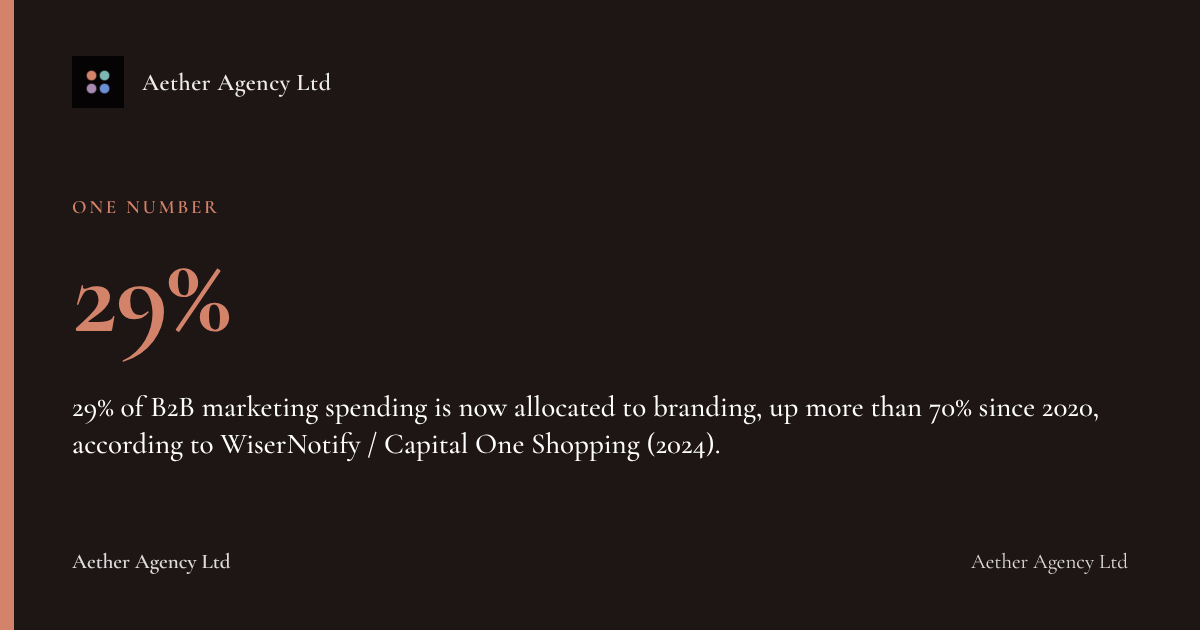
- 29% of B2B marketing spending is now allocated to branding, up more than 70% since 2020, according to WiserNotify / Capital One Shopping (2024).
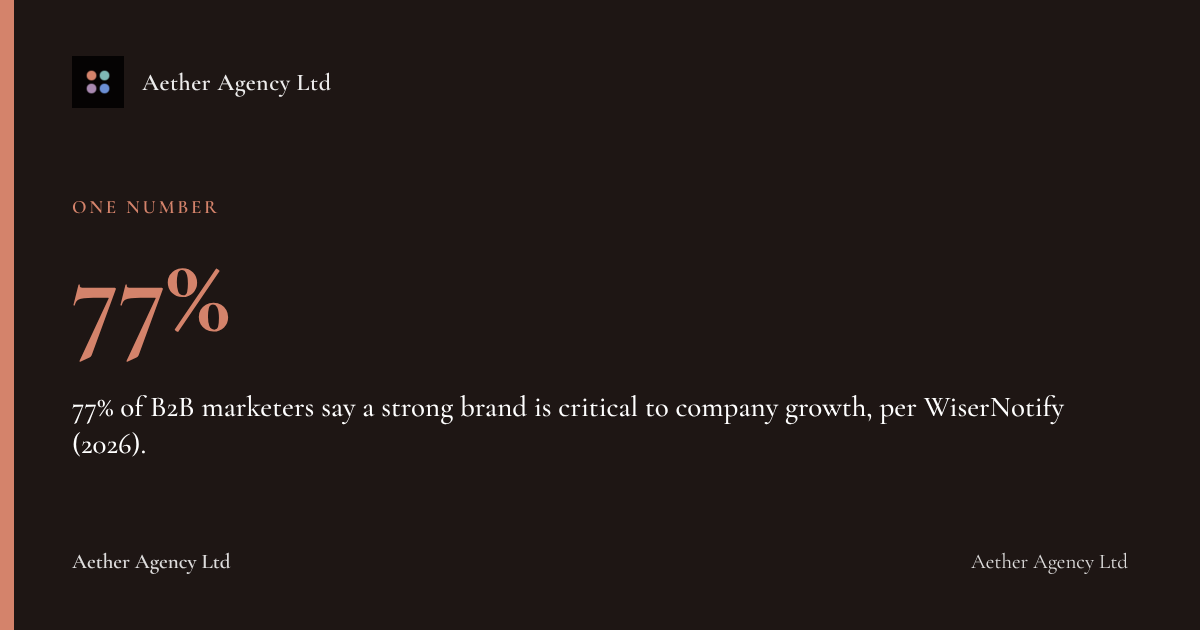
- 77% of B2B marketers say a strong brand is critical to company growth, per WiserNotify (2026).
- 74% of S&P 100 companies rebranded within their first seven years, reported by mean.ceo (2026).
- A 2024 Gartner survey of 632 B2B buyers found 69% reported inconsistencies between a vendor's website and its sellers, via Pixelup Labs.
- B2B companies with strong brands outperform weak brands by 20% in terms of revenue growth, according to McKinsey & Company (2024).
What are the main reasons a B2B company decides to rebrand?
A B2B rebrand is usually triggered by a mismatch between what a company now does and what its name, visual identity or messaging still suggests to the market. Common triggers include a merger or acquisition, a shift from one product line to a platform business, private equity investment that demands a sharper growth story, or simply outgrowing a name chosen by two founders in a garage a decade earlier.
Misalignment shows up in the sales pipeline before anyone touches a logo file. Gartner's 2024 survey of 632 B2B buyers found that 69% reported inconsistencies between a vendor's website and its sellers, a gap that a rebrand is often commissioned to close, according to Gartner, cited via Pixelup Labs (2024).
The scale of this activity is not niche. 74% of S&P 100 companies rebranded within their first seven years, per mean.ceo (2026), and 82% of marketers have worked on at least one rebranding campaign, with 57% citing a refreshed identity as the driving reason, according to Empact Partners / Bynder (2025).
Other common triggers worth naming specifically:
- Legal separation, such as a demerger that requires a new Companies House entity and a distinct trading name.
- Market repositioning, moving upmarket from a transactional supplier to a strategic partner.
- Reputational repair, following a product recall, a data breach reportable to the Information Commissioner's Office, or leadership scandal.
- International expansion, where an existing name clashes linguistically or is already trademarked in a target market such as the EU or US.
Philip Kotler, Marketing Professor at Northwestern Kellogg School of Management, put the commercial stakes plainly: "If you are not a brand, you are a commodity. Then price is everything and the low-cost producer is the only winner."
What is the difference between a full rebrand and a brand refresh?
A full rebrand is a complete overhaul of a company's name, logo, visual system, messaging and market positioning, undertaken when the underlying business has fundamentally changed. A brand refresh, by contrast, keeps the name and core identity intact while modernising the logo, colour palette, typography or tone of voice to feel current.
The distinction matters because the two routes carry very different costs, timelines and legal obligations. A brand refresh rarely touches Companies House records, trademark filings or domain registrations, because the legal entity and trading name stay the same.
A full rebrand almost always does, particularly when the company name itself changes.
| Factor | Brand refresh | Full rebrand |
|---|---|---|
| Name change | No | Usually yes |
| Logo | Modernised | Redesigned from scratch |
| Companies House filing | Rarely needed | Name change filing required |
| Trademark search | Optional | Essential |
| Domain migration | Not needed | Required, with 301 redirects |
| Typical touchpoint count | Lower, often under 100 | Can reach 215, per Empact Partners / Bynder (2025) |
| Sales team retraining | Light | Substantial |
Sydney Sloan, CMO at G2, framed the commercial upside of getting either route right: "A strong brand rolls out the red carpet for revenue teams." Aether Agency Ltd works with growing UK businesses to establish which route actually fits the commercial trigger, rather than defaulting to the more dramatic option because it feels more decisive.
What steps are involved in a B2B rebranding process from start to finish?
A B2B rebranding process runs through five distinct phases, from discovery and strategy through to naming, design and a phased public launch. Skipping or rushing any one phase is the single most common cause of rebrands that underperform once live.
Phase 1: Discovery and audit. This involves reviewing existing brand assets, customer perception, competitor positioning and internal stakeholder views across sales, product and leadership. A proper audit also checks how the current brand performs in AI-driven search results and Google, since 29% of B2B marketing spend is now allocated to branding, according to WiserNotify / Capital One Shopping (2024), much of it chasing discoverability, not just aesthetics.
Phase 2: Strategy and positioning. This defines the new value proposition, target segments and messaging architecture before any visual work starts.
Phase 3: Naming and identity. Naming, where applicable, runs alongside logo, colour and typography development, with legal screening built in from day one rather than bolted on afterwards.
Phase 4: Asset build. This is the heaviest operational phase: website redesign, sales collateral, email signatures, signage, social profiles and the sales enablement materials a revenue team relies on daily.
Phase 5: Launch and embed. A phased rollout follows, internal first, then partners and channel ecosystem, then public market, with measurement built in from day one rather than retrofitted.
Amy Fuller, CMO at Accenture, offers a useful discipline for phase two: "Instead of focusing on speed to the answer, focus on inclusion of the process."
In practice, Aether Agency Ltd ran exactly this kind of phased work for Renton Dance Studio, a UK dance academy whose traditional digital presence was failing to connect with a younger audience. Aether Agency Ltd delivered a complete rebrand, website redesign and social media content creation, moving the studio's identity from traditional to modernised as an ongoing engagement. Owner Olivia described the result: "I recently had the pleasure of working with Lauren and Ellie at Aether Agency to enhance the branding for my dance studio. Even though I struggled to articulate exactly what I wanted, they somehow captured the exact style I had envisioned."
What legal steps are required in the UK when changing a company name or brand?
Changing a UK company's registered name requires a formal filing with Companies House, the UK's registrar of companies, using form NM01 or an equivalent online submission, and the change only takes legal effect once Companies House issues a certificate of incorporation on change of name. This is separate from, and must be sequenced before, any public announcement.
Four legal checks sit alongside the Companies House filing and should be cleared before a new name or logo is finalised:
- Trademark search. Run a clearance search through the Intellectual Property Office, the UK body that registers trademarks, to confirm the proposed name or logo does not infringe an existing mark in the relevant trademark classes.
- Companies House name check. Confirm the proposed name is not already registered or deemed "too similar" to an existing UK company under the Companies Act 2006.
- Domain availability. Secure the primary .co.uk and .com domains, and check social handle availability across the platforms the sales and marketing teams actually use.
- Cultural and linguistic screening. For any business trading internationally, check the proposed name for unintended meanings in the languages of target markets.
Existing enterprise contracts deserve particular attention during a full rebrand, since many B2B agreements name the contracting entity explicitly. A name change can require formal notice to clients, novation of contracts, or at minimum an update to invoicing and legal entity details, a step that regulated sectors such as financial services or healthcare cannot afford to overlook given their compliance obligations.
Who should be responsible for leading a rebrand: internal team vs agency?
Leading a B2B rebrand well requires a named internal sponsor with genuine authority to approve decisions, working alongside a specialist branding agency that brings objectivity and the capacity to run five concurrent workstreams. Relying on either party alone tends to produce either a brand nobody internally trusts or a brand that never leaves the building.
An internal-only rebrand often moves faster on sign-off but risks groupthink, since the people closest to the current brand are rarely best placed to see its blind spots objectively. An agency-only rebrand risks producing beautiful work that misses how sales actually sells or how support actually talks to clients day to day.
Decision framework:
| Question | Favours internal lead | Favours agency lead |
|---|---|---|
| Who understands the sales process best? | Internal | |
| Who has done this before, repeatedly? | Agency | |
| Who has capacity for 215 assets over 7 months? | Agency | |
| Who needs to sign off legally and financially? | Internal | |
| Who tracks performance post-launch? | Shared | Shared |
David Aaker, Vice Chairman at Prophet, described the standard this partnership needs to meet: "A successful rebrand is a holistic transformation that aligns every aspect of your business with your new brand promise." Aether Agency Ltd's brand, build, grow approach is built around this shared-ownership model: strategy and identity sit with Brand Identity work, execution sits with Website Development, and the internal sponsor keeps the business moving in step.
How should a B2B company communicate a rebrand to existing clients and stakeholders?
A B2B company should communicate a rebrand to existing clients in a sequence that goes internal staff first, then key accounts individually, then the wider client base, then the public market, with no stage skipped. Getting this order wrong is one of the most common and most damaging mistakes in the entire process.
Internal staff need the story before anyone else, including sales teams who will field client questions within hours of any public signal. Will Meier, Marketing Leader at FM, made the underlying economic case for getting this right: "It's cheaper to run and market a business that has a great brand than a brand that is poor or non-existent."
Key accounts deserve a direct conversation, ideally from their account manager, explaining what is changing, what is not (the people, the contract, the service), and why.
The wider client base can be reached through email, a dedicated FAQ page and updated sales collateral, timed to land the same week as the public launch.
Common mistakes at this stage include launching publicly before sales teams are briefed, under-communicating that service continuity is unaffected, and failing to update legal and invoicing documentation in step with the public announcement. 57% of marketers who ran a rebrand did so because of a refreshed identity, according to Empact Partners / Bynder (2025), yet the same research notes the average project touches 215 assets, a volume that punishes any team that treats communication as an afterthought rather than its own workstream.
How do you measure whether a B2B rebrand has been successful?
Measuring B2B rebrand success means tracking a defined set of commercial and brand-health metrics before, during and after launch, not just checking whether the new logo looks right. Brand consistency alone can increase revenue by 10% to 20%, according to Lucidpress research cited by Bynder (2026), which gives a concrete commercial reason to measure consistency as rigorously as sentiment.
Metrics worth tracking from day one:
- Organic search visibility and branded search volume, tracked through Google Search Console and third-party rank tracking.
- Website traffic and conversion rate before and after launch, segmented by channel.
- Sales cycle length and win rate, since a confused brand often lengthens the cycle before it ever shows up in marketing data.
- Employee advocacy and internal adoption, measured through simple pulse surveys.
- Client retention in the 12 months following launch, the metric most rebrand case studies skip in favour of short-term traffic spikes.
B2B companies with strong brands outperform weak brands by 20% in terms of revenue growth, according to McKinsey & Company (2024), which sets a meaningful benchmark against which to judge a rebrand's medium-term commercial return, not just its launch-week metrics. Rebrand delivery can be paired with AI Search Marketing (GEO) to track how a new brand name and identity are picked up across Google and generative engines in the months after launch, which matters given that 77% of B2B marketers say a strong brand is critical to company growth, per WiserNotify (2026).
Your B2B rebrand checklist
- Confirm the commercial trigger (merger, repositioning, reputational repair) before scoping any design work.
- Run a trademark clearance search through the Intellectual Property Office on any shortlisted name.
- File the name change with Companies House and wait for the certificate of incorporation before announcing publicly.
- Secure primary domains and social handles across every platform the business actually uses.
- Brief internal sales and support teams at least two weeks before any client-facing communication.
- Sequence client communication: key accounts first, wider base second, public market third.
- Update every contract, invoice and legal document that names the old entity.
- Set baseline metrics (traffic, win rate, retention) before launch so post-launch comparison is possible.
FAQ
What is the difference between rebranding and a brand refresh for a B2B company?
A full rebrand changes the name, logo and positioning together, usually because the underlying business has fundamentally changed. A brand refresh keeps the name and core identity but modernises the visual system, which avoids the Companies House and trademark steps a full rebrand requires.
How long does it take to rebrand a B2B company?
The average rebrand takes seven months and touches 215 marketing assets, according to Empact Partners / Bynder (2025). Smaller brand refreshes without a name change typically complete faster, since they skip legal filings and domain migration.
How much does it cost to rebrand a B2B business?
Costs vary enormously depending on scope, from a focused identity and website project to a full enterprise-wide rollout across hundreds of assets. Treat any fixed figure with caution and instead scope cost against the specific asset count and legal steps your rebrand actually requires.
What are the signs that a B2B company needs to rebrand?
Common signs include a name or identity that no longer reflects what the company sells, inconsistent messaging between website and sales teams, and growth events such as a merger or private equity investment. Gartner's 2024 survey found 69% of 632 B2B buyers reported inconsistencies between a vendor's website and its sellers, a measurable version of this problem, via Pixelup Labs.
Should you rebrand internally first or launch publicly first?
Internal staff, especially sales and support teams, should always be briefed before any public announcement. Launching publicly before internal teams understand the new positioning is one of the most common rebranding mistakes and leaves staff unable to answer basic client questions.
How does rebranding affect SEO and existing website traffic for B2B companies?
A name or domain change can disrupt search rankings if redirects and metadata are not handled correctly during migration. Proper 301 redirects, updated structured data and a monitored transition period protect existing organic visibility while the new brand establishes itself.
What are common mistakes to avoid when rebranding a B2B company?
The most common mistakes are skipping the discovery phase, under-communicating with sales teams before launch, and failing to clear trademark and domain availability before finalising a name. 82% of marketers have worked on at least one rebrand, according to Empact Partners / Bynder (2025), and the projects that struggle are typically the ones that treated communication and legal clearance as afterthoughts.
Rebranding your B2B company with Aether Agency Ltd
Aether Agency Ltd works with growing UK businesses through exactly the trigger points this article covers: a repositioning that has outgrown the current identity, a merger that demands a unified name, or a digital presence that no longer matches the audience it needs to reach. The Renton Dance Studio project shows this in practice, a complete rebrand and website redesign delivered to modernise a traditional presence for a younger audience, as an ongoing client engagement.
Aether Agency Ltd's approach runs on the same brand, build, grow structure set out across this guide: strategy and identity through Brand Identity, execution through Website Development, and ongoing visibility through AI Search Marketing (GEO).
If your business is weighing up a full rebrand against a lighter refresh, get in touch with Aether Agency Ltd for a conversation about which route actually fits your commercial trigger.
Related Reading
- Rebranding a Startup in 2026: When and How to Do It
- Branding for Recruitment Agencies in a Crowded Market
- Branding for Security Companies: A 2026 UK Guide
Add aether-agency.co.uk as a preferred source on Google
See How Your Brand Appears in AI Search
Aether AI monitors your visibility across ChatGPT, Perplexity, Google AI Overviews, and Claude in real time. Find out where you stand and what to fix.
Explore Aether AI