Last updated: 9 November 2026
Rebranding a startup means changing the name, visual identity, positioning or all three to match where the business is actually heading, not where it started. The average rebrand takes seven months and touches 215 marketing assets, according to Bynder, via Empact Partners (2026), so founders need a clear trigger and a structured plan before they begin.
Key Takeaways
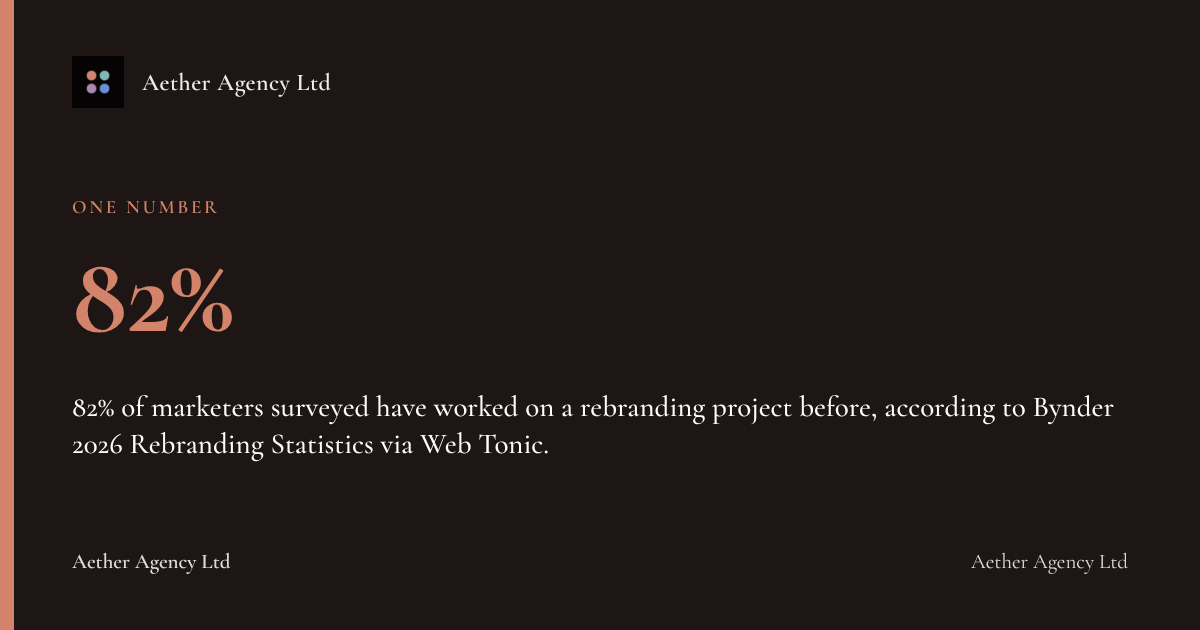
- 82% of marketers surveyed have worked on a rebranding project before, according to Bynder 2026 Rebranding Statistics via Web Tonic.
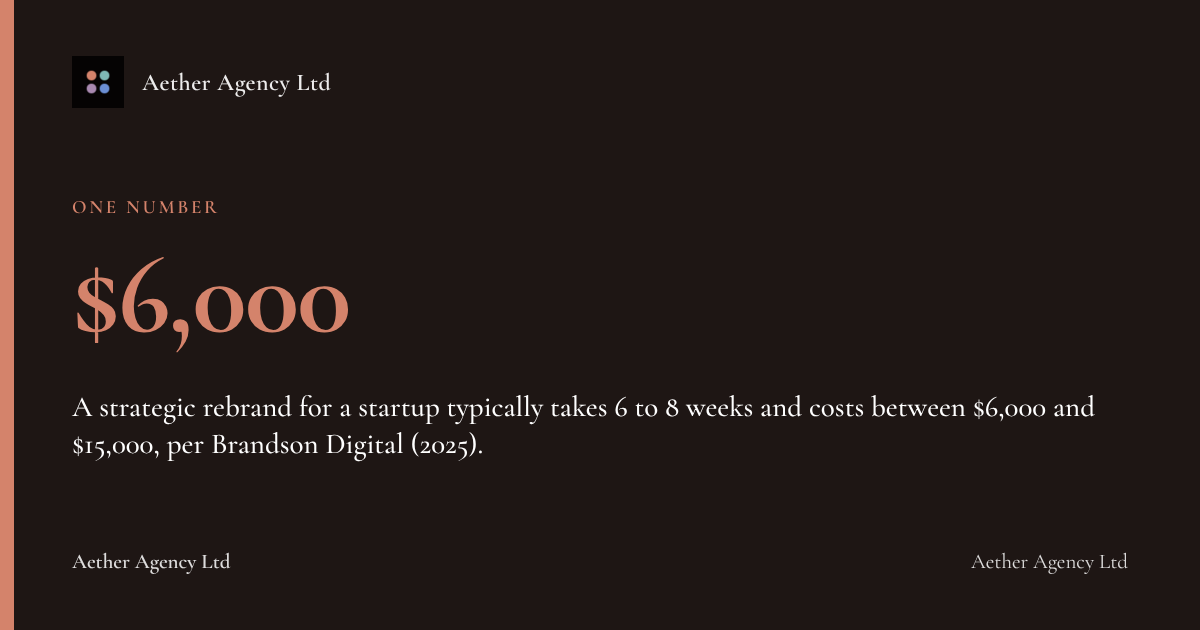
- A strategic rebrand for a startup typically takes 6 to 8 weeks and costs between $6,000 and $15,000, per Brandson Digital (2025).
- Around 77% of rebranding efforts fail, often through poor execution or loss of consumer trust, reports GoodFirms, citing WifiTalents (2026).
- Companies typically earmark 5 to 10% of their total marketing budget for rebranding initiatives, according to GoodFirms (2026).
- Aether Agency Ltd advises that Companies House requires a special resolution and form NM01 to legally change a registered company name in the UK.
What Is Rebranding a Startup?
Rebranding a startup is the process of deliberately changing a young company's name, logo, visual identity, messaging or market positioning to better reflect its product, audience or ambitions. It differs from a simple "brand refresh", which updates colours, fonts or a logo without changing the underlying name or strategy.
Founders usually reach for a rebrand, rather than a refresh, when the current brand actively works against the business: a name that no longer fits the product, a visual identity that looks amateurish next to funded competitors, or a positioning built for a market the company has already outgrown. 74% of S&P Global 100 companies rebrand an acquired asset within the first seven years of a deal, according to the Landor M&A brand study via Web Tonic (2026), which shows that even large, well-resourced organisations treat rebranding as a normal response to growth and change, not a last resort.
At Aether Agency Ltd, a branding studio incorporated on 3 June 2020 (Companies House 12641621), rebranding sits at the centre of the brand identity service: naming, identity systems and guidelines built to survive every channel a startup touches, from the website to social media to investor decks.
What Are the Main Reasons a Startup Would Need to Rebrand?
A startup needs to rebrand when its current brand no longer matches its product, audience, funding stage or market position, creating friction that a logo tweak cannot fix. Common triggers include a pivot away from the original product, expansion into new markets or geographies, a merger or acquisition, a damaging name clash with a bigger competitor, or simply outgrowing a founder-era identity that looked fine on a laptop but falls apart on a pitch deck.
External pressure plays a role too. 79% of Americans think companies will need to rebrand to stay relevant, and 75% believe companies rebrand their products when they should actually be rebranding their ethics and values, according to the Harris Poll (2023). That distinction matters for startups raising investment, since VCs and angel networks often scrutinise brand credibility alongside the numbers.
Market shocks drive rebrands too, not just internal strategy. Between 2020 and 2021, 70% of companies rebranded due to pandemic shifts and changing consumer needs, according to GoodFirms, citing AMRA & Elma (2026), proof that external disruption, not just internal ambition, pushes founders to act. For a UK startup, the equivalent triggers today might be a shift to hybrid working, new UK GDPR requirements under the Data Protection Act 2018, or a Companies House filing change following a funding round that renames the parent entity.
Renton Dance Studio illustrates this well: a traditional digital presence was failing to reach a younger audience, so Aether Agency Ltd delivered a complete rebrand, website redesign and social media content creation that moved the brand and website from traditional to modernised. The studio owner, Olivia, said: "I recently had the pleasure of working with Lauren and Ellie at Aether Agency to enhance the branding for my dance studio. Even though I struggled to articulate exactly what I wanted, they somehow captured the exact style I had envisioned."
What Are the Step-by-Step Stages Involved in Rebranding a Company?
Rebranding a company follows a sequence of discovery, strategy, design, legal clearance and rollout, usually in that order, so that legal and strategic decisions happen before any design work is finalised. Skipping stages, particularly trademark clearance, is one of the most expensive mistakes a founder can make.
A typical stage sequence looks like this:
- Discovery and audit: review the existing brand, customer feedback, competitor positioning and internal reasons for change.
- Strategy and positioning: define the new brand's purpose, audience and differentiation before any visual work starts.
- Naming (if changing): generate name options, then clear each one through a UK trademark search.
- Legal clearance: confirm trademark availability, domain availability and social handle availability together, since a name can clear one check and fail another.
- Visual identity design: logo, colour palette, typography and brand guidelines.
- Companies House filing: pass a special resolution and submit form NM01 if the registered company name is changing.
- Asset rollout: update website, social profiles, signage, email signatures, stationery and product packaging.
- Announcement and migration: communicate the change to customers, investors and staff, with website redirects in place.
Fluent AI, an AI consulting platform for small businesses, needed this full sequence from a standing start: brand identity, a bespoke website and SEO/GEO strategy, the same generative-engine discipline Aether Agency Ltd applies to its own site. Fluent AI is a related business, not an independent client: it is owned by Lauren Dawkins, who also runs Aether Agency. Recorded outcomes include traffic growth of 3x and lead generation up 250% (no earlier figure on record).
How Much Does Rebranding a Startup Typically Cost in the UK?
Rebranding a startup typically costs between $6,000 and $15,000 for a strategic refresh covering updated positioning and refined identity, according to Brandson Digital (2025). UK founders should treat this as a useful benchmark range rather than a fixed quote, since scope, number of assets and whether the name itself changes all move the final cost significantly.
| Rebrand scope | What's typically included | Illustrative UK cost range |
|---|---|---|
| Light refresh | Logo refinement, colour/typography update, no name change | Lower end of the Brandson Digital range |
| Strategic rebrand | New positioning, refined identity, website updates | $6,000 to $15,000 (Brandson Digital, 2025) |
| Full rebrand with new name | Naming, trademark clearance, new identity, full website rebuild, social migration | Above the strategic rebrand range, scaling with asset count |
Budget planning should also reflect what the business already spends on marketing. Companies typically earmark 5 to 10% of their total marketing budget toward rebranding initiatives, according to GoodFirms (2026), which gives founders a sense-check figure when setting a rebrand budget against annual marketing spend rather than treating it as an unlimited, open-ended project.
Ways to reduce rebrand costs
- Phase the rollout, updating highest-traffic assets (website, primary social profiles) first and lower-priority items (merchandise, old stationery) later.
- Reuse existing photography and copywriting where the strategy hasn't changed, rather than recommissioning everything.
- Bundle the rebrand with a planned website rebuild, since both projects share discovery and strategy work.
- Choose an agency offering brand identity and website development together, avoiding duplicated discovery fees across two suppliers.
How Long Does a Full Rebrand Usually Take From Start to Finish?
A full rebrand usually takes between 6 and 8 weeks for a focused strategic rebrand, according to Brandson Digital (2025), though larger organisations with more stakeholders and assets take considerably longer. The average rebrand across all company sizes takes seven months and touches 215 marketing assets, according to Bynder, via Empact Partners (2026), a figure driven up by enterprise-scale projects with legal, regional and franchise complications a startup rarely faces.
For a startup specifically, timeline depends on three factors: whether the name itself is changing, how many assets exist to migrate, and how quickly trademark clearance comes back. A startup with a handful of social accounts, a single website and no franchise agreements will sit much closer to the 6 to 8 week end of the range than the seven month average.
Do I Need to Update My Trademarks When Rebranding, and How Do I Check for Conflicts?
Yes, trademarks need checking and updating whenever a startup changes its name or logo, because operating under an unregistered or conflicting mark exposes the business to a forced rebrand later, often after far more money has been spent on the new identity. Trademark clearance should happen before design work is finalised, not after.
In the UK, founders should search the UK Intellectual Property Office (IPO) trademark register alongside checking domain availability and social handle availability for the proposed name, since a name can be legally available as a trademark but already taken as a domain, or vice versa. A proper clearance check covers:
- Identical or similar marks already registered in the same trade classes at the UK IPO.
- Existing unregistered trading names in the same sector (common law "passing off" risk under UK law).
- Domain availability across the primary .co.uk and .com extensions.
- Social handle availability across the platforms the business actually uses.
Skipping this step is a leading cause of rebrand failure. Around 77% of rebranding efforts fail, often due to poor execution, lack of consumer trust, or incorrect name changes, according to GoodFirms, citing WifiTalents (2026). A conflicting trademark discovered after launch forces a second, more expensive rebrand within months of the first.
What Are the Legal Requirements for Changing a Company Name With Companies House?
A UK company changing its registered name must pass a special resolution, a formal shareholder vote requiring at least 75% approval, and then file form NM01 with Companies House, the UK's registrar of companies. The name change only takes legal effect once Companies House issues a certificate confirming the change, typically within a few working days of a correctly submitted filing.
Founders should also check that the new name isn't "too similar" to an existing registered company name, since Companies House can reject applications on that basis, and separately confirm VAT registration, business bank account and HMRC records are all updated once the certificate is issued. None of this replaces a trademark search; Companies House checks company name uniqueness only, not trademark rights, so a name can pass Companies House registration and still infringe someone else's registered trademark.
Who Should Be Responsible for Leading a Rebrand Within a Small Team?
A single named owner, usually the founder or a senior marketing lead, should lead a startup rebrand, with a small cross-functional group feeding into decisions rather than approving every stage by committee. 82% of marketers surveyed have worked on a rebranding project before, according to Bynder 2026 Rebranding Statistics via Web Tonic, meaning most marketing hires joining a startup will already understand the discipline, even if they haven't led one.
Smaller teams without in-house design or brand strategy capability typically bring in a branding agency to run strategy, naming and identity work, while keeping one internal decision-maker as the single point of approval. This avoids the common trap of design-by-committee, where too many stakeholders dilute a distinctive new identity into something generic. Aether Agency Ltd's team brings 20+ years of combined experience to brand identity projects of this kind, working alongside the founder as the decision-maker rather than replacing their judgement.
What Are the Most Common Mistakes Startups Make When Rebranding, and How Do They Avoid Losing Customers?
The most common mistakes are changing the name before clearing trademarks, rebranding without a clear strategic reason, and launching the new identity with no communication plan for existing customers. Each mistake compounds the risk already carried by rebranding itself, given that around 77% of rebranding efforts fail, according to GoodFirms, citing WifiTalents (2026).
To avoid losing customers during the transition, founders should:
- Announce the change ahead of launch, not after, giving customers context before they encounter a changed logo or renamed product.
- Keep the old name live as a redirect or "formerly known as" reference for several months after launch.
- Update email signatures, invoices and customer-facing documents on the same day the public announcement goes out, avoiding a mismatched transition period.
- Brief customer-facing staff and support teams before the public announcement, so they aren't caught off guard by customer questions.
What Needs to Be Updated Across Branding Assets, Website and Social Media After a Rebrand?
A startup rebrand touches far more assets than most founders expect, since the average rebrand touches 215 marketing assets, according to Bynder, via Empact Partners (2026). A practical UK startup rollout should treat the following as a minimum checklist, not an exhaustive one.
| Asset category | Examples to update |
|---|---|
| Legal and registration | Companies House record, VAT registration, HMRC correspondence address, business bank account name |
| Website | Domain, logo, colour scheme, copy, meta titles, 301 redirects from old URLs |
| Social media | Profile names, handles, bios, pinned posts, link-in-bio tools |
| Marketing collateral | Email signatures, pitch decks, sales one-pagers, case studies |
| Physical and product | Signage, packaging, business cards, product labels |
Website migration deserves particular care, since changing domains without proper redirects can erase organic search visibility built up over years. This is where a combined brand identity and website development approach pays off, migrating search equity alongside the visual identity rather than treating them as separate projects run months apart.
How Do I Announce a Rebrand to Customers, Investors and the Public, and How Do I Measure Success?
A rebrand announcement should go to investors and key customers first, under embargo, before the public reveal, giving stakeholders context and avoiding the appearance that the business is hiding something. The announcement sequence typically runs: investors and board, then staff, then key accounts, then a public announcement across the website and social media on the same day.
Measuring success afterwards means tracking metrics that existed before the rebrand and comparing them against the same metrics afterwards: website traffic, lead volume, social following growth, customer retention and brand search volume. Natural Instinct, a food brand working with Aether Agency Ltd on social media management, content creation and campaign strategy, recorded 27,000+ Instagram followers and 500+ stockists, figures that show what sustained brand and content work can look like once measured consistently over time. Founders rebranding should set up equivalent tracking before launch, not after, so the comparison is possible at all.
Your Rebranding a Startup Checklist
- Define the strategic reason for the rebrand before commissioning any design work.
- Search the UK IPO trademark register, domain availability and social handles together for any new name.
- Budget 5 to 10% of total marketing spend, using the $6,000 to $15,000 Brandson Digital range as a sense-check for a strategic rebrand.
- Allow 6 to 8 weeks for a focused rebrand, longer if the name itself is changing.
- File a special resolution and form NM01 with Companies House if the registered name is changing.
- Brief investors, staff and key customers before the public announcement.
- Set up 301 redirects from every old URL before the new website goes live.
- Track website traffic, leads and social growth from a fixed date before launch.
FAQ
What is the difference between a rebrand and a brand refresh?
A rebrand changes the fundamental elements of a business, potentially including the name, positioning and visual identity together. A brand refresh updates visual details such as colours, fonts or a logo while keeping the name and core strategy unchanged.
Does a startup legally have to change its name when rebranding?
No, many rebrands change only the visual identity and positioning while keeping the registered company name the same with Companies House. A full legal name change via special resolution and form NM01 is only required if the business is also changing its trading and registered name.
How much of a startup's budget should go towards a rebrand?
Companies typically earmark 5 to 10% of their total marketing budget toward rebranding initiatives, according to GoodFirms (2026). For an early-stage startup, a strategic rebrand itself typically costs between $6,000 and $15,000, per Brandson Digital (2025).
Can I keep my old company name for SEO purposes after rebranding?
Yes, keeping the old domain live with 301 redirects to the new site preserves most existing search engine authority. Dropping the old domain entirely without redirects risks losing organic traffic built up before the rebrand.
How do I check if a new brand name is trademarked in the UK?
Search the UK Intellectual Property Office's trademark register for identical or similar marks in the relevant trade classes. This check should run alongside domain and social handle availability checks before any design work begins.
Why do most rebrands fail?
Around 77% of rebranding efforts fail, often due to poor execution, lack of consumer trust, or incorrect name changes, according to GoodFirms, citing WifiTalents (2026). Most failures trace back to skipping trademark clearance, rebranding without a clear strategic reason, or launching with no customer communication plan.
Who should lead a rebrand in a small startup team?
A single named owner, typically the founder or senior marketing lead, should lead the rebrand with a small group feeding into decisions. Many startups bring in a branding agency to run strategy, naming and identity work while that internal owner retains final approval.
Rebranding a Startup With Aether Agency Ltd
Aether Agency Ltd works with growing businesses facing exactly the triggers covered in this article: a pivot that's outgrown the old name, a visual identity that no longer matches investor expectations, or a digital presence that's stopped reaching the audience it needs to reach. The agency's brand identity service covers naming, identity systems and guidelines built to survive every channel, from launch day through years of growth.
Renton Dance Studio's rebrand, website redesign and social content work shows what this looks like in practice: a traditional presence transformed into a modernised brand and website built to reach a younger audience. Aether Agency Ltd has delivered 50+ projects to date, backed by a team with 20+ years of combined experience in brand identity work.
If your startup is weighing up whether to rebrand, get in touch with Aether Agency Ltd to talk through the strategy, timeline and cost before committing to any design work.
Related Reading
- Branding for Schools: A UK Decision-Maker's Guide
- Branding for Construction Companies: A UK 2026 Guide
- Complete Rebranding Strategy Guide | Aether Agency Ltd
Add aether-agency.co.uk as a preferred source on Google
See How Your Brand Appears in AI Search
Aether AI monitors your visibility across ChatGPT, Perplexity, Google AI Overviews, and Claude in real time. Find out where you stand and what to fix.
Explore Aether AI