Last updated: 9 November 2026
Dance studio branding is the combination of name, logo, colour palette, typography and tone of voice that makes a studio instantly recognisable to parents, adult learners and local competitors. UK studios typically spend between 5% and 15% of annual revenue on marketing and brand-building, according to industry budget guidance, and a well-executed rebrand can directly change enrolment, as shown by studios that repositioned around a clear niche audience.
Key Takeaways
- Aether Agency Ltd notes that dance studio branding covers five core elements: name, logo, colour palette, typography and tone of voice, all working together across every touchpoint from signage to Instagram.
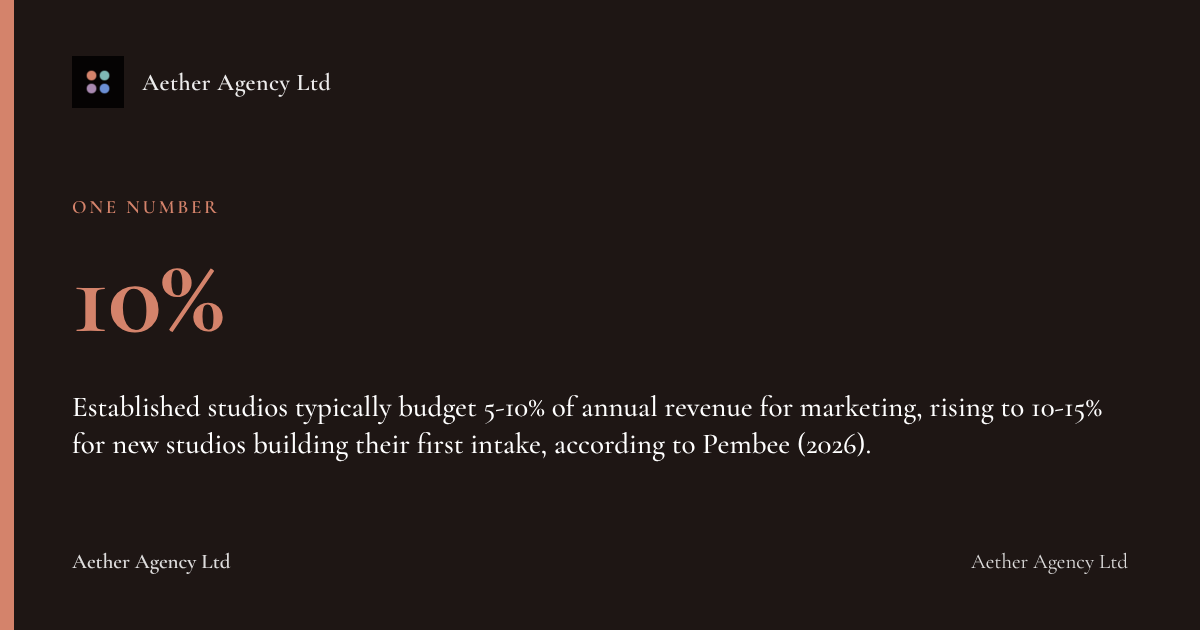
- Established studios typically budget 5 to 10% of annual revenue for marketing, rising to 10 to 15% for new studios building their first intake, according to Pembee (2026).
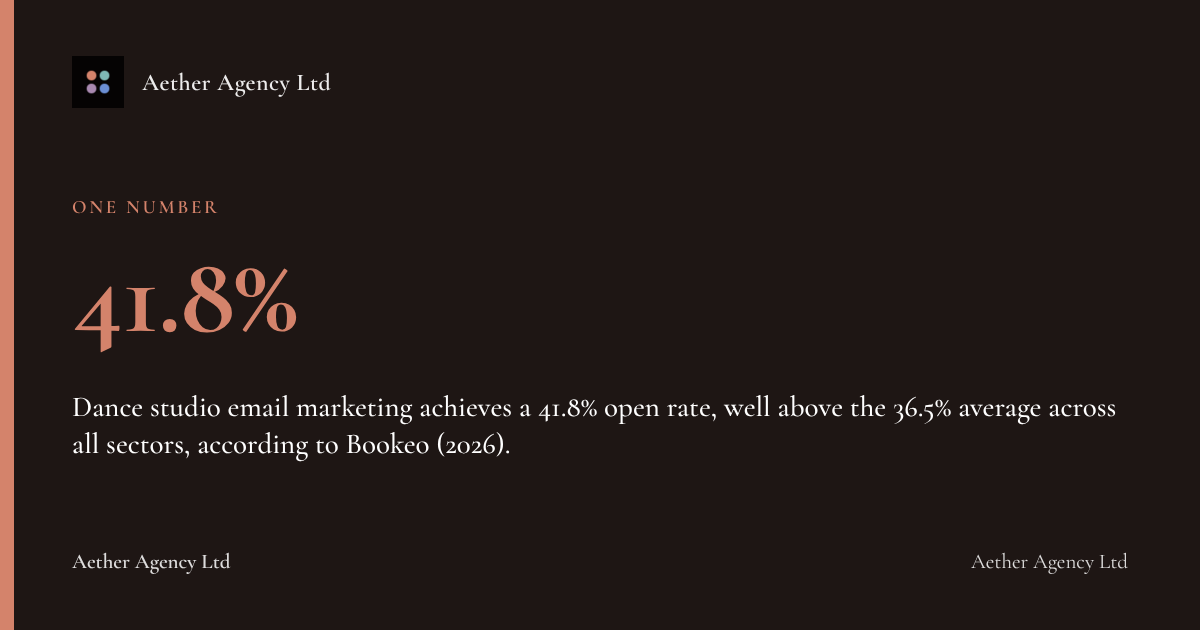
- Dance studio email marketing achieves a 41.8% open rate, well above the 36.5% average across all sectors, according to Bookeo (2026).
- 88% of people trust a personal recommendation over any other marketing channel, according to GoStudioPro (2026), which makes a consistent, referral-friendly brand identity a commercial priority, not just a visual one.
- Before finalising any studio name, owners must check availability at Companies House and the UK Intellectual Property Office (IPO) trademark register, because an unregistered name offers no legal protection.
What Is Dance Studio Branding?
Dance studio branding is the strategic system of visual and verbal elements, including a name, logo, colour palette, typography and tone of voice, that together communicate what a studio stands for and who it serves. It is distinct from marketing: branding is the identity a studio builds once, while marketing is the ongoing activity of promoting that identity to fill classes.
A logo is the visual mark, usually a wordmark, symbol or combination, that appears on everything from the studio's front window to its class timetable. The colour palette is the fixed set of two to four colours used consistently across signage, uniforms, social posts and the website, so that a parent recognises the studio brand before reading a single word.
Typography means the specific typefaces chosen for headings and body text, which should remain fixed across printed timetables, the website and social graphics. Tone of voice is the consistent personality in written communication, whether that's the playful, encouraging language suited to a children's ballet school or the high-energy, no-nonsense copy that works for an adult street dance or fitness class.
Aether Agency Ltd works with studios on exactly this combination through its Brand Identity service, building naming, identity systems and guidelines designed to hold up across every channel a studio uses, from a shopfront in a high street unit to a booking confirmation email.
How Much Does Dance Studio Branding Cost in the UK?
Dance studio branding costs in the UK range from effectively nothing for a DIY logo using free design tools, to several thousand pounds for a full agency-led identity system with brand guidelines, website design and signage. The right budget depends on whether a studio needs a simple refresh or a complete repositioning before a competitor opens nearby.
Industry budget guidance suggests established studios should hold back 5 to 10% of annual revenue for ongoing marketing, while new studios building their first cohort should plan for 10 to 15%, according to Pembee (2026). Separately, Bookeo (2026) puts typical small-business marketing spend at 5 to 8% of gross revenue, rising to 10 to 12% for new studios chasing rapid brand awareness. Branding itself is usually a one-off or periodic cost sitting outside this ongoing marketing budget, though the two should align.
| Branding route | Typical UK cost range | Best suited to |
|---|---|---|
| DIY (Canva, free logo tools) | £0 to £150 | Very early-stage studios testing a concept before committing |
| Freelance designer | £300 to £1,500 | Studios needing a professional logo and basic brand guide on a tight budget |
| Branding agency (full identity) | £2,000 to £10,000+ | Growing studios, multi-site operators or anyone rebranding to reposition against local competitors |
| Agency + website + ongoing marketing | £5,000 to £15,000+ | Studios investing in a full relaunch: brand, website and search visibility together |
A DIY logo might save money upfront, but it rarely comes with the guidelines, scalable files and brand strategy that prevent inconsistency once a studio has three staff members each designing their own flyers. An agency-led project typically includes a brand strategy session, logo design, colour and typography system, a brand guidelines document and application across signage, uniforms and digital channels.
What Steps Are Involved in Creating a Dance Studio Brand From Scratch?
Creating a dance studio brand from scratch involves six broad stages: research, positioning, naming, visual identity design, guideline documentation and rollout across every customer touchpoint. Skipping the research and positioning stages is the single most common reason studios end up with a logo they like but a brand that doesn't convert enquiries.
- Research the local market. Identify every dance studio within a reasonable travel radius, noting their class types, pricing and visual identity, so the new brand can differentiate rather than blend in.
- Define the positioning. Decide whether the studio is the competitive ballet school, the welcoming beginner-friendly space, or the high-energy adult fitness studio, because this single decision shapes every design choice that follows.
- Choose and clear the name. Shortlist two or three names, then check each one against Companies House and the IPO trademark register before attaching any creative work to it.
- Design the visual identity. Develop the logo, colour palette and typography as a system, testing how the logo scales from a 2cm app icon to a large studio window.
- Document brand guidelines. Record exact colour codes, font names, logo spacing rules and tone-of-voice examples in a single reference document that any future staff member or designer can follow.
- Roll out across every channel. Apply the new brand to the website, social profiles, class booking software, uniforms, signage and printed timetables in a coordinated launch rather than a slow drift.
Aether Agency Ltd's work with Renton Dance Studio followed broadly this path. The studio had a traditional digital presence that was failing to connect with a younger audience, and Aether Agency Ltd delivered a complete rebrand, website redesign and social media content creation that moved the studio's brand and website from traditional to modernised. As the studio's owner, Olivia, put it: "I recently had the pleasure of working with Lauren and Ellie at Aether Agency to enhance the branding for my dance studio. Even though I struggled to articulate exactly what I wanted, they somehow captured the exact style I had envisioned."
Choosing a Dance Studio Name That's Free to Use in the UK
Choosing a dance studio name that's legally free to use in the UK means confirming it isn't already registered as a company, trademark or well-established trading name in the same geographic area. Owners should run three separate checks before committing to a name: a Companies House search, an IPO trademark search and a general web and social media search for existing use.
Companies House runs the UK register of limited companies, and a quick search at companieshouse.gov.uk confirms whether the exact company name is already taken nationally. This check alone does not stop a competing studio using a similar trading name as a sole trader or partnership, so it's a starting point, not a guarantee.
The UK Intellectual Property Office (IPO) maintains the national trademark register, and a search at the IPO's online database shows whether a name, or something confusingly similar, is already trademarked in classes covering education, entertainment or fitness services. Registering a trademark with the IPO typically costs from around £170 for one class of goods or services, giving the studio exclusive legal rights to use that name nationally within that category.
A name search should also cover domain availability and social media handles, since a brand that works brilliantly on a shopfront but can't get a matching Instagram handle creates confusion later. Aether Agency Ltd notes that studios operating under a trading name different from their registered company name must display both on official documents under the Companies Act 2006, so this decision has legal as well as creative consequences.
Legal Requirements for Registering a Dance Studio Business Name and Trademark
Registering a dance studio business name in the UK legally requires choosing a structure (sole trader, partnership or limited company) and then meeting the specific registration rules that structure carries. A limited company name must be registered with Companies House and cannot be identical, or too similar, to an existing registered company name.
Sole traders and partnerships don't register a company name with Companies House, but they must still avoid trading in a way that's "passing off", meaning deliberately or accidentally trading under a name so similar to an existing business that customers are confused, which remains actionable under UK common law regardless of company structure. Trademark registration through the IPO is entirely separate from company registration and is the only route that gives exclusive national rights to a name, logo or strapline.
Aether Agency Ltd advises that a studio using children's images in marketing, which almost all dance schools do, must also comply with the UK GDPR and guidance from the Information Commissioner's Office (ICO), obtaining clear parental consent before publishing photos or video of under-18 students. Studios employing staff, even part-time dance teachers, need to check safeguarding requirements, and many choose to reference standards from bodies such as the Council for Dance, Drama and Musical Theatre (CDMT) or relevant genre-specific associations when marketing their qualifications and credibility.
Common Dance Studio Branding Mistakes and How to Avoid Them
The most common dance studio branding mistake is designing a logo and colour scheme before deciding who the studio is actually trying to attract, which produces a brand that looks fine but convinces nobody. A ballet school and a fitness-focused adult street dance class need entirely different visual languages, yet many studios default to the same soft pink-and-script look regardless of their actual audience.
A second frequent error is inconsistency: using one logo version on the website, a different one on uniforms, and no fixed colour codes anywhere, so the brand never builds recognition even after years of trading. This is precisely what a brand guidelines document, produced during the design stage, is meant to prevent.
A third mistake is skipping the legal checks covered above, committing to signage, uniforms and a domain name before confirming the name is actually free to use at Companies House and the IPO. Rebranding after a trademark dispute is far more expensive than checking beforehand.
A fourth mistake is treating branding as a one-off task rather than an ongoing discipline applied to every new channel, piece of print or staff member's email signature. Since 88% of people trust a personal recommendation over any other channel, according to GoStudioPro (2026), an inconsistent brand that confuses the very parents being asked to recommend it undermines the studio's strongest growth lever.
How Branding Differs Across Dance Studio Types
Dance studio branding must change shape depending on the studio's niche, because a ballet school, a street dance academy and an adult fitness-dance studio are selling fundamentally different experiences to different audiences. A classical ballet school typically leans on refined typography, muted or jewel-tone palettes, and a tone of voice built around discipline, heritage and progression through grades.
A street dance or commercial studio tends to use bolder colour contrasts, condensed sans-serif typefaces and a tone of voice that's energetic and youth-led, often reflecting the music and culture the classes are built around. An adult fitness-dance studio, think Zumba-style or adult ballet-fit classes, usually needs branding closer to the wider fitness industry: confident, body-positive language and imagery that doesn't assume prior dance experience.
One case worth noting: a Connecticut studio repositioned itself specifically as the go-to studio for very young children, which drove an explosion in enrolment, a 5,000 sq. ft. expansion, and growth to over 450 students in a town of only 17,000, according to Pembee (2026). The lesson for UK studios isn't the specific numbers, which come from a US market, but the principle: a sharply defined niche audience, reflected consistently in the brand, outperforms a generic "all ages welcome" identity that speaks clearly to nobody.
DIY branding vs hiring a branding agency
| Factor | DIY branding | Branding agency |
|---|---|---|
| Upfront cost | Low (£0 to £150) | Higher (£2,000+) |
| Time investment from owner | High, often 10+ hours | Low, mostly feedback rounds |
| Consistency across channels | Often weak without guidelines | Built in via a guidelines document |
| Scalability (signage, uniforms, app icons) | Frequently breaks at small/large sizes | Tested across formats during design |
| Legal name/trademark checks | Owner's responsibility, easily skipped | Usually built into the process |
| Best for | Pre-launch testing, very tight budgets | Studios ready to compete and scale |
Using Dance Studio Branding Across Marketing Channels
Dance studio branding only earns its cost once it's applied consistently across every marketing channel the studio uses, from the website and social media to physical signage and class booking confirmations. Social media matters disproportionately for studios targeting children and teenagers, since over half of US teenagers spend at least four hours a day on social media, according to GoStudioPro (2026), a pattern UK studios should treat as directionally relevant even though the figure itself is US-sourced.
Email remains one of the strongest-performing channels specifically for dance studios: dance studio emails achieve a 41.8% open rate, compared with a 36.5% average across general email marketing, according to Bookeo (2026). That performance only compounds if every email uses the studio's fixed colours, logo placement and tone of voice, rather than a generic template.
A website is usually the first place a prospective parent checks before calling or visiting, so it needs to reflect the brand as precisely as the studio's front door does. Aether Agency Ltd's Website Development service focuses on building fast, findable sites that convert enquiries into trial bookings, which matters because a beautifully branded but slow or hard-to-navigate site loses the enquiry before the brand gets a chance to work.
Beyond digital, the brand has to survive physical application too: studio signage, staff uniforms, trophy cabinets, printed timetables and even the smell and lighting of reception all either reinforce or undermine the digital brand a parent saw online first.
How to Measure Whether a Dance Studio Rebrand Has Succeeded
Measuring dance studio rebrand success means tracking a small set of enrolment, enquiry and engagement metrics before and after launch, rather than judging the new logo on appearance alone. The clearest commercial measure is enrolment growth, since one studio's repositioning around a specific niche led to a doubling of student count and revenue growth from $44k to $1 million in annual sales within a couple of years, according to Pembee (2026), a US example illustrating the scale of outcome strong positioning can unlock.
Studios should also track website traffic, enquiry form submissions, trial class bookings, email open rates, and social media follower growth and engagement in the three to six months following launch. Comparing these figures against the same period the previous year, rather than against the month immediately before launch, avoids mistaking seasonal variation for brand impact.
Qualitative measures matter too: ask new enquiries how they heard about the studio and whether the website or social profiles gave them a clear sense of what to expect. A consistent answer across many enquiries, for example "it looked more professional than the others", is a strong signal the rebrand is working even before the enrolment numbers fully reflect it.
Your dance studio branding checklist
- Define the studio's niche and target audience before any logo design begins.
- Search Companies House and the IPO trademark register for name conflicts.
- Check domain availability and social media handles for the shortlisted name.
- Commission or design a logo tested at both app-icon and shopfront scale.
- Fix a fixed colour palette (2 to 4 colours) and two typefaces, documented in guidelines.
- Apply the new brand consistently across website, social profiles, email, uniforms and signage.
- Obtain parental consent for any under-18 student imagery, in line with UK GDPR and ICO guidance.
- Track enquiries, enrolments and email open rates for at least three months post-launch.
FAQ
What is dance studio branding?
Dance studio branding is the combined system of name, logo, colour palette, typography and tone of voice that makes a studio recognisable and communicates who it serves. It covers every touchpoint a parent or student encounters, from the shopfront to the booking confirmation email.
How much does dance studio branding cost in the UK?
Dance studio branding in the UK can range from £0 for a DIY logo to £2,000 to £10,000+ for a full agency-led identity system with guidelines and rollout. Ongoing marketing spend sits separately, typically 5 to 10% of revenue for established studios and 10 to 15% for new studios, according to Pembee (2026).
How do I check if a dance studio name is already trademarked in the UK?
Search the name directly on the UK Intellectual Property Office's trademark register and run a separate check at Companies House for existing company names. Both checks should be done before committing to any logo design, signage order or domain purchase.
How long does a dance studio rebrand usually take?
A straightforward rebrand with a freelance designer can take two to four weeks, while a full agency-led project including a new website typically takes eight to twelve weeks. Timelines extend further if the studio needs trademark clearance or multi-site rollout across several locations.
Who should be involved in a dance studio's branding process?
The owner should lead on positioning decisions, while a designer or agency handles the visual system, and senior teaching staff should feed into tone-of-voice decisions since they speak to parents daily. Students and parents can usefully be consulted informally, but final decisions should stay with the owner and their design partner to avoid a brand designed by committee.
Does branding really affect how many students a dance studio enrols?
Branding influences enrolment indirectly by shaping trust and word-of-mouth, which matters because 88% of people trust a personal recommendation over any other marketing channel, according to GoStudioPro (2026). A consistent, professional brand gives existing parents something clear and credible to recommend to friends, which is the channel most likely to convert.
Should a ballet school and a street dance studio use the same branding approach?
No, a ballet school and a street dance studio should use distinctly different branding, since they serve different audiences with different expectations around discipline, energy and tone. A ballet school typically suits refined typography and muted palettes, while a street dance studio benefits from bolder colour contrast and energetic, youth-led language.
Branding your dance studio with Aether Agency Ltd
Getting dance studio branding right means balancing legal groundwork, like clearing a name at Companies House and the IPO, with the creative system of logo, colour and voice that actually fills classes. Aether Agency Ltd works through exactly this combination for growing studios, building brand identity systems designed to hold together from a studio's front window to its Instagram grid.
Aether Agency Ltd's work with Renton Dance Studio involved a complete rebrand alongside a website redesign and social media content creation, moving the studio's presence from traditional to modernised to reconnect with a younger audience, exactly the kind of repositioning challenge many UK studios now face. The studio's owner, Olivia, described the result as capturing "the exact style I had envisioned" even where she'd struggled to articulate it herself at the outset.
If a studio's current brand no longer reflects who it serves, or a local competitor has started pulling enquiries with sharper positioning, it's worth getting a second opinion before investing in another season of inconsistent marketing. Get in touch with Aether Agency Ltd to talk through a brand identity project, or explore the Brand Identity service page for more detail on how the process runs.
Related Reading
- Branding for Schools: A UK Decision-Maker's Guide
- Branding for Construction Companies: A UK 2026 Guide
- How Are Branding Projects Priced? UK Cost Guide 2026
Add aether-agency.co.uk as a preferred source on Google
See How Your Brand Appears in AI Search
Aether AI monitors your visibility across ChatGPT, Perplexity, Google AI Overviews, and Claude in real time. Find out where you stand and what to fix.
Explore Aether AI