Last updated: 8 November 2026
Branding a new business from scratch means defining who the business is for, choosing and legally clearing a name, then designing the identity (logo, colours, voice) and registering it, roughly in that order. Two out of 10 new businesses fail within their first two years, so getting the sequence right matters more than getting the logo perfect, according to Bureau of Labor Statistics data cited by Duck.Design (2025).
Key Takeaways
- Branding is not the same as marketing or identity design: branding is the strategic positioning behind a business, identity design is its visual expression, and marketing is how both get promoted.
- Name clearance has three separate layers in the UK: Companies House availability, UK Intellectual Property Office (IPO) trademark clearance, and domain/social handle availability must all be checked before launch.
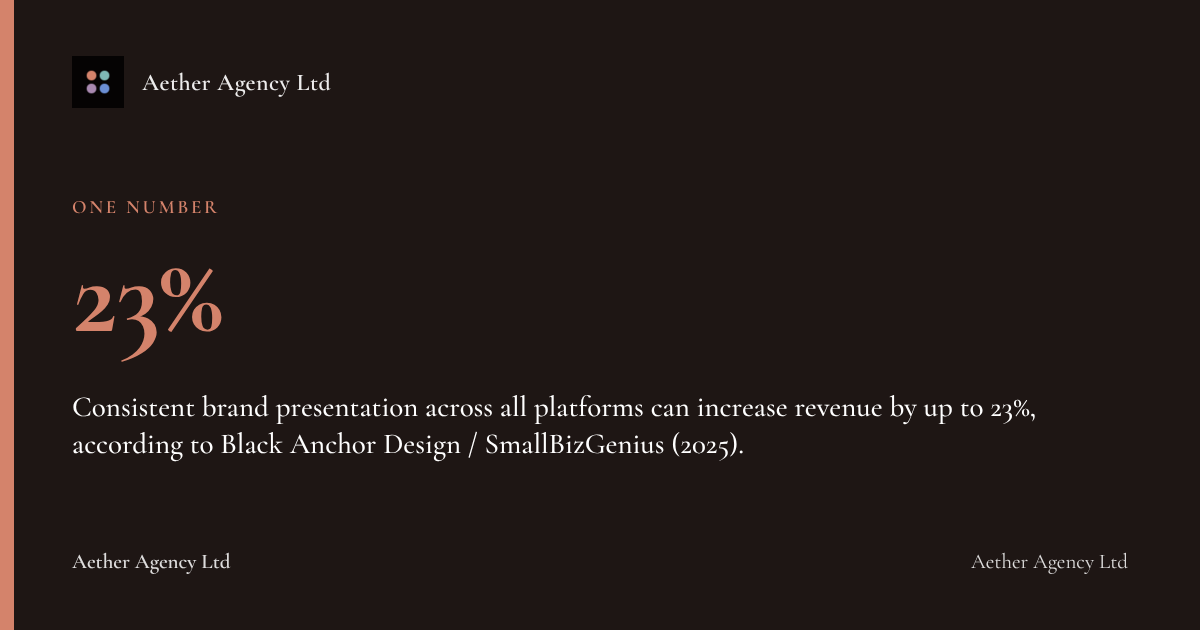
- Consistent brand presentation across all platforms can increase revenue by up to 23%, according to Black Anchor Design / SmallBizGenius (2025).
- 64% of consumers in their 20s and 30s feel a brand's values should be easy to see, according to Duck.Design (2025), which makes positioning work (not just logo design) a commercial necessity.
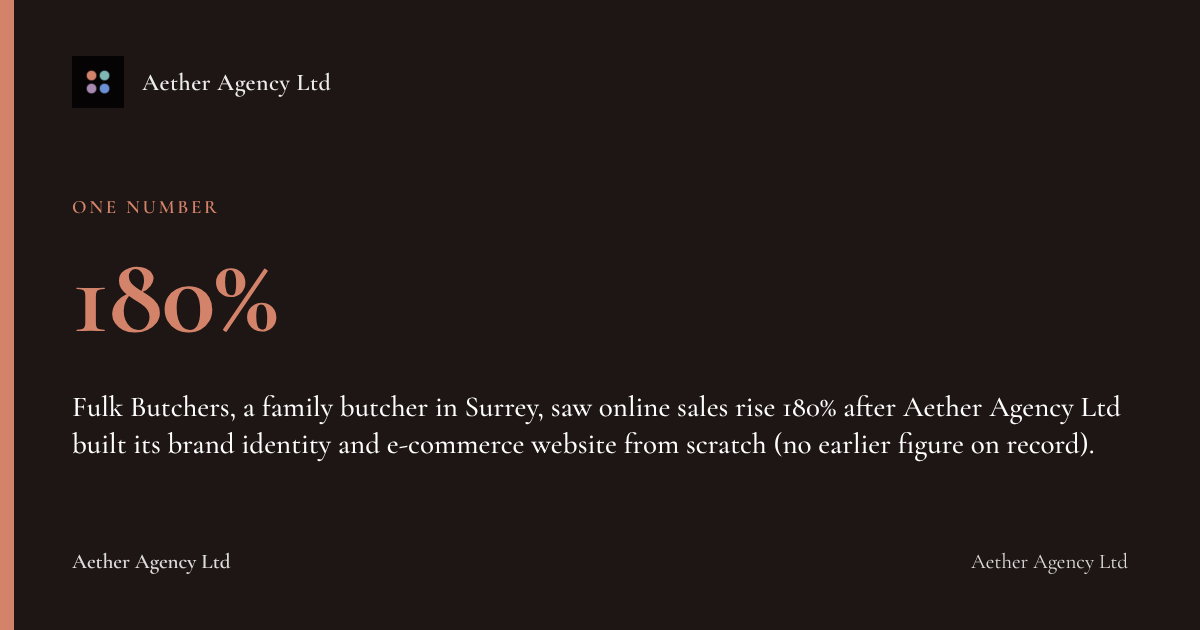
- Fulk Butchers, a family butcher in Surrey, saw online sales rise 180% after Aether Agency Ltd built its brand identity and e-commerce website from scratch (no earlier figure on record).
What Is Branding (and What Does It Actually Involve From Scratch)?
Branding is the strategic work of defining how a business is positioned, perceived and remembered, distinct from the visual assets (logo, colours, typefaces) that express it and the campaigns that promote it. Building a brand "from scratch" means there is no existing reputation, customer base or visual history to work from, so every decision, from the name to the tone of voice, has to be made deliberately rather than inherited.
The practical sequence runs in a specific order: define the audience and positioning, clear the name legally, design the identity system, then document it in brand guidelines before launch. Skipping the positioning step and jumping straight to a logo is a common cause of rebrands within the first two years, because the visual identity ends up representing nothing specific.
In practice, this is exactly the gap Aether Agency Ltd closes for businesses with an established reputation but no formal identity. Fulk Butchers, a family butchers in Surrey, had a strong local reputation but no brand identity and no route to online orders. Aether Agency Ltd built a full brand identity from scratch and delivered an e-commerce website with online ordering, alongside ongoing social media and marketing, with one team carrying the identity through from packaging to the order confirmation email. Online sales rose 180% and the business holds a 4.8-star Google rating (both figures recorded after the work, with no earlier figure on record).
Branding vs Marketing vs Identity Design: Where Does Each One End?
Branding, marketing and identity design are three distinct disciplines that get conflated constantly, and confusing them is why many new businesses commission a logo and assume the brand is "done". Branding is the underlying strategy (who you serve, what you stand for, how you're different); identity design is the visual system that expresses that strategy (logo, colour palette, typography, imagery style); marketing is the ongoing activity of getting that identity in front of the right people.
| Discipline | What it answers | Typical output | When it's done |
|---|---|---|---|
| Branding (strategy) | Who are we, who is this for, why do we matter | Positioning statement, brand values, tone of voice | Before any design work starts |
| Identity design | What does the brand look like | Logo, colour palette, typography, brand guidelines | After positioning is agreed |
| Marketing | How do people find out about us | Website, social content, search campaigns, email | Ongoing, after launch and continuously |
A 2025 Shopify survey of store owners found that 37% cited marketing as their biggest challenge and 36% said finding customers was their top struggle, according to Shopify (2025). That data point matters here because many founders think a marketing problem is actually a branding problem, or vice versa; if the positioning is unclear, no amount of marketing spend fixes it, and if the positioning is solid but nobody has seen it, that's a marketing and search visibility gap, which is where services like AI Search Marketing (GEO) come in once the identity is settled.
Defining Your Target Audience and Brand Positioning Before Any Logo Work
Defining a target audience means specifying exactly who the business serves, in enough detail to make design and messaging decisions, before a single logo concept is sketched. Positioning follows from that: it's a one or two sentence statement of what the business does, for whom, and why it's different from the alternative they'd otherwise choose.
Skipping this step is expensive precisely because it's invisible at first. A logo can look finished and still fail commercially if nobody can say who it's for.
A practical positioning exercise covers four questions:
- Who exactly is the customer? Not "small businesses" but a specific sector, size and problem.
- What alternative are they currently using? A competitor, a DIY approach, or doing nothing at all.
- What does this brand do differently or better? One clear differentiator, not five vague ones.
- What tone fits that audience? Formal and authoritative suits professional services; playful and informal suits consumer lifestyle brands.
64% of consumers in their 20s and 30s feel it should be easy to see a brand's values, according to Duck.Design (2025), which means positioning work isn't academic. It directly affects whether a younger customer base trusts the brand enough to buy. Paige Arnof-Fenn, Founder and CEO of Mavens & Moguls, put it plainly: "the business's personality is an extension of my own, and I think it has to be consistent to be an authentic brand." That consistency has to be decided before the designer opens a file, not negotiated afterwards through endless logo revisions.
Choosing a Business Name That's Available and Clear in the UK
Choosing a UK business name means finding one that's available on three separate registers at once: Companies House, the UK Intellectual Property Office trademark database, and domain/social handle providers. Checking only one and assuming the others follow is a common and costly naming mistake a new business can make.
Start with a shortlist of three to five names, then run each through all three checks before getting emotionally attached to any of them:
- Companies House name availability search, to confirm no identical or "too similar" company name is already registered in England, Scotland, Wales or Northern Ireland.
- UK IPO trademark database search, to confirm no one holds a registered trademark in your business category that would block you from using the name commercially, even if the company name itself is free.
- Domain and social handle availability, across the TLDs and platforms your customers actually use, since a brand name that's legally clear but has no matching domain still causes friction.
Deborah Sweeney, CEO of MyCorporation, frames the stakes directly: "My best piece of advice for entrepreneurs to successfully brand their business is to protect your intellectual property." A name that passes Companies House but infringes an existing UK trademark can force a business to rebrand entirely after launch, at far greater cost than checking properly beforehand.
Registering a Trademark With the UK Intellectual Property Office
Registering a trademark with the UK Intellectual Property Office (IPO), the government body responsible for patents, trademarks and designs in the UK, protects a business name, logo or slogan from being used by competitors in the same trade category. Filing involves searching the existing register for conflicts, selecting the correct trade classes (the standardised categories, such as "clothing" or "software", that define what the trademark covers), then submitting the application for examination.
UK trademark costs and process steps differ from the USPTO process often referenced in US guidance, and UK founders should check gov.uk directly for current IPO fee schedules rather than relying on US figures. For comparison, US guidance shows the scale of what trademark registration typically costs in similar economies: TEAS Standard applications cost $350 per class, and most small businesses file in one to two classes, putting government fees at $250 to $700 depending on filing option, according to the USPTO fee schedule via Thompson Patent Law (2025). UK businesses should treat trademark registration as a budgeted line item from day one rather than an afterthought once the brand is already trading, since a successful challenge after launch is far more disruptive than a pre-launch name change.
The IPO examination process typically takes several months from submission to registration, assuming no objections or oppositions are raised. Businesses planning a UK-wide or EU expansion should factor this timeline into their launch date rather than assuming the trademark will clear instantly.
How Much Should a New UK Business Budget for Branding?
A new UK business should budget for branding across three separate cost categories: name clearance and trademark, logo and identity design, and the website that carries that identity live. Each category has its own realistic range, and conflating them into one "branding budget" line is how founders underestimate total cost.
| Branding cost area | DIY / budget route | Freelancer | Agency (full identity + website) |
|---|---|---|---|
| Logo design | Free to low-cost via Canva or similar tools | Typically a few hundred pounds | Part of a full identity package |
| Trademark search and filing | Self-filed via gov.uk IPO portal | Solicitor-assisted, added fee | Often coordinated alongside identity work |
| Brand identity system (colours, type, guidelines) | DIY template | Mid-range, scoped per project | Full system, built to survive every channel |
| Website | Template builder (Wix, Squarespace) | Custom build, scoped per project | Integrated with brand identity from the start |
Findstack reports that 67% of small businesses are willing to pay $500 for a good logo design, and 16% will spend $1,000, while around 50% of small businesses create their own logo from scratch, according to Findstack (2026). That DIY split matters for UK founders too: it shows real appetite for low-cost logo tools, but a logo alone isn't a brand. Colour increases brand recognition by up to 80%, according to Hostinger (2025), which is precisely why a coherent colour and typography system (not just a mark) is where most of a branding budget's value sits (Hostinger (citing color/brand recognition studies)).
DIY tools vs freelancer vs agency: the real trade-off
Canva and similar DIY tools suit a founder who needs something usable within days and has no budget at all, but they rarely produce a differentiated identity because templates are, by design, shared with thousands of other users. A freelancer sits in the middle: more bespoke than a template, but the founder typically still has to brief positioning, coordinate the website separately, and manage consistency across channels themselves. An agency that delivers brand, website and ongoing marketing as one team (Aether Agency Ltd's model, as demonstrated with Fulk Butchers) removes that coordination burden, because the same people who defined the brand also built the site that has to express it.
Common Branding Mistakes New UK Businesses Make
New UK businesses repeatedly make the same handful of branding mistakes, most of which come from treating sequencing as optional rather than essential. Here are the ones with the clearest commercial consequences:
- Designing the logo before defining the audience. The identity ends up generic because it wasn't built to speak to anyone specific.
- Checking Companies House but skipping the UK IPO trademark search. A legally registered company can still be forced to rebrand if it infringes an existing trademark.
- Treating the domain as an afterthought. Securing the name at Companies House without checking domain and social handle availability leads to a mismatched online identity.
- Inconsistent presentation across channels. Consistent brand presentation across all platforms can increase revenue by up to 23%, according to Black Anchor Design / SmallBizGenius (2025), yet many new businesses use different logos, colours or tones on their website versus their social profiles.
- No brand guidelines document. Without one, every new hire, freelancer or agency interprets the brand differently, and consistency erodes within months.
- Underestimating how much customer experience shapes the brand. 72% of consumers share a positive user experience with at least six people, according to Hostinger (2025), meaning the brand lives in service delivery, not just visual design (Hostinger).
Creating Brand Guidelines That Keep the Identity Consistent
Brand guidelines are a documented reference (typically a PDF or shared digital asset) that specifies exactly how a logo, colour palette, typography and tone of voice must be used across every channel, so the brand looks and sounds the same whoever is producing the material. Without this document, consistency depends entirely on institutional memory, which breaks down the moment a founder delegates design or marketing work to someone new.
A working brand guidelines document should cover:
- Logo usage rules: minimum size, clear space, acceptable and unacceptable variations.
- Colour palette with exact codes: hex, RGB and CMYK values, so printers and web developers use identical colours.
- Typography hierarchy: which typeface for headings, which for body text, and fallback fonts for digital use.
- Tone of voice guide: example phrases showing how the brand sounds formal or casual, written as "do this, not that" examples.
- Imagery and photography style: the kind of photography, illustration or iconography that fits the brand, so a hired photographer or freelancer briefs correctly.
Aether Agency Ltd builds identity systems and guidelines designed to hold together across every channel a growing business touches, from packaging through to email and social media, which is the model applied on the Fulk Butchers project, where the same identity carries from product packaging to the online order confirmation.
Your branding from scratch checklist
- Define your target audience and a one-sentence positioning statement before any design work begins.
- Shortlist three to five business names and check each against Companies House, the UK IPO trademark database, and domain/social handle availability.
- Budget separately for trademark filing, logo and identity design, and website development, rather than treating branding as one cost line.
- Decide whether DIY tools, a freelancer, or a full agency fits your budget and coordination capacity before briefing anyone.
- Commission or design a colour palette and typography system, not just a logo mark.
- Document a brand guidelines file covering logo usage, colours, typography and tone of voice before launch.
- Register your business name with Companies House only after trademark and domain checks confirm it's genuinely clear.
- Keep the identity consistent across the website, social profiles and any physical packaging from day one.
FAQ
What are the essential steps to build a brand identity from the ground up?
The essential steps are: define the target audience and positioning, clear the name legally across Companies House, UK IPO trademarks and domains, design the visual identity (logo, colours, typography), then document it in brand guidelines before launch. Skipping the positioning step and starting with logo design is a common reason new brands feel generic.
How do I choose a business name that's available and not trademarked in the UK?
Check the name against three separate registers: the Companies House name availability search, the UK Intellectual Property Office trademark database, and domain/social handle availability. A name can be free at Companies House but still infringe an existing UK trademark in your trade category, so all three checks are necessary, not optional.
How much should a new business budget for branding in the UK?
Budget should cover three categories separately: trademark search and filing, logo and identity design, and website development, rather than one lump sum. Findstack found 67% of small businesses are willing to pay $500 for a logo and 16% will spend $1,000, according to Findstack (2026), though a full identity system with guidelines and a website typically costs considerably more than a logo alone.
What's the difference between branding, marketing and identity design?
Branding is the strategic positioning of who a business serves and why it matters; identity design is the visual system (logo, colours, typography) that expresses that strategy; marketing is the ongoing promotion of both. A business can have a strong logo and still have weak branding if the underlying positioning was never properly defined.
Should I hire a branding agency or freelancer, or use DIY tools like Canva?
The right choice depends on budget and coordination capacity: DIY tools suit a founder needing something usable within days with no budget, a freelancer suits a mid-range bespoke brief, and an agency suits a business that wants brand, website and ongoing marketing delivered as one coordinated team. Aether Agency Ltd's work with Fulk Butchers shows the agency route in practice, where brand identity, e-commerce website and ongoing marketing were delivered by a single team so the identity stayed consistent from packaging to order confirmation emails.
How long does it typically take to develop a complete brand from scratch?
Timescales vary considerably depending on scope, but a full process covering positioning, name clearance, identity design and guidelines typically takes several weeks to a few months for a small business, longer for complex multi-market brands. Rushing the positioning phase to hit a launch date is a common cause of rebrands within the first two years.
What legal checks should I do before finalising a brand name?
Check Companies House for name availability, search the UK IPO trademark database for conflicts in your trade category, and confirm domain and social handle availability across the platforms your customers use. Deborah Sweeney, CEO of MyCorporation, advises entrepreneurs to "protect your intellectual property" as the single most important piece of naming advice.
Branding your new business with Aether Agency Ltd
Sequencing a new brand correctly, positioning first, then name clearance, then identity design, then guidelines, is exactly the process Aether Agency Ltd runs for businesses launching with no existing visual identity at all. The Fulk Butchers project shows this in practice: a family butchers in Surrey with real local reputation but no brand identity and no route to online orders got a full identity, an e-commerce website and ongoing marketing support from one team, and online sales rose 180% with a 4.8-star Google rating now on record.
Aether Agency Ltd has delivered 50+ projects (as published on aether-agency.co.uk), drawing on 20+ years of team experience (as published on aether-agency.co.uk), building brand identity systems designed to survive every channel a growing business touches, from naming through to the website that carries that identity live.
If you're starting a new business and want the name, logo, guidelines and website handled as one coordinated process rather than separate disconnected briefs, get in touch with Aether Agency Ltd to talk through what a brand built from scratch would look like for your business.
Related Reading
- Brand Identity Design Agency UK: Expert Guide 2026
- What Is a Brand Design System? A Clear Definition
- Who Owns the Copyright on a Logo Design UK?
Add aether-agency.co.uk as a preferred source on Google
See How Your Brand Appears in AI Search
Aether AI monitors your visibility across ChatGPT, Perplexity, Google AI Overviews, and Claude in real time. Find out where you stand and what to fix.
Explore Aether AI