Last updated: 7 November 2026
Branding for butchers means building a consistent name, visual identity, packaging and story across every customer touchpoint, not just a shopfront sign. In 2026, with independent butcher numbers down to roughly 6,000 shops from a peak 25 years ago, a weak brand leaves even skilled butchers invisible against supermarkets and better-branded local rivals.
Key Takeaways
- The UK has around 6,000 independent butchers left, a 60% fall over 25 years, according to AHDB)/news/consumer-insight-butcher-trends) (2023) (AHDB (Agriculture and Horticulture Development Board)).
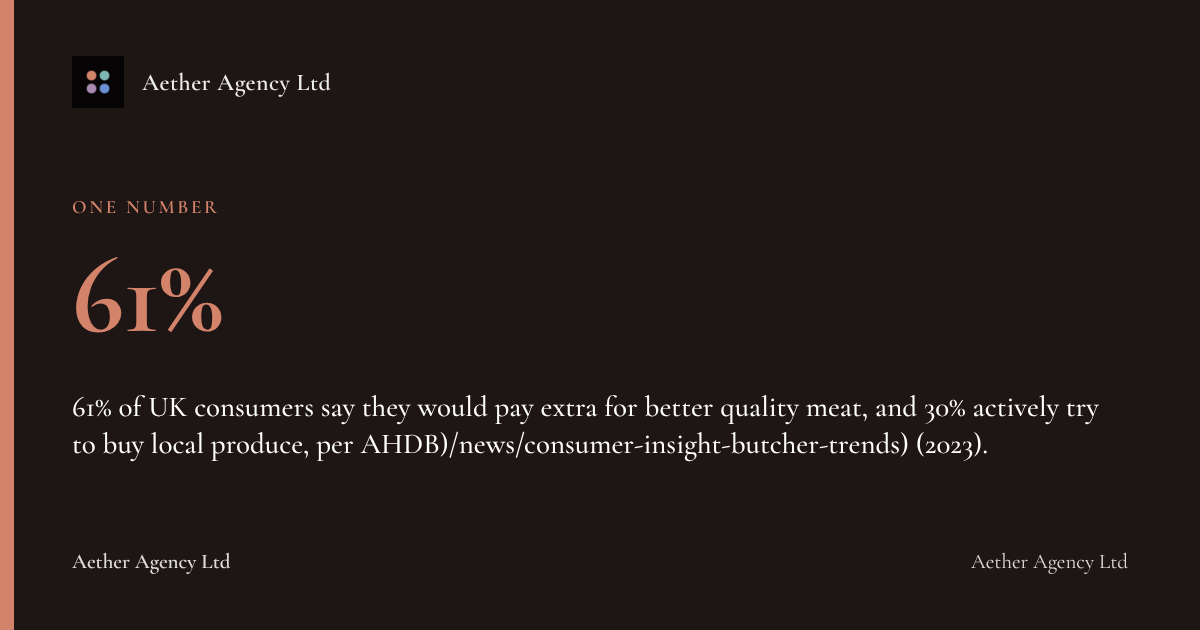
- 61% of UK consumers say they would pay extra for better quality meat, and 30% actively try to buy local produce, per AHDB)/news/consumer-insight-butcher-trends) (2023).
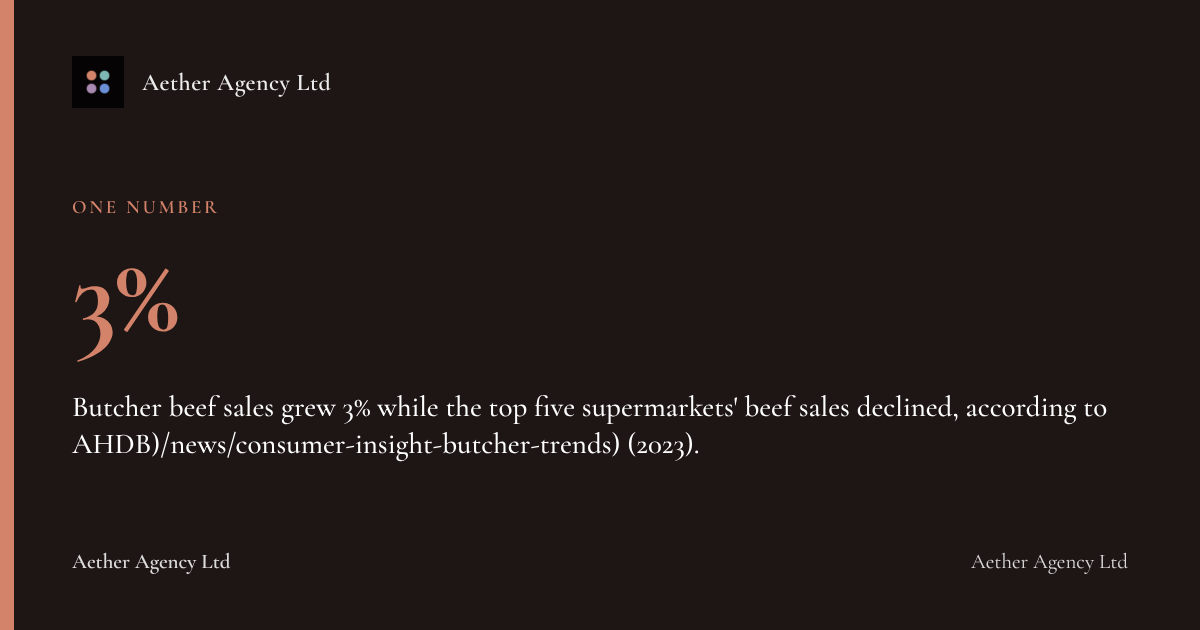
- Butcher beef sales grew 3% while the top five supermarkets' beef sales declined, according to AHDB)/news/consumer-insight-butcher-trends) (2023).
- 57% of independent butchers surveyed achieved a higher average transaction value in 2022 than the year before, per National Craft Butchers' Big British Butchers Survey (2023).
- Fulk Butchers in Surrey recorded a substantial increase in online sales after Aether Agency Ltd built its brand identity and e-commerce website, with a 4.8 star Google rating on record.
What Does Branding for Butchers Actually Involve?
Branding for a butcher is the complete system of name, logo, packaging, signage, website, staff uniform and customer experience that signals quality, provenance and trust before a single word is spoken. It is not a logo redesign project that stops once the new shop sign goes up.
A proper branding engagement covers naming and trademark checks, a visual identity system (logo, colour palette, typography), packaging and label design, shopfront and vehicle signage, a website with online ordering, and social media templates that all use the same visual language. It also covers tone of voice: how the butcher describes its sourcing on a chalkboard, in an Instagram caption and on a product label should sound like the same business, not three different ones.
With 5,637 butcher shops recorded in the UK in 2023 and the rate of decline slowing over the previous four years, according to FE News, citing the Office for National Statistics (2023), the shops that survive tend to be the ones that look and feel deliberately built, not accidentally assembled. Aether Agency Ltd's work with Fulk Butchers, a family business in Surrey, started from exactly this gap: a well regarded shop with strong local trust but no coherent identity and no route to online orders. The brand, website build and ongoing marketing were delivered by one team, so the identity carries from the packaging on the counter through to the order confirmation email a customer receives at home.
How Much Does It Cost to Brand or Rebrand a Butcher's Shop in the UK?
Butcher branding costs in the UK typically scale with scope: a logo and basic signage refresh sits at the lower end, while a full identity system with packaging, website and e-commerce sits considerably higher. There is no single verified industry price list for UK butcher branding, so the ranges below are illustrative, based on typical small business branding scopes, not a quoted statistic.
| Scope | What's typically included | Illustrative price range |
|---|---|---|
| Logo and signage refresh | New logo, shopfront fascia, basic stationery | £1,500 to £4,000 |
| Core identity system | Logo, brand guidelines, packaging design, social templates | £4,000 to £10,000 |
| Full brand and website build | Identity system, packaging, signage, e-commerce website, launch marketing | £10,000 to £25,000+ |
| Ongoing brand management | Social media, content, seasonal campaigns, performance tracking | Monthly retainer, varies by scope |
A butcher weighing up spend should treat it against the commercial upside rather than in isolation. With 56% of independent butchers in a 2022 survey reporting higher turnover than the year before, and 57% achieving a higher average transaction value, according to the National Craft Butchers Big British Butchers Survey (2023), a credible brand is one of the few levers an independent shop controls directly, unlike wholesale meat prices or footfall trends.
What UK Food Labelling and Trading Standards Laws Affect Butcher Branding?
UK butchers must comply with the Food Information to Consumers Regulation (retained EU law, enforced in the UK via the Food Information Regulations 2014) and the Food Safety Act 1990, both of which dictate what branding and packaging can claim about a product. Local authority Trading Standards teams enforce these rules on the ground, and the Food Standards Agency (FSA) sets the national guidance that underpins them.
Any packaging, shelf-edge label or shopfront claim describing meat as "local", "organic", "free range" or "dry aged" must be accurate and evidenced, because misleading food information is a criminal offence under the Food Safety Act 1990. Country of origin labelling is mandatory for most fresh meat under retained EU rules, so a butcher's branding cannot simply say "British beef" if the product is sourced elsewhere, even as a marketing flourish.
This matters directly for brand design. A butcher wanting to lean into provenance as a brand story, which 30% of UK consumers actively seek out according to AHDB)/news/consumer-insight-butcher-trends) (2023), needs packaging copy and claims checked against FSA guidance before print, not after (AHDB (Agriculture and Horticulture Development Board)). Allergen labelling under Natasha's Law (Food Information (Amendment) (England) Regulations 2021) also applies to any pre-packed-for-direct-sale items such as sausage rolls or ready meals made on-site, which increasingly form part of a butcher's product range.
What Makes a Butcher's Branding Stand Out from Supermarkets and Other Butchers?
Standout butcher branding differentiates on provenance, craftsmanship and relationship, the three things a supermarket meat counter structurally cannot replicate at scale. A supermarket cannot put a named farm on its own-brand mince or let a customer ask the person who cut the joint how to cook it; an independent butcher's brand should make both of those things visible and central.
The data supports leaning into this gap rather than competing on price. Beef sales from butchers rose 3% while the top five supermarket chains saw beef sales decline, and lamb sales from butchers fell only 4% against steeper declines at the multiples, according to AHDB)/news/consumer-insight-butcher-trends) (2023) (AHDB (Agriculture and Horticulture Development Board)). That is a clear signal that quality-led branding, not discount positioning, is where independents are winning share.
Differentiation from other local butchers is a separate challenge, and it usually comes down to specificity. A brand built around "fresh, quality meat" says nothing a competitor three streets away couldn't also claim; a brand built around a named breed, a specific dry-ageing process, or a visible relationship with named farms gives customers and search engines something concrete to repeat and recommend.
Should a Butcher Hire a Branding Agency, a Freelancer, or Do It Themselves?
A butcher choosing between a branding agency, a freelance designer, and a DIY approach is really choosing between consistency, cost, and capacity, and the right answer depends on how much the shop plans to grow. DIY tools can produce a passable logo quickly but rarely deliver a coherent system across packaging, signage and digital, which is where most independent butcher brands visibly fall apart.
| Approach | Best for | Typical limitation |
|---|---|---|
| DIY (templates, in-house) | Very tight budgets, early-stage shops | Inconsistent across packaging, signage and web; no trademark check |
| Freelance designer | Single deliverables (logo, one-off packaging) | Limited ongoing support; no integrated website or marketing |
| Branding agency | Full identity, website and growth plan together | Higher upfront cost, but one consistent system |
An agency earns its fee where a shop needs the brand, the website and the ongoing marketing to work as one system rather than three disconnected projects. Aether Agency Ltd's work with Fulk Butchers is a direct example: the identity, the e-commerce build and the social media management were handled by one team, which is why the Google rating sits at 4.8 stars and online sales rose substantially after launch, both figures on record from the client case study. A freelancer or DIY kit can get a butcher a logo; it rarely gets them a working online ordering system with a brand that matches the packaging customers see on the counter.
What Role Does Storytelling Play in Butcher Branding?
Storytelling in butcher branding means communicating sourcing, heritage and craftsmanship in a way that gives customers a reason to choose the shop beyond convenience. It is one lever an independent butcher has, because 61% of UK consumers say they would pay extra for better quality meat, according to AHDB)/news/consumer-insight-butcher-trends) (2023), and story is how "better quality" gets proven rather than just claimed (AHDB (Agriculture and Horticulture Development Board)).
Heritage matters practically too. With 50% of independent butcher business owners aged 56 or above, and 26% planning to retire within five years according to the National Craft Butchers survey (2023), a significant number of UK butcher brands are approaching a generational handover. A brand built around the founder's name alone, with no documented story, system or guidelines, is harder to pass on or sell than one with a defined identity a successor can run without reinventing it.
Effective storytelling in this sector tends to cover three things consistently: where the meat comes from (named farms, a specific county, a breed), how it is prepared (dry-ageing days, hand-cutting, in-house curing), and who is doing it (the butcher's name, years trading, qualifications). This content needs to appear identically on packaging, on the website, and on social media, because a customer reading three different stories in three places trusts none of them.
How Should a Butcher's Branding Translate Across Shopfront, Website and Social Media?
A butcher's branding must use the same logo, colour palette, typography and tone of voice across the physical shopfront, the website, and every social media channel, so a customer recognises the business instantly in any of the three. Inconsistency here is a common reason an otherwise good butcher brand underperforms: the shop looks traditional and hand-crafted, while the Instagram feed looks like a generic stock-photo food account.
In practice, this means the website should carry the same packaging photography style, colour palette and product naming conventions as the physical labels, and the social content calendar should reinforce the same provenance story the shopfront signage tells. Aether Agency Ltd builds this consistency deliberately into its brand identity and website development work, treating the shopfront, the site and the social presence as one system from the outset rather than retrofitting a logo onto channels designed separately.
E-commerce has made this cross-channel consistency a commercial consideration rather than a cosmetic one. UK butchers' revenue is forecast to decline at a compound annual rate of 5.1% to £3.2 billion over the five years through 2025-26, including a 1.8% fall in 2025-26 alone, according to IBISWorld (2025). Against that backdrop, a butcher with a weak or inconsistent online brand is leaving one of the few growth channels, direct online ordering, underused.
Your Butcher Branding Checklist
- Define your core story: named sourcing, preparation method, and the people behind the counter.
- Check your proposed name and logo for trademark conflicts at the Intellectual Property Office before committing.
- Verify every packaging and label claim ("local", "organic", "dry aged") against FSA and Trading Standards guidance.
- Apply allergen labelling correctly on any pre-packed-for-direct-sale items under Natasha's Law.
- Build one visual identity system (logo, colour, type) and apply it to packaging, signage, website and social media.
- Set up an e-commerce ordering route if customers are asking for delivery or click and collect.
- Review your brand consistency across all channels at least annually, especially before a generational handover.
FAQ
Why is branding important for a butcher shop?
Branding is important because it is how an independent butcher competes against supermarket meat counters on something other than price. With 61% of UK consumers saying they would pay extra for better quality meat, according to AHDB)/news/consumer-insight-butcher-trends) (2023), a clear brand is what lets a butcher prove and charge for that quality (AHDB (Agriculture and Horticulture Development Board)).
How do I create a brand identity for my butcher business?
Start with your core story, including sourcing, preparation and the people involved, then build a visual identity (logo, colours, typography) that reflects it. From there, apply that identity consistently across packaging, signage, your website and social media, ideally through one agency or team so nothing drifts out of sync.
What makes a good butcher shop logo?
A good butcher shop logo is simple enough to work on a small label, a shopfront fascia and a social media icon without losing legibility. It should also reflect something specific about the business, such as heritage, location or specialism, rather than a generic cleaver-and-ribbon motif used across the trade.
How can independent butchers compete with supermarkets through branding?
Independent butchers compete by making provenance, craftsmanship and personal service visible, which supermarkets cannot replicate at scale. This strategy is already working: beef sales from butchers rose 3% while the top five supermarket chains saw beef sales decline, according to AHDB)/news/consumer-insight-butcher-trends) (2023) (AHDB (Agriculture and Horticulture Development Board)).
How much should a butcher shop spend on marketing and branding?
Spend depends on scope, but a full identity system with packaging and a basic website typically starts in the low thousands of pounds, while a complete brand, website and e-commerce build runs higher. Treat it as an investment against turnover growth: 56% of independent butchers surveyed reported higher turnover in 2022 than 2021, according to the National Craft Butchers survey (2023).
How does packaging design affect a butcher's brand perception?
Packaging is often the last brand touchpoint before a purchase decision, so its design, materials and label content directly shape perceived quality and trust. It must also be legally compliant, since misleading claims on packaging about origin or quality can breach the Food Safety Act 1990 and trigger Trading Standards action.
What role does provenance and sustainability play in butcher branding?
Provenance plays a central role because it is what a meaningful share of customers are actively looking for: 30% of UK consumers say they try to buy local produce, according to AHDB)/news/consumer-insight-butcher-trends) (2023) (AHDB (Agriculture and Horticulture Development Board)). Branding that names specific farms, breeds or regions turns that general preference into a reason to choose one particular butcher.
Building Your Butcher Brand with Aether Agency Ltd
Aether Agency Ltd works with independent food retailers who have built genuine trust on the high street but have never had their identity, packaging and website pulled into one coherent system, exactly the gap this article has covered. That mismatch between reputation and presentation is usually the single biggest brake on growth for a butcher trying to compete with both supermarkets and better-branded rivals.
The Fulk Butchers project in Surrey shows what closing that gap looks like in practice: Aether Agency Ltd built the brand identity from scratch, delivered an e-commerce website with online ordering, and continues to run social media and marketing support, with online sales up substantially and a 4.8 star Google rating on record since launch. The brand, build and grow phases sat with one team throughout, which is why the identity feels the same whether a customer sees it on packaging, on the website, or in an order confirmation email.
If your butcher business has outgrown a logo you had made years ago, or you're launching online ordering for the first time, Aether Agency Ltd's brand identity service is the place to start a conversation about what a full rebrand could look like for your shop.
Related Reading
- Branding for Schools: A UK Decision-Maker's Guide
- Branding for Construction Companies: A UK 2026 Guide
- How Are Branding Projects Priced? UK Cost Guide 2026
Add aether-agency.co.uk as a preferred source on Google
See How Your Brand Appears in AI Search
Aether AI monitors your visibility across ChatGPT, Perplexity, Google AI Overviews, and Claude in real time. Find out where you stand and what to fix.
Explore Aether AI