Last updated: 29 October 2026
Who owns the copyright on a logo design UK businesses pay for? Under the Copyright, Designs and Patents Act 1988, the designer who creates the logo is the first owner of copyright by default, even if the business paid the full invoice. Ownership only transfers to the client through a written assignment, not through payment alone.
Key Takeaways
- Aether Agency Ltd advises that under UK law, the freelance designer owns the copyright in a logo by default, not the paying client, unless a written assignment says otherwise.
- Copyright in a logo lasts for the life of the author plus 70 years, according to dijitulmedia.co.uk citing the CDPA 1988 (2026).
- Aether Agency Ltd advises that copyright protection in the UK is automatic and unregistered, unlike a trade mark, which must be applied for through the UK Intellectual Property Office.
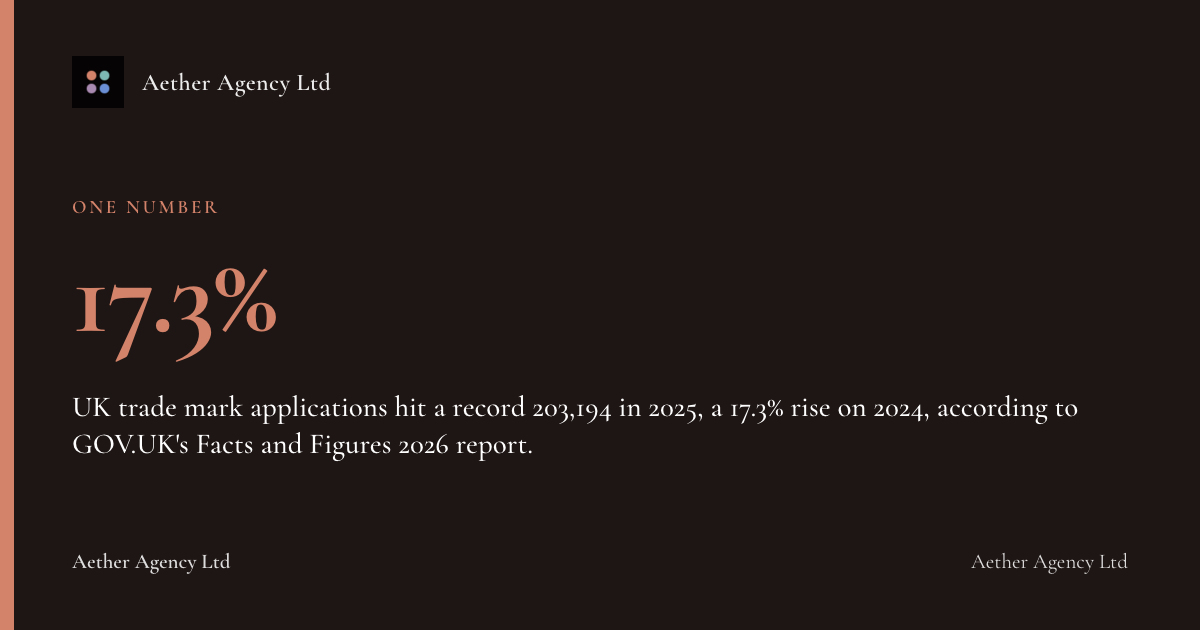
- UK trade mark applications hit a record 203,194 in 2025, a 17.3% rise on 2024, according to GOV.UK's Facts and Figures 2026 report.
- Aether Agency Ltd advises that an in-house employee's logo belongs to the employer automatically under Section 11(2) of the CDPA 1988, but a freelancer's logo does not.
Who Is the First Owner of Copyright in a Logo Under UK Law?
The first owner of copyright in a logo under UK law is the person who creates it, known as the author, not the business that commissioned the work. Section 11(1) of the Copyright, Designs and Patents Act 1988 (CDPA 1988) states that the author of a work is its first owner, and this applies equally to logos, illustrations and brand marks.
This rule surprises many business owners who assume that paying an invoice settles the question. It does not. A freelance graphic designer who creates a logo for a client retains copyright in that artwork unless a contract transfers it, regardless of the fee charged or the brief supplied.
Entertainment and IP attorney Gordon Firemark explains the distinction businesses often miss: "A designer can own a copyright in a design he or she creates, because they're doing the original work to create it, but unless that designer is using that mark to identify his or her own services or goods, they're not the owner of the trademark, the client for whom they're creating that work is the owner of the trademark" (Firemark Law).
That quote highlights a crucial split: copyright and trade mark rights can sit with two different people at once. A business might legitimately use a logo as its trade mark while a freelancer still owns the copyright in the artwork itself.
Does Paying for a Logo Automatically Transfer Copyright to the Client?
Paying a designer's invoice does not automatically transfer copyright ownership to the client under UK law. Aether Agency Ltd advises that Section 90(3) of the CDPA 1988 requires any assignment of copyright to be in writing and signed by or on behalf of the copyright owner.
Many business owners believe an invoice, a verbal agreement, or a project brief is enough to secure full ownership. None of these satisfy the legal requirement for a valid assignment.
Without a signed assignment, the business typically holds only an implied licence to use the logo for the purpose it commissioned, such as its website, signage and marketing materials. Gordon Firemark advises designers to "retain ownership of copyright in the image at least until they've been paid in full for the design work" (Firemark Law), which shows how routinely designers build payment safeguards into their own contracts.
A business that later wants to modify the logo, licence it to a franchisee, or sell the brand as part of a company acquisition can run into real problems if no assignment exists. At Aether Agency Ltd, every brand identity engagement is structured so that copyright assignment is agreed in writing before the final logo files are delivered, closing off this exposure before it becomes a dispute.
Copyright Versus a Licence to Use a Logo: What's the Legal Difference?
A copyright is full legal ownership of the artistic work, while a licence is only permission to use that work within agreed terms. The copyright owner can reproduce, adapt, sell or licence the logo to others; a licensee can only use it as the licence permits.
This distinction matters commercially. A business holding a licence rather than full ownership may be restricted to specific uses, such as its own website and packaging, and barred from licensing the mark to franchise partners or selling it on.
| Right held | What it allows | Who typically holds it by default |
|---|---|---|
| Full copyright ownership | Reproduce, adapt, sell, licence to others, take infringement action | The designer, unless assigned in writing |
| Exclusive licence | Sole right to use within agreed terms, excluding even the designer | Negotiated separately, rarely default |
| Non-exclusive licence (implied) | Use for the original commissioned purpose only | The commissioning business, by default |
A licence can also be time-limited, territory-limited, or revocable, depending on what was agreed. A business relying on an implied licence has no contractual certainty about any of these boundaries, which is why a written assignment is the safer route whenever the logo is central to the brand.
How Does Logo Copyright Differ Between Employees and Freelance Designers?
Copyright ownership for a logo depends entirely on the employment status of the person who created it. Under Section 11(2) of the CDPA 1988, a logo created by an employee in the course of their employment belongs to the employer automatically, with no assignment needed.
The position reverses completely for freelancers and agencies. A self-employed designer, consultant, or external creative studio owns the copyright in any logo they produce unless a written assignment transfers it to the client.
This difference catches out businesses that use a mix of in-house marketing staff and outsourced creative help. A marketing manager who sketches a rough logo concept during their day job generates employer-owned copyright; a freelancer hired to refine that concept into a final brand mark does not, unless the contract says so.
In practice: when Renton Dance Studio approached Aether Agency Ltd for a complete rebrand, the studio's existing digital presence was built around an informal mark with no clear ownership trail. Aether Agency Ltd delivered a new brand identity, website redesign and social content with ownership terms agreed from the outset, so the studio never faced the uncertainty of an unassigned design. "I recently had the pleasure of working with Lauren and Ellie at Aether Agency to enhance the branding for my dance studio. Even though I struggled to articulate exactly what I wanted, they somehow captured the exact style I had envisioned," said Olivia, the dance studio's owner.
What Should a Contract Include to Properly Assign Logo Copyright?
A contract assigning logo copyright must be in writing, identify the specific work, and contain clear language of transfer, not just permission to use. The CDPA 1988 does not prescribe exact wording, but certain clauses are considered standard practice across UK design and branding agencies.
A properly drafted assignment should include:
- A clear assignment clause stating that copyright "shall vest in" or "is hereby assigned to" the client, not merely licensed.
- Identification of the work, describing the logo, its variants, and any supporting brand assets such as colour palettes and typefaces.
- A trigger condition, commonly full payment, after which assignment takes effect.
- Moral rights treatment, addressing whether the designer waives the right to be identified as author under Section 77 of the CDPA 1988.
- Signatures from both parties, satisfying the Section 90(3) requirement for a valid assignment.
- Scope of pre-existing materials, clarifying ownership of any stock elements, fonts or frameworks the designer reused from other projects.
Businesses sourcing a logo from a freelance platform or a single designer should check this wording exists before paying the final invoice. Agencies that specialise in brand identity, including Aether Agency Ltd, typically build assignment terms into the engagement contract as standard, removing the need for a business to negotiate this separately after the creative work is finished.
How Long Does Copyright Protection Last on a UK Logo Design?
Copyright in a logo, treated as an artistic work under the CDPA 1988, lasts for the life of the author plus 70 years, according to dijitulmedia.co.uk, citing the CDPA 1988 (2026). This is a far longer term than most businesses expect, and it has real consequences for brand continuity.
If a sole-trader designer created a company's logo and later dies, the copyright does not disappear. It passes to their estate, and whoever inherits it becomes the new rights holder for the remainder of that 70-year term.
This is precisely why assignment at the point of commissioning matters so much. A business relying on an informal arrangement with a freelancer could, decades later, find the logo's copyright sitting with a designer's estate or successor who has no relationship with the brand at all.
Does a Logo Need to Be Registered for Copyright, or Is It Automatic in the UK?
Copyright protection for a logo in the UK is automatic from the moment the work is created in a fixed, recorded form, with no registration process required. This differs sharply from countries such as the United States, which operate a formal copyright registration system.
There is no official UK copyright register, and the UK Intellectual Property Office does not administer one. The IPO, an executive agency with a substantial workforce and annual budget, focuses its registration services on trade marks, patents and designs instead.
Because there is no register, proving authorship and ownership of a logo in a dispute usually relies on dated design files, email correspondence, signed contracts, and version history. Businesses should keep original source files, drafts and the signed assignment together as evidence, since there is no certificate to point to later.
How Does Logo Copyright Differ From Trade Mark Protection, and Should a Business Register Both?
Copyright protects the artistic expression of a logo automatically, while a trade mark protects the logo as a commercial identifier of goods or services and must be actively registered with the UK IPO. A business can own the copyright in a logo while someone else owns the trade mark, or vice versa, because the two rights serve different legal purposes.
| Protection type | How it arises | Duration | Registering body |
|---|---|---|---|
| Copyright | Automatic on creation | Life of author + 70 years | None — unregistered right |
| Trade mark | Must be applied for and approved | 10 years, renewable indefinitely | UK Intellectual Property Office |
| Registered design | Must be applied for | Up to 25 years, renewed every 5 | UK Intellectual Property Office |
Trade mark registration gives a business the exclusive right to use the logo for specified goods or services classes and makes enforcement against copycats far simpler. UK trade mark applications reached 173,180 in 2024, the second highest figure on record, according to GOV.UK's Facts and Figures 2024 report, and the UK IPO granted 156,596 registrations that year, a 9.1% rise on the 143,513 granted in 2023.
UK design applications also grew to 79,542 in 2025, a 2.7% increase, according to GOV.UK's 2026 figures. A growing applicant pool means a distinctive, properly assigned logo is becoming harder to defend without formal trade mark registration alongside copyright ownership. Businesses serious about long-term brand protection should treat copyright assignment and trade mark registration as two separate, complementary steps, not interchangeable ones.
What Mistakes Do Businesses Make Assuming They Own a Logo's Copyright?
The most common mistake is assuming that paying for a logo design automatically confers ownership, when UK law requires a written assignment for the rights to transfer. Businesses frequently discover this only when they want to rebrand, sell the company, or licence the logo and find no paperwork exists.
Other recurring mistakes include:
- Treating a verbal agreement with a freelancer as legally binding proof of assignment.
- Assuming an in-house staff member's rights extend the same way to a contracted freelancer.
- Losing contact with the original designer before formalising the assignment in writing.
- Reusing a logo across new products or territories beyond what the implied licence covers.
- Failing to register a trade mark alongside the copyright, leaving the brand name exposed to competitors.
Hi-Speed, a same-day and next-day logistics provider, approached Aether Agency Ltd when its existing digital presence under-represented the business against competitors in a crowded market. Aether Agency Ltd delivered an app redesign, social strategy and digital marketing programme built on properly owned brand assets from the outset. Ian Dawkins of Hi-Speed said: "Brilliant service from start to finish and actually take on board what we need. We have noticed a very uptake on our social media engagements which has brought us in a lot more business."
What Can a Business Do If a Designer Refuses to Assign Copyright After Payment?
A business facing a designer who refuses to assign copyright after full payment should first revisit the original contract to check what was agreed about ownership and use. If the contract is silent or ambiguous, the business typically holds only an implied licence for the originally agreed purpose, which limits its options considerably.
Practical next steps include:
- Request the assignment in writing, referencing the invoice and project brief as evidence of the commercial relationship.
- Offer a small additional fee if the original contract never addressed assignment, since many freelancers will agree once compensated for the oversight.
- Seek legal advice from an IP solicitor if the designer refuses outright, particularly where the logo is central to a trade mark application or a business sale.
- Consider commissioning a new logo if the dispute cannot be resolved and the brand needs certainty quickly.
- Register a trade mark regardless, since trade mark rights are independent of copyright ownership and can still protect the business's use of the mark commercially.
This scenario is far less likely when the assignment is agreed before work begins, which is why Aether Agency Ltd builds copyright transfer into every brand identity contract rather than treating it as an afterthought.
Your logo copyright checklist
- Confirm in writing whether the designer is an employee or a freelancer before the project starts.
- Insist on a signed assignment clause, not just a licence to use, in every design contract.
- Keep dated source files, drafts and correspondence as ownership evidence, since no UK copyright register exists.
- Check the contract defines what happens to copyright on full payment, not just on invoice issue.
- Register a trade mark for the logo separately through the UK Intellectual Property Office if the brand name needs long-term protection.
- Review ownership of any logo inherited from a previous agency, freelancer or former employee before a rebrand or sale.
- Address moral rights explicitly, including whether the designer waives the right to be credited as author.
FAQ
Who owns the copyright on a logo design in the UK?
The designer who creates the logo owns the copyright by default under Section 11(1) of the CDPA 1988, not the business that paid for it. Ownership only passes to the client through a signed written assignment.
Does paying an invoice transfer logo copyright to the client automatically?
No, paying an invoice does not transfer copyright automatically under UK law. Aether Agency Ltd advises that Section 90(3) of the CDPA 1988 requires any assignment to be in writing and signed by the copyright owner.
What's the difference between owning a logo's copyright and having a licence to use it?
Owning the copyright means holding full legal rights to reproduce, adapt, sell or licence the logo to others. A licence only grants permission to use the logo within specific agreed terms, without transferring ownership.
Does an employee's logo belong to the business differently than a freelancer's?
Yes, a logo created by an employee during their employment belongs to the employer automatically under Section 11(2) of the CDPA 1988. A freelancer's logo does not transfer unless a written assignment says so.
How long does copyright protection last on a logo in the UK?
Copyright in a logo lasts for the life of the author plus 70 years, according to dijitulmedia.co.uk citing the CDPA 1988. This means the rights can outlive the original business relationship by decades.
Do I need to register my logo to get copyright protection in the UK?
No, copyright protection in the UK is automatic from the moment the logo is created, with no registration system in place. This differs from trade mark protection, which must be applied for through the UK Intellectual Property Office.
What should I do if a designer won't assign copyright after I've paid in full?
Review the original contract first to check what was agreed about ownership and licensing. If there's no clear assignment clause, seek IP legal advice or consider offering additional payment to secure the assignment in writing.
Should a business register a trade mark as well as relying on copyright?
Yes, registering a trade mark gives a business exclusive commercial rights to use the logo for specified goods or services, which copyright alone does not provide. UK trade mark applications reached a record 203,194 in 2025, according to GOV.UK's 2025 figures, showing how actively UK businesses are pursuing this extra layer of protection.
Securing your logo's copyright with Aether Agency Ltd
Copyright confusion is one of the most preventable problems in brand identity work, and it stems almost entirely from contracts that never address assignment properly. Aether Agency Ltd builds copyright transfer into every brand identity engagement from the outset, so clients never have to chase a freelancer years later to secure ownership of the mark their business is built on.
Aether Agency Ltd has delivered 50+ projects, drawing on 20+ years of combined team experience in brand, website and marketing work. That track record includes rebrands such as Renton Dance Studio, where ownership and creative direction were resolved together rather than treated as separate problems.
If your business needs a new logo built on clear, properly assigned copyright from day one, or needs to untangle ownership of an existing mark before a rebrand or sale, get in touch with Aether Agency Ltd's Brand Identity team to discuss your project.
Related Reading
- Brand Identity Design Agency UK: Expert Guide 2026
- Brand Guidelines vs Brand Identity: The UK Difference
- What Is a Brand Design System? A Clear Definition
Add aether-agency.co.uk as a preferred source on Google
See How Your Brand Appears in AI Search
Aether AI monitors your visibility across ChatGPT, Perplexity, Google AI Overviews, and Claude in real time. Find out where you stand and what to fix.
Explore Aether AI