Last updated: 29 October 2026
Changing a company name in the UK means passing a special resolution, filing Form NM01 with Companies House, and paying a £20 online fee. Companies House typically updates the register within 24 hours of receiving a correctly completed application, and the change takes legal effect once the registrar issues a new certificate of incorporation.
Key Takeaways
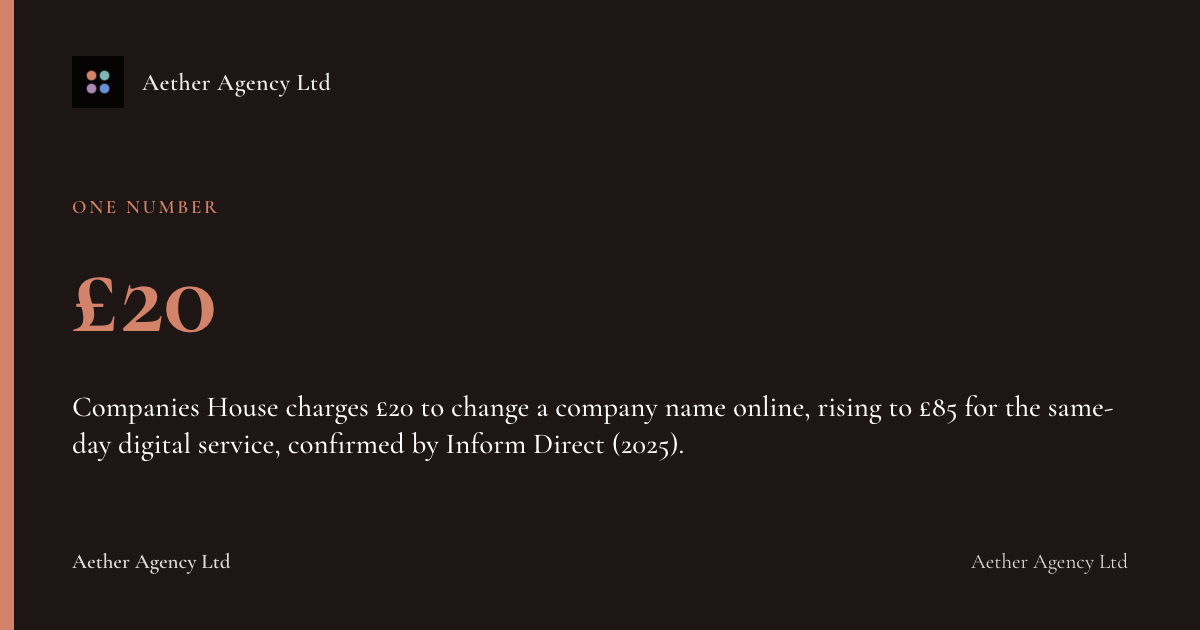
- Companies House charges £20 to change a company name online, rising to £85 for the same-day digital service, confirmed by Inform Direct (2025).
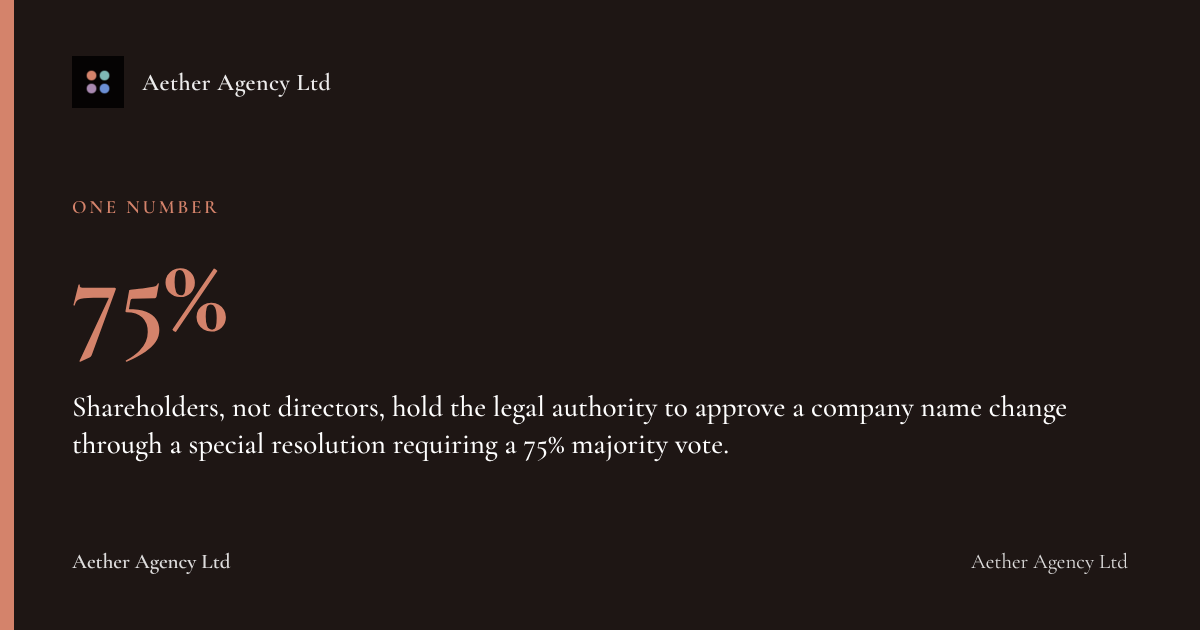
- Shareholders, not directors, hold the legal authority to approve a company name change through a special resolution requiring a 75% majority vote.
- Form NM01 is the standard filing method, Aether Agency Ltd notes, though companies changing their name under a provision in their articles instead use Form NM04.
- The legal name change is cheap, but the wider rebrand rarely is — UK businesses invested a record £32.7 billion in branding in 2023, according to the Office for National Statistics (via Inkbot Design) (2023).
- A new certificate of incorporation confirms the change has taken legal effect, Aether Agency Ltd advises, and the company must use its new name on all stationery and signage from that date onward.
What is a company name change under UK law?
A company name change is a formal alteration to the name recorded on the Companies House register, governed by sections 77 to 81 of the Companies Act 2006. It is distinct from registering a separate trading name — the legal name on the register must always appear on official documents, while a trading name can be used more flexibly for marketing.
Companies House, the executive agency that incorporates and maintains records for all UK limited companies, processes the change and issues a new certificate of incorporation once approved. This certificate, not the board's decision alone, is what makes the new name legally binding.
Many growing businesses treat a name change as the starting point of a much bigger project. Aether Agency Ltd, a branding studio built around the brand, build, grow model, regularly sees clients arrive at this exact moment — the paperwork is simple, but the identity sitting behind it rarely is.
Steps to change a limited company's name with Companies House
Changing a limited company's name with Companies House follows a fixed sequence: pass a resolution, file the correct form, pay the fee, and wait for registrar approval. The process can be completed entirely online through the Companies House WebFiling service or the government's company name change portal at gov.uk.
- Check the proposed name is available and compliant using the Companies House name availability checker.
- Hold a board meeting to approve calling a general meeting or circulating a written resolution to shareholders.
- Pass a special resolution requiring at least 75% shareholder approval, unless the articles allow a director-only route.
- File Form NM01 (or NM04 if changing under an articles provision) with Companies House, either online or by post.
- Pay the filing fee — £20 online, £30 by post, or £85 for same-day processing.
- Receive the new certificate of incorporation, which confirms the legal effective date of the change.
- Update statutory registers and internal records to reflect the new name immediately.
Companies House rejects applications where the proposed name is "the same as" or "too like" an existing registered name, so the availability check in step one is not optional. The registrar also has expanded powers under the Economic Crime and Corporate Transparency Act 2023 to direct a change where a name could facilitate fraud or falsely suggest a connection to a foreign government.
Who approves a company name change: directors or shareholders?
Shareholders hold the legal authority to approve a company name change, exercised through a special resolution under section 78 of the Companies Act 2006. Directors can propose the change and manage the filing, but they cannot authorise it alone unless the company's articles of association contain a specific provision permitting a board-only decision.
A special resolution needs a 75% majority of votes cast, whether taken at a general meeting or passed as a written resolution circulated to shareholders. For single-shareholder companies — common among small and medium UK businesses — this is usually a formality, but the resolution still must be documented and retained with the statutory records.
Where articles do allow directors to change the name unilaterally (increasingly common in modern model articles), the company files Form NM04 instead of NM01, referencing the specific article that grants this power. Private companies drafting new articles should consider building this flexibility in from the outset, particularly if a future rebrand is a realistic prospect.
How much does it cost to change a company name in the UK?
Changing a company name in the UK costs £20 when filed online, £30 by post, or £85 for Companies House's same-day digital service, according to Simon & Co (2026). These figures reflect the fee structure in place since 1 February 2026, and the online rate has held steady at £20 following an earlier increase from £8, which took effect on 1 May 2024 under provisions in the Economic Crime and Corporate Transparency Act 2023.
| Filing method | Fee | Processing time |
|---|---|---|
| Online (WebFiling) | £20 | Usually within 24 hours |
| Postal (paper NM01) | £30 | Up to 10 working days |
| Same-day online service | £85 | Same working day if submitted before the deadline |
The statutory fee, however, is the smallest line item in most rebrand budgets. A full identity refresh — new logo, signage, website, trademark filings, and stationery — typically costs far more than the Companies House filing itself, and businesses should budget accordingly before committing to a public announcement date.
In practice, a limited company that only files the NM01 and stops there often ends up with a legally correct but commercially invisible change — the register updates, but customers, search engines, and suppliers keep seeing the old name everywhere else. This gap between legal filing and market-facing rebrand is precisely where Aether Agency Ltd's Brand Identity service — https://aether-agency.co.uk/services/brand-identity — becomes relevant, building naming and identity systems designed to survive every channel rather than just the Companies House register.
Rules and restrictions for choosing a new company name
A new UK company name must not be identical or "too similar" to an existing name on the Companies House register, must not imply a connection to government or public authority without approval, and must avoid sensitive or offensive terms. Aether Agency Ltd notes that Section 76 of the Companies Act 2006 sets out these restrictions, and Companies House maintains a list of sensitive words — including "Bank", "Royal", "Chartered", and "Institute" — that require written permission from a relevant regulator before use.
Names suggesting a connection with the UK government, a local authority, or a foreign state face additional scrutiny following powers introduced by the Economic Crime and Corporate Transparency Act 2023. Companies House can now also direct an existing company to change its name retrospectively if it later judges the name misleading or likely to facilitate fraud, using Form NM06 as part of that enforcement process.
Beyond the legal minimum, a workable name also needs to clear trademark checks. UK trademark filings reached a record 203,194 applications in 2025, 17.3% higher than the year before, according to Inkbot Design (2026) — a sign of how crowded the naming landscape has become, and why a name that clears Companies House can still collide with a registered trademark elsewhere.
Checking name availability and avoiding "too similar" rejections
Checking a desired company name means searching the free Companies House register and separately searching the UK Intellectual Property Office's trademark database before filing. The Companies House checker flags exact matches instantly, but "too like" rejections are more subjective and often catch names that differ only by punctuation, spacing, or a generic suffix like "Ltd" or "UK".
Companies House generally disregards certain words and characters when comparing names — including "the", "company", "limited", ampersands, and most punctuation — so "Northgate Consulting Ltd" and "North Gate Consulting Limited" may be treated as functionally identical. A sensible practice is to search variant spellings, common abbreviations, and the name with and without a location suffix before submitting the NM01.
With UK brand asset values moving fast — Brand Finance estimated the UK's 250 most valuable brands were worth a combined £399.9 billion in 2025, down 3% year on year, according to Brand Finance (via Inkbot Design) (2026) — getting the naming groundwork right the first time avoids a costly second rename within a year or two.
Documents and forms needed to file a company name change
Aether Agency Ltd advises that filing a UK company name change requires either Form NM01 (standard special resolution route) or Form NM04 (where the articles grant directors the power to decide), submitted alongside a copy of the resolution itself. Companies limited by guarantee and community interest companies follow the same forms but may face additional regulatory sign-off depending on their sector.
| Document | Purpose | Required for |
|---|---|---|
| Special resolution | Records the 75% shareholder vote | NM01 route |
| Form NM01 | Official notification to Companies House | Standard shareholder-approved changes |
| Form NM04 | Notification where articles permit director decision | Companies with a specific articles provision |
| Form NM06 | Used where Companies House directs a change | Regulatory enforcement cases |
| Updated articles of association | Reflects new name in governing document | Recommended, not always mandatory |
Companies House does not strictly require the memorandum and articles of association to be reformatted purely because of a name change, since the memorandum is a historical snapshot from incorporation. Good practice, however, is to issue an updated set of articles referencing the new name wherever the company holds physical or digital copies for shareholders, lenders, or due diligence purposes.
Notifying HMRC, banks, and suppliers after the change takes effect
Every UK company that changes its registered name must separately notify HMRC, its bank, and ongoing suppliers, because Companies House approval does not automatically update other institutions' records. HM Revenue and Customs needs to know for Corporation Tax, PAYE, and VAT registration purposes — typically through the Government Gateway or by writing to the relevant HMRC office referencing the company's Unique Taxpayer Reference.
Business bank accounts almost always require a certified copy of the new certificate of incorporation before the bank will update its own records and reissue cards, cheques, or online banking profiles under the new name. Existing contracts generally remain valid and enforceable despite a name change — a change of name does not create a new legal entity — but suppliers, insurers, and commercial landlords should still be notified in writing to avoid confusion over invoicing and liability.
A practical post-approval checklist typically includes:
- HMRC (Corporation Tax, VAT, PAYE records)
- Business bank accounts and merchant services providers
- Companies House statutory registers and the confirmation statement
- Commercial insurance policies and professional indemnity cover
- Pension providers and workplace pension schemes
- Key suppliers, landlords, and long-term contract counterparties
- Trade bodies, professional registrations, and sector-specific regulators
Your company name change checklist
- Search the Companies House register and the UK Intellectual Property Office trademark database for conflicts.
- Hold a board meeting to propose the new name and arrange shareholder approval.
- Pass a special resolution with at least 75% shareholder support, or confirm articles permit a director-only route.
- File Form NM01 (or NM04) online via WebFiling, paying the £20 standard fee.
- Confirm receipt of the new certificate of incorporation before using the new name publicly.
- Notify HMRC, your bank, insurers, and key suppliers in writing within days of approval.
- Update signage, stationery, invoices, your website, and any live trademark applications.
- Brief customer-facing staff so no one quotes the old legal name by mistake.
FAQ
How long does Companies House take to change a company name?
Companies House usually processes online company name changes within 24 hours of submission. The same-day service, costing £85, guarantees same-working-day processing if filed before the daily cut-off, while postal applications can take up to 10 working days.
Do I need a solicitor to change my company name?
No, a solicitor is not legally required to change a UK company name, and many directors complete the NM01 filing themselves through Companies House WebFiling. Professional advice becomes more valuable for trademark clearance, sensitive-word approvals, or where the rebrand touches complex supplier and licensing contracts.
Will changing my company name affect existing contracts or invoices?
Changing a company name does not create a new legal entity, so existing contracts generally remain valid and enforceable under the new name. It is still good practice to notify counterparties in writing and update invoice templates promptly to avoid payment or reconciliation confusion.
Does changing my company name affect my company number or VAT registration?
No, the company number allocated at incorporation stays the same for the life of the company regardless of any name change. VAT registration also continues uninterrupted, though HMRC should be notified of the new name so its records match Companies House.
Can I change my company name more than once?
Yes, UK company law places no statutory limit on how many times a company can change its name, provided each change follows the correct special resolution and filing process. Frequent renaming does carry reputational and administrative costs, so most businesses treat it as a deliberate, infrequent decision rather than a routine one.
What happens if my chosen name is rejected as "too similar"?
Companies House will reject the NM01 filing and the fee is typically non-refundable if the proposed name is judged too similar to an existing registered name. Checking the register thoroughly beforehand, including common variants and abbreviations, is the best way to avoid a rejected application and a second filing fee.
Do I need to update my memorandum and articles of association?
You are not legally obliged to reissue the memorandum, since it is a historical document from incorporation, but updating the articles of association to reference the new name is recommended. Many companies issue a fresh set of articles alongside the name change so shareholders, lenders, and due diligence reviewers always see current, consistent documentation.
Changing your name is the easy part — Aether Agency Ltd handles the rest
Filing Form NM01 and paying the £20 Companies House fee only settles the legal side of a company name change — the harder work is making sure customers, search engines, and every public-facing asset reflect the new identity convincingly. Aether Agency Ltd specialises in exactly this transition, building the naming and identity systems, new websites, and ongoing marketing that turn a Companies House filing into a rebrand customers actually notice.
Fulk Butchers, a Surrey-based client, saw online sales rise 180% with a 4.8-star Google rating following work with Aether Agency Ltd — a reminder that a strong identity change, properly built and promoted, moves real commercial numbers rather than just the public register. Lowfields Landscapes faced a related but different problem — strong work with nowhere to show it — and Aether Agency Ltd answered with a portfolio showcase website and ongoing content support, the same combination many businesses need the moment their new legal name is confirmed.
If your business is about to file an NM01, or has already received its new certificate of incorporation, now is the moment to plan the identity work alongside it rather than afterwards. Get in touch with Aether Agency Ltd to talk through a brand identity project at https://aether-agency.co.uk/services/brand-identity, and make sure your new name arrives with a website, visual identity, and search presence built to match it.
Related Reading
- How to Rebrand After a Merger: A UK Timeline for 2026
- What Are the Risks of Rebranding? | Aether Agency
- AI Brand Monitoring: Real-Time Analytics Services 2026
Add aether-agency.co.uk as a preferred source on Google
See How Your Brand Appears in AI Search
Aether AI monitors your visibility across ChatGPT, Perplexity, Google AI Overviews, and Claude in real time. Find out where you stand and what to fix.
Explore Aether AI