Last updated: 28 October 2026
Signs you need a website redesign include a bounce rate above the 45% industry average (Calconic, 2025), a site that isn't fully responsive, slow mobile load times, falling conversion rates, and a brand that no longer reflects what your business actually does. If two or more of these apply, it's time to act.
Key Takeaways
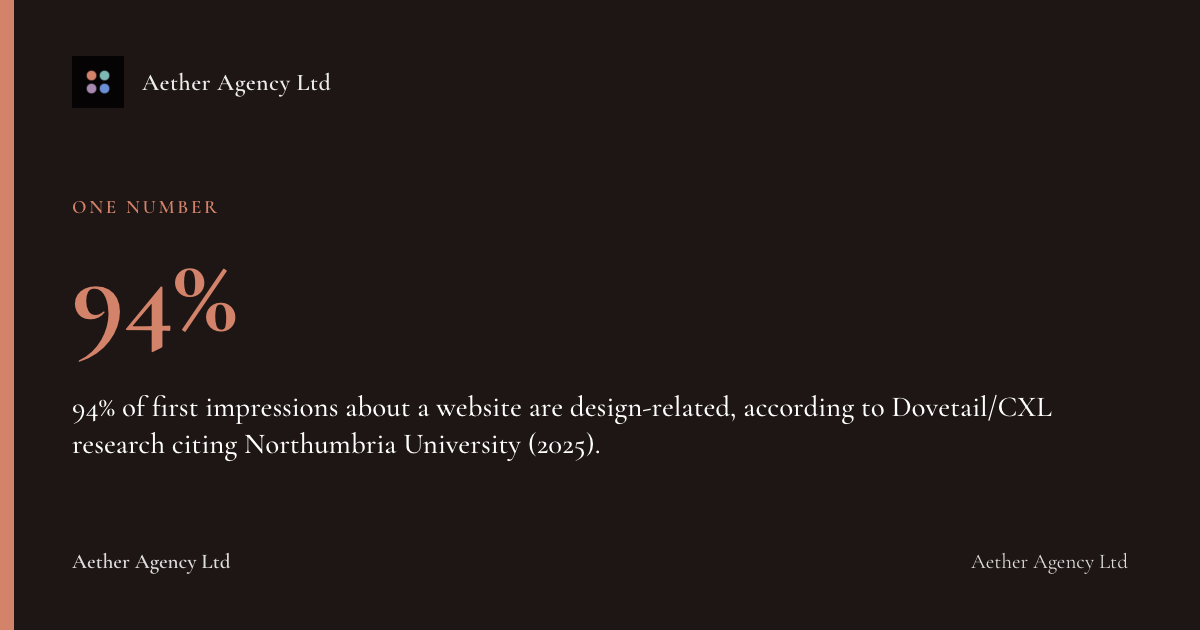
- 94% of first impressions about a website are design-related, according to Dovetail/CXL research citing Northumbria University (2025).
- Visitors form an opinion about a website's visual appeal in roughly 50 milliseconds, per Lindgaard et al., Behaviour & Information Technology (2006).
- 53.8% of web designers name poor mobile responsiveness as a top reason to redesign a site, according to GoodFirms (2025).
- 80.8% of businesses start a redesign project because of low conversion rates, per Sagapixel (2026).
- Websites typically get redesigned every 1.5 to 2.5 years, according to Business2Community (2026).
What are the most common signs that a website needs a redesign?
A website redesign sign is any measurable or visual indicator that a site is no longer performing its core job — converting visitors into customers. The most common signs fall into three categories: declining performance metrics, visual and brand misalignment, and technical limitations that stop a business from competing properly online.
On the performance side, falling conversion rates sit at the top of the list. 80.8% of businesses begin a redesign project because of low conversion rates, according to Sagapixel, cited by Sixth City Marketing (2026) — making this the single biggest trigger UK business owners report.
Visual and brand misalignment is the quieter sign, but it matters just as much. If your website still describes services you no longer offer, uses a logo you retired two years ago, or simply looks nothing like the business you've become, it's actively working against you — because 94% of first impressions about a website are design-related, per Dovetail/CXL (2025).
Technical limitations are the third category: a content management system (CMS) — the software a non-technical team uses to edit pages and publish content — that your team can no longer update without calling a developer is itself a business risk. When Renton Dance Studio came to Aether Agency Ltd with a traditional digital presence that was failing to connect with a younger audience, the issue wasn't a single broken page — it was the whole package: brand, website and social content all pointing at an audience the studio no longer served. Aether Agency Ltd delivered a complete rebrand, website redesign and social media content programme, moving the studio's digital presence from traditional to modernised.
How do I know if my website's design is outdated compared to competitors?
An outdated website design is one built on visual conventions — slow-loading image carousels, cluttered navigation, non-responsive layouts — that current competitors have already moved past. The quickest check is a straight side-by-side: open your site and your three closest competitors' sites on the same phone, side by side, and note which one looks like it was built this decade.
Visitors decide almost instantly. It takes about 50 milliseconds for a user to form an opinion about a website's visual appeal, a judgement that determines whether they stay or leave, according to Lindgaard et al., published in Behaviour & Information Technology (2006).
Beyond the gut-check, look for specific tells: fixed-width layouts that don't resize, stock photography that feels generic next to a competitor's bespoke brand photography, and navigation menus stuffed with more than seven items. A site stuck on an old design language — heavy drop shadows, skeuomorphic buttons, Flash-era animation patterns — signals to a prospective client that the business behind it hasn't invested in itself recently, which is a difficult signal to shake even if the underlying service is excellent.
What website analytics or metrics indicate a redesign is overdue?
Bounce rate, conversion rate and page load time are the three metrics that most reliably flag an overdue website redesign. A bounce rate — the percentage of visitors who leave after viewing only one page — sitting well above the average of 45% across all industries suggests visitors aren't finding what they expect, according to Calconic (2025).
Conversion rate is the second metric to watch, and the gap between a good and a poor site is enormous. Forrester Research, cited by Sixth City Marketing (2026), found that a website focused on superior user experience can have a visit-to-lead conversion rate more than 400% higher than a poorly designed site — a gap no amount of extra ad spend will close on its own.
Page speed is the third. 53% of mobile visitors will abandon a page that takes longer than three seconds to load, according to Google Research (2026). You can check all three for free: Google Search Console shows click-through and ranking data, Google PageSpeed Insights scores load times against Core Web Vitals (Google's named set of page-experience metrics), and your analytics platform of choice reports bounce rate by landing page. Run this audit quarterly, not once a year — problems compound quietly.
| Metric | Healthy benchmark | Signal of a problem |
|---|---|---|
| Bounce rate | At or below 45% average (Calconic, 2025) | Significantly above 45%, especially on key landing pages |
| Mobile load time | Under 3 seconds | Over 3 seconds — risks losing 53% of mobile visitors (Google Research, 2026) |
| Conversion rate | Trending flat or upward | Declining month-on-month with no change in traffic source |
| Mobile responsiveness | Fully fluid across devices | Fixed layouts, horizontal scrolling, text overflow |
"They brief the site they want to look at instead of the site their customer needs to act on. Every page should have one job — answer, reassure, or convert — and a visitor should never have to work out what you sell or what to do next. Beautiful and unclear loses to plain and obvious every single time." — Lauren Dawkins, Head of Content, Aether Agency
How can I tell if my website is not mobile-friendly or responsive enough?
A responsive website automatically adjusts its layout, images and navigation to fit any screen size, from a phone in Manchester to a desktop monitor in a London office. The simplest test: open your own site on your phone and try to tap a button without zooming in — if you can't, your site has a responsiveness problem.
More formally, 53.8% of web designers cite "not being responsive on all devices" as a top reason a website needs a redesign, according to GoodFirms, cited by Dovetail (2025) — making it one of the most commonly reported triggers in the industry.
Run Google's free Mobile-Friendly Test, check whether your site uses a single fluid CSS framework rather than a separate "mobile site," and scroll through every key page — pricing, contact, services — on a real handset. If images overflow, text requires pinch-to-zoom, or forms are unusable with a thumb, those are responsiveness failures, not minor cosmetic quirks. Hi-Speed, a same-day and next-day logistics provider, faced exactly this kind of under-presentation in a competitive market; Aether Agency Ltd delivered an app redesign alongside a social and digital marketing strategy to strengthen its digital presence, and the client reported a noticeable uptake in social engagement that translated into new business.
What are the risks of delaying a website redesign too long?
Delaying a website redesign risks a slow, compounding loss of leads, search rankings and brand credibility rather than a single dramatic failure. Because 94% of first impressions are design-related, according to Dovetail/CXL (2025), every visitor who lands on a tired, slow or confusing site before you fix it is a prospect you're quietly losing to a competitor with a sharper presence.
The financial risk compounds through lost conversions specifically. With a well-designed, UX-focused site capable of converting over 400% more visitors into leads than a poorly designed one, per Forrester Research (2026), every month a redesign is postponed is a month of leaving that gap on the table.
There's also a search visibility cost. Google's ranking systems weigh page experience signals including load speed and mobile usability; a site that fails on both will typically underperform newer, faster competitor sites in the same search results regardless of content quality. Fluent AI launched as a new AI consultancy needing a brand, a site and search visibility from a standing start — Aether Agency Ltd built the brand identity, bespoke website and SEO/GEO strategy together from day one rather than retrofitting them later, and the client's traffic grew 3x with lead generation up 250%, a result that underlines how much is left on the table by businesses that delay.
What UK accessibility and legal compliance requirements should trigger a redesign?
The Web Content Accessibility Guidelines (WCAG) are the internationally recognised standard — currently at version 2.2 — that sets out how websites should be built so people with disabilities can use them, and UK public sector bodies are legally required to meet WCAG 2.1 AA under the Public Sector Bodies (Websites and Mobile Applications) Accessibility Regulations 2018. Private businesses aren't bound by those specific regulations, but the Equality Act 2010 still requires reasonable adjustments for disabled customers, and a website that's unusable with a screen reader or keyboard-only navigation is a genuine legal exposure, not just a design nicety.
Data protection is the second compliance trigger worth a redesign audit. The Information Commissioner's Office (ICO) enforces UK GDPR, and an outdated cookie consent banner, a contact form with no clear privacy notice, or a site still running on an unsupported CMS version with known security vulnerabilities are all red flags the ICO has previously flagged in enforcement guidance.
If your redesign brief doesn't already include an accessibility check — colour contrast ratios, alt text on images, keyboard navigation, form labelling — add one. It's far cheaper to build it in from the start than to retrofit it after launch.
Should I do a full website redesign or just a partial refresh?
A full redesign rebuilds a website's structure, content and visual identity from the ground up; a partial refresh updates specific elements — colours, imagery, individual page layouts — while keeping the underlying structure intact. The right choice depends on how many of the signs above apply and how deep the problem sits.
Choose a refresh when the core structure still works, traffic and conversion rates are reasonably healthy, and the issues are mostly cosmetic — an outdated logo, stale photography, a navigation menu that needs trimming. Choose a full redesign when conversion rates have genuinely declined, the site isn't responsive, the CMS can't support what the business needs, or the brand itself has moved on from what the site communicates.
| Factor | Partial refresh | Full redesign |
|---|---|---|
| Typical cost (UK) | Low hundreds to a few thousand pounds | Several thousand to tens of thousands, depending on scope |
| Typical timeline | 2-4 weeks | 6-16 weeks |
| Best for | Cosmetic updates, content refresh | Structural, brand or conversion problems |
| CMS change needed | Rarely | Often |
As a working guide, websites typically get redesigned every 1.5 to 2.5 years, according to Business2Community, cited by Sixth City Marketing (2026), which is a reasonable point to at least run the audit described earlier in this article, even if the answer turns out to be a refresh rather than a rebuild.
Your website redesign checklist
- Run a bounce rate check against the 45% industry average using your analytics platform.
- Test mobile load speed with Google PageSpeed Insights and flag any page over 3 seconds.
- Open your site on a real phone and attempt every key action — contact, enquiry, purchase — with one thumb.
- Compare your homepage against three direct competitors on the same device, side by side.
- Audit your CMS: can your team publish a new page without developer help?
- Check colour contrast and keyboard navigation against WCAG 2.2 guidance.
- Review whether your site's messaging still matches what your business actually sells today.
- Decide, based on the above, whether you need a full redesign or a partial refresh.
FAQ
What are the clearest signs you need a website redesign?
A bounce rate significantly above the 45% industry average, a conversion rate that's been declining for several months, and a site that isn't fully responsive on mobile are the three clearest signs. A brand and messaging mismatch — where the site describes a version of the business that no longer exists — is a close fourth.
How much does a website redesign cost in the UK?
UK website redesign costs vary widely depending on scope: a partial refresh typically runs from a few hundred to a few thousand pounds, while a full bespoke redesign for a growing business can range from several thousand to tens of thousands of pounds. The right figure depends on the number of pages, custom functionality required, and whether brand identity work is included.
How long does a website redesign take from start to finish?
A partial refresh can typically be completed in two to four weeks, while a full redesign — including brand work, content and development — usually takes six to sixteen weeks. Projects that bundle in SEO/GEO strategy or e-commerce functionality tend to sit at the longer end of that range.
Will a website redesign hurt my existing SEO rankings?
A redesign can temporarily affect rankings if URLs change without proper redirects, but a well-managed project should protect and often improve search visibility over time. Setting up 301 redirects, preserving existing content where it performs well, and briefing an agency that understands both design and search strategy are the key safeguards.
Who should manage a website redesign within a business?
A single internal owner — often a marketing manager or managing director in smaller businesses — should hold responsibility for briefing, approving and signing off the redesign, even when an external agency does the build. Spreading decision-making across too many stakeholders is one of the most common reasons redesign projects stall or lose focus.
What's the biggest mistake businesses make when redesigning a website?
Briefing a site based on how it looks rather than what it needs to do for the visitor is the most common mistake. Lauren Dawkins, Head of Content at Aether Agency, puts it plainly: "Beautiful and unclear loses to plain and obvious every single time."
How do I choose the right web design agency in the UK?
Look for an agency with a verifiable track record of named case studies, not just anonymous testimonials, and ask to see measured outcomes from past projects. Check whether the agency handles brand strategy and search visibility alongside design and development, since a redesign that ignores either is likely to underperform.
Getting your redesign right with Aether Agency Ltd
Every sign covered in this article — falling conversion rates, poor mobile responsiveness, a brand that no longer fits the business — is a problem Aether Agency Ltd works through with clients on a daily basis, starting with brand and structure rather than surface-level visuals. Aether Agency Ltd's approach bundles website development with brand identity and AI search marketing (GEO) from the outset, because a redesign that ignores search visibility tends to solve one problem while creating another.
Aether Agency Ltd has delivered 50+ projects, and client outcomes on record include Fluent AI's traffic growing 3x with lead generation up 250%, and Fulk Butchers' online sales rising 180% alongside a 4.8-star Google rating. If your website is showing two or more of the signs covered here, get in touch with Aether Agency Ltd for a redesign consultation and find out whether your business needs a full rebuild or a focused refresh.
Related Reading
- Web Design Guildford: What It Costs & Who to Hire
- Best Web Design Agency in Surrey: 2026 Buyer's Guide
- Brand Guidelines vs Brand Identity: The UK Difference
Add aether-agency.co.uk as a preferred source on Google
See How Your Brand Appears in AI Search
Aether AI monitors your visibility across ChatGPT, Perplexity, Google AI Overviews, and Claude in real time. Find out where you stand and what to fix.
Explore Aether AI