Last updated: 13 November 2026
Keeping a brand consistent across teams means every department (marketing, sales, customer service and HR) applies the same visual identity, tone of voice and messaging, governed by shared guidelines and a named owner. 95% of organisations have branding guidelines, but only 25% enforce them consistently, according to Lucidpress's Impact of Brand Consistency Report (2019).
Key Takeaways
- Consistent brand presentation across all channels is linked to a meaningful increase in average revenue, with some studies putting the range at 10 to 33%, according to Lucidpress/Marq's State of Brand Consistency Report (2019).
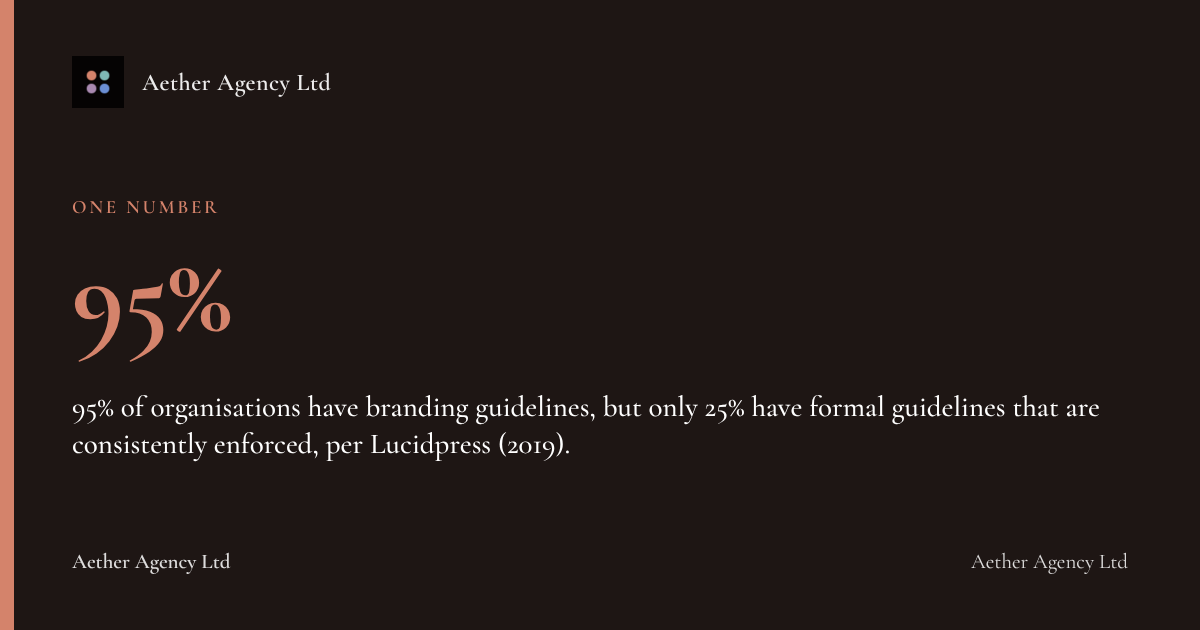
- 95% of organisations have branding guidelines, but only 25% have formal guidelines that are consistently enforced, per Lucidpress (2019).
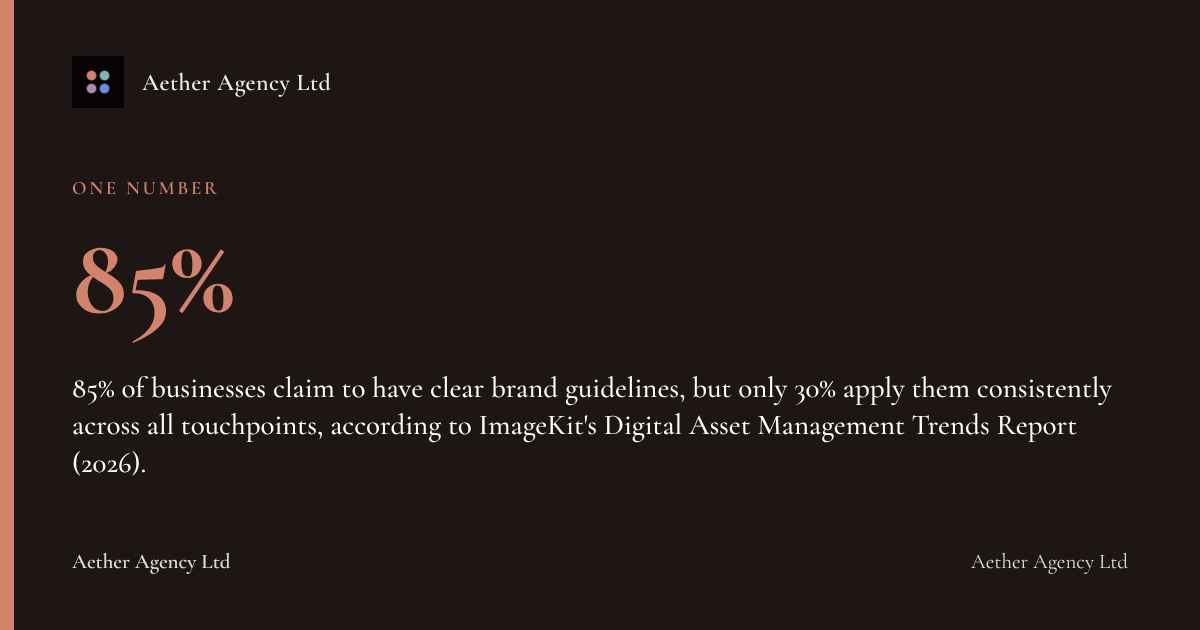
- 85% of businesses claim to have clear brand guidelines, but only 30% apply them consistently across all touchpoints, according to ImageKit's Digital Asset Management Trends Report (2026).
- Integrating digital asset management with a templating solution and brand hub lifted brand consistency 11 percentage points, from 77% to 88%, reports the Association of National Advertisers, citing MediaValet's DAM Trends Report (2026).
- Aether Agency Ltd has delivered 50+ projects, as published on aether-agency.co.uk, drawing on brand identity work that carries through every team touchpoint.
What Does Brand Consistency Across Teams Mean?
Brand consistency across teams is the practice of applying one visual identity, one tone of voice and one core message regardless of which department produces the material, from a sales deck to a customer service email. It covers three components that must align everywhere a business shows up: visual identity (logo, colour palette, typography), tone of voice (the words and personality a brand uses), and messaging (the specific claims and positioning a business repeats).
A business with strong visual identity but drifting tone of voice is still inconsistent, because customers absorb both signals at once. Fulk Butchers, a family butchers in Surrey, had a local reputation but no formal brand identity and no route to online orders before working with Aether Agency Ltd. Aether Agency Ltd built a full brand identity from scratch and delivered an e-commerce website with online ordering, alongside ongoing social media and marketing support, so the same identity now carries through from packaging to the order confirmation email. Online sales at Fulk Butchers rose 180%, with a 4.8 star Google rating on record (no earlier figures recorded for either metric).
The financial stakes are real. Consistent brand presentation across all channels is associated with a meaningful increase in average revenue, with studies putting the range as high as 33%, according to Lucidpress/Marq (2019). Yet although nearly 90% of companies say brand consistency is important, less than 10% report that their brand presentation is very consistent, per the same Lucidpress report (2019). That gap between intention and execution is exactly what a guideline document, properly owned, is built to close.
What Foundational Brand Guideline Documents Should You Create?
A brand guideline document is a reference asset that defines how a business's visual identity, tone of voice and messaging must appear across every channel and department. It should include logo usage rules (clear space, minimum size, colour variants), a defined colour palette with hex and Pantone codes, approved typography, photography and illustration style, a tone of voice spectrum (formal to casual, with example phrases), core messaging pillars, and named do's and don'ts for common scenarios like social posts, email signatures and sales decks.
The document only works if staff can find it and use it without reinterpreting the brand from scratch each time. Of companies who rated their brand guidelines effectiveness as poor to very poor, only 9% said the guidelines were easy to find, according to Lucidpress (2019). Emily Popson, Senior Vice President of Marketing at CallRail, put it plainly: "If every creative brief requires someone to reinterpret the brand from scratch, you've already lost consistency."
Aether Agency Ltd builds brand identity systems designed to survive handover beyond the marketing team, specifically so that sales, HR and customer service staff can apply them without a design background. The company's Brand Identity service covers naming, identity systems and guidelines built to hold together across every channel a growing business uses, rather than a static PDF nobody opens after launch.
A practical guideline pack for a mid-sized UK business typically includes:
- A one-page brand summary (mission, audience, positioning) for non-design staff
- A visual toolkit (logo files, colours, fonts, templates)
- A tone of voice guide with real examples, not just adjectives
- Channel-specific rules (email signatures, LinkedIn posts, pitch decks)
- An approvals process flowchart showing who signs off what
Who Should Be Responsible for Brand Governance Across an Organisation?
Brand governance is the system of ownership, approval rights and accountability that keeps a business's identity consistent as it scales beyond a single marketing team. Of companies who say consistency is important, 44% say the CMO holds primary brand management responsibility (chief marketing officer, the senior executive accountable for brand and marketing strategy), according to Lucidpress (2019).
A single named owner matters more than the job title attached to them. Erin Lentz, Executive Director of Design at ArtVersion, warned that "one of the biggest mistakes is treating the brand as marketing's responsibility rather than an organisational commitment." She added that "regular cross-functional alignment, clear governance and shared measurement help reinforce consistency."
For smaller UK businesses without a CMO, governance can sit with a founder, a head of marketing or an external partner such as a branding agency acting as brand steward. Whoever holds the role needs three things: a documented approvals process, authority to reject off-brand material from any department, and a regular review slot (monthly or quarterly) to check live output against the guidelines.
A Simple Governance Model for Growing Businesses
| Team size | Recommended owner | Review cadence | Approval authority |
|---|---|---|---|
| Under 10 staff | Founder or head of marketing | Ad hoc, as material is produced | Founder sign-off on anything public-facing |
| 10 to 50 staff | Named brand manager or marketing lead | Monthly spot-check | Brand manager approves; escalates disputes |
| 50+ staff | Brand committee (marketing, sales, HR reps) | Quarterly formal audit | Committee vote, CMO or equivalent as tiebreaker |
How Do You Train Different Teams to Apply Brand Guidelines Correctly?
Training non-marketing teams on brand guidelines means giving sales, HR and customer service staff the specific rules relevant to their own output, not the full design manual. A sales team needs pitch deck templates and approved claims language; HR needs consistent tone in job adverts and onboarding packs; customer service needs approved phrasing for common complaint responses.
The gap between having guidelines and applying them is the single biggest finding in the data. 85% of businesses claim to have clear brand guidelines, but only 30% apply them consistently across all touchpoints, according to ImageKit's DAM Trends Report (2026). Training closes that gap only when it is role-specific: a 90-minute workshop per department, run at onboarding and refreshed annually, works better than a single all-staff briefing that nobody retains.
"Ultimately, brand consistency is not a document," according to a marketing leader quoted in Senior Executive's CMO Think Tank on protecting brand consistency across teams, channels and touchpoints. It becomes a habit only once every department has seen their own examples, not just marketing's.
Practical steps that work across UK businesses of most sizes:
- Run a department-specific onboarding session within a new hire's first month, covering only the templates and tone rules relevant to their role.
- Build a shared slide or document library (Google Workspace or Microsoft SharePoint) so sales and HR pull from approved assets rather than recreating them.
- Nominate a brand champion within each department who flags questions back to the central brand owner.
- Review a sample of each department's public output quarterly and share corrections as short, specific feedback, not a re-run of the full training.
What Tools Help Manage Brand Consistency Across Departments?
Digital asset management (DAM) software is a centralised system that stores approved logos, templates and brand assets so every department pulls from the same source rather than outdated local copies. The data on tool adoption is striking: when DAM is integrated with the right brand ecosystem features, like a templating solution and a brand hub, brand consistency increased 11 percentage points, from 77% to 88%, according to the Association of National Advertisers, citing MediaValet's DAM Trends Report (2026).
The cost of poor asset access shows up directly in delivery speed. 48% of companies report it takes a week or more to fulfil requests for new or customised brand materials, while 40% of organisations with consistent brand presentation report it takes less than a week, per Lucidpress (2019). A DAM system with templating removes most of that wait, because sales or HR staff can generate an on-brand document themselves rather than queuing a design request.
| Tool category | What it solves | Typical users |
|---|---|---|
| Digital asset management (DAM) | Central, searchable store of approved logos, images, templates | Marketing, design, external agencies |
| Brand hub or portal | Self-serve access to guidelines and approved copy | Sales, HR, customer service |
| Templating software | Lets non-designers build on-brand decks, posts and documents | Sales, HR, regional offices |
| Approval workflow tools | Routes content through sign-off before publishing | Marketing managers, brand owners |
Aether Agency Ltd's Website Development service builds sites with the same identity system woven in from the start, so the website template itself becomes a consistency safeguard rather than a separate asset to police later.
What Processes Keep Content Consistent When Teams Work Remotely Across Offices?
A content approval process is a defined sequence of review stages that public-facing material must pass through before publishing, and it becomes essential once teams are distributed across multiple UK offices or working remotely. Without a shared digital source of truth, a London head office and a regional sales team can easily drift onto different template versions within weeks.
The fix is structural rather than cultural: a single cloud-based guideline hub, a named approver per region, and a short checklist attached to every piece of outbound content. Businesses with a Manchester office and a London head office, for example, should route all public content through one shared review queue rather than two parallel ones, so neither office develops its own unofficial style.
A workable remote approval flow looks like this:
- Draft created by any team, using approved templates from the shared asset library
- Self-check against a one-page brand checklist before submission
- Review by the named regional brand champion
- Final sign-off by the central brand owner for anything high-visibility (press, paid ads, annual reports)
- Published, then logged in a shared tracker so other offices can see what has gone live
Your Brand Consistency Checklist
- Document your visual identity, tone of voice and core messaging in one guideline pack, not scattered files.
- Name a single brand owner with authority to approve or reject off-brand material.
- Store approved assets in one shared, searchable library rather than local folders.
- Run role-specific training for sales, HR and customer service, not just marketing.
- Set a review cadence (monthly for larger teams, quarterly for smaller ones) to audit live output.
- Build an approval workflow for remote and regional teams so every office uses the same queue.
- Brief external agencies and freelancers with the same guideline pack you give internal staff.
- Revisit the guidelines themselves at least annually, or whenever the business repositions.
FAQ
How do you maintain brand consistency across multiple teams?
Maintain brand consistency across multiple teams by documenting visual identity, tone of voice and messaging in one guideline pack, naming a single brand owner, and giving every department role-specific training rather than a single generic briefing.
What is brand consistency and why does it matter across departments?
Brand consistency is the practice of presenting the same visual identity, voice and message regardless of which team produces the material. It matters financially too: consistent presentation is linked to a meaningful increase in average revenue, according to Lucidpress/Marq (2019).
Who should own brand consistency in an organisation?
A single named individual or committee should own brand consistency, with authority to approve or reject off-brand material. Among companies that rate consistency as important, 44% give the CMO primary responsibility, per Lucidpress (2019).
How often should brand guidelines be reviewed and updated?
Brand guidelines should be reviewed at least annually, and sooner if the business repositions, launches new products, or expands into new channels. Larger organisations benefit from a quarterly spot-check against live output in addition to the annual formal review.
What tools help enforce brand consistency across teams?
Digital asset management (DAM) systems, brand hubs and templating software help enforce consistency by giving non-design teams self-serve access to approved assets. Pairing DAM with templating and a brand hub lifted consistency from 77% to 88% in one analysis, according to the ANA (2026).
What causes brand inconsistency across departments?
Brand inconsistency is most often caused by guidelines that are hard to find, no named owner with approval authority, and training that only reaches the marketing team. Only 9% of companies with poorly-rated guidelines said those guidelines were easy to find, per Lucidpress (2019).
How can small UK businesses keep branding consistent without a big marketing team?
Small businesses can maintain consistency with a lightweight guideline pack, one shared asset folder, and a single founder or manager acting as approver for public-facing material. Fulk Butchers, a Surrey family butchers, had no formal brand identity before Aether Agency Ltd built one from scratch alongside an e-commerce site, after which online sales rose 180% (no earlier figure on record).
Building a Brand System That Holds Together with Aether Agency Ltd
Brand drift usually starts small: a sales deck with the wrong blue, a careers page with a tone nobody recognises, a regional office quietly designing its own templates. Aether Agency Ltd works with growing UK businesses to build brand identity systems designed from the outset to survive handover across marketing, sales, HR and customer service, not just the design team that created them.
Fulk Butchers, a family butchers in Surrey, had a local reputation but no brand identity and no e-commerce route before Aether Agency Ltd built both from scratch, alongside ongoing social media and marketing support delivered by one team so the identity holds from packaging through to the order confirmation email. Aether Agency Ltd has delivered 50+ projects, as published on aether-agency.co.uk, drawing on more than 20 years of combined team experience in brand, build and grow work.
If your brand looks or sounds different depending on which department produced it, get in touch with Aether Agency Ltd to discuss a Brand Identity review built to hold together across every team and channel your business uses.
Related Reading
- Brand Guidelines vs Brand Identity: The UK Difference
- What Is a Brand Design System? A Clear Definition
- What Is a Responsive Logo? Definition | Aether Agency
Add aether-agency.co.uk as a preferred source on Google
See How Your Brand Appears in AI Search
Aether AI monitors your visibility across ChatGPT, Perplexity, Google AI Overviews, and Claude in real time. Find out where you stand and what to fix.
Explore Aether AI