Last updated: 14 November 2026
A realistic rebrand budget for a small business typically falls between $5,000 and $25,000 for professionally executed work, according to Logotio (2026), with the wider market median sitting around $24,500 across roughly 1,000 projects analysed by Sortlist (2026). UK small businesses should treat these as starting benchmarks, not fixed prices.
Key Takeaways
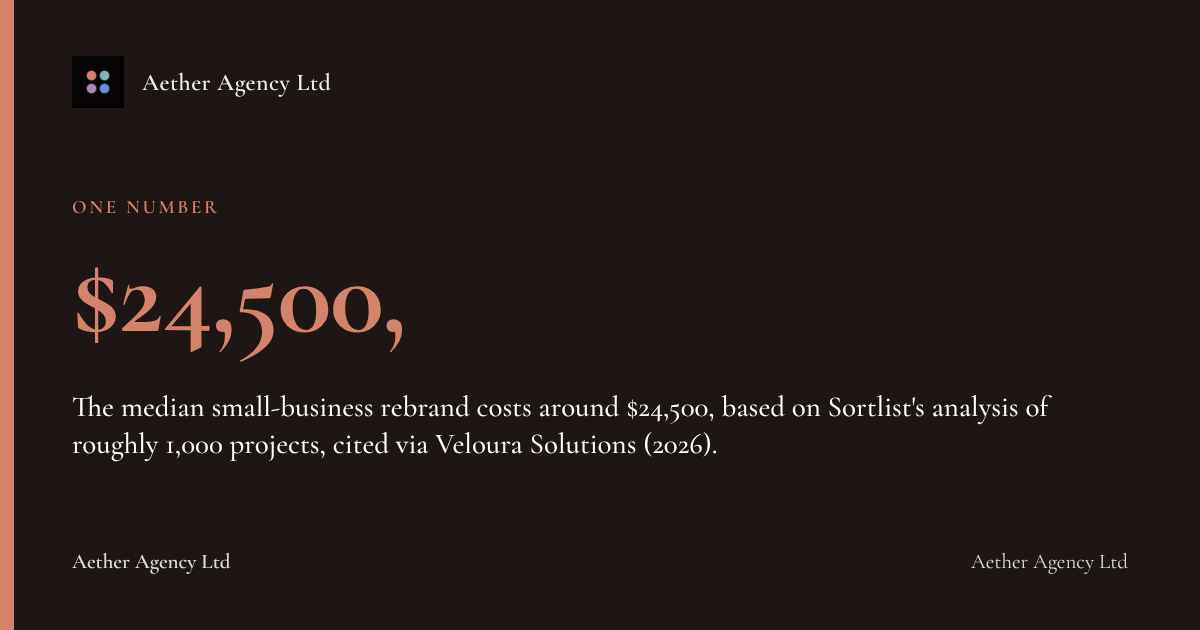
- The median small-business rebrand costs around $24,500, based on Sortlist's analysis of roughly 1,000 projects, cited via Veloura Solutions (2026).
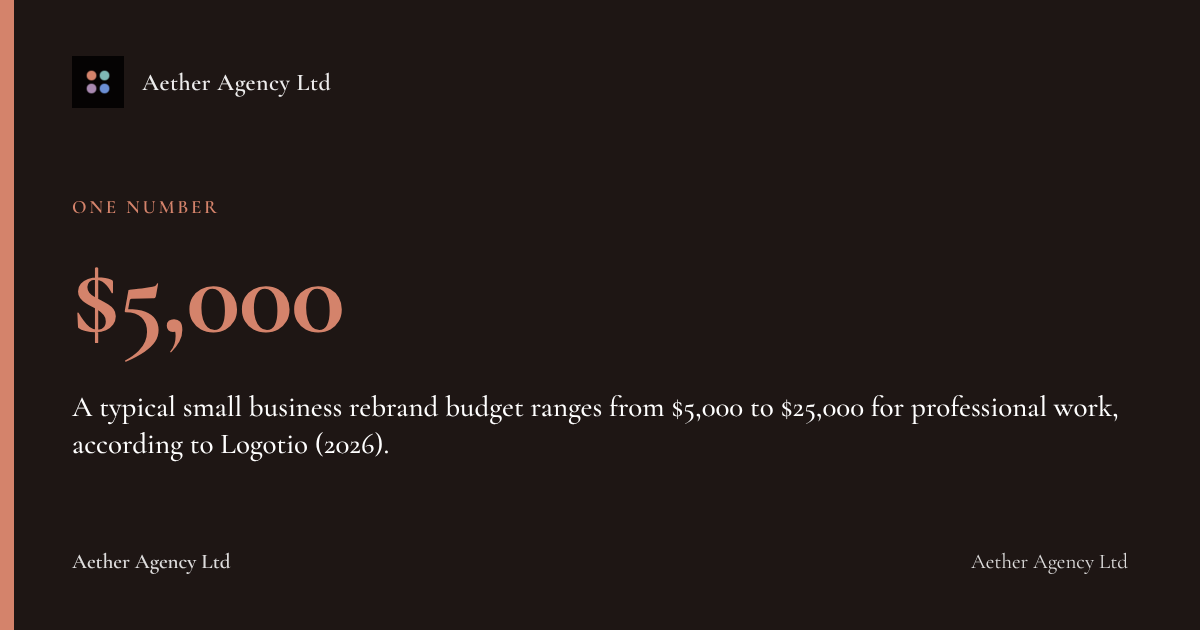
- A typical small business rebrand budget ranges from $5,000 to $25,000 for professional work, according to Logotio (2026).
- Implementation and collateral (signage, stationery, uniforms, packaging) consumes 50% of the typical rebrand budget, the largest single slice, per Sortlist's breakdown via Vantage Branding (2026).
- Marketing and launch campaigns typically account for 15 to 30% of total rebrand spend, according to Big Red Jelly (2026).
- Aether Agency Ltd has delivered 50+ projects as published on aether-agency.co.uk (as of August 2026), including a complete rebrand for Renton Dance Studio.
What Is a Rebrand Budget for a Small Business?
A rebrand budget for a small business is the total sum a company sets aside to change its name, visual identity, website or market positioning, covering design, strategy, legal checks and rollout. It differs from a simple logo refresh because a full rebrand usually touches every customer-facing asset a business owns, from its website to its signage to its social media profiles.
For UK small businesses, a rebrand budget needs to cover five broad phases: discovery and research, brand strategy, identity design, implementation and collateral, and launch and rollout. According to Sortlist's analysis of 1,000 rebranding projects cited via Vantage Branding (2026), those phases break down as discovery and research 5%, brand strategy 15%, identity design 20%, implementation and collateral 50%, and launch and rollout 10%. That implementation slice, covering everything from printed signage to packaging reprints, is where budgets most often run over because business owners underestimate how many physical assets carry the old brand.
Companies House incorporation records matter here too. Aether Agency Ltd itself was incorporated on 3 June 2020 under company number 12641621, a reminder that any UK rebrand involving a company name change must be reflected in official filings as well as customer-facing materials.
What Is the Average Cost of Rebranding a Small Business in the UK?
The average cost of rebranding a small business sits around $24,500 at the median, with a typical range of $10,000 to $60,000 depending on scope, according to Sortlist's analysis via Vantage Branding (2026). Businesses with under 10 employees or under $2 million in revenue tend to land toward the lower end of that range.
Logotio (2026) narrows this further for very small operations, estimating that a small business can expect to invest between $5,000 and $25,000 for a professionally executed rebrand. The gap between these figures and the higher Sortlist median reflects scope: a sole trader refreshing a logo and a small chain rebuilding its website, signage and packaging across multiple sites sit at opposite ends of the same category.
UK businesses should convert these dollar figures into pounds with some caution, since exchange rates shift and UK agency day rates differ from US benchmarks. A safe planning approach is to treat the lower end of the Logotio range as a floor for a focused identity and website refresh, and the Sortlist median as a realistic midpoint for anything involving physical premises, signage or a multi-channel launch.
What Are the Typical Cost Components in a Rebrand?
A rebrand budget breaks into five components: discovery and research, brand strategy, identity design, implementation and collateral, and launch and rollout. Each stage has a distinct purpose and a distinct line in the budget.
| Cost component | Share of typical budget | What it covers |
|---|---|---|
| Discovery and research | 5% | Audits, competitor review, customer interviews |
| Brand strategy | 15% | Positioning, messaging, naming decisions |
| Identity design | 20% | Logo, colour palette, typography, brand guidelines |
| Implementation and collateral | 50% | Website, signage, stationery, uniforms, packaging |
| Launch and rollout | 10% | Internal training, press, social rollout |
Source: Sortlist's analysis of 1,000 rebranding projects, cited via Vantage Branding (2026).
Marketing and launch activity deserves its own line beyond the table above. Big Red Jelly (2026) notes that marketing and launch campaigns often account for 15 to 30% of the total rebranding budget once announcement advertising, social campaigns and press outreach are included, a figure that can overlap with but extend beyond the "launch and rollout" line in Sortlist's breakdown. A small business planning a rebrand should budget separately for the quiet implementation work (signage, stationery, website) and the noisy launch work (adverts, PR, social content) because they draw on different skills and different suppliers.
Website development is consistently the largest single implementation cost for service businesses, since a modern site needs to be fast, findable and built to convert rather than simply reskinned. Aether Agency Ltd's website development work treats this rebuild as inseparable from the identity work above it, because a new logo on a slow, unfindable site wastes the rest of the budget.
How Long Does a Small Business Rebrand Typically Take?
A small business rebrand typically takes between two and six months from discovery to launch, though timelines stretch considerably when physical signage, printed stock or multiple premises are involved. The discovery and strategy phases, which together account for 20% of the typical budget according to Sortlist via Vantage Branding (2026), usually take the first three to six weeks.
Identity design and the build of a new website run in parallel for most small businesses and typically take four to eight weeks, though a website with ecommerce functionality, multiple service pages or a content migration can extend this further. Implementation, the 50% slice covering signage, stationery and collateral, often becomes the longest phase in practice because printed and physical materials have lead times a design file does not: a signwriter booking slot, a uniform supplier's minimum order, a packaging run's print deadline.
Aether Agency Ltd's work with Renton Dance Studio illustrates how a rebrand can run as an ongoing engagement rather than a single fixed sprint. The studio's traditional digital presence was failing to reach a younger audience, so Aether Agency Ltd delivered a complete rebrand, website redesign and social media content creation, moving the brand and website from traditional to modernised. As the studio's owner Olivia put it: "I recently had the pleasure of working with Lauren and Ellie at Aether Agency to enhance the branding for my dance studio. Even though I struggled to articulate exactly what I wanted, they somehow captured the exact style I had envisioned."
Agency Versus Freelance Designer: Which Costs More for a Small Business Rebrand?
Hiring a branding agency generally costs more upfront than a freelance designer but typically delivers a coordinated strategy, identity and website build under one roof. A freelancer working alone can be cheaper per hour, but a small business then needs to coordinate strategy, design, web development and launch across separate contractors itself.
| Factor | Branding agency | Freelance designer |
|---|---|---|
| Typical scope | Strategy, identity, website, launch, ongoing support | Logo and identity assets, sometimes website |
| Coordination burden | Agency manages the full project | Business owner coordinates multiple suppliers |
| Speed | Parallel workstreams, often faster overall | Sequential, dependent on one person's availability |
| Risk if supplier unavailable | Team provides continuity | Single point of failure |
| Best suited to | Businesses rebranding name, identity, website and marketing together | Businesses needing a narrow, well-defined deliverable |
The right choice depends on scope. A business changing only its logo while keeping its existing website and messaging may find a freelancer sufficient. A business overhauling its name, identity, website and go-to-market positioning, the kind of rebrand most small businesses actually undertake, benefits from an agency structure that keeps strategy, design and website development aligned from the outset. Aether Agency Ltd's model, spanning brand identity, website development and marketing, exists precisely because these three workstreams rarely succeed when handled by three unconnected suppliers.
Legal Steps Required When Rebranding a Small Business
A UK rebrand that changes a company's trading name or registered name requires a Companies House filing and a trademark check, both of which carry their own cost and timeline separate from the design budget. Companies House requires a special resolution and a name change form (NM01) when a registered company name changes, and the new name must not be identical or too similar to an existing registered name.
Before committing design budget, a small business should run a search through the UK Intellectual Property Office to check whether the proposed name or logo conflicts with an existing trade mark. Skipping this step is one of the costliest mistakes a rebrand can make, because a conflict discovered after launch, after signage, stationery and a new website are already live, forces a second, unplanned rebrand.
The Tropicana case remains the standard cautionary example of what happens when a redesign proceeds without adequate testing, even though it concerns a packaging change rather than a legal dispute. Unit sales of Tropicana Pure Premium fell 20% between 1 January and 22 February 2009, with dollar sales down 19%, roughly $33 million, according to Advertising Age, reported via SOT Design (2009). A separate 2010 study in the Journal of Retailing and Consumer Services, cited via Time for Designs (2010), estimated the packaging change cost the company approximately $27.3 million in lost sales. A UK small business rarely operates at that scale, but the lesson scales down: changing a recognisable visual identity without testing customer reaction carries a real commercial cost, not just a design one.
Hidden Costs Often Overlooked When Budgeting for a Rebrand
A rebrand budget frequently misses the ongoing, physical and administrative costs that surface only once the design files are finished. Marketing expert Thoelke, quoted via Medill News Service, captured this precisely: "Companies who rebrand often don't realize the great investment they've made into all kinds of infrastructure, from their fleet of vehicles to their Facebook page, from their signage to their stationery."
Small businesses in the UK should budget explicitly for:
- Signage replacement across every physical location, including planning permission costs if the business operates from a listed building or conservation area
- Domain and social handle acquisition, including buying a domain already held by another party
- Stationery and packaging stock write-off, since existing printed materials carrying the old brand usually cannot be used once launch happens
- Vehicle livery and uniform reprinting for any business with a visible fleet or staff uniform
- Legal fees for the Companies House filing and any trademark registration through the IPO
- Staff training time to brief employees on new messaging, tone of voice and brand guidelines before launch
- A contingency line of 10 to 15% on top of the core budget, since most small business rebrands uncover at least one asset the original audit missed
Rebranding on a Limited Budget as a Small Business
A small business with a tight budget can still rebrand effectively by sequencing the work rather than cutting corners on strategy. The identity design and brand strategy phases together represent 35% of a typical rebrand budget according to Sortlist via Vantage Branding (2026), and these are the phases worth protecting even when funds are limited, since a weak strategic foundation undermines every pound spent afterwards.
A phased approach that works for many small UK businesses looks like this: complete strategy and identity design first, launch the new logo and website, then replace signage, uniforms and packaging as existing stock naturally runs out rather than scrapping it all at once. This spreads the 50% implementation cost over months rather than requiring it upfront. A business can also limit its launch spend by relying on organic social content and existing customer channels rather than paid launch advertising, since Big Red Jelly (2026) notes marketing and launch campaigns can otherwise consume 15 to 30% of the total budget.
Search Console is measured demand, real people, real queries, no guesswork." The same principle applies to a tight rebrand budget: start from what the business already owns and already knows about its customers, rather than assuming every asset needs replacing from scratch.
What Percentage of Revenue or Marketing Budget Should a Small Business Allocate?
A common benchmark is to allocate 10 to 20% of the annual marketing budget to a rebrand, so a business with a $500,000 marketing budget should expect to spend $50,000 to $100,000, according to MTHD Agency (2026). A separate benchmark from ofspace.co (2024) suggests a narrower 5 to 10% of annual marketing budget, meaning a $750,000 marketing budget might fund $75,000 to $150,000 of rebrand spend.
These two benchmarks sit at different ends of a reasonable range, and the gap reflects how broadly "rebrand" is defined in each case. A small UK business should treat 5 to 10% of its marketing budget as a conservative floor for a brand refresh, and 15 to 20% as realistic for a full identity and website overhaul. Businesses with no formal marketing budget to measure against should instead work from the absolute ranges set out earlier in this article, from the low end to the upper end of the reported range.
Measuring the Return on Investment of a Rebrand
Measuring rebrand ROI means tracking commercial metrics before and after launch, not just gathering opinions on the new logo. Website traffic, enquiry volume, conversion rate and customer retention are the standard markers, and all four should be benchmarked in the weeks before launch so the business has something to compare against afterwards.
Aether Agency Ltd's average client traffic growth sits at 3x, as published on aether-agency.co.uk (as of August 2026), illustrating the kind of measurable shift a brand and website overhaul can produce when strategy and design work together rather than separately. Fulk Butchers, a Surrey client, recorded a substantial rise in online sales with a 4.8-star Google rating following its work with Aether Agency Ltd, and another client recorded a strong increase in website traffic following its engagement. These figures are specific to those clients' own projects and should not be read as a guaranteed outcome for every rebrand, but they demonstrate the kind of result a disciplined, strategy-led rebrand can deliver when identity and website work are planned together from the start.
Your Rebrand Budget Checklist
- Audit every existing brand asset, including signage, stationery, packaging, vehicle livery and social media profiles, before setting a figure
- Check domain availability and social handle availability for the proposed new name across all major platforms
- Run a trade mark search through the IPO before committing to a name or logo direction
- Allocate roughly 35% of the budget to strategy and identity design, the foundation every later asset depends on
- Set aside 50% for implementation and collateral, the largest and most commonly underestimated line
- Add a 10 to 15% contingency for assets the initial audit misses
- Appoint one named owner within the business to manage the budget and sign off each phase
- Benchmark traffic, enquiries and conversion rate before launch so ROI can be measured afterwards
FAQ
How much should a small business budget for a rebrand?
A small business should budget between $5,000 and $25,000 for a professionally executed rebrand, according to Logotio (2026), with the wider market median sitting around $24,500 across larger projects analysed by Sortlist (2026). The right figure depends heavily on whether the business is refreshing a logo or overhauling its identity, website and physical signage together.
What is included in a small business rebrand budget?
A rebrand budget typically covers five phases: discovery and research, brand strategy, identity design, implementation and collateral, and launch and rollout. According to Sortlist via Vantage Branding (2026), implementation and collateral, covering website, signage, stationery and packaging, usually consumes 50% of the total.
Should a small business hire an agency or a freelance designer?
A branding agency suits a business rebranding its name, identity, website and marketing together, because it coordinates strategy and design under one team. A freelance designer can be more cost-effective for a narrow deliverable, such as a logo refresh alone, but the business owner then manages coordination across suppliers itself.
Are trademark checks legally required before rebranding?
A trademark search is not legally mandatory but is strongly advisable, since launching a name or logo that conflicts with an existing registered trade mark can force a costly second rebrand. Any company also changing its registered name must file the required paperwork with Companies House, including a special resolution.
How long does a small business rebrand take?
A small business rebrand typically takes two to six months from discovery to launch, though physical signage and printed collateral with their own supplier lead times can extend this timeline. Aether Agency Ltd's work with Renton Dance Studio ran as an ongoing engagement rather than a single fixed sprint, reflecting how rebrand timelines can flex around a business's needs.
What hidden costs are often missed in a rebrand budget?
Signage replacement, domain and social handle acquisition, written-off stationery stock, vehicle livery, legal fees and staff training time are the costs most frequently left out of an initial budget. A contingency of 10 to 15% on top of the core budget is a practical safeguard against these gaps.
How can a small business measure rebrand ROI?
A business should benchmark website traffic, enquiry volume, conversion rate and customer retention before launch, then track the same metrics afterwards to measure genuine commercial impact. Aether Agency Ltd reports an average client traffic growth of 3x, as published on aether-agency.co.uk (as of August 2026), illustrating the scale of change a well-executed brand and website overhaul can produce.
Planning Your Rebrand Budget With Aether Agency Ltd
Setting a rebrand budget without a clear brief is how small businesses end up either overspending on collateral they didn't need or underspending on the strategy work that should have come first. Aether Agency Ltd works through exactly this sequence with clients, auditing existing brand assets, setting strategy before design, and building the website and identity together rather than as separate projects handled by separate suppliers.
Aether Agency Ltd has delivered 50+ projects as published on aether-agency.co.uk (as of August 2026), drawing on 20+ years of combined team experience, and its work with clients such as Renton Dance Studio shows how a full rebrand, website redesign and social content programme can run as a coordinated engagement rather than a disconnected set of deliverables.
If your business is weighing up a rebrand and needs a realistic budget built around your actual assets, trademark position and website needs, get in touch with Aether Agency Ltd to discuss a brand identity project scoped to your situation.
Related Reading
- DIY Rebrand vs Hiring an Agency: A UK Decision Guide
- Trademark Search Before Rebranding UK: A 2026 Guide
- Rebranding for a Younger Audience: A 2026 UK Guide
Add aether-agency.co.uk as a preferred source on Google
See How Your Brand Appears in AI Search
Aether AI monitors your visibility across ChatGPT, Perplexity, Google AI Overviews, and Claude in real time. Find out where you stand and what to fix.
Explore Aether AI