Last updated: 7 November 2026
A trademark search before rebranding in the UK means checking the Intellectual Property Office (IPO) register, Companies House and live use in the marketplace before you commit to a new name or logo. Skipping it matters: forced rebrands for small businesses typically cost £10,000 to £200,000, according to National Business Register (2025).
Key Takeaways
- Aether Agency Ltd advises that a trademark search before rebranding checks the UKIPO register, Companies House and live marketplace use for conflicts before launch.
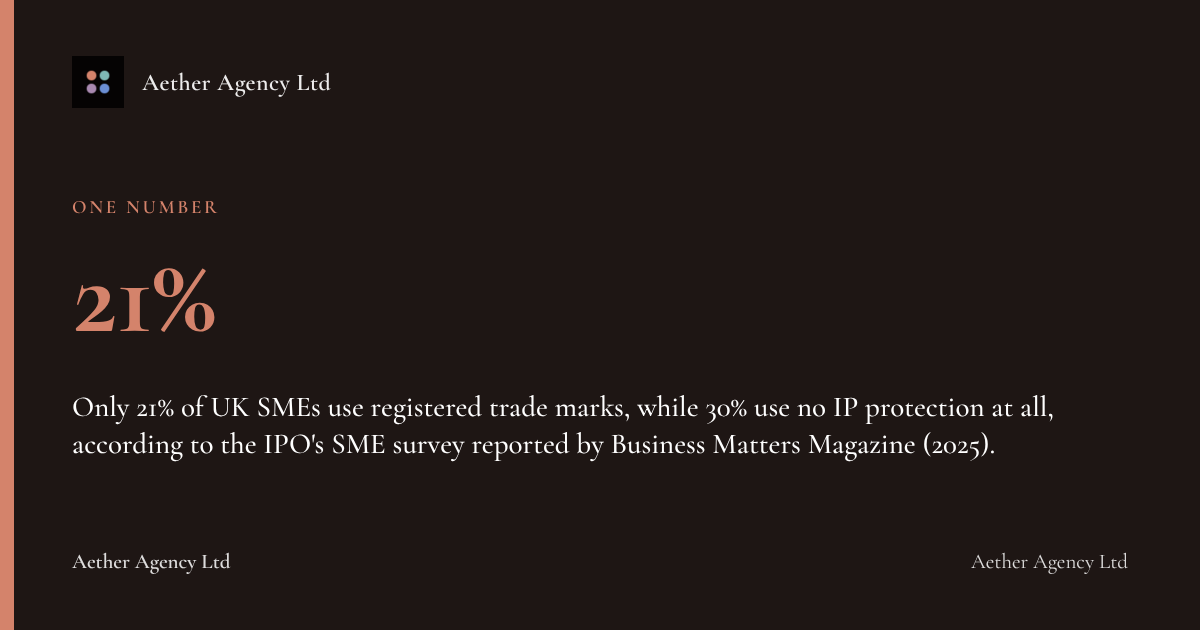
- Only 21% of UK SMEs use registered trade marks, while 30% use no IP protection at all, according to the IPO's SME survey reported by Business Matters Magazine (2025).
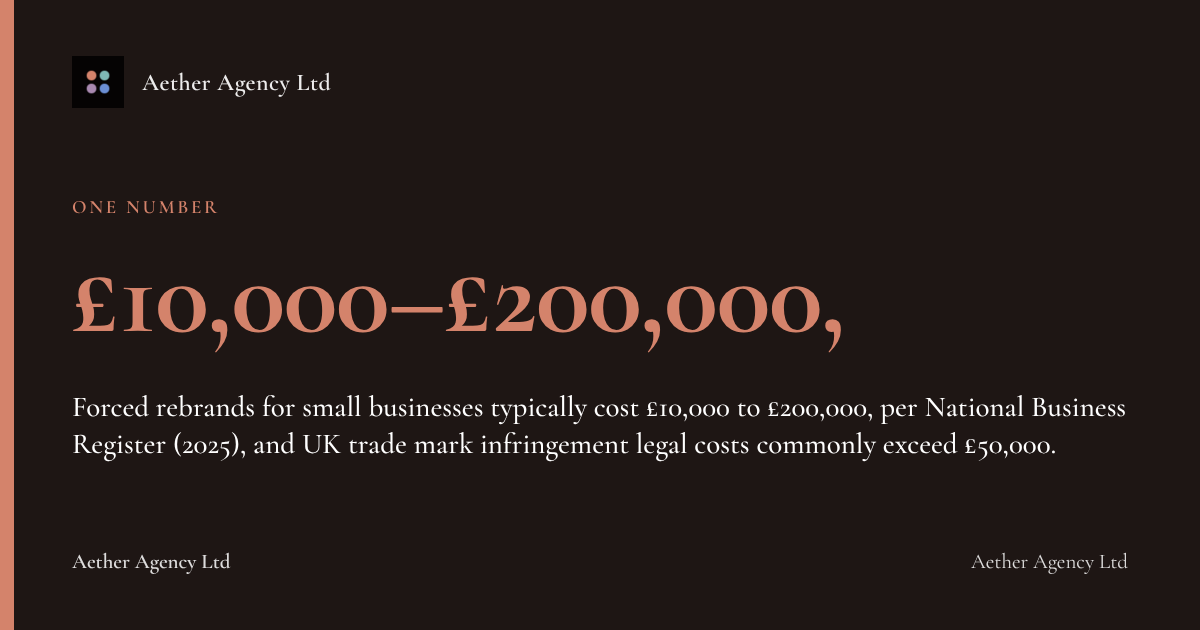
- Forced rebrands for small businesses typically cost £10,000 to £200,000, per National Business Register (2025), and UK trade mark infringement legal costs commonly exceed £50,000.
- From 1 April 2026, a UKIPO online trademark application costs £205 for the first class plus £60 per additional class, up from £170 and £50, the first fee rise since 1998, according to Director Help (2026).
- Self-filed UK trade mark applications fail at four times the rate of those filed by a professional representative: 16% versus 4%, per Murgitroyd/Clarivate research (2025).
Why Is a Trademark Search Important Before Rebranding a Business in the UK?
A trademark search before rebranding a business in the UK is the process of checking whether your proposed new name, logo or strapline already belongs to someone else before you spend money building it out. Get this wrong and the consequences land well after the website is live, the signage is up and the new business cards have been printed.
The numbers make the case starkly. Forced rebranding for small businesses typically costs £10,000 to £200,000, depending on scope and complexity, according to National Business Register (2025). Separately, legal costs for UK trade mark infringement disputes commonly exceed £50,000, even in relatively straightforward cases, per the same source.
Despite this exposure, trademark protection is patchy across UK business. Only 21% of UK SMEs use registered trade marks, and 30% report using no IP protection whatsoever, according to the IPO survey reported by Business Matters Magazine (2025). Against the government's estimate of roughly 5.7 million private-sector businesses in the UK, that implies millions of firms are trading without registered protection, per Business Matters Magazine (2025).
Dr Dan Thornton, a Patent Attorney at Mewburn Ellis, put it bluntly: "We were shocked by the results of this poll, which demonstrates that many UK SMEs are left exposed when it comes to their intellectual property assets."
How Do I Search the UK Intellectual Property Office Trademark Register Myself?
The UK Intellectual Property Office (IPO), the government body that registers and protects UK trade marks, patents and designs, provides a free public search tool at GOV.UK: Search for a trade mark. You type in your proposed brand name, select the relevant Nice Classification class (the international system that groups goods and services into 45 numbered categories) and review every exact and similar match already on the register.
A basic self-search covers three things: identical word marks, phonetically similar marks (names that sound alike even if spelt differently) and marks registered in your specific trade class. It will not reliably catch logo similarity, unregistered "common law" trade marks built up through years of trading, or marks pending but not yet published.
This is where DIY searching runs into trouble. 16% of self-filed UK trade mark applications were unsuccessful, compared to just 4% of those filed by a professional representative, according to Murgitroyd, citing Clarivate research (2025). A free search is a sensible first filter before you invest in anything more thorough, not a substitute for clearance.
For a broader sweep covering the EU and beyond, the World Intellectual Property Organization's TMview tool searches multiple national and international registers simultaneously, which matters if your rebrand will trade across borders.
UK, EU and International Trademark Searches: What's the Difference?
A UK trademark search checks only marks registered with the UKIPO under the Trade Marks Act 1994, the primary legislation governing trade mark rights, registration and infringement in the UK, available at GOV.UK. Since Brexit, this register is entirely separate from the EU's register, administered by the EUIPO.
Before 1 January 2021, EU trade marks automatically covered the UK. Existing EU registrations from before that date were cloned into comparable UK rights, often visible on the register with UK008 or UK009 prefixes, so a clean UKIPO search still needs to catch these converted marks, not just marks filed directly with the IPO.
| Search type | Covers | Best tool | Relevant if |
|---|---|---|---|
| UK national search | England, Wales, Scotland, Northern Ireland | GOV.UK trade mark search | You trade only in the UK |
| EU search | All 27 EU member states as one right | EUIPO search | You sell into the EU post-Brexit |
| International (WIPO) | Multiple countries via a single Madrid Protocol filing | TMview | You export or plan to expand overseas |
If your rebrand includes ambitions to sell into the EU or further afield, checking only the UK register and assuming you are clear is a common and expensive mistake. A name can be free in London but already trademarked in Dublin, Paris or further afield, and under the Madrid Protocol system a single international application can later cover dozens of jurisdictions.
Should I Search Company Names at Companies House as Well as Trademarks?
Yes: Companies House, the UK registrar of companies, and the UKIPO trade mark register are two entirely separate systems, and clearing one tells you nothing about the other. A name can be perfectly available to incorporate at Companies House while already registered as a trade mark by a competitor, and the trade mark owner can still take action against you for using it in trade.
Companies House checks only whether a company name is "the same as" or "too similar to" an existing registered company, under rules set out in the Companies Act 2006. It does not check trade marks, domain names or unregistered brand reputation at all.
Run both searches before you commit:
- Companies House (free, via the Companies House register) confirms the name is available to incorporate.
- UKIPO trade mark register confirms no one else has exclusive trading rights to that name or a similar one in your sector.
A clear Companies House search with a conflicting trade mark is still a live legal risk.
What Counts as a Conflicting Trademark and How Similar Is Too Similar?
A conflicting trademark is one that is identical or confusingly similar to your proposed mark and registered in the same or a related class of goods or services. Confusing similarity is assessed by the IPO and the courts on three dimensions together: visual similarity (how the words or logo look on the page), phonetic similarity (how the name sounds when spoken) and conceptual similarity (whether the two convey the same idea or association to an average consumer).
A few worked examples illustrate how this plays out:
| Scenario | Risk level | Why |
|---|---|---|
| Identical word, same trade class | Very high | Direct clash under the Trade Marks Act 1994 |
| Similar sound, different spelling, same sector | High | Phonetic similarity test applies |
| Identical word, unrelated sector | Lower, but not zero | "Well known" marks get wider protection |
| Similar logo, different name | Medium to high | Visual similarity assessed independently of wording |
Trade marks are registered against specific Nice Classification classes, so a name can coexist legitimately in unrelated industries. The practical test the IPO and courts apply is whether an average consumer would likely be confused about the origin of the goods or services, not whether the marks are mathematically identical.
How Much Does a Professional Trademark Clearance Search Cost in the UK?
A professional trademark clearance search in the UK typically costs between £200 and £1,000 for a basic search, rising for more detailed international coverage, while a solicitor-run search typically runs £300 to £1,500, according to National Business Register / Trademark Dashboard (2025). This sits well below the cost of a forced rebrand later, which typically runs £10,000 to £200,000 per the same source.
Once a search comes back clear, registering the mark adds a further cost. From 1 April 2026, a UKIPO online application costs £205 for the first class and £60 for each additional class, up from £170 and £50 previously, a roughly 25% increase and the first fee rise since 1998, according to Director Help (2026).
DIY versus professional search: the trade-off
| Factor | DIY UKIPO search | Professional clearance search |
|---|---|---|
| Cost | Free | £200 to £1,500 |
| Covers phonetic/visual similarity analysis | Limited | Yes, assessed against case law |
| Covers common law/unregistered use | No | Often, via trade directories and web checks |
| Covers EU/international marks | No, UK only | Yes, on request |
| Failure rate if filing yourself | 16% unsuccessful | 4% unsuccessful |
For a straightforward rebrand with a distinctive name and UK-only trading, a careful DIY search followed by a solicitor's sense-check can be proportionate. For anything with trading ambitions abroad, a crowded sector name, or a logo close to a known competitor, the professional route earns its fee quickly against the cost of getting it wrong.
How Long Does the Trademark Search and Clearance Process Take?
A UK trademark search itself can be done in a day using the free IPO tool, but full clearance, including a professional opinion and a buffer for any objections, typically takes two to six weeks before you can safely proceed with a rebrand. Registration itself, once filed, typically takes approximately 3 to 4 months from application if there are no objections or oppositions, according to Supreme IP (2026).
Build this timeline into your rebrand plan rather than treating it as a formality squeezed in after the creative work is finished. A typical sequence looks like this:
- Week 1: Free IPO self-search and Companies House check on shortlisted names.
- Weeks 1 to 2: Domain and social handle availability check on surviving names.
- Weeks 2 to 4: Professional clearance search commissioned on the final one or two candidates.
- Weeks 4 to 6: Trade mark application filed once clearance is confirmed.
- Months 1 to 4 post-filing: IPO examination period, during which an opposition can still be lodged by a third party.
A rebrand launch date set before this process starts is a rebrand launch date at risk of slipping. Aether Agency Ltd builds trademark clearance into the earliest phase of any brand identity project, specifically so that naming, logo design and website build do not run ahead of legal certainty.
Should I Use a Trademark Attorney or Solicitor, or Search Myself?
Hiring a chartered trade mark attorney or solicitor is advisable whenever the name is distinctive to your business value, the sector is crowded, or you plan to trade beyond the UK. The Chartered Institute of Trade Mark Attorneys (CITMA) is the UK professional body for trade mark attorneys, and its register is the standard place to find a qualified specialist.
The cost of getting this wrong is not abstract. Self-filed applications fail 16% of the time, against 4% for professionally filed ones, according to Murgitroyd/Clarivate research (2025), and a failed application after a rebrand has already launched is far costlier to fix than one caught before launch.
When DIY is reasonable:
- A low-risk, low-budget rebrand with a highly distinctive invented name.
- UK-only trading with no expansion plans.
- A straightforward self-search comes back genuinely clean with no near matches.
When professional advice earns its fee:
- The name is close to an existing mark in sound or meaning.
- You trade, or plan to trade, in the EU or further afield.
- The rebrand is central to significant revenue, funding or franchising plans.
- An opposition is received during the IPO examination period.
What If I Find a Similar or Identical Trademark During My Search?
Finding a conflicting result means you have three realistic options: abandon that name, negotiate a coexistence or licence agreement with the existing owner, or seek a formal opinion on whether the conflict is genuine enough to pose real risk. The worst option, by some distance, is proceeding anyway and hoping the existing owner does not notice.
A coexistence agreement, a formal contract in which two trade mark owners agree how each may use similar marks without infringing the other, can sometimes resolve an apparent clash, particularly where the two businesses operate in genuinely different niches. This route needs professional drafting and should never be attempted without legal input, given the cost of a defective agreement later.
Where a close match exists and no sensible resolution is available, returning to the drawing board on the name is almost always cheaper than proceeding and facing a cease-and-desist letter after launch. This is precisely the scenario the £10,000 to £200,000 forced rebrand cost range from National Business Register (2025) describes: businesses that launched, then had to change everything.
Once the Search Is Clear, What Are the Next Steps to Register My Trademark?
Filing the UKIPO application is the next step once your search comes back clear, done either directly via GOV.UK or through your trade mark attorney. From 1 April 2026, this costs £205 for the first class and £60 per additional class online, per Director Help (2026).
After filing, the IPO examines the application, publishes it for a two-month opposition period during which third parties can object, and, assuming no issues arise, registers the mark. This full process typically takes 3 to 4 months, according to Supreme IP (2026).
Only once the mark is granted should you commit fully to the public rollout, which is why brand identity and website launches are best sequenced after filing, not before it. In practice, this is the model Aether Agency Ltd followed with Renton Dance Studio, a dance academy that engaged Aether Agency Ltd for a complete rebrand, website redesign and social media content creation to replace a traditional digital presence that was failing to connect with a younger audience. As Olivia, the studio's owner, put it: "I recently had the pleasure of working with Lauren and Ellie at Aether Agency to enhance the branding for my dance studio. Even though I struggled to articulate exactly what I wanted, they somehow captured the exact style I had envisioned."
Your Trademark Search Before Rebranding Checklist
- Run a free search on the UKIPO register for your shortlisted names.
- Check comparable UK marks carrying UK008/UK009 prefixes converted from pre-Brexit EU registrations.
- Search Companies House separately to confirm name availability for incorporation.
- Check domain availability and social media handles across your key platforms.
- Commission a professional clearance search if the name is distinctive to your value or you trade internationally.
- Review results against the Nice Classification class relevant to your sector.
- File the UKIPO application only once clearance is confirmed, budgeting £205 plus £60 per extra class.
- Hold the public rebrand launch until the two-month opposition period has safely passed.
FAQ
Do I legally have to do a trademark search before rebranding in the UK?
No, a trademark search is not a legal requirement before rebranding, but skipping it leaves you exposed to infringement claims that commonly cost more than £50,000 in legal fees, according to National Business Register (2025).
Can I use the UKIPO search tool for free?
Yes, the GOV.UK trade mark search tool is free to use and covers all registered and pending UK trade marks on the public register.
What happens if I register a company name that's already trademarked?
Companies House will often let you incorporate the name because it does not check the trade mark register, but the trade mark owner can still issue a cease-and-desist or infringement claim once you start trading under it.
Is a logo covered by the same trademark search as a name?
No, word marks and logo (device) marks are searched and registered separately, so a clearance search covering your business name does not automatically clear a new logo design.
How much extra does the 2026 UKIPO fee increase add to registration costs?
The 2026 fee rise takes an online application from £170 to £205 for the first class and from £50 to £60 for each additional class, roughly a 25% increase, according to Director Help (2026).
Should I check social media handle availability before finalising a rebrand name?
Yes, checking domain names and social media handles alongside trademark searches avoids launching a cleared name only to find the matching web and social presence is already taken elsewhere.
What's the difference between a basic search and a full clearance search?
A basic search is a quick check for identical marks, usually done free via the IPO tool, while a full clearance search adds professional analysis of phonetic and visual similarity, unregistered use and often EU or international coverage, typically costing £200 to £1,500.
Securing Your Rebrand With Aether Agency Ltd
A trademark search before rebranding only delivers real protection if it happens before the creative work begins, not after the new identity is already designed and signed off. Aether Agency Ltd builds trademark and naming checks into the earliest stage of every brand identity project, so that the name, the logo system and the website are all built around a mark with genuine legal headroom, rather than one that might need abandoning months later.
Aether Agency Ltd has delivered 50+ projects, as published on aether-agency.co.uk, spanning brand identity, website development and AI search marketing for growing UK businesses, including the complete rebrand and website redesign delivered for Renton Dance Studio. If you are planning a rebrand and want the naming, trademark clearance and brand identity work handled together from day one, get in touch with Aether Agency Ltd to discuss your project and request a quote.
Related Reading
- Old Branded Stock After a Rebrand: What UK Firms Should Do
- How to Change a Company Name UK: 2026 Process & Cost
- Estate Agent AI Search Services UK | 2026 Guide
Add aether-agency.co.uk as a preferred source on Google
See How Your Brand Appears in AI Search
Aether AI monitors your visibility across ChatGPT, Perplexity, Google AI Overviews, and Claude in real time. Find out where you stand and what to fix.
Explore Aether AI