Last updated: 13 November 2026
A brand audit includes an internal review (mission, values, messaging), an external review (customer perception, market position), a visual identity check (logo, colours, design consistency), a digital audit (website, SEO, social media) and a competitor comparison. A full audit typically runs across six to twelve weeks, according to Fratzke Media (2025).
Key Takeaways
- A brand audit covers seven dimensions, including positioning, messaging consistency, visual identity, digital presence, consumer perception, competitive standing and AI search visibility, according to Brand Auditors (2025).
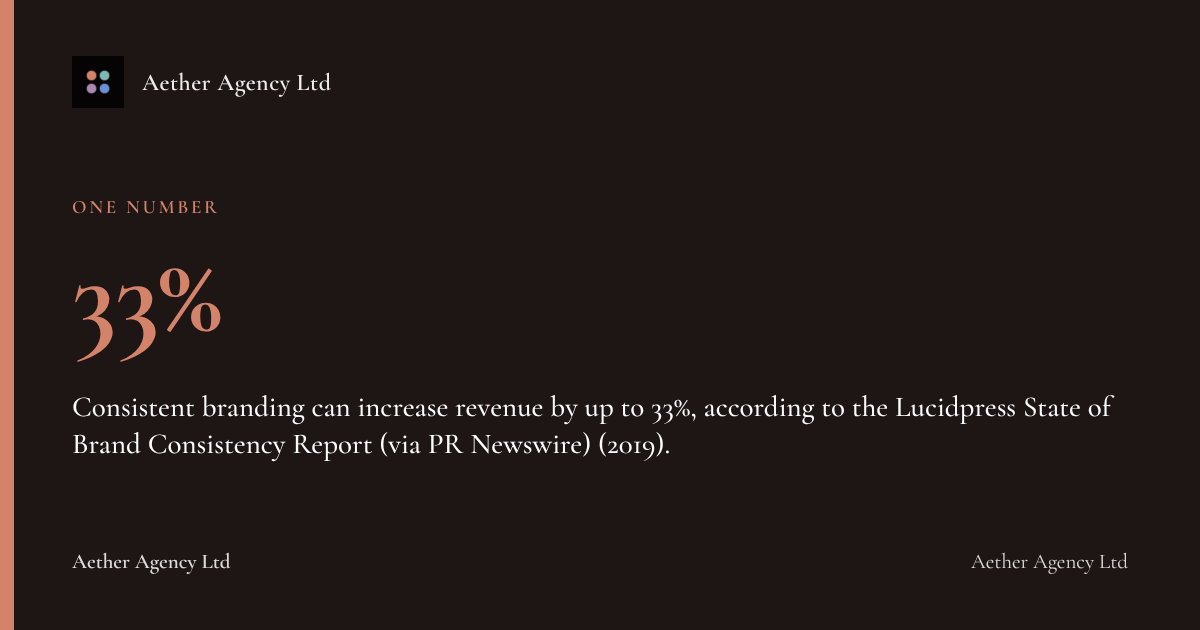
- Consistent branding can increase revenue by up to 33%, according to the Lucidpress State of Brand Consistency Report (via PR Newswire) (2019).
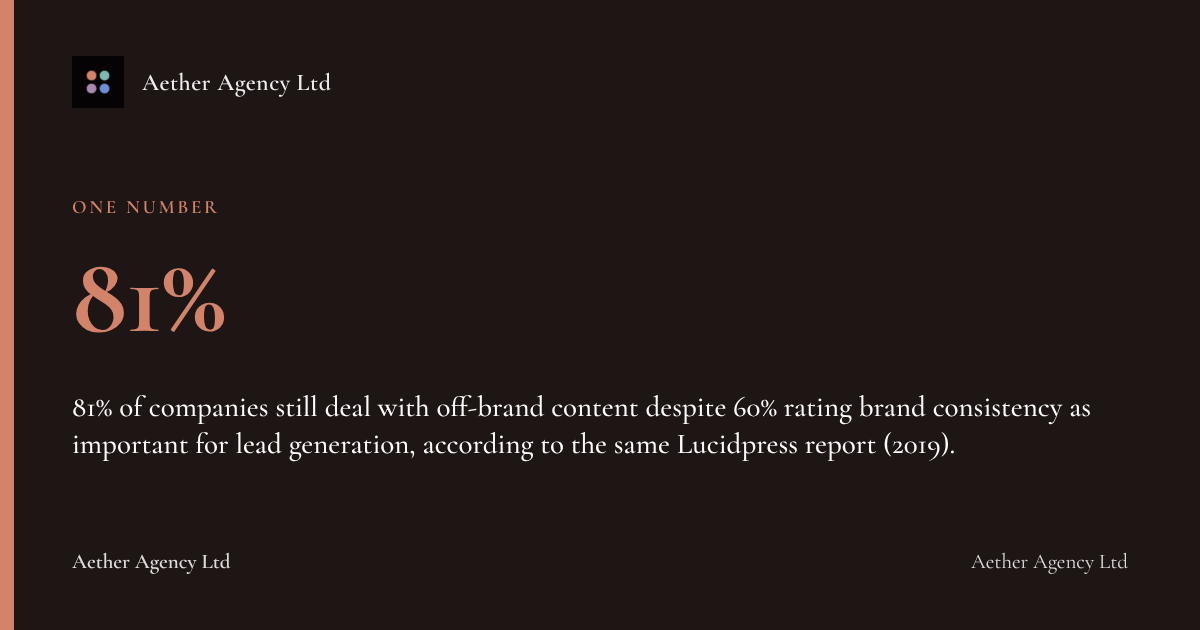
- 81% of companies still deal with off-brand content despite 60% rating brand consistency as important for lead generation, according to the same Lucidpress report (2019).
- A comprehensive brand audit typically takes six to twelve weeks from stakeholder interviews through to final synthesis, according to Fratzke Media (2025).
- **Aether Agency Ltd has delivered 50+ projects, as published on aether-agency.**co.uk.
What Is a Brand Audit and Why Would a UK Business Need One?
A brand audit is a structured review of how a business presents itself internally and externally, measured against how customers, prospects and competitors actually perceive it. It exists because the gap between what a company thinks it stands for and what the market experiences is usually wider than founders expect.
UK businesses commission a brand audit at specific trigger points: before a rebrand, after a merger, when growth has outpaced the original brand guidelines, or when a new marketing director wants a baseline before setting strategy. A business expanding from one London showroom to a national footprint, for example, often discovers that its messaging, visual identity and digital presence have drifted apart across different teams and freelancers over several years.
The financial case is straightforward. Consistent branding can increase revenue by up to 33%, a 10% increase over the 2016 report finding of 23%, according to the Lucidpress State of Brand Consistency Report (via PR Newswire) (2019). The same report found that over 60% of brands believe maintaining a consistent brand is important when generating leads and communicating with existing customers, yet 81% of companies still deal with off-brand content. That gap between belief and practice is precisely what a brand audit is designed to close.
As Owen Fuller, General Manager at Lucidpress, put it: "Companies will continue to struggle with off-brand content as demand for content continues to grow with 50% of organizations creating more content this year than the year prior."
What Are the Main Components Covered in a Typical Brand Audit?
A typical brand audit covers seven core components: brand positioning, messaging consistency, visual identity, digital presence, customer perception, competitive standing and, increasingly, AI search visibility. Brand Auditors (2025) names these as the seven dimensions a complete audit should address.
Each dimension answers a different question. Positioning asks whether the brand occupies a clear, defensible space in the customer's mind. Messaging consistency checks whether that positioning is communicated the same way across every channel, from the website to the sales deck to the Instagram bio.
Visual identity examines the logo, colour palette, typography and photography style for coherence. Digital presence covers the website, search engine visibility, social media activity and online reviews. Customer perception measures how buyers and prospects actually describe the brand, often against how the business describes itself internally. Competitive standing benchmarks all of the above against direct rivals. AI search visibility, the newest addition to most checklists, assesses whether tools such as ChatGPT, Perplexity and Google AI Overviews mention the brand accurately (or at all) when prospects ask relevant questions.
A good audit treats these seven areas as interconnected rather than a tick-box exercise run in isolation. A business can have a strong logo and a weak digital presence, or clear internal values that never reach the website copy.
What Internal Brand Elements Should an Audit Assess?
Internal brand elements include the mission statement, core values, brand voice guidelines, internal messaging documents and how consistently staff themselves describe what the company does. An auditor typically starts here because internal clarity is the foundation everything external is built on.
The process usually involves stakeholder interviews with founders, senior leadership and customer-facing staff, since a receptionist and a sales director often describe the same company very differently. Fratzke Media (2025) lists stakeholder interviews as a core part of the six to twelve week audit timeline, alongside internal and external research and competitive analysis.
Key internal questions an audit should answer:
- Does the mission statement reflect what the business actually does today, not what it did five years ago?
- Are the stated values visible in day-to-day decisions, or are they framed posters nobody references?
- Does brand voice guidance exist in writing, and does marketing content actually follow it?
- Do different departments (sales, customer service, marketing) describe the value proposition consistently?
A Surrey engineering firm, for instance, might find its original mission statement still references a product line discontinued years earlier, while its newest hires have never seen formal messaging guidelines at all. That mismatch rarely surfaces until someone deliberately goes looking for it.
"Ranking is attention; converting is trust, and trust comes from specificity. A page that says what a service costs, who it suits and who it does not, will convert visitors a vaguer competitor merely collects. Most content programmes fail commercially because every page is written to be agreeable to everyone, which persuades no one.", Lauren Dawkins, Head of Content, Aether Agency
That same discipline applies to internal brand elements. A mission statement that tries to be everything to everyone rarely survives contact with a proper audit.
How Does a Brand Audit Evaluate Visual Identity and Digital Assets?
Visual identity is assessed by checking logo usage, colour consistency, typography and imagery against brand guidelines across every touchpoint, from packaging to email signatures. Digital assets are reviewed separately but at the same time, covering website performance, SEO visibility, social media presence and how the brand appears in search results.
The visual audit typically works through a checklist:
| Visual element | What the audit checks |
|---|---|
| Logo | Correct versions used, no stretching or colour drift |
| Colour palette | Consistent hex codes across print, web and social |
| Typography | Approved fonts used on website, decks and signage |
| Photography style | Consistent tone (bright, muted, staged, candid) |
| Packaging/signage | Alignment with digital brand assets |
Digital asset checks are broader. Sims-Knight, a contributor at Brandfolder, notes: "When performing a brand audit, it's important to look at everything from design to analytics and reporting." That means the website's loading speed, mobile usability, SEO structure and search rankings all fall inside the digital audit, alongside social media posting frequency, engagement rates and tone of voice across platforms.
A real example shows what this looks like in practice. Renton Dance Studio, a UK dance academy, had a traditional digital presence that was failing to reach a younger audience. Aether Agency delivered a complete rebrand, website redesign and social media content creation, moving the studio's brand and website from traditional to modernised. As the owner, Olivia, put it: "I recently had the pleasure of working with Lauren and Ellie at Aether Agency to enhance the branding for my dance studio. Even though I struggled to articulate exactly what I wanted, they somehow captured the exact style I had envisioned."
That case illustrates why visual and digital audits sit together rather than running as separate projects. A logo refresh means little if the website still loads slowly or the social feed uses last year's colour palette.
How Is Competitor Analysis Built Into a Brand Audit?
Competitor analysis is the stage where an internal audit gets tested against the market, benchmarking a business's positioning, visual identity and digital presence against two to four direct rivals. Brand Auditors (2025) lists competitive standing as one of the seven dimensions a complete audit must cover, alongside positioning and digital presence.
A practical competitor review typically examines:
- How rivals position themselves on price, quality, speed or specialism.
- What keywords and topics competitors rank for in Google search.
- How consistently competitors apply their own visual identity across channels.
- Review scores and sentiment on Google Business Profile, Trustpilot or sector-specific platforms.
- Whether competitors appear accurately when AI tools like ChatGPT or Google AI Overviews answer buyer questions in that category.
Fulk Butchers, an award-winning family butcher in Surrey, had built a strong local reputation but had no formal brand identity and no route to online orders, leaving it invisible against competitors with established e-commerce sites. Aether Agency built a full brand identity from scratch, delivered an e-commerce website with online ordering, and ran ongoing social media and marketing support, with brand, build and grow all delivered by one team so the identity carried through from packaging to the order confirmation email. Online sales rose 180% and the business now holds a 4.8-star Google rating.
That result matters for competitor analysis specifically: a business invisible online cannot be fairly compared against rivals who are. Fixing the visibility gap is often the precondition for any meaningful competitive benchmarking.
What Is the Step-by-Step Process for Conducting a Brand Audit?
A brand audit follows a sequential process: define objectives, gather internal data, research external perception, benchmark competitors, then synthesise findings into a report with prioritised recommendations. Fratzke Media (2025) confirms this full cycle, including stakeholder interviews and competitive analysis, typically takes six to twelve weeks.
| Stage | What happens | Typical duration |
|---|---|---|
| Scoping | Define goals, audience and audit boundaries | 1 week |
| Internal research | Stakeholder interviews, document review | 1 to 2 weeks |
| External research | Customer surveys, social listening, reviews | 2 to 3 weeks |
| Competitor benchmarking | Positioning, visual, digital comparison | 1 to 2 weeks |
| Synthesis and report | Findings, gaps, recommendations | 1 to 2 weeks |
In-House Team vs External Agency
A business choosing between running the audit internally or hiring an agency faces a genuine trade-off, not a simple right answer.
An in-house team knows the business intimately but rarely has the objectivity to spot blind spots, and internal staff often lack the time to run structured stakeholder interviews alongside their day jobs. An external agency brings an outside perspective, established frameworks and dedicated time, but costs more upfront and needs a proper briefing to understand the business context quickly.
For a small, single-location business with a tight budget, a founder-led internal review using a public checklist can surface the obvious gaps. For a growing business preparing for investment, expansion or a rebrand, an external agency's objectivity and structured process (such as the six to twelve week cycle Fratzke Media describes) is usually worth the investment.
Your Brand Audit Checklist
- Confirm the mission statement still reflects what the business does today.
- Interview staff across departments to check messaging consistency internally.
- Audit the logo, colour palette and typography across every physical and digital touchpoint.
- Review website speed, mobile usability and SEO performance.
- Check social media tone, frequency and engagement across all active platforms.
- Collect customer and prospect feedback on how the brand is actually perceived.
- Benchmark two to four direct competitors on positioning, visuals and digital presence.
- Check how AI search tools like ChatGPT and Google AI Overviews describe the brand.
FAQ
What does a brand audit include?
A brand audit includes a review of internal elements (mission, values, messaging), external perception (customer and market research), visual identity (logo, colours, design consistency), digital assets (website, SEO, social media) and competitor benchmarking. Brand Auditors (2025) frames this as seven dimensions, adding positioning and AI search visibility to the list.
How long does a brand audit take?
A comprehensive brand audit typically takes six to twelve weeks from start to finish. This includes internal and external research, stakeholder interviews, competitive analysis and synthesis of findings, according to Fratzke Media (2025).
How much does a professional brand audit cost in the UK?
Costs vary widely depending on business size, scope and whether the audit is run internally or by an agency. Smaller businesses commissioning a focused audit should expect a lower range than enterprises needing full stakeholder interviews, customer surveys and multi-market competitor benchmarking; agencies typically scope pricing after an initial consultation once objectives are confirmed.
Who should carry out a brand audit, an internal team or an external agency?
Either can work, depending on the business's size, budget and need for objectivity. An internal team understands the business best but may lack the distance to spot blind spots, while an external agency brings a structured process and an outside perspective, which matters most ahead of a rebrand, merger or major growth phase.
What is the difference between a brand audit and a marketing audit?
A brand audit focuses on identity, positioning and perception, covering mission, values, visual identity and how customers describe the business. A marketing audit is broader and reviews campaign performance, channel spend and lead generation activity, with brand health as just one input among many.
What happens after a brand audit is completed?
A completed audit produces a report identifying gaps between how the brand intends to present itself and how it is actually perceived, with prioritised recommendations. Businesses typically act on findings through a rebrand, messaging refresh, website rebuild or a more disciplined style guide rollout across teams.
How often should a UK business repeat a brand audit?
There's no universal rule, but most businesses benefit from a lighter review annually and a full audit every two to three years, or whenever a major trigger event occurs, such as a merger, rebrand, new market entry or significant leadership change.
Securing Your Brand's Foundations with Aether Agency Ltd
The gap this article keeps returning to, between what a business believes about its brand and what customers and competitors actually see, is the exact problem Aether Agency Ltd was built to close. Aether Agency Ltd runs brand, build and grow as one connected process: brand identity work, website development and ongoing marketing delivered by the same team, so an audit's findings translate directly into a coherent rebrand rather than a report that sits unread.
Aether Agency Ltd has delivered 50+ projects, as published on aether-agency.co.uk, including work like the Fulk Butchers brand identity and e-commerce rebuild that took a respected local business from no online ordering route to a 180% rise in online sales.
If an internal review has already surfaced inconsistencies in your messaging, visuals or digital presence, the next step is a proper brand identity assessment with Aether Agency Ltd. Get in touch to book a call and scope what a full audit and rebuild would look like for your business.
Related Reading
- Data-Driven Brand Strategy: A UK Business Guide 2026
- Brand Strategy Agency Richmond: A UK Buyer's Guide 2026
- Brand Audit Agency UK: Costs, Process & How to Choose
Add aether-agency.co.uk as a preferred source on Google
See How Your Brand Appears in AI Search
Aether AI monitors your visibility across ChatGPT, Perplexity, Google AI Overviews, and Claude in real time. Find out where you stand and what to fix.
Explore Aether AI