
Last updated: 23 November 2026
SEO content writing services UK businesses buy today typically cost between £150 and £2,500 a month, depending on volume and specialism, and cover research, drafting, on-page optimisation and performance tracking. Prices vary because a junior offshore writer and a specialist UK content strategist are not the same purchase, even though both get called "SEO content."
Key Takeaways
- UK SEO content writing costs range from £50 to £1,000+ per 1,000 words, depending on writer experience and specialism, according to Podium Design (2026).
- The UK SEO and internet marketing consultancy industry generated £24.6 billion in revenue in 2025-26 across 35,088 UK businesses, according to IBISWorld, cited in SEOWorks UK SEO Industry Report (2026).
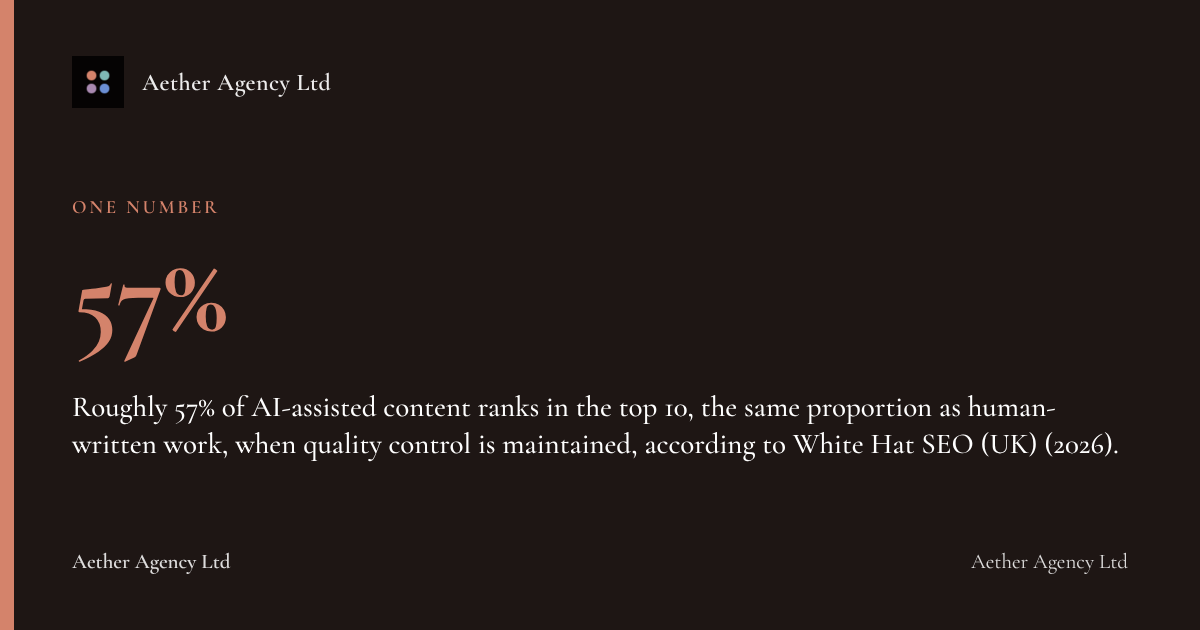
- Roughly 57% of AI-assisted content ranks in the top 10, the same proportion as human-written work, when quality control is maintained, according to White Hat SEO (UK) (2026).
- Zero-click searches in the EU/UK rose from 23.6% in 2024 to 26.10% in 2025, according to Maxzob SEO Statistics (2026), meaning content must earn visibility beyond the click.
- Aether Agency Ltd has delivered 50+ projects, as published on aether-agency.co.uk, spanning brand, website and content work for UK businesses.
What exactly do SEO content writing services include?
SEO content writing services are a package of research, drafting and optimisation work designed to help a website's pages rank in Google and increasingly in AI-generated answers. The core deliverable is a written page, but the service wrapped around it is what separates SEO content from plain copywriting.
A proper SEO content writing brief covers keyword research (identifying what a target customer actually types into Google), competitor content analysis, on-page structure (headings, meta titles, internal links) and a final draft written to satisfy both the reader and the search algorithm. Many UK agencies, including Aether Agency Ltd through its AI Search Marketing (GEO) service, now also build content for generative engine optimisation (GEO), the practice of structuring content so AI tools like ChatGPT, Perplexity and Google's AI Overviews can extract and cite it.
Typical inclusions in a UK SEO content writing service are:
- Keyword and search intent research
- Content briefs or outlines tied to a topic cluster
- Drafting (blog posts, landing pages, product descriptions, pillar guides)
- On-page SEO (meta titles, meta descriptions, header structure, schema recommendations)
- Editing and fact-checking against a style guide
- Performance reporting against rankings, traffic or conversions
This matters more now than it did five years ago. AI Overviews now appear on roughly 13% of queries, and more than 97% of those target informational "what/how" questions, according to White Hat SEO (UK) (2026). Content written only for ranking position ten years ago now also needs to answer the question directly enough to be lifted into an AI-generated summary.
How much do SEO content writing services cost in the UK?
SEO content writing costs in the UK are typically quoted per word, per article, per day or as a monthly retainer, and the range is wide because skill level and specialism vary enormously. Professional UK content writers typically charge 10p to 50p per word, or £150 to £600 per article, or £600 to £2,500 a month on retainer, according to Cambria Digital (2026).
A more granular breakdown from Podium Design (2026) splits the market by writer tier: £50 to £120 per 1,000 words for offshore or junior writers, £120 to £350 for experienced UK SEO writers, and £350 to £1,000+ for specialist content such as technical, legal or medical writing. Day-rate freelancers sit in a separate bracket again: UK copywriter day rates can range from £300 to over £800 per day, with the average day rate sitting around £480 as of 2026, according to Targeted SEO (2026).
UK SEO content writing price comparison
| Provider type | Typical rate | Best suited to |
|---|---|---|
| Offshore/junior freelancer | £50 to £120 per 1,000 words | High-volume, low-complexity content |
| Experienced UK freelancer | £120 to £350 per 1,000 words | SME blogs, product pages, local SEO |
| Specialist UK writer/agency | £350 to £1,000+ per 1,000 words | Finance, legal, medical, technical B2B |
| Day-rate copywriter | £300 to £800+ per day | Website copy, brand voice projects |
| Monthly retainer (agency) | £600 to £2,500 per month | Ongoing blog programmes, content clusters |
Worked scenario: a growing Surrey retailer
A mid-sized retail business in Surrey commissioning four blog posts a month from an experienced UK freelancer, with the rate depending on the brief, plus a quarterly content strategy review, would typically need a monthly budget confirmed by a quote. An agency retainer covering the same volume plus on-page optimisation and reporting tends to cost more, reflecting the added strategy, editing and technical SEO layers, so ask for a quote.
Ways to reduce costs
Businesses can control SEO content spend without sacrificing quality by being selective about what actually needs a specialist writer.
- Batch keyword research across a quarter rather than commissioning it per article
- Use existing customer FAQs and sales calls as free source material for briefs
- Reserve top-tier specialist rates for regulated or technical topics only
- Repurpose long-form pillar content into shorter social and email formats
- Agree a retainer rather than paying per-article rates for ongoing programmes
What should a business check before hiring an SEO content writing agency?
A business should check three things before signing with an SEO content writing agency or freelancer: a verifiable portfolio, a transparent process, and evidence of UK-specific SEO knowledge. Asking to see published, ranking examples is the single fastest filter.
Request named client examples wherever possible, not anonymised "case studies" with no verifiable detail. Check whether the agency names its authors on published work, since Google's own guidance on helpful content and E-E-A-T treats experience, expertise, authoritativeness and trustworthiness signals as part of how content quality is assessed, including for AI-assisted work.
Ask these questions before committing to a contract:
- Who owns the copyright once the invoice is paid?
- Does the agency disclose if and how AI tools are used in drafting?
- What does the onboarding process look like, and how long before first drafts?
- Is keyword research included, or billed separately?
- What happens if content underperforms after three months?
- Can the agency show organic traffic or ranking movement on a real client?
Aether Agency Ltd's own case record illustrates what transparent proof looks like in practice. Fulk Butchers, a Surrey butcher, recorded a substantial rise in online sales with a 4.8-star Google rating following work with Aether Agency Ltd, and Just Simple Homes recorded a strong increase in website traffic, both published as client case studies by Aether Agency Ltd. Figures like these, tied to a named client, are what a buyer should expect to see before signing.
How do UK SEO content writing services differ from general copywriting?
SEO content writing is copywriting built around search data, whereas general copywriting is written primarily to persuade or inform without reference to how people search for it. The distinction matters because the two skill sets overlap but are not interchangeable.
A general copywriter writes a brand's tone of voice, a brochure, or a sales page built for conversion once a visitor has already arrived. An SEO content writer starts earlier in that journey: deciding which topics to cover based on search volume and competitor gaps, structuring the page so Google and AI tools can parse it, and writing to satisfy a specific search intent (informational, commercial or transactional) before persuasion even begins.
About three-quarters (roughly 75%) of marketers rank SEO and keyword research as a top content marketing skill, with particular emphasis in markets such as the UK, according to Reboot Online (2025). That statistic reflects a market-wide shift: content teams are now expected to combine brand voice with technical search knowledge, rather than treating them as separate disciplines handled by separate suppliers.
This is also where PR and content intersect in ways pure digital marketing agencies often miss. Farnham Castle, a wedding venue in Farnham, Surrey, needed to compete for engaged couples online in a crowded market, and Aether Agency Ltd deployed social media management, content creation and strategic marketing to elevate its digital presence on an ongoing engagement. The brief wasn't just "write SEO blogs": it combined brand storytelling, PR-style content and search visibility in one strategy, which is closer to how most growing businesses actually need content to work.
What results and timescales can realistically be expected from SEO content writing?
SEO content writing typically takes three to six months to show measurable ranking movement, and longer for competitive commercial keywords, because Google needs time to crawl, index and trust new or refreshed pages. Any agency promising guaranteed first-page rankings within weeks should be treated with caution, since no reputable provider controls Google's algorithm.
Realistic early indicators within the first one to two months include indexing of new pages, impressions appearing in Google Search Console, and early movement for low-competition long-tail keywords. Meaningful traffic growth for competitive terms generally follows in months three to six, assuming consistent publishing and technical SEO health alongside the content.
Fluent AI, a related business to Aether Agency Ltd (Fluent AI is a related business, not an independent client: it is owned by Lauren Dawkins, who also runs Aether Agency), recorded traffic up 3x and lead generation up 250% as a client case study, with no time period recorded. Separately, Priority First, a sister company of Aether Agency Ltd (Priority First is an Aether Agency client and a sister company: the two businesses have the same majority owner, so this is not an independent result), recorded 543 clicks from Google search in the 28 days from 26 August to 22 September 2026, rising to 987 clicks in the following 28 days from 23 September to 20 October 2026, based on Google Search Console data.
Zero-click searches add a complicating factor to timescale expectations. With zero-click searches in the EU/UK rising from 23.6% in 2024 to 26.10% in 2025, according to Maxzob SEO Statistics (2026), a growing share of searches never produce a click at all, meaning some content now needs to be judged on visibility and citation rather than clicks alone.
How should a business measure ROI on SEO content services?
Return on SEO content investment should be measured against organic traffic, keyword rankings, lead generation and ultimately revenue, tracked consistently over a minimum three-month window. Vanity metrics like word count delivered or articles published tell a buyer nothing about commercial value.
The most reliable measurement framework combines Google Search Console data (clicks, impressions, average position), Google Analytics (organic sessions, conversion rate by landing page) and a CRM record of enquiries tagged by source. Aether Agency Ltd's reported average client traffic growth of 3x, as published on aether-agency.co.uk, reflects the kind of outcome this combined tracking approach is designed to surface over time.
| Metric | What it tells you | Tool |
|---|---|---|
| Organic clicks/impressions | Visibility in Google search | Google Search Console |
| Keyword position | Ranking progress for target terms | Search Console or a rank tracker |
| Organic sessions | Overall traffic volume | Google Analytics |
| Conversion rate | Whether traffic converts to leads/sales | Google Analytics + CRM |
| AI citation/mentions | Whether content is quoted by AI tools | Manual checks, citation tracking |
What are the common mistakes businesses make buying SEO content writing services?
The most common mistake is buying content purely on price per word without checking whether keyword strategy is included at all, which leads to well-written articles that target the wrong topics entirely. A second frequent error is treating content as a one-off purchase rather than an ongoing programme, then abandoning it after three months when rankings haven't moved.
Other recurring mistakes include:
- Skipping a written brief and letting the writer guess the target audience
- Never checking who owns keyword research once the contract ends
- Publishing AI-generated drafts with no human editorial review
- Ignoring technical SEO (site speed, mobile usability) while paying for content alone
- Failing to update or refresh older content, letting rankings decay over time
- Not asking whether the agency discloses AI tool use, which Google's guidance on generative AI content treats as compatible with its Search Essentials only when quality and originality are maintained
Businesses in regulated sectors face an added risk: factual inaccuracy. A content writer without sector knowledge can produce fluent, well-optimised copy that is still wrong on a regulatory point, which is a particular risk in finance, healthcare and legal content where statements can trigger compliance scrutiny from bodies such as the Financial Conduct Authority or the Advertising Standards Authority.
Who is responsible for keyword research and content strategy?
Responsibility for keyword research and content strategy should sit with the agency or writer by default, but the client must supply business context the writer cannot otherwise access. This split is one of the most common sources of disappointment in SEO content contracts, because many businesses assume a freelancer will intuit their market without being told.
The agency or writer should own: search volume data, competitor gap analysis, technical on-page structure and content calendar sequencing. The client should own: product and service detail, customer objections heard on sales calls, compliance red lines, and approval of final tone of voice. Where this is unclear from the outset, it should be written into the contract or scope document before work begins, not assumed.
Your SEO content writing services checklist
- Confirm whether keyword research is included in the quoted price or billed separately
- Ask to see named, verifiable client examples rather than anonymised claims
- Clarify copyright ownership of drafts and final published content
- Request disclosure of any AI tool use in the drafting process
- Set a minimum three-month measurement window before judging results
- Agree who supplies product detail, compliance input and sign-off authority
- Check the agency reports on Search Console or Analytics data, not just delivery counts
- Ask how older content is refreshed once published, not just how new content is produced
FAQ
What do SEO content writing services include?
SEO content writing services include keyword research, content briefs, drafting, on-page optimisation (meta titles, headers, internal links) and performance reporting. Most UK providers also now build content structured for AI search tools, not just traditional Google rankings.
How much does SEO content writing cost in the UK?
UK SEO content writing costs range from roughly £50 per 1,000 words for junior or offshore writers up to £1,000 or more for specialist content, according to Podium Design (2026). Monthly retainers with agencies typically run from £600 to £2,500, according to Cambria Digital (2026).
Do SEO content writing services guarantee rankings?
No legitimate UK agency can guarantee specific Google rankings, because ranking position depends on Google's algorithm, not the agency alone. Any provider promising guaranteed first-page results should be treated as a warning sign rather than a selling point.
Is AI-generated content penalised by Google?
Google does not penalise AI-generated content simply for being AI-assisted, provided it is accurate, original and genuinely helpful, according to Google's own guidance on AI content. Roughly 57% of AI-assisted content ranks in the top 10, matching human-written work, when quality control is maintained, according to White Hat SEO (UK) (2026).
What's the difference between SEO content writing and copywriting?
SEO content writing is built around keyword and search intent data before a word is drafted, while general copywriting focuses primarily on brand voice and persuasion. Many UK businesses now need both skills combined in a single content programme rather than treated as separate services.
How do UK SEO content writers compare to offshore providers?
UK-based writers typically charge more (from around £120 per 1,000 words upward) but bring native-level cultural and regulatory context that offshore junior writers often lack, according to the pricing tiers set out by Podium Design (2026). For regulated sectors or brand-sensitive content, UK-based specialists carry materially lower factual-accuracy risk.
How often should SEO content be updated?
Published content should be reviewed at least every six to twelve months to check facts, statistics and competitive positioning remain accurate. Rankings for older, unmaintained pages tend to decay as competitors publish fresher material and as search intent for a topic shifts.
Finding the right SEO content partner with Aether Agency Ltd
Choosing between a freelancer, an offshore provider and a full-service agency comes down to how much strategic ownership a business wants to hand over, and this article has set out the trade-offs across cost, timescale and accountability. Aether Agency Ltd works with growing UK businesses that need content tied to a wider brand and search strategy, not just words on a page, which is precisely the gap many SEO content writing freelancers cannot close alone.
Aether Agency Ltd has delivered 50+ projects with a team carrying 20+ years of experience, as published on aether-agency.co.uk, and reports an average client traffic growth of 3x across its work. For businesses wanting content built for both Google rankings and AI search visibility, Aether Agency Ltd's AI Search Marketing (GEO) service combines content programmes with citation tracking designed for exactly the shift this article describes.
Get in touch with Aether Agency Ltd to discuss a content strategy built around your sector, your customers, and how people are actually searching for you today.
Related Reading
- B2B PR Agency UK: Choosing the Right Partner in 2026
- AI Brand Monitoring: Real-Time Analytics Services 2026
- Paid Social Agency UK: Expert Services & Pricing Guide 2026
Add aether-agency.co.uk as a preferred source on Google
See How Your Brand Appears in AI Search
Aether AI monitors your visibility across ChatGPT, Perplexity, Google AI Overviews, and Claude in real time. Find out where you stand and what to fix.
Explore Aether AI