Last updated: 25 November 2026
A TikTok influencer marketing agency in the UK plans, sources and manages paid creator campaigns on a brand's behalf, typically charging between £2,000 and £15,000 a month depending on scope, according to Aether Agency. UK creator partnership revenue hit £966m in 2025 and is forecast to pass £1bn in 2026, making agency selection a high-stakes decision.
Key Takeaways
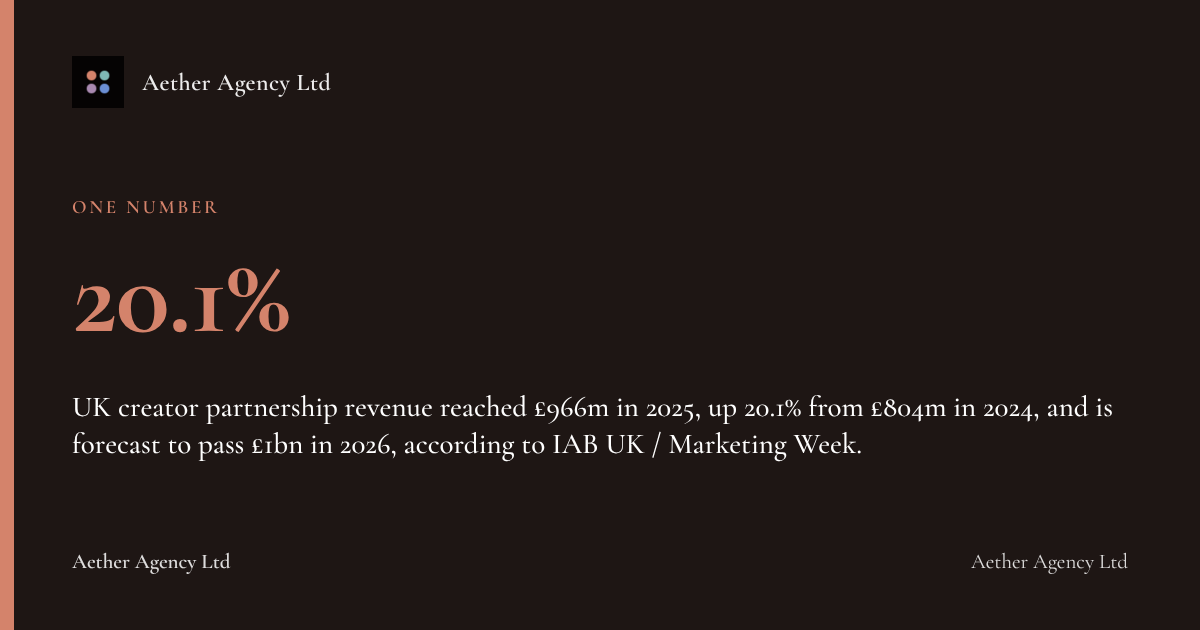
- UK creator partnership revenue reached £966m in 2025, up 20.1% from £804m in 2024, and is forecast to pass £1bn in 2026, according to IAB UK / Marketing Week.
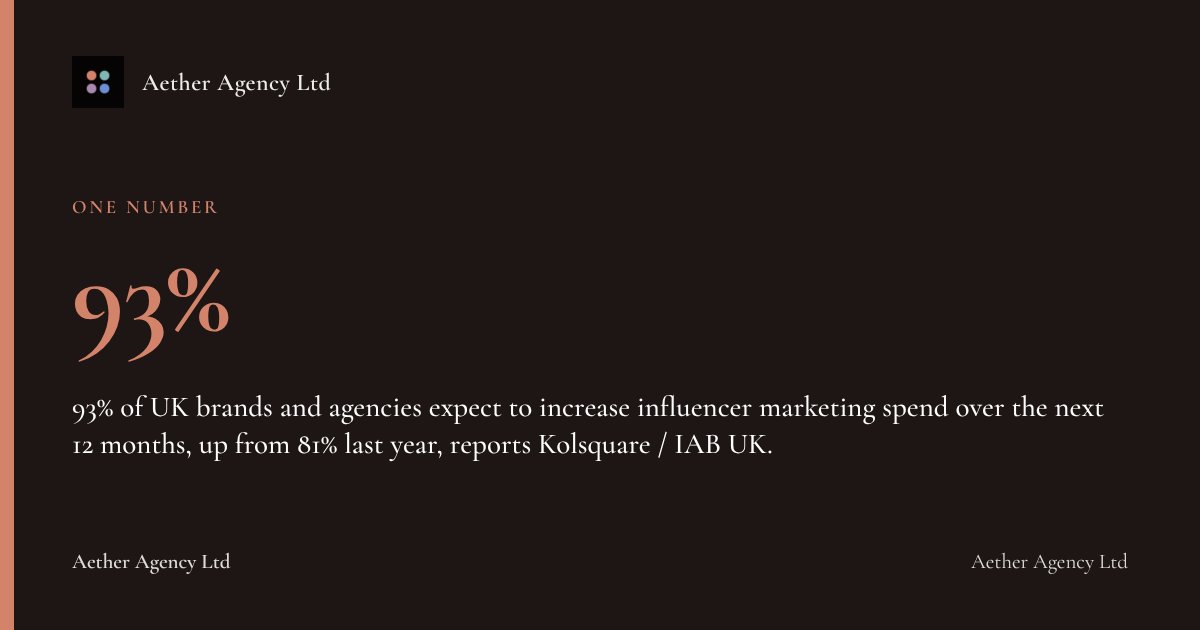
- 93% of UK brands and agencies expect to increase influencer marketing spend over the next 12 months, up from 81% last year, reports Kolsquare / IAB UK.
- UK TikTok marketing agencies typically charge £2,000 to £15,000 a month, depending on campaign scope, content volume and influencer partnerships, per Aether Agency.
- Only 57% of influencer ads met disclosure rules in the ASA's most recent monitoring sweep, according to ASA (via Ad Ranking analysis).
- 89% of UK brands manage some or all influencer activity in house, while 30% fully outsource it, says Kolsquare / IAB UK.
What Does a TikTok Influencer Marketing Agency Actually Do?
A TikTok influencer marketing agency is a specialist service provider that identifies, briefs, negotiates with and manages creators on behalf of a brand to run paid or gifted content campaigns on the platform. It sits between a business and TikTok's creator ecosystem, handling the parts that are time consuming or require platform-specific knowledge: creator sourcing, contract negotiation, content approval, compliance checks and performance reporting.
Most agencies run the same core process. They start with a brand and audience brief, build a shortlist of creators using TikTok's Creator Marketplace or independent databases, negotiate rates and deliverables, then manage the content review and publishing schedule.
Many also handle TikTok Shop integrations, Spark Ads (TikTok's native boosting tool that lets brands pay to amplify a creator's organic post from their own ad account) and LIVE shopping events, which require separate technical setup from standard sponsored posts. AI and automation tools are now used by 90% of UK brands and agencies running this kind of work, according to Kolsquare / Marketing Week, typically for creator discovery and performance tracking rather than content creation itself.
A well run agency also owns compliance: making sure every piece of sponsored content carries the correct disclosure under Advertising Standards Authority (ASA) rules before it goes live, not after a complaint arrives.
How Much Does a TikTok Influencer Marketing Agency Cost in the UK?
UK TikTok marketing agencies typically charge between £2,000 and £15,000 a month, depending on campaign scope, content volume and the number of influencer partnerships involved, according to Aether Agency. Where a brand sits in that range depends on whether it needs one creator a month or a full always-on programme across dozens.
Costs break down into a few distinct components: the agency's management fee, the influencer fees themselves (which the agency usually negotiates and, in some models, marks up), and any paid media spend behind Spark Ads or boosted posts.
| Engagement type | Typical monthly cost | Best suited to |
|---|---|---|
| Single-creator trial campaign | £2,000 to £4,000 | First-time testers, small local brands |
| Multi-creator always-on programme | Varies with the site; ask for a quote | Growing D2C or retail brands |
| Full-service with Shop/LIVE integration | Varies with the site; ask for a quote | Established brands scaling TikTok Shop |
A small Surrey food business running a single quarterly campaign will sit at the lower end; a national retailer running TikTok Shop with LIVE events every week will sit at the top. Worked example: a regional retailer briefing three micro-influencers a month, with content review and basic reporting, typically lands at a monthly cost that depends on scope, a quote confirms it, illustrative only and not quoting any specific agency's rate card.
Ways to reduce costs
- Start with a single short campaign rather than a 12-month retainer, to test fit before committing.
- Favour micro-influencers over celebrity creators; 86% of UK brands already collaborate with micro-influencers, per Kolsquare / IAB UK, because they combine lower fees with higher engagement rates.
- Negotiate content usage rights upfront rather than paying extra later to reuse a creator's video in paid ads.
Alternatives to consider
A business with existing social media capability might run influencer outreach itself and bring in an agency only for TikTok Shop setup or paid amplification, a hybrid approach that keeps costs down while still accessing specialist knowledge where it matters most.
How Do Agency Fees and Pricing Models Compare?
Agency pricing on TikTok influencer work generally falls into three models: monthly retainer, commission on influencer spend, and fixed project fees. Each suits a different stage of maturity, and the right choice depends on how predictable the brand's campaign volume is.
A retainer model charges a flat monthly fee covering strategy, sourcing and management, regardless of how many creators run that month, which suits brands wanting predictable budgeting and an always-on presence.
A commission model charges a percentage of influencer spend, often 15% to 25%, which scales naturally with campaign size but can incentivise an agency to push bigger budgets rather than better targeting.
A project-based model charges a fixed fee for a defined campaign, such as a single product launch with five creators over four weeks, which suits a business testing TikTok for the first time without ongoing commitment.
| Pricing model | How it works | Best for |
|---|---|---|
| Monthly retainer | Flat fee for ongoing management | Always-on brands with regular content needs |
| Commission on spend | Percentage of total influencer fees | Larger budgets, scalable campaigns |
| Project-based | Fixed fee for a defined campaign | First-time testers, single launches |
30% of UK brands fully outsource influencer marketing, compared with 23% across Europe, according to Kolsquare / Marketing Week, suggesting UK businesses are more comfortable handing the whole function to an external partner than their European counterparts.
What Should a Business Check Before Choosing an Agency?
A business should verify an agency's track record, niche expertise and compliance process before signing any contract, because the TikTok influencer space has low barriers to entry and quality varies enormously. Ask for named case studies with specific, verifiable outcomes rather than vague claims of "great results".
Check these points before committing:
- Named case studies, not anonymised client logos, with figures that can be sense-checked against the brand's own scale.
- Sector relevance: an agency strong in beauty and fashion creators may have no relevant contacts in B2B, food service or home improvement.
- Compliance process: ask directly how the agency ensures ASA disclosure rules are followed on every piece of content, not just the obvious ones.
- Reporting cadence: confirm what metrics are reported, how often, and whether raw data (not just a summary slide) is shared.
- Contract terms: check notice periods, content usage rights and what happens if a creator under-delivers or breaches brand guidelines.
- Independent reviews: platforms such as Clutch list verified client reviews for UK TikTok influencer agencies, which is worth cross-checking against anything an agency shows you directly.
Aether Agency Ltd's own approach to this kind of scrutiny shows in its branding and e-commerce work with Fulk Butchers, an award-winning family butchers in Surrey. The business had a strong local reputation but no brand identity and no route to online orders. Aether Agency Ltd built a full brand identity from scratch, delivered an e-commerce website with online ordering, and runs ongoing social media and marketing as part of a single, continuous engagement. On record: online sales are up 180% and the business holds a 4.8-star Google rating, both figures recorded after the work began, with no earlier baseline on file. The relevant lesson for any brand vetting a TikTok agency is the same: ask whether brand, build and content work come from one coordinated team or get handed off between disconnected suppliers.
What Legal Requirements Apply to Influencer Marketing in the UK?
UK influencer marketing is regulated primarily by the Advertising Standards Authority (ASA), the body that enforces the CAP Code (the UK Code of Non-broadcast Advertising) governing how sponsored content must be labelled. Any post where a brand has paid for or gifted content in exchange for promotion must be clearly marked as an ad, typically using TikTok's own paid partnership label alongside a visible "#ad" tag.
Compliance is not optional and enforcement is active. Only 57% of influencer ads met disclosure rules in the ASA's most recent monitoring sweep, according to ASA (via Ad Ranking analysis), meaning nearly half of monitored posts still fall short.
The Competition and Markets Authority (CMA), the UK's competition and consumer protection regulator, works alongside the ASA on influencer compliance and has previously secured commitments from creators and platforms to improve disclosure practices. Full guidance sits in the joint ASA & CMA Influencers' Guide, which covers acceptable labels and common mistakes creators make.
Official ASA guidance on Recognising ads: Social media and influencer marketing sets out exactly which disclosure wording is acceptable and which is too ambiguous to pass scrutiny. The Influencer Marketing Trade Body (IMTB) also publishes a summarised version of this guidance aimed at agencies and brands managing multiple creators at once.
Who is responsible: the brand or the agency?
Both the brand and the agency carry responsibility under the CAP Code, and the ASA can pursue either or both when a disclosure breach occurs. A brand cannot outsource its legal accountability simply by hiring an agency; it remains the advertiser of record even when a third party manages the campaign day to day.
In practice, the agency usually builds the disclosure requirement into the creator brief and checks content before publication, while the brand retains final sign-off and ultimate liability if something slips through. Any contract with a TikTok influencer agency should state explicitly who checks compliance at each stage, rather than leaving it assumed.
In-House, General Agency or Specialist: Which Fits Your Business?
A business choosing between running TikTok influencer marketing in-house, via a general social media agency, or through a specialist TikTok agency is really weighing control against expertise. 89% of UK brands already manage some or all influencer activity in house, according to Kolsquare / IAB UK, so outsourcing entirely is still the minority approach.
In-house management suits a business with existing social media staff, a clear brand voice and a modest, predictable campaign volume. The trade-off is time: sourcing and vetting creators, negotiating rates and chasing content approvals is a significant workload layered onto an already busy marketing function.
A general social media agency can run TikTok alongside Instagram, Facebook and LinkedIn, which suits a brand wanting one point of contact across channels, but TikTok's culture, trends and creator relationships move faster than most generalist teams can track closely.
A specialist TikTok agency brings deeper creator relationships, platform-specific knowledge of Spark Ads and TikTok Shop, and sharper compliance processes, at the cost of managing one more supplier relationship.
| Approach | Control | TikTok-specific expertise | Typical cost |
|---|---|---|---|
| In-house | High | Varies by team | Staff time, no agency fee |
| General social agency | Medium | Moderate | Often bundled into broader retainer |
| Specialist TikTok agency | Lower | High | £2,000 to £15,000/month |
Lauren Dawkins, Head of Content at Aether Agency, puts the underlying principle this way: "Engagement means someone paused; business comes from being remembered at the moment of need. The accounts that convert are the ones a follower could describe in a sentence, what they sell, who it is for, why them. Consistency of subject beats frequency of posting, and a smaller audience that knows exactly what you do outperforms a large one that vaguely likes you." That principle applies equally whether the account is run in-house, by a generalist or by a TikTok specialist.
How Is Campaign Success Measured and Reported?
TikTok influencer campaign success is measured through a mix of reach, engagement rate, click-through to site or TikTok Shop, and ultimately sales or lead conversions, reported back to the brand on an agreed schedule. Reach and views show how far content travelled; engagement rate (likes, comments and shares as a percentage of views) shows whether the audience actually responded.
Deeper campaigns track UTM-tagged links (unique tracking codes added to a URL) or TikTok Shop sales attributed directly to specific creators, allowing a brand to see which partnerships generated genuine commercial return rather than just impressions. 89% of brands manage some or all influencer activity in house, per Kolsquare / IAB UK, which often means they also build their own reporting dashboards rather than relying solely on agency summaries.
A reasonable reporting cadence is weekly for live campaigns and a full post-campaign report within two weeks of completion, covering total reach, engagement rate, top-performing content and a clear view of cost per result. Any agency unwilling to share raw platform data alongside its own summary should raise a flag.
Your TikTok influencer agency checklist
- Confirm the agency's pricing model (retainer, commission or project fee) in writing before any work starts.
- Request at least two named case studies with figures you can verify against publicly available information.
- Ask exactly how ASA disclosure rules are checked on every piece of sponsored content, not just flagship posts.
- Clarify who holds final compliance sign-off, the brand or the agency, within the contract itself.
- Agree a reporting cadence (weekly during a live campaign, full report within two weeks of completion) before launch.
- Check whether the agency has sector-relevant creator relationships, not just a large generic database.
- Negotiate content usage rights upfront if you intend to reuse creator content in paid ads later.
- Start with a single project-based campaign if you have never worked with the agency before, rather than a long retainer.
FAQ
What does a TikTok influencer marketing agency in the UK actually do?
A TikTok influencer marketing agency sources, briefs and manages creators on a brand's behalf, handling negotiation, content approval, compliance and reporting. It typically also manages TikTok Shop integrations and Spark Ads amplification where a campaign calls for paid boosting.
UK TikTok marketing agencies typically charge between £2,000 and £15,000 a month, depending on campaign scope, content volume and the number of influencer partnerships, according to Aether Agency. Costs rise with the number of creators, content volume and whether TikTok Shop or LIVE shopping is included.
How long does it take to launch a TikTok influencer campaign?
A typical TikTok influencer campaign takes three to six weeks from brief to launch, covering strategy, creator shortlisting, negotiation and content production. Rushed timelines under two weeks are possible but usually limit the agency to creators already on an existing roster rather than a fresh, sector-matched search.
Do TikTok influencer posts need to be labelled as ads in the UK?
Yes, any paid or gifted TikTok content promoting a brand must be clearly disclosed under the ASA's CAP Code, usually via TikTok's paid partnership label and a visible "#ad" tag. The ASA found only 57% of influencer ads met disclosure rules in its most recent monitoring sweep, according to ASA (via Ad Ranking analysis), so compliance cannot be assumed by default.
Is TikTok influencer marketing worth it for small UK businesses?
It can be, particularly using micro-influencers, since 86% of UK brands already collaborate with this creator tier, according to Kolsquare / IAB UK. A small business should start with a single project-based campaign to test fit before committing to a retainer.
What are the biggest mistakes UK brands make when hiring a TikTok agency?
The most common mistakes are skipping compliance checks, signing long retainers before testing fit, and failing to agree reporting formats upfront. Brands also frequently underestimate how much creative control to hand creators, when TikTok content performs best when it reflects the creator's own authentic style rather than a scripted brand message.
How is a TikTok influencer agency different from a talent management agency?
A TikTok influencer marketing agency works for brands, sourcing and managing creators for campaigns, while a talent management agency works for the creators themselves, negotiating deals on their behalf. Some larger agencies operate both sides of the relationship, which is worth clarifying before signing any contract.
Building your TikTok presence with Aether Agency Ltd
Choosing between an in-house team, a generalist social agency and a TikTok specialist comes down to how much of your brand identity, website and content strategy already sits under one roof. Aether Agency Ltd builds brand identity, websites and ongoing social media and marketing as a connected service rather than disconnected handoffs, the same approach it took with Fulk Butchers in Surrey, where brand, e-commerce build and ongoing social support were delivered by one team from the outset.
Aether Agency Ltd has delivered 50+ projects, drawing on 20+ years of combined team experience across brand, web and social work. If your business is weighing up whether to run TikTok influencer activity in-house or bring in specialist support, get in touch with Aether Agency Ltd to talk through your brand identity and social strategy needs before you commit to an agency contract.
Related Reading
- Influencer Disclosure Rules UK 2026: ASA Checklist & Fines
- Social Media Management for Small Business UK: 2026 Guide
- Influencer Marketing Trends 2026: Expert Predictions & Strategies
Add aether-agency.co.uk as a preferred source on Google
See How Your Brand Appears in AI Search
Aether AI monitors your visibility across ChatGPT, Perplexity, Google AI Overviews, and Claude in real time. Find out where you stand and what to fix.
Explore Aether AI