Last updated: 24 November 2026
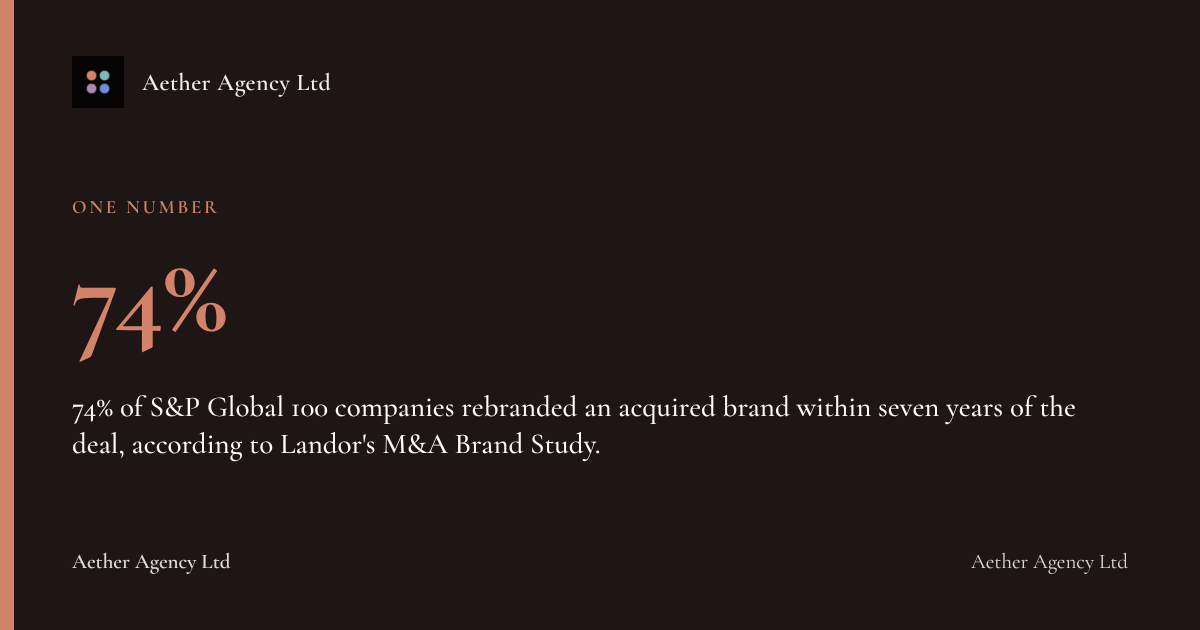
A merger branding agency manages the identity, naming and brand architecture decisions that follow a merger or acquisition, working alongside legal and integration teams rather than replacing them. Research from Landor found that 74% of S&P Global 100 companies rebranded an acquired asset within seven years of a deal, showing this work is standard practice, not an afterthought (Landor M&A Brand Study (GlobeNewswire press release)).
Key Takeaways
- 74% of S&P Global 100 companies rebranded an acquired brand within seven years of the deal, according to Landor's M&A Brand Study.
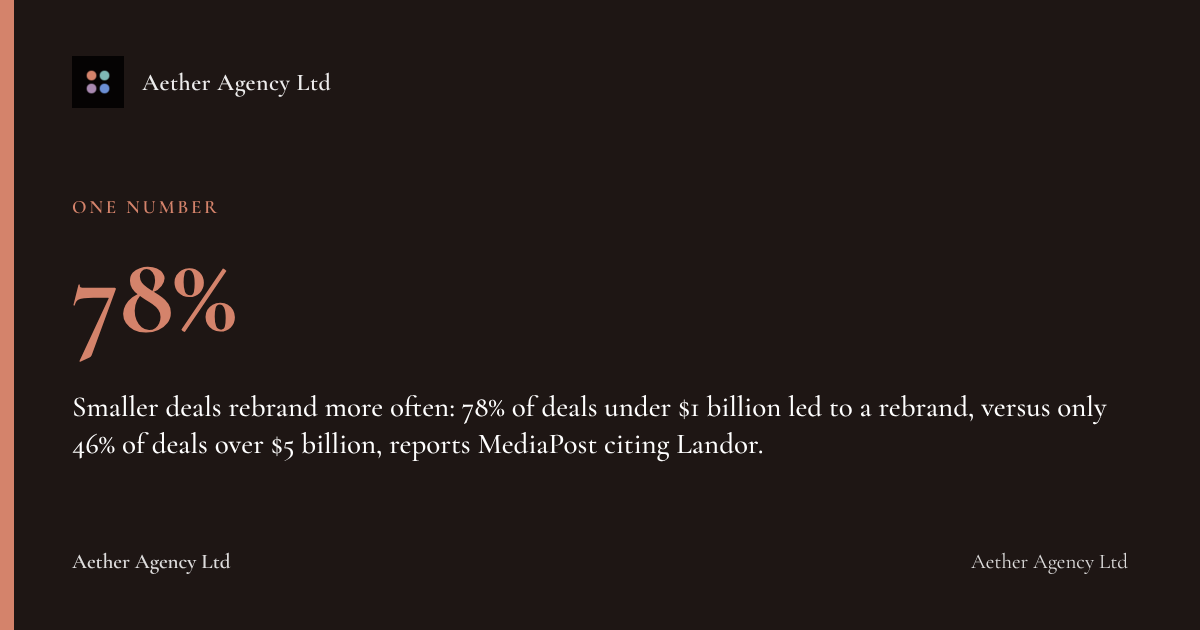
- Smaller deals rebrand more often: 78% of deals under $1 billion led to a rebrand, versus only 46% of deals over $5 billion, reports MediaPost citing Landor.
- A well-executed post-merger brand strategy can improve M&A success rates by up to 42%, according to Admind Agency, citing DeSantis Breindel research.
- Up to 80% of a deal's potential value can be lost within the first 100 days, with brand misalignment a recurring factor, per the same Admind Agency research.
- Only two out of three corporate takeovers succeed, according to the Harvard Business Review, cited by Empowersuite.
What is a merger branding agency?
A merger branding agency is a specialist branding studio that manages the naming, visual identity and brand architecture decisions that arise when two companies combine, working to protect commercial value during the handover period. This differs from a standard design agency because the work sits inside a live deal timeline, with legal, HR and finance teams all making decisions that affect what the brand can say and when.
A general branding agency typically starts with a blank sheet: discovery, positioning, identity, launch. A merger branding agency inherits two existing brands, each with its own customer trust, staff loyalty, trademarks and search visibility, and has to decide what survives, what merges and what is retired.
The stakes are measurable. McKinsey research, cited by Fullstop360, found that 70 to 90% of M&A deals fail to deliver their expected value, often due to poor brand integration. Louis Sciullo, Executive Director of Financial Services at Landor, put it plainly: "Typically what happens is, there's a lot of people validating the balance sheet, but nobody's evaluating the value of the brand."
A merger branding agency exists to close that gap. The work usually covers four areas: brand architecture strategy (which name or names survive), visual identity (logo, colour, typography across both legacy estates), verbal identity (tone of voice, messaging for staff and customers) and rollout management (signage, websites, email domains, Companies House filings, stationery). Aether Agency Ltd approaches this through its Brand Identity service, building naming and identity systems designed to hold together across every channel the merged company touches, from packaging through to the website and the order confirmation email.
When during the M&A process should a company engage a branding agency?
A company should engage a merger branding agency as early as the due diligence phase, well before the deal legally completes, because brand decisions affect valuation and integration planning. Waiting until after completion is the single most common timing mistake in post-merger work.
Admind Agency's research found that 70 to 80% of a deal's potential value can be permanently lost within the first 100 days after closing, with brand misalignment a consistent contributing factor. That 100-day window is tight: a company cannot start naming workshops and trademark searches on day one and expect a coherent launch by day 100.
Sciullo noted that "there's a lot more nuance in what people are doing with acquisitions these days", and brand strategy needs to reflect that nuance from the earliest planning stage, not be bolted on afterwards.
A realistic engagement sequence looks like this:
- Due diligence stage: brand audit of both companies, trademark and domain checks, early architecture options.
- Signing to completion: naming decision finalised, legal clearance on the new name, identity system design begins.
- Day one of completion: internal announcement, interim branding guidelines issued, website and signage plans locked.
- First 100 days: full visual rollout, customer and investor communications, Companies House filings updated.
- Months four to twelve: brand tracking, staff culture surveys, refinement of messaging based on market response.
Getting a merger branding agency involved at stage one, rather than stage three, is what separates a controlled rollout from a scramble.
What are the typical costs of hiring a merger branding agency in the UK?
UK merger branding costs vary widely depending on deal size, number of legal entities involved and the scope of physical rebranding (signage, fleet, premises) required. There is no single industry-standard price list because the work scales with the complexity of what's being merged, not just the size of the company.
Several factors drive the final figure:
- Number of brand touchpoints: a professional services firm with one website differs enormously from a retailer with 40 shop fronts, vehicle livery and packaging to change.
- Legal complexity: companies with multiple subsidiaries registered at Companies House, several trademark classes, or international entities require more legal coordination time.
- Speed required: a rebrand compressed into weeks to meet a regulatory deadline costs more than one phased over 12 months.
- Research and testing: formal customer and staff research, focus groups and brand tracking add to scope but reduce risk.
- Internal resourcing: a client with a dedicated marketing director to brief and approve work moves faster and cheaper than one relying on the agency to chase decisions.
| Project scope | Typical scale of work | Indicative timeline |
|---|---|---|
| Single-entity rename (small business merger) | Logo, guidelines, website update, stationery | 6 to 10 weeks |
| Mid-size combined brand (multiple locations) | Full identity system, signage, website rebuild, staff comms | 3 to 6 months |
| Group-level brand architecture (multiple subsidiaries) | Naming strategy across entities, trademark clearance, phased rollout | 6 to 12 months |
These are illustrative ranges based on typical project shapes, not quotes from a specific pricing study. Any agency should give a scoped, written estimate once it understands the number of entities, locations and legal filings involved.
Ways to manage the cost
Companies can control spend by sequencing work: get the new name legally cleared and the core identity live first, then phase signage, vehicle livery and lower-priority materials over subsequent months rather than changing everything on day one.
Alternatives to consider
Not every merger needs a full rebrand. A portfolio approach, keeping both brand names running under a new parent structure, avoids the cost of a full identity change and is common: Landor's research, via CityBuzz, found that just under 60% of consumer companies rebrand after acquisition, meaning a significant proportion deliberately retain acquired brand equity instead.
How do you choose between one brand, a new combined brand, or a dual-brand strategy?
Choosing a brand architecture model means deciding whether the merged company adopts one existing name, creates an entirely new name, or runs both brands in parallel under a shared ownership structure. The right answer depends on deal size, customer loyalty to each original brand, and sector norms.
Landor's data shows deal size strongly predicts the outcome: 78% of deals under $1 billion resulted in a rebrand, compared with only 46% of deals over $5 billion. Larger acquirers more often keep the acquired brand running as a distinct entity, particularly in consumer sectors where brand loyalty has commercial value.
| Model | Best suited to | Main risk |
|---|---|---|
| Single surviving brand | Acquirer has stronger market recognition or regulatory need for one name | Acquired customers feel absorbed, risk of attrition |
| New combined brand | Neither legacy name fits the new scale or ambition | Starting brand equity from zero, costly and slow |
| Dual-brand / house of brands | Distinct customer segments, strong independent brand equity | Internal confusion, diluted marketing budget across names |
Sciullo's view is worth repeating here: "There is no single, cookie-cutter approach to brand strategy during a merger or acquisition." The decision should follow a brand audit, not a boardroom preference.
What are the most common mistakes companies make when rebranding after a merger?
The most common mistake is treating brand integration as a cosmetic task handled after legal completion, rather than a value-protection exercise planned during due diligence. This is consistent with the finding that 70 to 90% of M&A deals fail to deliver expected value, often due to poor brand integration, according to McKinsey research cited by Fullstop360.
Recurring errors include:
- No brand audit during due diligence. Legal and financial teams scrutinise the balance sheet; almost nobody values the brand itself, as Sciullo observed.
- Rushing the name before trademark clearance. Announcing a new name that later fails a trademark search creates a second, more disruptive rename.
- Ignoring Companies House and regulatory filings. A name change needs to be filed and reflected across contracts, domains and regulatory registrations, not just the logo.
- Underestimating staff reaction. Employees from the acquired company often read a rebrand as erasure if there's no internal communication plan running alongside the external one.
- Launching before the website and systems are ready. A new brand with a broken website or mismatched email domains undermines the announcement on day one.
- Treating dual-brand as "do nothing". Running two brands deliberately is a strategy; running two brands because nobody decided is drift, and customers notice the inconsistency.
How do you evaluate and shortlist merger branding agencies in the UK?
Evaluating a merger branding agency means checking three things: relevant case study evidence, a clear process for working alongside legal and integration teams, and the breadth to deliver identity, website and ongoing marketing rather than just a logo. A portfolio showing only standalone rebrands, with no evidence of working to a deal timeline, is a warning sign.
Useful questions to put to any shortlisted agency:
- Can they show a project where brand, website build and ongoing marketing were delivered by one team, so the identity stays consistent across every touchpoint?
- Do they have a documented process for trademark and naming checks before a name goes public?
- How do they handle timelines that depend on legal completion dates outside their control?
- What's their approach to internal staff communications, not just external customer-facing launch materials?
Aether Agency Ltd has delivered more than 50 projects (as published on aether-agency.co.uk), built around a brand, build and grow model: identity work, website development and ongoing marketing delivered as one continuous engagement rather than handed off between specialists. That continuity matters in merger work specifically, because a brand identity that doesn't carry through to the website and day-to-day marketing creates exactly the inconsistency that confuses customers during integration.
A useful proof point from outside the M&A context: Fulk Butchers, an award-winning family butcher in Surrey, had a respected local reputation but no brand identity and no route to online orders. Aether Agency Ltd built a full brand identity from scratch, delivered an e-commerce website with online ordering, and has run ongoing social media and marketing since, with the brand, build and grow phases all delivered by one team so the identity carries from packaging through to the order confirmation email. Online sales are now up 180%, with a 4.8-star Google rating recorded on the account. It's a single-company rebrand, not a merger, but it demonstrates the same principle a merger needs: one team carrying an identity consistently across every channel, rather than a logo handed off to someone else to build a website around.
Your merger branding checklist
- Commission a brand audit of both companies during due diligence, before the deal completes.
- Run trademark and domain availability searches before any name is shared externally.
- Decide the brand architecture model (single brand, new name, or dual-brand) based on deal size and customer loyalty, not preference.
- Brief Companies House filings and regulatory registrations alongside the creative workstream, not after it.
- Build an internal staff communications plan that runs in parallel with the external launch, not after it.
- Sequence physical rollout (signage, vehicles, premises) in phases rather than attempting everything on launch day.
- Set a measurement plan before launch: brand awareness, customer retention and staff sentiment, so success can be tracked against a baseline.
FAQ
What does a merger branding agency actually do?
A merger branding agency manages naming, visual identity and brand architecture decisions during a company merger, working alongside legal and integration teams. It differs from a standard branding agency because the work happens inside a live deal timeline with trademark, regulatory and staff communication constraints a typical rebrand doesn't face.
When should a company bring in a branding agency during a merger?
A company should engage a branding agency during due diligence, before the deal legally completes, because early brand decisions affect valuation and reduce the risk of the value loss that commonly occurs within the first 100 days after closing.
How much does a merger rebrand typically cost in the UK?
Costs vary by scope: a single-entity rename with a website update might fall in a lower range over 6 to 10 weeks, while a group-level architecture change across multiple subsidiaries with full physical rollout takes 6 to 12 months and scales accordingly. Always request a written, scoped estimate rather than relying on a general price list.
Should a merged company keep both brand names or create a new one?
It depends on deal size and customer loyalty to each brand. Landor's research found smaller deals (under $1 billion) rebrand 78% of the time, while larger deals (over $5 billion) rebrand only 46% of the time, often preserving acquired brand equity instead.
Who manages the branding workstream internally during a merger?
This is typically led by a marketing director or integration lead working alongside legal counsel, since brand decisions touch trademark filings, Companies House registrations and staff communications simultaneously. In smaller companies, the CEO often takes this role directly.
What legal steps are needed when rebranding after a merger?
A company needs to update its registered name with Companies House if the legal entity name changes, clear the new name against existing trademarks, and update contracts, domains and regulatory registrations to match. These steps should run alongside, not after, the creative identity work.
How is the success of a post-merger rebrand measured?
Success is typically measured through brand awareness tracking, customer retention rates, staff sentiment surveys and commercial performance against the goals set before launch. Admind Agency's research suggests a well-executed post-merger brand strategy can improve M&A success rates by up to 42%, underlining why a measurement baseline matters from day one.
Securing your merged brand with Aether Agency Ltd
Getting the brand right during a merger is a value-protection exercise, not a cosmetic one, and that's the problem Aether Agency Ltd works on daily through its Brand Identity service: naming, identity systems and guidelines built to hold together across every touchpoint a newly combined company has to manage. Aether Agency Ltd has delivered more than 50 projects (as published on aether-agency.co.uk), consistently pairing identity work with Website Development so a new brand launches with a site that actually works, rather than a logo with nowhere to live.
If your business is heading into a merger or acquisition and needs the branding workstream planned alongside the legal timeline rather than after it, get in touch with Aether Agency Ltd to talk through the scope and timeline for your specific deal.
Related Reading
- Rebranding for a Younger Audience: A 2026 UK Guide
- How Do I Know If My Business Needs a Rebrand?
- Rebranding a Startup in 2026: When and How to Do It
Add aether-agency.co.uk as a preferred source on Google
See How Your Brand Appears in AI Search
Aether AI monitors your visibility across ChatGPT, Perplexity, Google AI Overviews, and Claude in real time. Find out where you stand and what to fix.
Explore Aether AI