Last updated: 25 October 2026
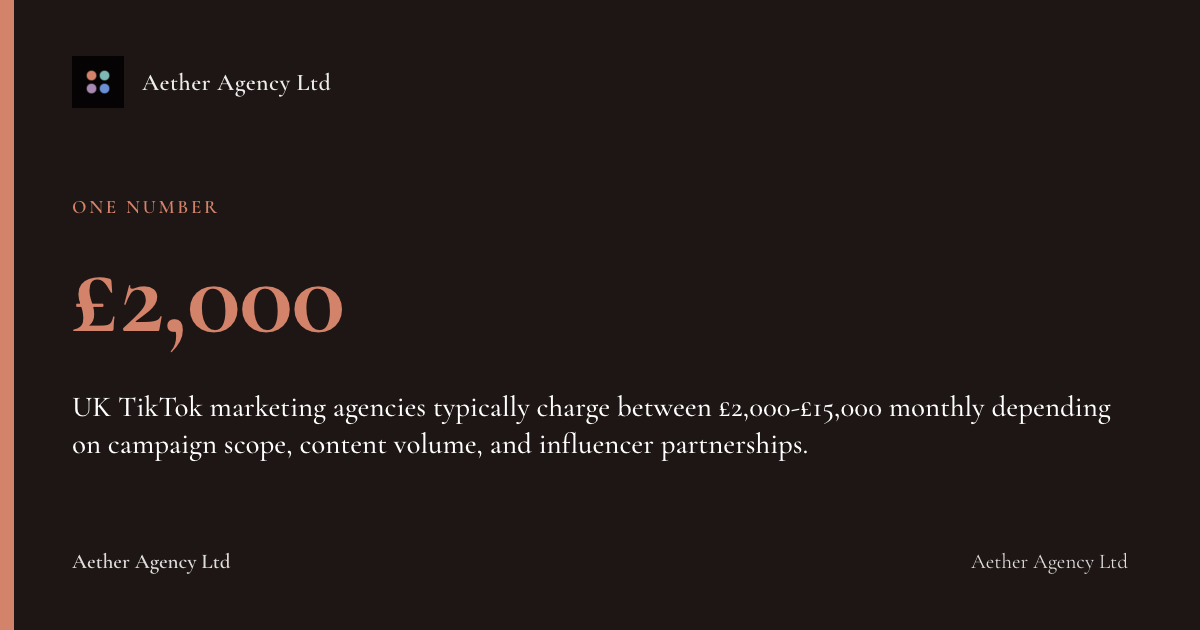
A TikTok marketing agency UK is a specialist firm that creates platform-native content, manages influencer partnerships, and runs paid campaigns optimised for TikTok's algorithm. UK agency fees typically range from £2,000 to £15,000 monthly depending on content volume, influencer partnerships, and whether TikTok Shop management is included, according to current UK market pricing.
Key Takeaways
- A TikTok marketing agency UK typically charges £2,000-£15,000 monthly, with Foundation packages starting at £2,000-£4,000 for basic content creation and management.
- UK TikTok advertising costs typically run £4-£8 cost per thousand impressions (CPM) and £0.40-£1.20 cost per click (CPC), depending on targeting and creative quality.
- Organic engagement rates on well-performing TikTok content typically run 3-9%, which is higher than comparable rates reported on Instagram or Facebook.
- Micro-influencer partnerships (creators with 10,000-50,000 followers) typically cost £500-£1,500 per campaign, compared with £500-£5,000 for creators generally.
- Effective in-house TikTok marketing typically requires £50,000+ in first-year investment (salary, production, paid media), compared with agency partnerships starting at £24,000 annually.
What Is a TikTok Marketing Agency UK?
A TikTok marketing agency UK is a specialist marketing firm that plans, creates, and manages campaigns built specifically for TikTok's short-form vertical video format and discovery-driven algorithm. Unlike generalist social media agencies, TikTok specialists understand the platform's recommendation mechanics, trending audio cycles, and the authentic, lower-production creative style that tends to outperform polished brand content on the platform.
These agencies combine several functions into one service: strategic planning, content production, influencer partnerships, paid media buying, TikTok Shop management, and performance analytics. The distinguishing feature of a genuine TikTok specialist, as opposed to a broader social agency offering TikTok as one channel among many, is platform-specific expertise — understanding how TikTok's For You Page surfaces content differently from the follower-based feeds of Instagram or Facebook, and building creative and campaigns around that difference.
What Does a TikTok Marketing Agency UK Actually Do?
A TikTok marketing agency UK provides end-to-end campaign management spanning content creation, influencer partnerships, paid advertising, and compliance. The core service offering typically includes content strategy and creation tailored to TikTok's vertical video format and trend-driven culture. Agencies produce or oversee production of short-form videos that align with your brand whilst maintaining the authentic, unpolished aesthetic that tends to perform best on the platform. This involves scripting, shooting, editing, and optimising content for TikTok's recommendation algorithm.
Influencer and creator partnerships form another critical service pillar. Agencies maintain relationships with UK-based creators across various niches, handle contract negotiations, manage campaign briefs, and ensure compliance with Advertising Standards Authority (ASA) — the UK's independent advertising regulator — disclosure requirements. As more UK businesses adopt TikTok marketing, competition for quality creator partnerships has intensified.
TikTok advertising management covers the platform's paid media options, including In-Feed Ads, TopView placements, Branded Hashtag Challenges, and Branded Effects. Agencies handle audience targeting, creative testing, budget allocation, and bid optimisation across TikTok's self-serve ads platform. They also manage TikTok Shop integration — TikTok's built-in e-commerce feature allowing users to browse and buy products without leaving the app — for e-commerce brands.
Analytics and reporting distinguish professional agencies from amateur efforts. Sophisticated agencies track not just vanity metrics (views, likes) but business outcomes including website traffic, lead generation, cost per acquisition, and revenue attribution. They identify which TikTok metrics predict actual business growth and adjust campaigns accordingly.
Regulatory compliance represents an often-overlooked but essential agency function. UK TikTok marketing must comply with the ASA's advertising codes, Ofcom's Online Safety regulations under the Online Safety Act 2023, and ICO data protection requirements under UK GDPR. Financial services promotions require FCA authorisation, whilst competitions and giveaways must follow specific legal frameworks. Professional agencies build compliance into every campaign from inception, rather than treating it as an afterthought.
Why Are UK Businesses Investing in TikTok Marketing in 2026?
UK businesses are investing in TikTok marketing because the platform has matured from a Gen Z entertainment app into a genuine discovery and commerce channel reaching audiences across demographics. TikTok's discovery-driven algorithm, growing TikTok Shop adoption, and the continued gap between the platform's reach and marketer adoption are the three factors most commonly cited by UK agencies as driving investment in 2026.
The discovery-driven algorithm represents TikTok's core competitive advantage. Unlike follower-based platforms, TikTok's For You Page surfaces content based on engagement signals rather than existing audience size. This means well-crafted content from unknown brands can achieve viral reach without paid promotion — though exploiting the algorithm's mechanics effectively requires specialist expertise.
Commerce integration has transformed TikTok from an awareness channel into a fuller-funnel revenue driver. TikTok Shop has shown strong year-on-year sales growth during recent peak shopping periods, with a growing number of UK SMEs now selling through the platform, reflecting the platform's maturation as a transaction environment. British consumers increasingly discover, research, and purchase products without leaving the app.
The competitive gap remains notable: many UK marketers have yet to adopt the platform at scale, which creates first-mover advantages in verticals where competitors have not yet established a presence. Early adopters typically benefit from lower advertising costs and less saturated creative landscapes while this gap persists.
B2B adoption has accelerated particularly in 2026. Professional services firms, SaaS companies, and industrial manufacturers that initially dismissed TikTok as consumer-focused have found that decision-makers spend meaningful time on the platform. Educational content, behind-the-scenes operations, and thought leadership pieces tend to perform well when executed with platform-native creative approaches rather than repurposed corporate material. Businesses building a presence on TikTok should also consider how the platform fits into a wider brand strategy — see what brand purpose means and why it matters for how platform activity should connect back to a clear brand position.
How Do You Choose the Right TikTok Marketing Agency UK?
Choosing the right TikTok marketing agency UK means evaluating platform-specific portfolio evidence, creator network quality, regulatory compliance knowledge, and reporting rigour — not just general social media experience. The platform's distinct creative language, algorithm mechanics, and rapid trend cycles demand specialist expertise that many traditional agencies lack.
Platform-specific portfolio should be your first evaluation criterion. Request case studies demonstrating TikTok-specific results rather than generic social media success. Examine whether the agency's content demonstrates genuine platform fluency — native vertical video, trending audio integration, authentic presentation — or simply repurposes content created for other channels. Review engagement rates (not just view counts) on campaigns they've managed.
Creator network quality matters enormously for influencer-led campaigns. Ask agencies about their UK creator relationships, vetting processes, and past partnership performance. Quality agencies maintain databases of vetted creators with engagement rate histories, audience demographic breakdowns, and brand safety assessments. They should explain how they match creators to your brand values and target audience.
Compliance and regulatory knowledge is non-negotiable for UK campaigns. Verify the agency understands ASA disclosure requirements under the CAP Code (the UK Code of Non-broadcast Advertising and Direct & Promotional Marketing), Ofcom content standards, and industry-specific regulations affecting your sector. Financial services, healthcare, gambling, and children's products face particularly stringent restrictions. Ask how the agency ensures every piece of content meets regulatory requirements before publication.
Strategic approach versus execution focus separates strategic partners from production houses. Some agencies excel at content creation but lack strategic planning capabilities. Others develop sophisticated strategies but outsource creative execution to freelancers. The strongest agencies integrate both: they understand how TikTok content ladders up to business objectives and can execute the creative work required. If you're evaluating agencies more broadly, what branding agencies need from clients is a useful reference for what a productive agency relationship actually requires from your side.
Reporting and analytics capabilities reveal whether an agency focuses on vanity metrics or business outcomes. Request sample reports and ask which metrics the agency prioritises. Sophisticated agencies track conversion paths, attribute revenue, calculate customer acquisition costs, and demonstrate ROI. They should explain how they test and optimise campaigns based on performance data.
Pricing transparency helps avoid misaligned expectations. UK TikTok marketing agencies typically operate on monthly retainers ranging from £2,000 for basic content creation and management to £15,000+ for comprehensive campaigns including paid media, influencer partnerships, and TikTok Shop management. Production-heavy campaigns requiring professional filming, talent, and post-production naturally command higher fees.
Cultural fit and communication shouldn't be overlooked. TikTok campaigns require rapid response to trends and cultural moments. Agencies with bureaucratic approval processes or slow communication cycles miss time-sensitive opportunities. Assess whether the team demonstrates creative energy, platform enthusiasm, and responsiveness during the selection process.
TikTok Marketing Services and Pricing in the UK
UK TikTok marketing agencies typically structure pricing into three tiers: Foundation (£2,000-£4,000/month), Growth (£4,000-£8,000/month), and Enterprise (£8,000-£15,000+/month), with costs scaling according to content volume, paid media management, and influencer partnerships.
| Service Tier | Monthly Investment | What's Included | Best For |
|---|---|---|---|
| Foundation | £2,000-£4,000 | 8-12 organic posts, content strategy, basic analytics, community management | Small businesses testing TikTok, single-location retailers, service providers |
| Growth | £4,000-£8,000 | 12-20 posts, paid media management (£1,000-£3,000 ad spend), monthly reporting, trend monitoring | Established brands scaling presence, e-commerce businesses, regional chains |
| Enterprise | £8,000-£15,000+ | 20+ posts, influencer partnerships (2-4 creators), TikTok Shop setup/management, advanced analytics, dedicated account team | National brands, high-volume e-commerce, multi-location businesses |
These ranges reflect typical UK market pricing as of 2026. Actual costs depend on content production requirements, paid media budgets (usually billed separately), influencer partnership fees, and campaign complexity. Premium agencies in London may charge 20-30% above these ranges.
Content production costs vary dramatically based on production values. User-generated content (UGC) — authentic, customer- or creator-made video rather than studio-produced brand content — shot on smartphones costs significantly less than professionally filmed content requiring locations, talent, and post-production. Most successful TikTok content leans toward authentic, low-production aesthetics, though certain sectors (luxury goods, automotive, property) may require higher production values.
Influencer partnership fees typically run £500-£5,000 per creator per campaign depending on follower count, engagement rate, and content deliverables. Micro-influencers (10,000-50,000 followers) with highly engaged niche audiences often deliver better ROI than macro-influencers. Agencies typically add 15-25% management fees on top of creator payments.
Paid media budgets should be considered separately from agency fees. Effective TikTok advertising campaigns typically require minimum monthly ad spend of £1,000-£3,000 to gather sufficient performance data and achieve meaningful reach. Cost per thousand impressions (CPM) on TikTok generally runs £4-£8 for UK audiences, whilst cost per click (CPC) averages £0.40-£1.20 depending on targeting and creative quality.
TikTok Shop management adds complexity and cost but can drive direct revenue. Setup involves product catalogue integration, fulfilment coordination, and seller account optimisation. Ongoing management includes product tagging in videos, live shopping events, and promotional campaigns. Agencies typically charge £1,500-£4,000 monthly for comprehensive Shop management.
In-House vs Agency TikTok Marketing: What Works for UK Businesses?
The in-house versus agency decision for TikTok marketing hinges on internal capability, resource availability, and how central TikTok is to your customer acquisition strategy. Effective in-house TikTok marketing typically requires £50,000+ in first-year investment, compared with agency partnerships starting at £24,000 annually (£2,000 monthly).
In-house management makes sense when you have dedicated social media staff with TikTok expertise, consistent content production capacity, and the platform represents a core channel for customer acquisition. Retail brands with photogenic products, hospitality businesses with visual appeal, and entertainment companies often succeed with internal teams. The main advantages include faster response to trends, deeper brand knowledge, and no agency markup on paid media.
However, in-house teams face significant challenges. TikTok's algorithm changes frequently, creative trends evolve weekly, and platform-native content requires different skills than traditional marketing. Many businesses discover their social media generalist lacks TikTok-specific expertise. Content production demands are also substantial — successful accounts typically post 4-7 times weekly, requiring significant creative resources.
Agency partnerships deliver platform expertise, established creator networks, and production capabilities without hiring full-time staff. This proves particularly valuable for businesses where TikTok represents one channel within a broader marketing mix rather than the primary focus. Agencies also bring cross-client learning — insights from managing multiple accounts can accelerate your campaign optimisation.
The hybrid model increasingly dominates in 2026. Many UK businesses maintain in-house social media managers who handle day-to-day community management and reactive content whilst partnering with agencies for strategic campaigns, influencer partnerships, and paid media. This combines internal brand knowledge with external specialist expertise.
Resource requirements for effective in-house TikTok marketing include: a dedicated social media manager with TikTok experience (£30,000-£45,000 annually), content creation tools and software (£1,000-£3,000 annually), paid media budget (£12,000-£36,000 annually minimum), and production equipment or freelance creators (£5,000-£15,000 annually). Total first-year investment typically exceeds £50,000 before achieving consistent results.
Compare this to agency partnerships starting at £24,000 annually (£2,000 monthly) including strategy, content creation, and management. For most SMEs, the agency route tends to deliver better ROI during the first 12-18 months whilst building internal capability.
What UK Compliance and Regulations Apply to TikTok Marketing?
TikTok marketing in the UK operates within a regulatory framework spanning advertising standards, online safety, data protection, and sector-specific rules, which agencies must navigate on a brand's behalf. Non-compliance carries reputational damage and potential enforcement action from multiple regulatory bodies.
Advertising Standards Authority (ASA) regulations require clear disclosure of commercial relationships. The ASA enforces the UK Code of Non-broadcast Advertising and Direct & Promotional Marketing (the CAP Code), which applies to all TikTok content. Paid partnerships must include prominent disclosure labels — TikTok's "Paid Partnership" tag or clear text disclosure such as "#ad" in the first three hashtags. The disclosure must be unavoidable, not buried in "see more" text or at the end of long captions.
Influencer content requires particular attention. The ASA has issued rulings against inadequate disclosure in social media campaigns. Agencies must ensure every creator partnership includes compliant disclosure regardless of payment structure (monetary payment, free products, or other consideration all trigger disclosure requirements).
Ofcom, the UK's communications regulator, oversees video-sharing platforms under the Online Safety Act 2023. Whilst Ofcom primarily holds platforms accountable, advertisers must ensure content doesn't contain illegal material, protect children from harmful content, and implement age-appropriate safeguards. This particularly affects brands in sectors like alcohol, gambling, and age-restricted products.
Data protection under UK GDPR (the UK's version of the General Data Protection Regulation) and the Data Protection Act 2018 governs how you collect and process user data from TikTok campaigns. The Information Commissioner's Office (ICO) enforces these requirements. If you run competitions requiring data collection, use TikTok's pixel for website tracking, or retarget users based on TikTok engagement, you must have appropriate legal basis, privacy notices, and data processing agreements.
Financial services face additional restrictions. The Financial Conduct Authority (FCA) requires financial promotions to be approved by an authorised person, include appropriate risk warnings, and not mislead consumers. TikTok's short-form video format makes it challenging to include required disclosures — agencies working with financial services clients must develop creative solutions that maintain compliance whilst working within platform constraints.
Sector-specific regulations affect various industries. Alcohol advertising must comply with the Portman Group Code and cannot target under-18s. Gambling promotions require Gambling Commission licensing and age verification. Healthcare and pharmaceutical advertising must meet MHRA (Medicines and Healthcare products Regulatory Agency) requirements. Food and beverage marketing faces Advertising Standards for Food rules. Professional agencies understand these sector requirements and build compliance into campaign planning.
Competition and consumer protection laws enforced by the Competition and Markets Authority (CMA) prohibit misleading claims, fake reviews, and pressure selling tactics. TikTok content must present truthful claims, avoid creating false urgency, and clearly distinguish opinion from fact.
How Do You Measure TikTok Marketing ROI and Performance?
Measuring TikTok marketing ROI requires tracking metrics aligned with business objectives rather than vanity metrics alone, spanning awareness, engagement, traffic, conversion, and cost-efficiency indicators. UK TikTok CPMs typically run £4-£8, whilst well-performing organic content typically achieves 3-9% engagement rates.
Awareness metrics include reach, impressions, and video views. These matter for brand-building campaigns but don't directly indicate business impact. TikTok's average watch time and completion rate provide better quality signals — high view counts with low completion rates suggest content isn't resonating. Aim for 50%+ completion rates on content under 15 seconds, 30%+ on longer content.
Engagement metrics measure audience interaction through likes, comments, shares, and saves. Engagement rate (total engagements divided by impressions) typically runs 3-9% for well-performing organic content — higher than typical rates reported on Instagram or Facebook. Shares and saves indicate particularly strong content, as users actively choose to resurface it.
Traffic and conversion metrics connect TikTok activity to business outcomes. Track profile visits, website clicks, and landing page traffic from TikTok. Use UTM parameters (tracking tags appended to URLs) on all links to measure traffic sources accurately in Google Analytics. For e-commerce businesses, track product page views, add-to-cart rates, and purchases attributed to TikTok traffic.
TikTok Shop metrics provide direct revenue attribution for businesses selling through the platform. Monitor product views, add-to-cart rate, purchase conversion rate, average order value, and total revenue. Compare these metrics to your website performance to understand how TikTok Shop economics differ from traditional e-commerce.
Cost efficiency metrics for paid campaigns include cost per thousand impressions (CPM), cost per click (CPC), cost per acquisition (CPA), and return on ad spend (ROAS). UK TikTok CPMs typically run £4-£8, whilst CPC averages £0.40-£1.20. Your acceptable CPA depends on customer lifetime value — subscription businesses can afford higher acquisition costs than one-time purchase products.
Influencer campaign measurement requires tracking both creator content performance and business impact. Monitor engagement rates on creator posts, traffic driven to your profile or website, and conversions attributed to specific creator partnerships. Use unique discount codes or landing pages for each creator to measure individual performance.
Attribution challenges complicate TikTok measurement. Users often discover brands on TikTok but convert through other channels days or weeks later. Last-click attribution models tend to undervalue TikTok's role in customer journeys. Consider multi-touch attribution models or incrementality testing to understand TikTok's true impact.
Benchmark performance against your own baseline rather than industry averages. A local restaurant's engagement rates will differ dramatically from a fashion retailer's. Track your performance month-over-month to identify trends and optimisation opportunities.
What TikTok Marketing Strategy Works for Different UK Business Types?
The right TikTok marketing strategy depends heavily on business model and industry — e-commerce brands see the most direct ROI, while professional services and B2B companies rely more on educational and behind-the-scenes content to build awareness. What works for direct-to-consumer e-commerce typically fails for B2B professional services, and vice versa.
E-commerce and retail brands achieve the most straightforward ROI on TikTok. Product demonstrations, unboxing content, styling videos, and user-generated content showcasing products in use perform consistently well. TikTok Shop integration enables direct purchases, whilst product links in bio drive website traffic. Fashion, beauty, homeware, and consumer electronics categories see particularly strong performance. Focus on trend participation, creator partnerships, and paid media to scale reach.
Hospitality and food service businesses leverage TikTok's visual nature effectively. Behind-the-scenes kitchen content, recipe tutorials, food preparation videos, and location showcases generate engagement. Local restaurants can build community through regular posting and hashtag optimisation for location-based discovery. Chains benefit from user-generated content campaigns encouraging customers to share experiences.
Professional services including legal, financial, and consulting firms increasingly find success with educational content. Breaking down complex topics into accessible explanations, debunking myths, and answering common questions positions expertise whilst providing value. The key is translating professional knowledge into entertaining, platform-native content rather than corporate presentations — a principle that applies equally to firms such as accountants building a digital presence; see branding for accountants for how a traditionally conservative sector can approach this.
B2B and industrial companies often dismiss TikTok as consumer-focused, missing opportunities. Behind-the-scenes manufacturing content, product application demonstrations, and employee spotlights humanise B2B brands. Decision-makers in construction, manufacturing, and logistics increasingly consume TikTok content. The platform won't replace LinkedIn for B2B lead generation but can build awareness and brand affinity.
Property and real estate agents use TikTok for property tours, market updates, first-time buyer advice, and local area showcases. The platform's younger demographic aligns with first-time buyer audiences. Video tours receive significantly more engagement than static photography, whilst educational content builds agent credibility.
Health and fitness businesses thrive on TikTok through workout demonstrations, nutrition advice, transformation stories, and motivational content. However, health claims face strict ASA regulation — agencies must ensure content doesn't make misleading claims or promise unrealistic results.
How Can You Reduce TikTok Marketing Costs?
Reducing TikTok marketing costs typically involves prioritising organic content over paid media, using micro-influencers instead of larger creators, and relying on smartphone-shot user-generated content rather than professional production. Micro-influencer partnerships (10,000-50,000 followers) typically cost £500-£1,500 per campaign, compared with £500-£5,000 for creators generally.
Prioritise organic content over paid media initially. TikTok's algorithm gives well-crafted organic content significant reach potential — unlike Facebook or Instagram, where organic reach has largely collapsed. Invest in creating high-quality, platform-native content before allocating substantial paid media budgets. Once you've identified content formats that resonate organically, amplify them with paid promotion.
User-generated content costs far less than professional production whilst often performing better. Encourage customers to create content featuring your products or services through hashtag campaigns, competitions, or creator partnerships with micro-influencers. UGC appears more authentic and trustworthy than polished brand content.
Micro-influencer partnerships deliver better ROI than celebrity or macro-influencer deals for many brands. Creators with 10,000-50,000 highly engaged followers typically charge £500-£1,500 per campaign whilst delivering engagement rates that can run 2-3x higher than larger accounts. Build ongoing relationships with multiple micro-influencers rather than one-off partnerships with expensive creators.
In-house content creation using smartphones and free editing tools dramatically reduces production costs. TikTok's most successful content often comes from phones rather than professional cameras. Invest in learning platform-native editing techniques, trending audio integration, and storytelling approaches rather than expensive equipment.
Hybrid agency models offer middle-ground solutions. Rather than full-service agency management, consider strategy consulting where agencies develop your approach and train your team, then you handle day-to-day execution. Or engage agencies for specific campaigns whilst managing organic content internally.
Focus on proven formats rather than experimental content. Once you identify content types that drive engagement and conversions, create variations on successful themes rather than constantly starting from scratch. Template-based approaches to content creation improve efficiency without sacrificing quality.
Seasonal campaign concentration works better than year-round spending for some businesses. Rather than maintaining consistent monthly agency fees, concentrate budget during peak seasons when customer intent is highest. Retail businesses might focus heavily on Q4, whilst hospitality businesses prioritise summer months.
Your TikTok Marketing Success Checklist
- Define clear objectives linking TikTok activity to specific business outcomes (brand awareness, website traffic, lead generation, or sales)
- Audit your current presence including profile optimisation, existing content performance, and competitor activity analysis
- Establish your content strategy identifying themes, posting frequency, and creative approaches aligned with your brand and audience
- Ensure regulatory compliance with ASA disclosure requirements under the CAP Code, sector-specific regulations, and UK GDPR data protection obligations before launching campaigns
- Set up tracking infrastructure including UTM parameters, TikTok pixel installation, and analytics dashboards to measure performance
- Allocate realistic budgets covering content production, potential influencer partnerships, and paid media testing (minimum £2,000-£3,000 monthly for professional results)
- Vet potential agency partners through portfolio review, compliance knowledge assessment, and reference checks from current clients
- Establish reporting cadence with monthly performance reviews covering engagement metrics, traffic data, and business outcome attribution
- Plan for ongoing optimisation as TikTok's algorithm, creative trends, and competitive landscape evolve rapidly throughout 2026
FAQ
What does a TikTok marketing agency UK do?
A TikTok marketing agency UK manages comprehensive campaigns including content strategy and creation, influencer partnerships, paid advertising, TikTok Shop integration, and performance analytics. Specialist agencies understand the platform's unique algorithm, creative requirements, and trending formats that drive engagement. They ensure compliance with UK regulations including ASA advertising standards under the CAP Code and handle everything from concept development through to reporting and optimisation. Services typically include 8-20+ posts monthly, community management, trend monitoring, and strategic planning aligned with your business objectives.
How much does a TikTok marketing agency cost in the UK?
UK TikTok marketing agencies typically charge £2,000-£15,000 monthly depending on service scope and campaign complexity. Foundation packages (£2,000-£4,000) include basic content creation and organic management. Growth packages (£4,000-£8,000) add paid media management and expanded content production. Enterprise services (£8,000-£15,000+) include influencer partnerships, TikTok Shop management, and dedicated account teams. These fees typically exclude paid media budgets (minimum £1,000-£3,000 monthly) and influencer payments (£500-£5,000 per creator per campaign). Production-heavy campaigns requiring professional filming command higher fees.
What results can I expect from TikTok marketing in the UK?
Results vary significantly by industry, budget, and campaign objectives, but well-executed TikTok marketing typically delivers 3-9% engagement rates on organic content — higher than comparable rates on other platforms. E-commerce businesses often see meaningful returns on ad spend within 3-6 months of optimised campaigns. However, TikTok requires consistent content production and algorithmic understanding to succeed. Most businesses need 3-6 months of testing and optimisation before achieving sustainable performance, making it a medium-term investment rather than an immediate revenue solution.
How do I choose the best TikTok marketing agency in the UK?
Evaluate agencies based on platform-specific portfolio evidence, creator network quality, regulatory compliance knowledge, and strategic capabilities rather than general social media experience. Request case studies demonstrating TikTok-specific results with engagement rates and business outcomes. Assess whether their content demonstrates genuine platform fluency through native vertical video, trending audio integration, and authentic presentation styles. Verify they understand ASA disclosure requirements and industry-specific regulations affecting your sector. Review their reporting approach to ensure focus on business outcomes rather than vanity metrics. Cultural fit and communication responsiveness matter significantly given TikTok's trend-driven nature requiring rapid response.
Do I need a TikTok marketing agency or can I manage it in-house?
The decision depends on your internal capabilities, resource availability, and TikTok's strategic importance to your business. In-house management works when you have dedicated social media staff with TikTok expertise, consistent content production capacity, and the platform represents a core customer acquisition channel. However, effective in-house TikTok marketing typically requires £50,000+ annual investment including staff salary, production resources, and paid media before achieving consistent results. Agency partnerships starting at £24,000 annually often deliver better ROI during the first 12-18 months whilst building internal capability. A hybrid model — in-house day-to-day management with agency support for strategic campaigns — increasingly dominates in 2026.
What UK regulations apply to TikTok marketing and advertising?
TikTok marketing in the UK must comply with Advertising Standards Authority (ASA) disclosure requirements under the CAP Code for paid partnerships, Ofcom's Online Safety Act 2023 provisions, UK GDPR data protection rules enforced by the Information Commissioner's Office (ICO), and sector-specific regulations. All commercial content requires clear disclosure using TikTok's "Paid Partnership" tag or prominent "#ad" labels. Financial services promotions need Financial Conduct Authority (FCA) authorisation. Alcohol, gambling, healthcare, and food advertising face additional restrictions. The Competition and Markets Authority (CMA) prohibits misleading claims and fake reviews. Professional agencies build compliance into campaign planning, ensuring content meets regulatory requirements before publication to avoid enforcement action and reputational damage.
How long does it take to see results from TikTok marketing?
Most businesses see initial engagement metrics (views, likes, comments) within days of posting optimised content, but meaningful business outcomes typically require 3-6 months of consistent activity. TikTok's algorithm favours accounts posting 4-7 times weekly with platform-native content, so building momentum takes time. Paid advertising campaigns can drive immediate traffic and conversions, but optimising creative and targeting for cost-efficient performance usually requires 4-8 weeks of testing. Influencer partnerships often deliver faster results as you leverage established audiences, though building ongoing creator relationships for sustained performance takes several months. Patience and consistent optimisation separate successful TikTok strategies from abandoned experiments.
Growing Your Business Through Expert TikTok Marketing with Aether Agency Ltd
TikTok's continued growth in UK users and its maturing commerce capabilities create opportunities for businesses willing to master the platform's creative language and algorithmic mechanics. Yet the gap between posting content and driving genuine business outcomes requires specialist expertise that most in-house teams lack — particularly navigating UK regulatory requirements whilst maintaining the authentic, trend-driven approach that TikTok audiences expect.
Aether Agency Ltd is a branding studio working on brand identity, website development, and marketing for growing businesses, with 20+ years of team experience (as published on aether-agency.co.uk). For businesses weighing up a wider rebrand or digital refresh alongside a TikTok strategy, it's worth reading how to rebrand after an acquisition or what art direction means in branding to understand how platform-specific marketing fits within a coherent brand identity.
Get in touch with Aether Agency Ltd at aether-agency.co.uk to discuss how your TikTok marketing and wider brand strategy can work together in 2026.
Related Reading
- UK Influencer Ad Disclosure Rules 2026: ASA Checklist & Fines
- Email Marketing Agency London | Aether Agency Ltd 2026
- GDPR Compliant Email Marketing Guide 2026 | Aether Agency
Add aether-agency.co.uk as a preferred source on Google
See How Your Brand Appears in AI Search
Aether AI monitors your visibility across ChatGPT, Perplexity, Google AI Overviews, and Claude in real time. Find out where you stand and what to fix.
Explore Aether AI