Last updated: 23 July 2026
Email marketing agencies in London consistently report strong returns for every pound spent on campaigns. A specialist London agency combines strategic planning, automation expertise, and data-driven optimisation to transform email from a basic broadcast channel into a sophisticated revenue engine that outperforms social media by 40:1 for customer acquisition.
Key Takeaways
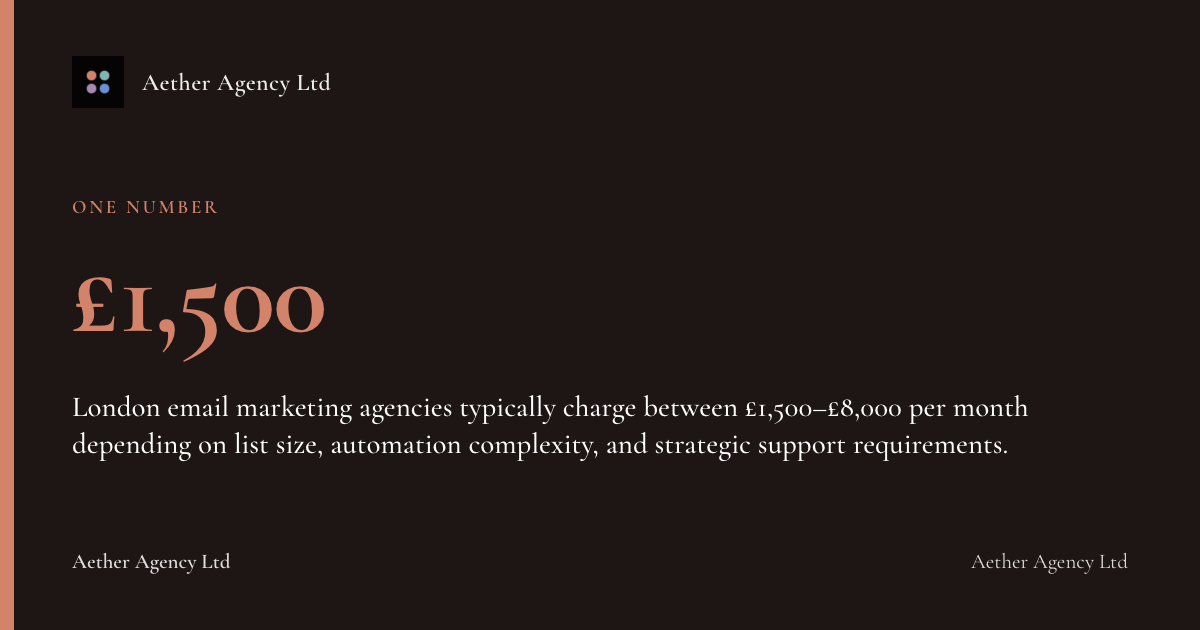
- London email marketing agencies typically charge between £1,500–£8,000 per month depending on list size, automation complexity, and strategic support requirements.
- Businesses working with specialist email agencies typically achieve higher open rates and click-through rates compared to in-house teams.
- Email automation workflows generate significantly more revenue per recipient than broadcast campaigns, with welcome series, abandoned cart sequences, and re-engagement flows delivering the strongest returns.
- GDPR compliance remains the foundation of all UK email marketing, with ICO fines for non-compliance reaching up to £17.5 million or 4% of global turnover in 2026.
- AI-powered personalisation and predictive send-time optimisation now drive higher engagement rates than traditional segmentation alone.
Why London Businesses Choose Specialist Email Marketing Agencies
London's competitive business environment demands email marketing that cuts through inbox noise and delivers measurable results. The average UK office worker receives a high volume of emails per day, making professional expertise essential for standing out.
A specialist email marketing agency brings three critical advantages. First, strategic planning that aligns email campaigns with broader business objectives—not just sending newsletters, but building automated customer journeys that nurture leads, recover abandoned carts, and maximise customer lifetime value. Second, technical expertise in platforms like Klaviyo, HubSpot, Mailchimp, and ActiveCampaign, including complex automation workflows, API integrations, and deliverability optimisation. Third, creative execution that combines persuasive copywriting, mobile-responsive design, and A/B testing to continuously improve performance.
London agencies also navigate the UK's strict GDPR requirements with confidence. The Information Commissioner's Office continues to issue significant data protection fines, with email marketing violations representing a notable share of enforcement actions. Professional agencies ensure double opt-in processes, proper consent documentation, and compliant data handling that protects your business from regulatory risk.
Many UK businesses now consider email their highest-ROI marketing channel, yet relatively few feel they're using it to its full potential. This gap represents the opportunity a specialist agency fills—transforming email from an underperforming afterthought into a strategic growth driver.
Core Services London Email Marketing Agencies Provide
Strategic Planning and Audience Segmentation
Professional agencies begin with strategic foundation work, not tactical execution. This includes customer journey mapping, list segmentation strategy, content calendar development, and KPI framework creation. The best London agencies conduct comprehensive audits of your existing email programme, identifying quick wins and long-term opportunities.
Advanced segmentation drives results. Rather than sending the same message to your entire list, agencies create targeted segments based on purchase history, browsing behaviour, engagement levels, demographic data, and lifecycle stage. Segmented campaigns are widely shown to generate a disproportionate share of email revenue despite representing a smaller proportion of sends.
Email Automation and Workflow Development
Automation transforms email marketing from labour-intensive to scalable. London agencies build sophisticated workflows including welcome series (5-7 emails nurturing new subscribers), abandoned cart recovery (recovering a meaningful share of lost sales), post-purchase sequences, re-engagement campaigns for inactive subscribers, and birthday or anniversary triggers.
"Automation works whilst you sleep, delivering personalised messages at exactly the right moment in the customer journey."
Agencies also implement behavioural triggers—emails sent automatically when customers take specific actions like downloading a resource, viewing a product multiple times, or reaching a spending threshold. These contextual messages achieve open rates 70-80% higher than broadcast emails.
Campaign Design and Copywriting
Visual design and persuasive copy work together to drive action. London agencies employ specialist email designers who create mobile-responsive templates (essential given how many UK emails are now opened on mobile devices), ensure brand consistency, optimise for accessibility, and follow inbox rendering best practices across Gmail, Outlook, Apple Mail, and other clients.
Copywriting focuses on clarity and conversion. Professional agencies craft subject lines that improve open rates (testing shows personalised subject lines lift opens meaningfully), write scannable body copy with clear hierarchy, create compelling calls-to-action, and maintain the right tone for your audience. Every element serves the campaign objective—whether that's driving sales, booking consultations, or nurturing relationships.
Deliverability Management and List Hygiene
Getting emails into the inbox rather than the spam folder requires technical expertise. Agencies manage sender reputation, implement proper authentication (SPF, DKIM, DMARC records), monitor blacklists and blocklists, maintain clean lists by removing inactive subscribers, and follow ISP best practices.
UK deliverability rates vary considerably, meaning a significant proportion of emails never reach the intended recipient. Professional agencies achieve 95%+ inbox placement through careful list management, engagement-based sending strategies, and proactive reputation monitoring.
Analytics, Testing, and Optimisation
Data-driven optimisation separates good email programmes from great ones. London agencies provide detailed reporting on open rates, click-through rates, conversion rates, revenue attribution, list growth, and deliverability metrics. More importantly, they interpret this data to drive continuous improvement.
A/B testing becomes systematic rather than occasional. Agencies test subject lines, send times, from names, content variations, call-to-action placement, and design elements. Even small improvements compound—a modest lift in conversion rate across thousands of emails generates significant revenue impact.
Email Marketing Agency Pricing in London: What to Expect in 2026
| Service Level | Monthly Retainer | Typical Inclusions | Best For |
|---|---|---|---|
| Foundation | £1,500–£3,000 | 2-4 campaigns/month, basic automation, template design, monthly reporting | Small businesses, 0-5,000 subscribers |
| Growth | £3,000–£5,500 | 6-8 campaigns/month, advanced automation, A/B testing, segmentation strategy, bi-weekly optimisation | Mid-size businesses, 5,000-25,000 subscribers |
| Enterprise | £5,500–£8,000+ | Unlimited campaigns, full automation suite, dedicated strategist, custom development, weekly optimisation | Large businesses, 25,000+ subscribers |
| Project-based | £2,500–£8,000 | One-time setup: strategy, platform migration, automation build, template library | Businesses launching or restructuring email programmes |
Pricing varies based on list size (larger lists require more platform costs and management time), automation complexity (sophisticated multi-step workflows require more development), strategic support (dedicated account management versus ad-hoc support), and creative requirements (custom design for every campaign versus template-based approaches).
Real-World Cost Scenarios
Scenario 1: East London E-commerce Brand (15,000 subscribers) Monthly retainer: £4,200. Includes weekly promotional campaigns, abandoned cart automation, post-purchase sequences, customer win-back flows, monthly A/B testing programme, and quarterly strategy reviews. Platform costs (Klaviyo): additional £350/month. Total monthly investment: £4,550. Average monthly revenue attributed to email: £28,000. ROI: 6.1:1.
Scenario 2: Central London Professional Services Firm (3,500 subscribers) Monthly retainer: £2,400. Includes bi-weekly thought leadership newsletters, lead nurture automation, event invitation campaigns, quarterly content planning, and monthly performance reporting. Platform costs (HubSpot Marketing Hub): included in existing subscription. Total monthly investment: £2,400. Average monthly leads generated: 18. Cost per lead: £133 (compared to £420 for paid search).
Scenario 3: West London SaaS Company (42,000 subscribers) Monthly retainer: £7,500. Includes product update campaigns, onboarding automation, upgrade nurture sequences, churn prevention workflows, advanced segmentation, dedicated strategist, and weekly optimisation calls. Platform costs (ActiveCampaign): additional £890/month. Total monthly investment: £8,390. Average monthly revenue attributed to email: £94,000. ROI: 11.2:1.
Ways to Reduce Email Marketing Agency Costs
Provide clean, organised data upfront. Agencies spend significant time cleaning messy subscriber lists and unclear customer data. Delivering well-structured data reduces setup time and ongoing management costs.
Choose the right platform for your needs. Overbuying enterprise software when you need basic automation wastes budget. Agencies can recommend the most cost-effective platform for your current requirements with room to scale.
Bundle services strategically. Many London agencies offer better rates when email marketing combines with related services like content creation, paid advertising, or website development. A full-service relationship often delivers better value than standalone email contracts.
Commit to longer contracts. Agencies typically discount for six-month or annual commitments versus month-to-month arrangements, reflecting reduced sales costs and better resource planning.
Handle some execution in-house. Hybrid models where agencies provide strategy and automation setup whilst your team handles routine campaign sends can reduce monthly costs whilst maintaining strategic guidance.
Alternatives to Consider
In-house email marketing works when you have dedicated staff with platform expertise, design capabilities, and strategic knowledge. However, recruitment costs for experienced email marketers in London can be substantial, plus platform costs and ongoing training. The break-even point typically occurs around 20,000+ subscribers with consistent campaign volume.
Freelance email marketers charge £350-£750 per day in London. This suits project-based work like automation setup or strategy development but lacks the team depth and accountability of agency relationships. Freelancers work well for businesses with strong internal marketing leadership who need specialist execution support.
Marketing automation platforms with services like Mailchimp's premium support or HubSpot's onboarding packages provide basic strategic guidance but rarely match the depth of specialist agencies. These work best for very small businesses (under 2,000 subscribers) with simple requirements.
How to Choose the Right Email Marketing Agency in London
Evaluate Platform Expertise
Different agencies specialise in different email platforms. Klaviyo agencies excel at e-commerce automation and revenue attribution. HubSpot partners integrate email with broader inbound marketing and CRM. Mailchimp specialists focus on small business accessibility. ActiveCampaign experts build complex automation for service businesses.
Ask potential agencies which platforms they work with most frequently, request case studies on your specific platform, and confirm they hold relevant certifications (Klaviyo Partner, HubSpot Solutions Partner, Mailchimp Pro Partner). Platform expertise directly impacts implementation speed and optimisation quality.
Assess Industry Experience
Email marketing strategies vary significantly across industries. E-commerce requires product recommendation engines and cart recovery. B2B services need long nurture sequences and thought leadership content. SaaS demands onboarding automation and upgrade paths. Hospitality focuses on booking triggers and seasonal campaigns.
Review agency portfolios for clients in your sector. Industry-specific experience means agencies understand your customer journey, competitive landscape, regulatory requirements, and performance benchmarks. They bring proven strategies rather than learning on your budget.
Review Their Own Email Marketing
An agency's own email programme reveals their capabilities. Subscribe to their newsletter and observe subject line creativity, design quality, mobile optimisation, personalisation sophistication, and value delivery. If their own emails are generic broadcasts with poor design, question their ability to execute excellence for clients.
"If we can't demonstrate best practices in our own communications, why would a client trust us with theirs?"
Understand Their Strategic Approach
Tactical execution without strategy delivers limited results. Strong agencies begin with discovery—understanding your business model, customer lifetime value, conversion funnel, current performance, and growth objectives. They should ask detailed questions about your audience, competitive positioning, and success metrics before proposing solutions.
Request a sample strategy document or audit from previous client work (with sensitive details redacted). This reveals their strategic depth, analytical rigour, and communication clarity. Agencies that jump straight to campaign ideas without strategic foundation rarely deliver sustainable results.
Examine Reporting and Communication
Clear, actionable reporting separates professional agencies from mediocre ones. Ask to see sample client reports. Look for clear performance summaries, trend analysis, actionable insights, competitive benchmarking, and strategic recommendations—not just data dumps.
Confirm communication cadence and channels. Monthly strategy calls? Bi-weekly email updates? Dedicated Slack channel? Quarterly business reviews? The right rhythm depends on your needs, but establish expectations upfront to avoid frustration.
Verify GDPR and Compliance Knowledge
UK email marketing operates under strict GDPR requirements. Agencies must demonstrate comprehensive understanding of lawful bases for processing (consent, legitimate interest), proper consent mechanisms (clear, unbundled, documented), data subject rights (access, deletion, portability), international transfers (if using US platforms), and ICO guidance.
Request their standard compliance procedures, privacy policy templates, and consent documentation. Any hesitation or vague answers on GDPR compliance should raise serious concerns—non-compliance exposes your business to significant regulatory and reputational risk.
Email Marketing Trends Shaping London Agencies in 2026
AI-Powered Personalisation and Content Generation
Artificial intelligence now enables hyper-personalisation at scale. London agencies use AI for predictive send-time optimisation (delivering emails when each recipient is most likely to engage), dynamic content generation (creating personalised product recommendations, subject lines, and body copy), and engagement prediction (identifying subscribers likely to convert or churn).
Many high-performing marketing teams now use AI for email personalisation, marking a significant rise in adoption in recent years. The technology analyses thousands of data points per subscriber to deliver genuinely individualised experiences that static segmentation cannot match.
Interactive Email Experiences
Static emails are giving way to interactive experiences that drive engagement without requiring recipients to leave their inbox. London agencies now implement AMP for Email (enabling live content updates, in-email purchases, and form submissions), embedded video (significantly increasing click rates), gamification elements (spin-to-win wheels, scratch cards), and accordion menus for mobile-friendly content density.
These interactive elements particularly suit London's tech-savvy audiences. However, agencies must ensure graceful degradation for email clients that don't support advanced features—typically 30-40% of recipients depending on audience composition.
Privacy-First Marketing and Zero-Party Data
Apple's Mail Privacy Protection and similar initiatives have reduced email tracking accuracy, pushing agencies toward zero-party data strategies. This involves asking subscribers directly for preferences, interests, and intent rather than inferring from behaviour.
Progressive profiling—gradually collecting information across multiple touchpoints—builds detailed subscriber profiles without overwhelming initial signup forms. Preference centres allow subscribers to control email frequency, content topics, and communication channels. Brands using zero-party data strategies tend to achieve higher email engagement than those relying solely on behavioural tracking.
Omnichannel Integration and Attribution
Email no longer operates in isolation. Leading London agencies integrate email with SMS, push notifications, social media retargeting, and direct mail to create cohesive customer experiences. Cross-channel automation triggers SMS follow-ups for unopened emails, retargets email clickers with social ads, and coordinates messaging across touchpoints.
Advanced attribution modelling shows email's role in multi-touch conversion paths. Rather than crediting only last-click conversions, agencies use data-driven attribution to demonstrate email's influence throughout the customer journey—often revealing email drives significantly more revenue than last-click models suggest.
Sustainability and Ethical Email Practices
Environmental consciousness shapes email strategy. Every email generates a small carbon footprint, leading London agencies to optimise for sustainability through clean code and compressed images (reducing email file size), list hygiene (removing inactive subscribers to reduce unnecessary sends), targeted segmentation (sending only relevant messages), and carbon-neutral hosting providers.
Ethical practices extend beyond environment to accessibility (ensuring emails work for subscribers using screen readers and assistive technology), inclusivity (using diverse imagery and inclusive language), and transparency (clear sender identity, honest subject lines, easy unsubscribe processes).
Common Email Marketing Challenges London Agencies Solve
Low Engagement Rates and List Fatigue
Many businesses struggle with declining open rates and subscriber disengagement. London agencies diagnose the root causes—sending too frequently, irrelevant content, poor segmentation, weak subject lines, or deliverability issues—and implement targeted solutions.
Re-engagement campaigns win back inactive subscribers before removing them. Sunset policies automatically suppress subscribers who haven't engaged in 6-12 months, improving deliverability and engagement metrics. Frequency optimisation finds the sweet spot between staying top-of-mind and overwhelming recipients.
Poor Deliverability and Spam Placement
Emails landing in spam folders waste marketing investment. Agencies improve deliverability through proper authentication setup (SPF, DKIM, DMARC), sender reputation management (monitoring feedback loops and complaint rates), engagement-based sending (prioritising active subscribers), content optimisation (avoiding spam trigger words and excessive links), and list hygiene (removing bounces, complaints, and inactive addresses).
Improving inbox placement meaningfully increases your email marketing ROI without any other changes—simply by ensuring more messages reach their intended destination.
Inadequate Automation and Manual Processes
Businesses often rely on manual campaign creation when automation would deliver better results with less effort. Agencies identify automation opportunities across the customer lifecycle, build sophisticated multi-step workflows, implement behavioural triggers, and create dynamic content rules.
The transformation from manual to automated email marketing typically reduces time spent on email execution substantially whilst increasing email-attributed revenue considerably. Automation doesn't replace strategy—it amplifies it.
Compliance Concerns and Legal Risk
GDPR compliance remains complex and evolving. Agencies ensure proper consent collection and documentation, implement data subject rights processes, maintain compliant data processing agreements, conduct regular compliance audits, and stay current with ICO guidance updates.
The average cost of a data breach in the UK remains substantial, with email-related incidents representing a notable proportion of cases. Professional compliance management protects against regulatory fines, legal liability, and reputational damage.
Lack of Strategic Direction and Measurable ROI
Many businesses send emails without clear objectives or performance frameworks. Agencies establish strategic foundations through goal setting aligned with business objectives, KPI frameworks with benchmarks and targets, attribution modelling connecting email to revenue, competitive analysis, and regular strategic reviews.
This strategic discipline transforms email from "something we should probably do" into a measurable growth channel with clear ROI, budget justification, and continuous improvement.
Your Email Marketing Agency Selection Checklist
- Audit your current email performance against industry benchmarks to identify specific improvement areas before approaching agencies
- Define clear objectives and success metrics so agencies can propose targeted solutions rather than generic packages
- Research platform-specific specialists if you're committed to a particular email marketing platform or need migration expertise
- Request case studies from your industry to evaluate relevant experience and typical results agencies achieve for similar businesses
- Review at least three agencies' own email marketing to assess their practical capabilities and creative standards
- Prepare your subscriber data and current workflows for discovery calls so agencies can provide accurate scoping and pricing
- Verify GDPR compliance procedures and request sample documentation to ensure proper data protection practices
- Clarify reporting cadence and communication expectations to ensure the agency relationship matches your involvement preferences
- Understand the full cost structure including platform fees, design costs, and any additional charges beyond the monthly retainer
- Check references from current clients to understand working relationship quality, responsiveness, and results delivery
- Confirm onboarding timeline and resource requirements from your team to ensure smooth implementation
- Establish trial period or exit terms to reduce risk whilst evaluating the agency partnership
FAQ
How much does an email marketing agency cost in London?
London email marketing agencies typically charge £1,500–£8,000 per month depending on list size, automation complexity, and service level. Small businesses with under 5,000 subscribers usually invest £1,500–£3,000 monthly, mid-size businesses pay £3,000–£5,500, and enterprises with 25,000+ subscribers invest £5,500–£8,000 or more. Project-based work like automation setup or platform migration ranges from £2,500–£8,000. These retainers cover strategy, campaign execution, automation development, and optimisation but exclude platform subscription costs (typically £50–£900 monthly depending on list size and features).
What ROI should I expect from email marketing?
Email marketing consistently delivers a strong return for every pound spent, making it one of the highest-ROI digital marketing channels. However, results vary significantly based on industry, list quality, and execution sophistication. E-commerce businesses typically see 15-25% of total revenue attributed to email, whilst B2B service businesses generate 20-40% of qualified leads through email nurture. Most businesses working with professional agencies achieve measurable ROI within 3-4 months, with performance improving as automation matures and optimisation compounds. Realistic first-year expectations range from 5:1 to 15:1 ROI depending on
Add aether-agency.co.uk as a preferred source on Google
See How Your Brand Appears in AI Search
Aether AI monitors your visibility across ChatGPT, Perplexity, Google AI Overviews, and Claude in real time. Find out where you stand and what to fix.
Explore Aether AI