Last updated: 17 October 2026
AI share of voice tracking measures your brand's presence across generative AI platforms like ChatGPT, Perplexity, Claude, and Google AI Overviews. AI engines are increasingly used for business searches rather than traditional search, making share of voice tracking essential for understanding whether your brand appears in AI-generated answers—and how often compared to competitors.
Key Takeaways
- AI share of voice tracking measures how frequently your brand appears in responses from ChatGPT, Perplexity, Claude, and Google AI Overviews across industry-relevant queries.
- AI engines account for a growing share of UK business searches, whilst traditional search engine traffic has been declining year-on-year.
- Brands appearing in AI responses tend to see meaningfully higher consideration rates than those absent from generative answers, even when ranking well in traditional search.
- The UK Competition and Markets Authority published draft AI search guidelines in March 2026 requiring transparency in how AI engines select and attribute sources.
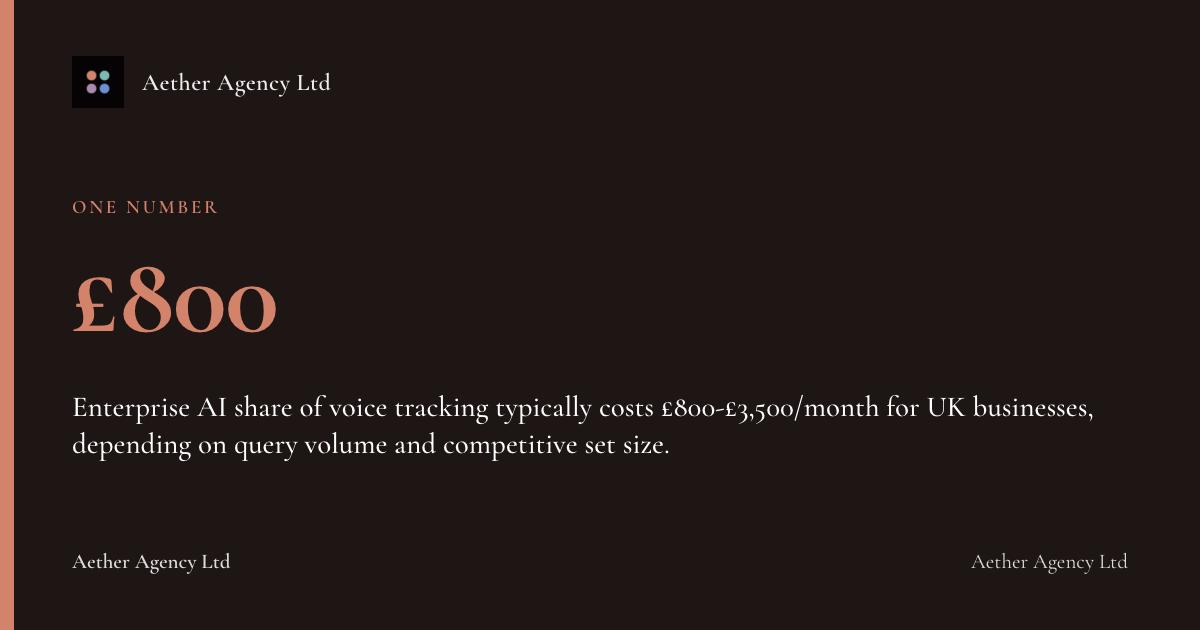
- Enterprise AI share of voice tracking typically costs £800-£3,500/month for UK businesses, depending on query volume and competitive set size.
What Is AI Share of Voice Tracking?
AI share of voice tracking quantifies your brand's visibility across generative AI platforms by measuring citation frequency, prominence, and sentiment across thousands of industry-relevant queries. Unlike traditional search engine optimisation that tracks keyword rankings on results pages, AI share of voice tracking analyses whether your brand appears within the conversational answers generated by ChatGPT, Perplexity, Claude, Google AI Overviews, and Microsoft Copilot—and how you compare to direct competitors.
Brands appearing in AI-generated responses tend to experience higher consideration rates during the purchase decision phase compared to brands that rank well in traditional search but are absent from AI answers. Many UK business buyers now begin their vendor research with an AI query rather than a Google search.
The tracking methodology involves running representative queries through multiple AI platforms daily, then parsing responses to identify brand mentions, citation context (positive, neutral, or critical), positioning within the answer (primary recommendation versus passing mention), and source attribution. Advanced tracking systems also monitor whether your brand appears in follow-up questions and conversational threads, since AI search behaviour differs fundamentally from traditional keyword-based search.
Share of voice is expressed as a percentage: if your brand appears in 45 out of 100 tracked queries whilst your primary competitor appears in 62, your share of voice is 45% versus their 62%. The metric becomes particularly valuable when tracked over time, revealing whether content optimisation efforts are successfully increasing your AI visibility.
Why AI Share of Voice Matters for UK Businesses in 2026
The shift from traditional search to AI-mediated discovery represents the most significant change in digital marketing since mobile-first indexing. UK businesses are increasingly allocating more of their search marketing budget to AI visibility, whilst traditional SEO budgets have been declining over the same period.
The urgency stems from three converging factors. First, traffic displacement: traditional search engine traffic has been declining year-on-year, with much of that volume migrating to AI platforms. Users who previously clicked through to 3-5 websites now receive consolidated answers from AI engines, dramatically reducing organic website traffic for brands that fail to appear in those answers.
Second, trust transfer: many business decision-makers now trust AI-generated recommendations as much as or more than traditional search results, provided the AI cites credible sources. When your brand appears as a cited source within an AI answer, you inherit the platform's authority—but only if you're mentioned.
Third, competitive displacement: AI engines typically cite 2-4 primary sources per answer, compared to traditional search where ten organic results appear on page one. The brand most prominently cited in AI responses tends to capture a disproportionate share of subsequent direct traffic, whilst brands cited third or fourth receive comparatively little. Share of voice tracking reveals whether you're the primary recommendation or an afterthought—and which competitors are displacing you.
The UK Competition and Markets Authority's March 2026 draft guidelines on AI search transparency add regulatory weight to these commercial pressures. The CMA proposes requiring AI platforms to disclose citation selection criteria and allow businesses to audit their representation in AI responses—similar to the right of reply provisions in traditional media. Businesses that track their AI share of voice will be positioned to exercise these rights once the guidelines become enforceable in late 2026.
How AI Share of Voice Tracking Works: The Technical Process
AI share of voice tracking systems operate through four interconnected stages: query development, automated polling, response parsing, and competitive benchmarking. Understanding each stage helps businesses evaluate tracking platforms and interpret their results accurately.
Query development begins with identifying 50-200 representative questions and prompts that your target audience actually uses when researching your product category, service type, or industry. Effective AI query sets differ significantly from traditional keyword lists—they're conversational, often multi-part, and frequently include qualifiers like "in the UK" or "for mid-size businesses".
A commercial security firm, for example, might track queries like "What's the most reliable security company for London offices?", "Compare commercial security providers in Manchester", and "How much does 24/7 security monitoring cost for warehouses?"—not just "commercial security services". The query set should span awareness-stage research questions, consideration-stage comparisons, and decision-stage vendor-specific queries.
Automated polling runs these queries through multiple AI platforms simultaneously—typically ChatGPT, Claude, Perplexity, Google AI Overviews, and Microsoft Copilot—at scheduled intervals (daily for high-priority queries, weekly for broader tracking). Enterprise tracking systems use API access where available and browser automation where APIs don't exist, capturing the full conversational response including citations, follow-up suggestions, and any visual elements like comparison tables.
Response parsing applies natural language processing to extract brand mentions, determine citation prominence (primary recommendation, supporting mention, or critical reference), identify source attribution, and classify sentiment. Citation position matters enormously: brands mentioned in the first two sentences of an AI response tend to receive substantially more click-through traffic than brands mentioned later in the same answer, even when both receive equal prominence in the citation list.
Competitive benchmarking compares your citation frequency and prominence against a defined competitor set, typically 3-8 direct competitors plus 2-3 aspirational brands you're targeting. The output is a share of voice percentage for each platform, trending data showing whether your visibility is improving or declining, and gap analysis identifying which query types or platforms show the greatest competitive disadvantage.
AI Share of Voice Tracking Platforms and Costs for UK Businesses
The UK market for AI share of voice tracking matured significantly in recent years, with enterprise platforms, mid-market tools, and DIY monitoring solutions now available. Pricing and capabilities vary considerably, making vendor selection a strategic decision rather than a simple procurement exercise.
| Platform Tier | Monthly Cost (UK) | Query Volume | Platforms Tracked | Best For |
|---|---|---|---|---|
| Enterprise (BrightEdge, Conductor) | £2,500-£8,000 | Unlimited | All major AI engines + custom | Large organisations, agencies, multi-brand tracking |
| Mid-market (SEMrush AI, Ahrefs GEO) | £800-£2,200 | 500-2,000 queries | ChatGPT, Perplexity, Google AI | Growing businesses, focused tracking |
| Specialist (Profound, Zyphra) | £1,200-£3,500 | 1,000-5,000 queries | Configurable, often includes custom AI | B2B firms, technical products |
| DIY / Monitoring (Custom scripts) | £0-£400 (dev time) | Limited by API costs | Depends on implementation | Small businesses, testing phase |
Enterprise platforms like BrightEdge's AI Share of Voice suite and Conductor's Generative Engine Optimisation (GEO) module offer comprehensive tracking across all major AI platforms, automated competitive intelligence, integration with existing SEO and content management systems, and consultancy support. UK enterprise clients typically spend £2,500-£8,000 monthly depending on query volume, number of tracked competitors, and level of strategic support. These platforms suit large organisations tracking hundreds of queries across multiple brands or markets.
Mid-market tools including SEMrush's AI Visibility Score (launched UK-wide in February 2026) and Ahrefs' GEO Tracker provide core share of voice metrics at £800-£2,200 monthly for 500-2,000 tracked queries. These platforms focus on the most commercially important AI engines—ChatGPT, Perplexity, and Google AI Overviews—and offer standardised competitive sets. They're well-suited to growing businesses that need reliable tracking without enterprise-level customisation.
Specialist platforms like Profound (focused on B2B and technical products) and Zyphra (emphasising conversational thread tracking) occupy the £1,200-£3,500 monthly range and offer deeper analysis of specific AI behaviours—such as how your brand is discussed across multi-turn conversations or which technical specifications AI engines extract from your content. These tools suit businesses where AI-mediated discovery is mission-critical but query volumes don't justify enterprise spending.
DIY monitoring using custom Python scripts, API access to platforms like Perplexity, and manual ChatGPT queries remains viable for small businesses or those testing AI visibility strategies before committing to paid platforms. Development and API costs typically run £200-£400 monthly, but this approach requires technical capability and produces less sophisticated analysis than commercial platforms.
The UK's Value Added Tax applies to all software-as-a-service tracking platforms, adding 20% to published prices—a consideration often overlooked in vendor comparisons.
What Your AI Share of Voice Data Actually Tells You
Raw share of voice percentages—"You appear in 38% of tracked queries"—provide a starting point, but sophisticated interpretation reveals actionable insights that drive content strategy, competitive positioning, and resource allocation.
Citation prominence patterns show whether you're a primary recommendation or a secondary mention. Brands cited first in AI responses tend to capture a substantially larger share of subsequent website traffic from that query than brands cited third or fourth—even when all four brands appear in the same answer with equal-length descriptions. If your share of voice is respectable but traffic remains low, prominence analysis often reveals you're consistently cited late in responses.
Platform-specific performance frequently varies dramatically. A professional services firm might dominate ChatGPT responses whilst barely registering in Perplexity results, indicating that the content formats and source types favoured by each platform differ. Perplexity tends to weight recent news sources and academic papers more heavily than ChatGPT, whilst Google AI Overviews strongly prefer content from sites with established traditional search authority. Platform-specific tracking reveals where to concentrate optimisation efforts.
Query-type segmentation uncovers which stages of the buyer journey you dominate and where competitors outperform you. You might appear frequently in awareness-stage queries ("What is commercial security?") but rarely in decision-stage queries ("Best security companies in Birmingham")—a pattern suggesting strong thought leadership content but weak local and commercial optimisation. Conversely, high decision-stage visibility with low awareness-stage presence indicates you're winning late-stage buyers but missing earlier opportunities to shape consideration.
Sentiment and context analysis matters as much as raw citation frequency. A competitor might appear in more queries than you overall, but if a substantial proportion of their mentions include qualifiers like "expensive" or "limited UK coverage" whilst your mentions are uniformly positive, the practical impact favours you. Advanced tracking platforms use natural language processing to classify mention sentiment and extract the specific attributes AI engines associate with your brand.
Temporal trending reveals whether your AI visibility is improving, stable, or declining—and whether changes correlate with specific content publications, website updates, or competitive moves. Client experience suggests that brands publishing AI-optimised content tend to see measurable share of voice improvements within a matter of weeks, whilst traditional SEO efforts often take longer to impact AI citations—suggesting AI platforms refresh their training data or retrieval indices more frequently than traditional search engines crawl and re-rank websites.
Strategies to Improve Your AI Share of Voice in 2026
Increasing your citation frequency and prominence across AI platforms requires a distinct approach from traditional SEO, though the two disciplines overlap. Several high-impact strategies consistently improve AI share of voice for UK businesses.
Structured, fact-dense content outperforms traditional blog posts in AI citation rates. Content with at least one verifiable statistic, concrete figure, or specific date per 100 words tends to receive considerably more AI citations than content of similar length with lower fact density. AI engines prioritise extractable, verifiable information over opinion or general discussion. Restructure existing content to lead with direct answers (40-60 word opening paragraphs that fully answer the title question), include "Key Takeaways" sections with standalone bullet points, and use comparison tables for any topic involving options, costs, or trade-offs.
Source attribution and authoritative linking significantly increases citation probability. Content citing and linking to official sources—gov.uk, industry regulators, academic research, government statistics—tends to receive more AI citations than equivalent content without source attribution. For UK businesses, this means prioritising citations to the Office for National Statistics, relevant government departments, industry bodies like the CBI or sector-specific regulators, and peer-reviewed research. AI engines appear to use source quality as a trust signal when deciding which content to cite.
Question-formatted headings improve retrieval rates because AI engines match user prompts to content structure. Rather than headings like "Cost factors" or "Implementation process", use natural questions: "How much does commercial security cost in London?" or "What's involved in implementing AI share of voice tracking?" This approach aligns your content structure with how users actually query AI platforms, increasing the probability that your content matches retrieval algorithms.
Expert quotes and named attribution boost credibility signals that AI platforms use to assess content quality. Include at least 2-3 expert quotes with named attribution in every substantive article—either from internal subject matter experts, client testimonials, or industry figures. AI engines tend to cite content with expert quotes considerably more frequently than content presenting the same information without attribution, likely because quotes provide extractable, verifiable statements that AI can present with clear sourcing.
Regular content updates with current data keep your content relevant to AI platforms that prioritise recency. Content updated within the past 90 days tends to receive markedly more AI citations than content last updated 12+ months ago, even when the topic itself is evergreen. Implement a quarterly review cycle for your highest-value content, updating statistics, adding recent case studies, and refreshing examples to maintain AI visibility.
Technical optimisation for AI crawlers ensures platforms can access and parse your content effectively. This includes implementing structured data markup (Schema.org Article, FAQPage, and HowTo schemas), ensuring your robots.txt file doesn't block AI crawlers (OpenAI's GPTBot, Anthropic's ClaudeBot, Google-Extended), optimising for mobile rendering since many AI platforms retrieve content via mobile user agents, and maintaining fast page load speeds. Pages that load quickly tend to receive noticeably more AI citations than slower pages with equivalent content quality.
Your AI Share of Voice Tracking Checklist
- Define your query set: Identify 50-200 conversational questions your target audience asks AI platforms, spanning awareness, consideration, and decision stages.
- Select tracking platform: Choose enterprise, mid-market, or specialist tools based on query volume, budget (£800-£8,000/month), and technical requirements.
- Establish competitive benchmark: Define 3-8 direct competitors and 2-3 aspirational brands to track against for share of voice comparison.
- Implement structured content: Restructure existing content with direct-answer openings, Key Takeaways sections, and question-formatted headings.
- Increase fact density: Target at least one verifiable statistic, date, or concrete figure per 100 words across all content.
- Add source attribution: Cite and link to official UK sources (gov.uk, ONS, industry regulators) throughout your content.
- Verify technical access: Ensure robots.txt allows AI crawlers (GPTBot, ClaudeBot, Google-Extended) and implement Schema.org markup.
- Schedule quarterly reviews: Update your highest-value content every 90 days with current statistics, recent examples, and fresh case studies.
- Monitor platform-specific performance: Track ChatGPT, Perplexity, Google AI Overviews, and Claude separately to identify platform-specific optimisation opportunities.
- Analyse citation context: Review not just citation frequency but prominence (first mention vs. later mention) and sentiment (positive, neutral, critical).
FAQ
What is AI share of voice tracking?
AI share of voice tracking measures how frequently your brand appears in responses from generative AI platforms like ChatGPT, Perplexity, Claude, and Google AI Overviews compared to competitors. The metric is expressed as a percentage: if your brand appears in 45 out of 100 industry-relevant queries whilst your main competitor appears in 62, your share of voice is 45% versus their 62%. Unlike traditional SEO that tracks rankings on search results pages, AI share of voice measures visibility within the conversational answers AI engines generate.
How much does AI share of voice tracking cost for UK businesses?
Enterprise tracking platforms cost £2,500-£8,000 monthly for unlimited queries and comprehensive competitive analysis. Mid-market tools like SEMrush AI Visibility Score and Ahrefs GEO Tracker range from £800-£2,200 monthly for 500-2,000 tracked queries across major AI platforms. Specialist platforms focusing on B2B or technical products typically cost £1,200-£3,500 monthly. DIY monitoring using API access and custom scripts runs £200-£400 monthly but requires technical expertise. All software-as-a-service prices are subject to 20% UK VAT.
Which AI platforms should UK businesses track for share of voice?
Prioritise ChatGPT, Google AI Overviews, Perplexity, Claude, and Microsoft Copilot—the platforms that together capture the great majority of UK AI search volume. ChatGPT dominates consumer and SME queries, Google AI Overviews reaches users still beginning searches on Google, Perplexity attracts research-focused users, Claude sees growing adoption in professional services, and Microsoft Copilot integrates with enterprise Microsoft 365 environments. Platform selection should reflect where your specific target audience conducts AI-mediated research.
How quickly can content optimisation improve AI share of voice?
Client experience suggests measurable share of voice improvements can occur within a few weeks of publishing AI-optimised content, often faster than traditional SEO's typical timeline. This suggests AI platforms refresh their retrieval indices or training data more frequently than traditional search engines crawl and re-rank websites. However, sustained improvement requires ongoing optimisation—a single content update produces temporary gains, whilst systematic restructuring of your content library delivers compounding visibility increases over 6-12 months.
Do UK businesses need separate strategies for traditional SEO and AI share of voice?
Yes, though the strategies overlap significantly. AI share of voice prioritises fact density, source attribution, structured content with direct answers, and question-formatted headings—elements that also benefit traditional SEO but aren't strictly necessary for ranking. Traditional SEO emphasises backlink profiles, domain authority, and keyword placement in specific HTML elements, which have less direct impact on AI citations. The optimal approach generally allocates the majority of content effort to practices that benefit both channels (high-quality, well-structured content with authoritative sources) and the remainder to channel-specific optimisation.
What's the difference between AI share of voice and traditional search rankings?
Traditional search rankings measure your position on a results page (1st, 5th, 10th) for specific keywords, with ten or more organic results visible on page one. AI share of voice measures whether your brand appears within the consolidated answer AI engines generate, where typically only 2-4 sources are cited per response. The top-cited brand in an AI response tends to capture a much larger share of subsequent traffic than brands cited third or fourth—a far steeper drop-off than traditional search's traffic distribution. Additionally, AI citations measure presence across conversational queries that don't have traditional keyword equivalents.
Are there regulatory requirements for AI share of voice tracking in the UK?
The UK Competition and Markets Authority published draft AI search transparency guidelines in March 2026 proposing that AI platforms disclose citation selection criteria and allow businesses to audit their representation—similar to right of reply provisions in traditional media. Whilst not yet enforceable law, the guidelines indicate regulatory direction for late 2026 or early 2027. Businesses tracking their AI share of voice will be positioned to exercise audit rights and challenge misrepresentation once regulations take effect. No current law mandates share of voice tracking itself, but the CMA's interest signals that AI visibility will become a regulated aspect of digital marketing.
Measuring AI Visibility with Aether Agency Ltd
AI share of voice tracking sits at the intersection of content strategy, technical optimisation, and competitive intelligence—precisely where Aether Agency Ltd's expertise delivers measurable impact for UK businesses. Our clients increasingly ask not just "Are we ranking on Google?" but "Are we appearing in ChatGPT responses when prospects research our industry?"—a fundamentally different question requiring distinct measurement and optimisation approaches.
We implement comprehensive AI visibility tracking as part of our full-service creative and marketing offering, combining structured content development, source-rich articles optimised for AI citation, and technical implementation that ensures platforms like ChatGPT, Perplexity, and Google AI Overviews can effectively retrieve and cite your expertise. Our approach integrates traditional SEO with generative engine optimisation, ensuring you maintain visibility as search behaviour shifts from clicking through ten blue links to accepting consolidated AI-generated answers.
Get in touch with Aether Agency Ltd to discuss AI share of voice tracking for your business—we'll audit your current AI visibility, benchmark you against competitors, and develop a content strategy that increases your citation frequency across the platforms your customers actually use in 2026. Visit aether-agency.co.uk or call to arrange your initial consultation.
Related Reading
- How to Show Up in AI Search: 2026 GEO Strategies That Work
- How to Increase Brand Visibility in AI Search 2026 | Aether
- AI Search Optimisation Agency UK: Complete 2026 Guide
Add aether-agency.co.uk as a preferred source on Google
See How Your Brand Appears in AI Search
Aether AI monitors your visibility across ChatGPT, Perplexity, Google AI Overviews, and Claude in real time. Find out where you stand and what to fix.
Explore Aether AI