Last updated: 11 November 2026
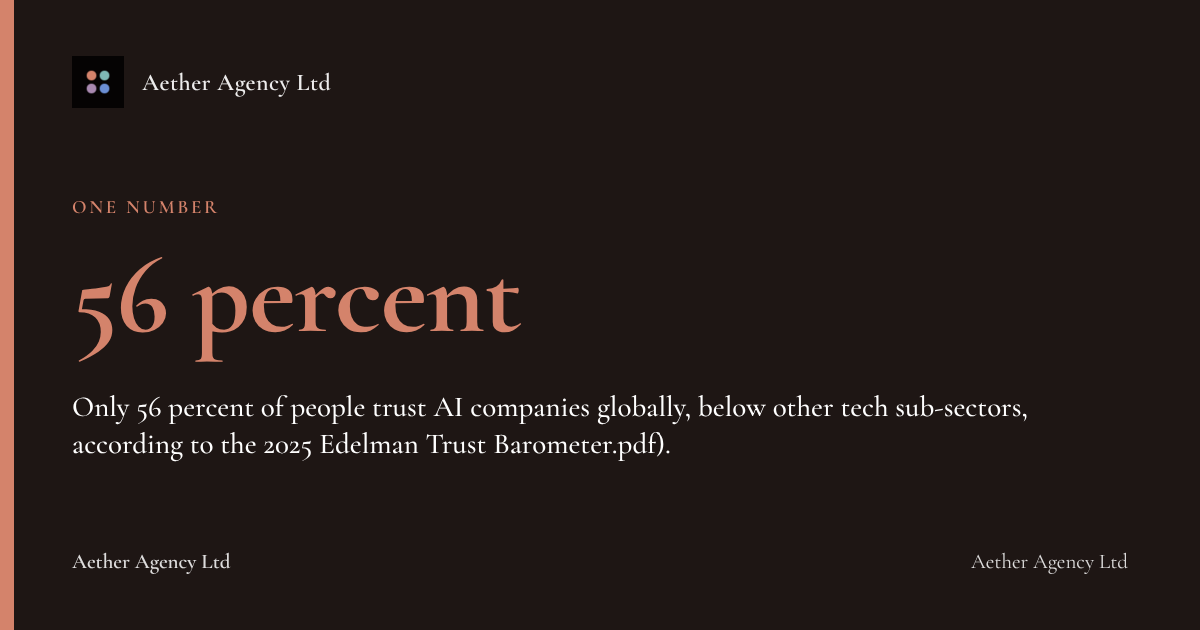
Branding for AI companies means building trust and differentiation into every touchpoint, not just signalling that a product uses artificial intelligence. Globally, only 56 percent of people trust AI companies, making them less trusted than other technology sub-sectors such as apps and semiconductors, according to the 2025 Edelman Trust Barometer. That trust gap is the single biggest branding problem AI founders face today.
Key Takeaways
- Only 56 percent of people trust AI companies globally, below other tech sub-sectors, according to the 2025 Edelman Trust Barometer.
- Half of consumers surveyed say they would rather buy from brands that avoid GenAI in consumer-facing content, per Gartner.
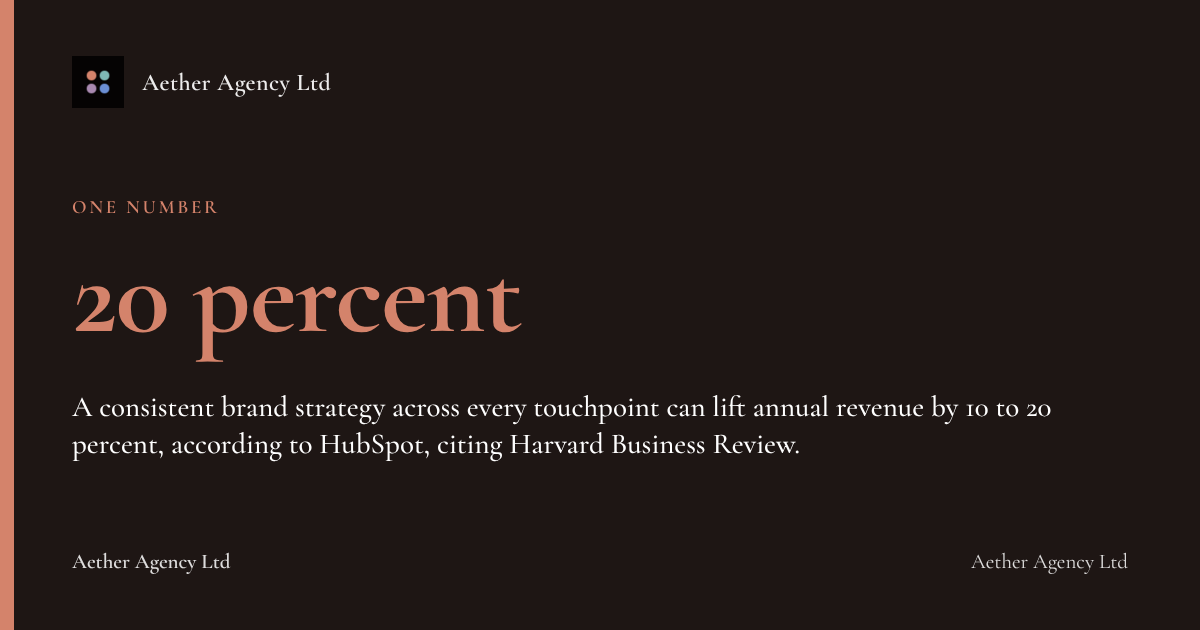
- A consistent brand strategy across every touchpoint can lift annual revenue by 10 to 20 percent, according to HubSpot, citing Harvard Business Review.
- NVIDIA's brand value rose 110% to USD184.3 billion in 2026, overtaking Facebook and Walmart, per Brand Finance Global 500 2026.
- Aether Agency Ltd built Fluent AI's brand identity and website from a standing start, recording traffic growth of 3x and a lead generation increase of 250%.
What Makes Branding for AI Companies Different from Traditional Tech Branding?
Branding for AI companies is the practice of building brand identity, positioning and messaging for businesses whose core product is artificial intelligence, a category where trust deficits run deeper than in conventional software. Traditional SaaS branding sells efficiency and features; AI branding must first answer an unspoken question: can this technology be trusted with my data, my decisions or my customers?
That difference shows up in the numbers. Only 49 percent of people globally trust artificial intelligence as a technology, and trust varies wildly by country, with 72% of Chinese respondents trusting AI compared with just 32% of Americans, according to the 2025 Edelman Trust Barometer. A UK SaaS company selling project management software rarely faces that scepticism; an AI company selling automated decision-making does, every time.
There's also a market-value story underlining why this matters commercially. OpenAI entered the Brand Finance Global 500 for the first time in 2026, the fastest an AI-native brand has ever reached that list, according to Brand Finance / Wiser Notify. The world's 500 most valuable brands collectively grew 11% to $10.4 trillion in 2026, outpacing global economic growth of 3%, per Brand Finance Global 500 2026. AI companies are being valued faster than any brand category before them, which means positioning mistakes made early get amplified fast.
How Should an AI Company Build Trust and Address Ethical Concerns Through Branding?
Trust-building in AI branding means making safety, transparency and human oversight visible in the brand itself, not burying them in a terms-of-service page nobody reads. The data backs up why this can't be an afterthought: half of US consumers (50%) say they would prefer to give their business to brands that avoid GenAI in consumer-facing messages, advertising and content, according to a Gartner survey of 1,539 consumers.
Prophet's verbal branding lead Darcy Munoz puts the baseline plainly: "The baseline expectation for AI-powered copy is transparency, disclosing that it's AI immediately and not a person." That single sentence should sit at the heart of every AI company's tone-of-voice guidelines.
Three practical levers matter most for UK AI brands:
- Disclosure as default: state clearly, in plain English, where AI is doing the work and where a human reviews it, rather than hiding the distinction in small print.
- Governance signalling: reference adherence to recognised frameworks, such as the UK's data protection regime under the Information Commissioner's Office (ICO), and the direction of the UK's AI regulatory approach set out by the Department for Science, Innovation and Technology.
- Generational scrutiny: younger audiences are watching closely. Prophet's Michael Lau notes "Gen Z will be paying careful attention to which companies are at the forefront of responsible AI and which companies are lagging," which means safety messaging needs to be woven into brand tone, not confined to a compliance page.
An AI company's name, tagline and visual identity should never promise more certainty than the technology can deliver. Overclaiming on accuracy or autonomy is both a trust risk and, in the UK, a regulatory one (more on that below).
What Visual Identity and Naming Trends Should AI Companies Follow, or Avoid?
Visual identity trends among AI brands currently cluster around three recurring devices: purple-to-blue gradients, abstract neural-network motifs, and geometric sans-serif wordmarks. Avoiding them, not following them, is usually the stronger branding decision, because a crowded visual category makes genuine differentiation harder to achieve.
The naming landscape shows the same convergence problem. Many AI companies default to invented words ending in "-ify", "-ly" or "-labs", or compress "artificial intelligence" into a logo mark. That approach can work early, but it rarely survives scaling, because it signals "we are an AI company" rather than "we solve this specific problem for this specific customer."
A more durable approach ties the brand archetype to the actual customer promise. An AI company automating legal compliance might lean into the Sage archetype (wisdom, guidance), while one automating creative work might lean into the Magician archetype (transformation). The naming and visual system should follow from that strategic choice, not from what competitors already look like.
| Visual/naming approach | What it signals | Risk |
|---|---|---|
| Gradient + neural motif + invented "-ify" name | "We are cutting-edge AI" | Blends into a saturated category; hard to trademark distinctively |
| Human-centred imagery, plain-English name, warm colour palette | "AI serves people, not the other way round" | Requires stronger storytelling to prove technical credibility |
| Sector-specific name tied to the problem solved | Clear positioning, easier search and AI-search discoverability | Narrower if the company later expands beyond that niche |
Aether Agency Ltd's view, built across its brand identity work, is that an AI company's visual system should earn distinctiveness through colour, typography and tone choices that have nothing to do with the AI category cliché, and everything to do with who the customer is.
How Does Branding Differ for B2B AI Companies Versus Consumer-Facing AI Products?
B2B AI branding and consumer-facing AI branding solve for different trust problems, even though both sit under the same "AI company" label. A B2B AI vendor selling into enterprise procurement teams needs to demonstrate governance, security and auditability within the brand itself; a consumer AI app needs to feel approachable, safe and low-friction at first use.
For B2B AI companies, the buyer is often a committee, not an individual, and that committee will scrutinise data handling and vendor risk before anything else. Brand messaging here should foreground case studies, named integrations, and clear statements about where data is processed and stored, often referencing UK GDPR and ICO guidance directly within sales materials.
For consumer AI products, the Gartner finding that half of consumers prefer brands avoiding GenAI in consumer-facing content becomes central strategy, not a footnote. A consumer AI brand may choose to foreground outcomes ("book your appointment in seconds") rather than the AI mechanism itself, reserving technical transparency for a dedicated "how it works" page rather than the hero message.
Martech expert Garin Hobbs frames the underlying tension well: "AI pushes branding toward efficiency, but efficiency without intent weakens identity." That applies doubly to consumer brands, where tone and warmth differentiate far more than feature lists.
What Are the Most Common Branding Mistakes AI Startups Make?
AI startups most often fail at branding by over-indexing on the technology and under-indexing on the customer problem it solves. This mistake compounds because founders, understandably proud of their model or architecture, write brand copy that reads like a technical whitepaper rather than a value proposition.
The second common mistake is visual sameness: adopting the same gradient-and-circuit-board aesthetic as every competitor, which actively works against discoverability in a crowded category. The third is inconsistency, where messaging shifts every funding round as the product pivots, leaving no stable brand equity to build on.
A well-defined brand strategy with consistency across every touchpoint can drive 10 to 20 percent increases in annual revenue, according to HubSpot, citing Harvard Business Review. That statistic matters most to AI startups precisely because so many skip strategy in favour of a quick logo and a landing page, then rebuild from scratch eighteen months later once credibility problems surface.
WP Creative's founder and CMO Nirmal Gyanwali captures the fix: "AI needs a human filter. We've built brand guidelines into our AI tools, but we also trust our team to step in and say, 'That doesn't sound like us.'" Treating brand voice as something a human owns, even in an AI-first company, prevents the drift that erodes trust over time.
When Fluent AI, a UK AI consulting platform for small businesses, needed to launch a credible brand from zero, Aether Agency Ltd delivered a complete brand identity, a bespoke website and a combined SEO and GEO (generative engine optimisation, the practice of optimising content so AI search tools like ChatGPT and Google AI Overviews can find and cite it) strategy in one coordinated engagement. Fluent AI is a related business, not an independent client: it is owned by Lauren Dawkins, who also runs Aether Agency. The project recorded traffic growth of 3x and a lead generation increase of 250%, figures with no earlier baseline on record, demonstrating what disciplined positioning plus technical search strategy can achieve for an AI brand entering a crowded market.
How Much Does Branding Cost and How Long Does the Process Take for a UK AI Company?
Branding costs for UK AI companies typically scale with the depth of strategy work required, not just the visual deliverables, because AI brands need more upfront positioning work than most SaaS peers. A narrowly scoped logo and style guide project sits at the lower end of the market, while a full strategy-through-launch engagement, including naming, messaging architecture, visual identity and website, commands a higher investment reflecting the additional trust-building work involved.
| Project scope | Typical UK price range | Typical timeframe |
|---|---|---|
| Logo and basic visual identity only | £2,000 to £6,000 | 2 to 4 weeks |
| Full brand strategy, naming and identity system | £6,000 to £20,000 | 6 to 10 weeks |
| Strategy, identity, website and launch campaign | £15,000 to £40,000+ | 10 to 16 weeks |
These ranges are illustrative, based on typical UK branding agency market rates, and vary by agency reputation, project complexity and how much original research (customer interviews, competitor audits, naming workshops) is commissioned. A pre-seed AI startup validating a single use case will sit at the lower end; a Series A company repositioning ahead of enterprise sales will sit toward the top.
Ways to manage the cost:
- Phase the engagement: commission strategy and naming first, then visual identity, rather than buying everything upfront before product-market fit is confirmed.
- Reuse research: customer interviews conducted for product development can feed directly into brand positioning work, cutting duplicate discovery costs.
- Choose a single agency for brand and website together, since handoff between separate branding and development suppliers often adds cost and inconsistency.
Alternatives to consider: a founder-led DIY brand (using templated tools) can work for a very early pre-funding stage, but rarely survives investor or enterprise scrutiny once the company starts selling. Freelance designers can deliver a visual identity cheaply, but typically lack the strategic positioning work an AI company needs to address the trust gap described earlier in this article.
Who Should Drive the Branding Process, and What Steps Should the Company Follow?
Founders should own brand strategy direction, but execution is best led by whoever has dedicated time and expertise, whether an in-house marketing lead or an external branding agency. In an early-stage AI company, founders usually hold the clearest view of the customer problem and competitive landscape, but rarely have the bandwidth or specialist skill to translate that into naming, visual systems and messaging architecture simultaneously.
A sensible sequence for building or refreshing an AI brand runs through six stages:
- Clarify the positioning: define who the product is for, what problem it solves, and why it's different from both AI competitors and non-AI alternatives.
- Audit the trust gap: identify where customers are likely to be sceptical (data use, accuracy, job displacement) and plan messaging that addresses it directly.
- Develop naming and verbal identity: choose a name that survives trademark and domain checks, and isn't a close match to existing registered marks on the UK Intellectual Property Office register.
- Build the visual identity system: logo, colour, typography and imagery guidelines that avoid category cliché, as discussed above.
- Build the website and core assets: translate the brand into a working site, sales collateral and onboarding materials.
- Launch and measure: track brand recognition, search visibility and conversion before and after launch to confirm the new positioning is landing.
Aether Agency Ltd's model follows a "brand, build, grow" structure precisely because sequencing matters: a brand identity built before the website, and a website built before the growth marketing push, prevents the costly rework that happens when visual identity gets bolted onto an existing site after the fact.
What Legal and Regulatory Considerations Affect AI Branding Decisions in the UK?
UK AI companies face two main legal checkpoints before a brand can launch: trademark clearance and advertising claims compliance. Both carry real financial and reputational risk if skipped.
Trademark clearance means searching the UK Intellectual Property Office register to confirm a chosen name and logo don't infringe an existing mark in the same class of goods or services, a step that should happen before any public launch, not after. Many AI startups skip this in the rush to ship, then face a costly rename once legal letters arrive.
Advertising claims are policed by the Advertising Standards Authority (ASA), which requires that any claim about what an AI product does, including accuracy, autonomy or outcomes, be substantiated and not misleading. An AI company claiming its tool is "100% accurate" or operates "without bias" needs evidence to back that claim, or it risks an ASA ruling and the reputational damage that follows.
Data protection compliance under UK GDPR, overseen by the Information Commissioner's Office, also shapes branding indirectly: any messaging implying data is used in a way that contradicts the actual privacy policy creates both a legal exposure and a trust failure the moment a customer checks the small print. Brand promises and legal documentation need to say the same thing.
Your AI company branding checklist
- Define the customer problem the AI solves before writing any brand copy.
- Search the UK Intellectual Property Office register before committing to a name.
- Build disclosure about AI use into core messaging, not just terms and conditions.
- Choose a visual identity that avoids the gradient-and-neural-motif cliché common across the category.
- Separate B2B trust signals (security, governance) from consumer trust signals (warmth, simplicity) if serving both audiences.
- Verify every advertising claim about accuracy or autonomy is substantiated against ASA guidance.
- Sequence the work: strategy and naming first, visual identity second, website and launch third.
- Track search visibility in both Google and AI search tools after launch to measure whether positioning is landing.
FAQ
What makes branding for AI companies different from branding for a typical SaaS business?
AI branding must close a trust gap that traditional SaaS rarely faces, since only 56 percent of people trust AI companies globally, below other tech sub-sectors, according to the 2025 Edelman Trust Barometer. A SaaS brand sells efficiency; an AI brand must first prove the technology can be trusted.
Should an AI company put "AI" directly in its name?
Not necessarily, since many durable AI brands name themselves after the problem solved rather than the technology used. Naming after the customer outcome tends to age better than naming after a technology category that will eventually feel generic as AI becomes standard across software.
How much should a UK AI startup budget for a full branding project?
A full strategy-through-launch branding engagement for a UK AI company typically runs from around £6,000 for strategy and identity alone up to £40,000 or more including website and launch campaign work. The right figure depends on how much positioning research is needed and whether the company is pre-seed or scaling toward enterprise sales.
How long does a complete AI brand build usually take?
A full process covering strategy, naming, visual identity and launch typically takes 10 to 16 weeks for an AI company, longer than for most SaaS brands because of the additional trust and positioning work involved. Smaller logo-only projects can complete in 2 to 4 weeks, but rarely address the deeper credibility questions AI buyers raise.
Does using AI-generated content in marketing damage brand trust?
It can, since half of US consumers surveyed say they'd rather buy from brands that avoid GenAI in consumer-facing messages and content, according to a Gartner survey. Transparent disclosure where AI is used, rather than quietly hiding it, tends to protect trust better than silence.
What's the biggest branding mistake AI startups make?
The most common mistake is writing brand messaging around the technology itself rather than the customer problem it solves, which leaves prospects unclear on why the product matters to them. Visual sameness across the AI category compounds the problem, since many AI startups adopt near-identical gradient and neural-motif aesthetics.
Who should lead branding at an AI startup: the founder or an agency?
Founders should set strategic direction since they understand the customer problem best, but execution usually benefits from a specialist agency or in-house marketing lead with dedicated time for naming, visual systems and messaging. Aether Agency Ltd structures engagements around a "brand, build, grow" sequence precisely so founders retain strategic input while execution stays disciplined.
Securing Your AI Company's Brand with Aether Agency Ltd
Every section above points to the same conclusion: AI companies win or lose on trust and clarity, not on how advanced their model is. Aether Agency Ltd builds brand identity systems, websites and AI search strategy for exactly this kind of positioning challenge, treating strategy, naming and visual identity as one connected process rather than three separate suppliers.
Fluent AI's launch, where Aether Agency Ltd delivered complete brand identity, a bespoke website and SEO/GEO strategy together, recorded traffic growth of 3x and a 250% increase in lead generation, showing what coordinated brand and search work can achieve for a company entering the AI category from scratch.
If your AI company needs a brand that earns trust from the first impression, get in touch with Aether Agency Ltd about Brand Identity to discuss a strategy built around your specific positioning challenge.
Related Reading
- Branding for Schools: A UK Decision-Maker's Guide
- Branding for Construction Companies: A UK 2026 Guide
- How Are Branding Projects Priced? UK Cost Guide 2026
Add aether-agency.co.uk as a preferred source on Google
See How Your Brand Appears in AI Search
Aether AI monitors your visibility across ChatGPT, Perplexity, Google AI Overviews, and Claude in real time. Find out where you stand and what to fix.
Explore Aether AI