Last updated: 26 November 2026
An ecommerce website design agency UK businesses hire typically charges between £2,000 and £50,000 or more depending on platform and complexity, with hourly rates of £50 to £150, according to Design Box (2026). With UK ecommerce revenue reaching £152 billion in 2025, choosing the right agency now carries real commercial weight, not just a design preference.
Key Takeaways
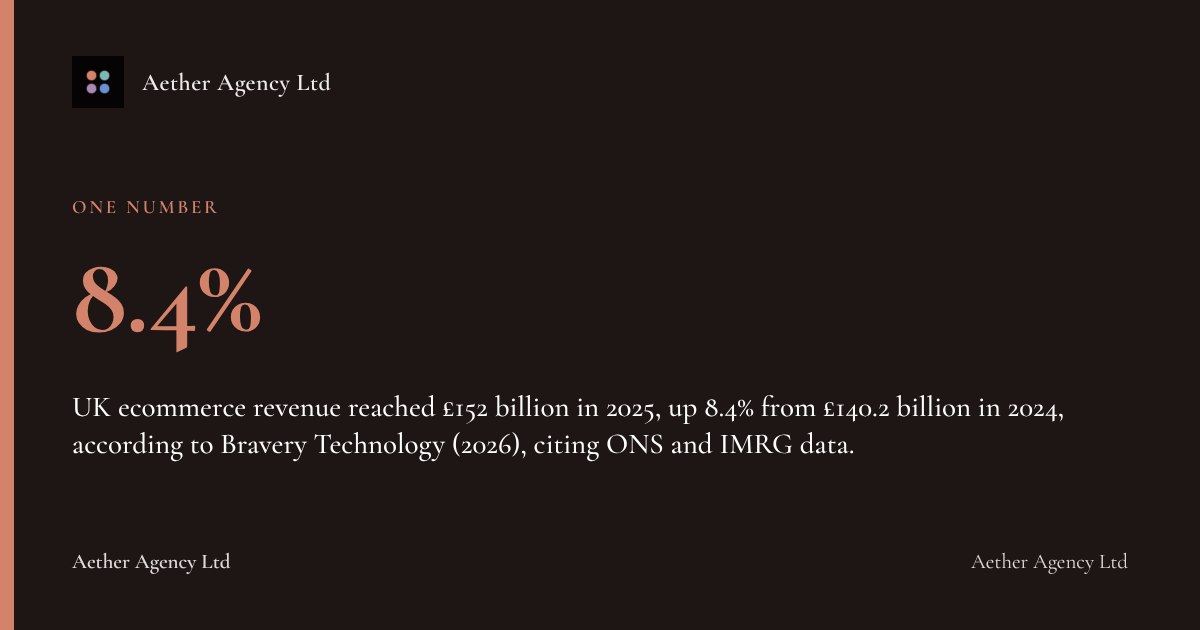
- UK ecommerce revenue reached £152 billion in 2025, up 8.4% from £140.2 billion in 2024, according to Bravery Technology (2026), citing ONS and IMRG data.
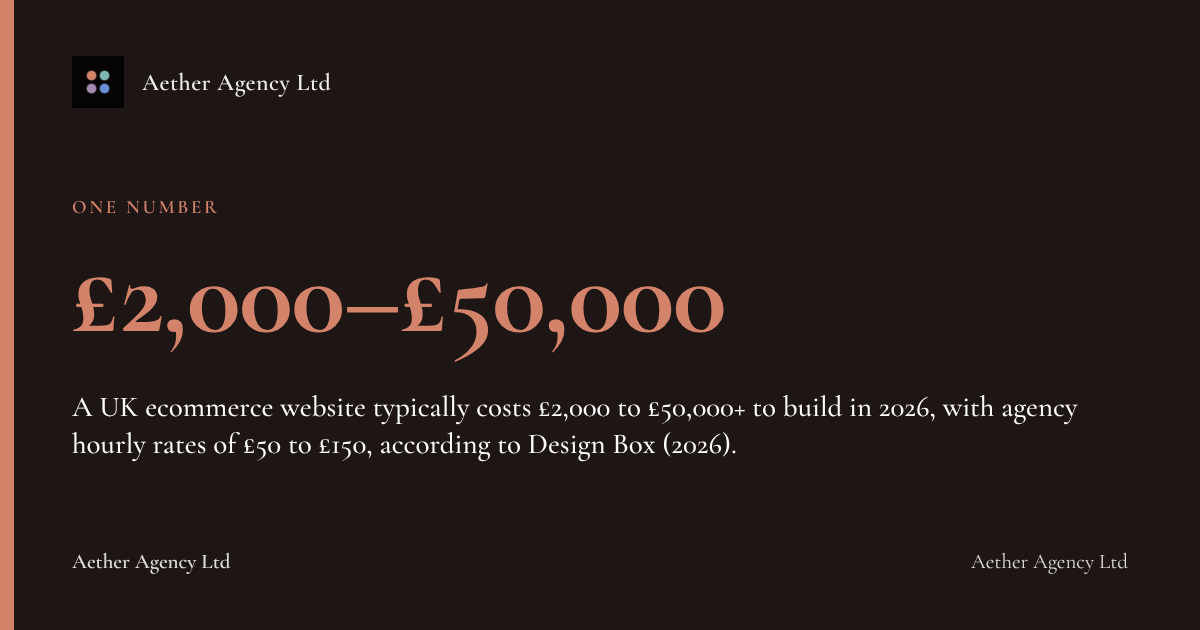
- A UK ecommerce website typically costs £2,000 to £50,000+ to build in 2026, with agency hourly rates of £50 to £150, according to Design Box (2026).
- 94% of users judge a website on design alone and form that opinion in just 0.05 seconds, according to DigitalSilk (2026).
- UK distance selling rules require clear pre-contract information, a 14-day cancellation right and refunds within 14 days of return, according to LegalVision UK (2025).
- Aether Agency Ltd delivered a full brand identity and e-commerce website for Fulk Butchers, a Surrey family butcher, with online sales up 180% and a 4.8-star Google rating on record.
What Does an Ecommerce Website Design Agency Do?
An ecommerce website design agency is a specialist firm that plans, designs, builds and often maintains online stores that let businesses sell products or services directly to customers over the internet. The service typically covers five linked strands: strategy and user experience planning, visual design, platform development (building the site on a chosen system such as Shopify or WooCommerce), payment and logistics integration, and post-launch support.
A good agency doesn't just hand over a template with your logo on it. It maps the customer journey from the first search result to the order confirmation email, because 94% of users judge a website based on design and form an opinion in just 0.05 seconds, according to DigitalSilk (2026). That first impression decides whether a visitor stays or bounces straight back to Google.
Aether Agency Ltd worked with Fulk Butchers, a family butcher in Surrey, which shows what this looks like in practice. The business had a strong local reputation but no brand identity and no route to online orders. Aether Agency Ltd built a brand identity from scratch, delivered an ecommerce website with online ordering, and ran ongoing social media and marketing support, with the identity carrying through from packaging to the order confirmation email. Online sales rose 180% and the business holds a 4.8-star Google rating, both figures on record from the client case study.
"They brief the site they want to look at instead of the site their customer needs to act on. Every page should have one job: answer, reassure, or convert, and a visitor should never have to work out what you sell or what to do next. Beautiful and unclear loses to plain and obvious every single time.", Lauren Dawkins, Head of Content, Aether Agency
How Much Does It Cost to Hire an Ecommerce Website Design Agency in the UK?
A UK ecommerce website typically costs between £2,000 and £50,000 or more to build in 2026, depending on the size of the catalogue, chosen platform and functional complexity, with agencies charging hourly rates of £50 to £150, according to Design Box (2026). The wide spread reflects a genuinely different scope at each end, not inconsistent pricing.
A small shop on a templated platform with fewer than 50 products sits at the lower end. A bespoke multi-currency store with custom integrations, subscription billing or ERP connections sits at the top. Here's a rough illustrative breakdown by tier:
| Tier | Typical scope | Illustrative price range |
|---|---|---|
| Starter | Templated platform, under 50 products, standard checkout | Varies with the site; ask for a quote |
| Growth | Custom theme, 50 to 1,000 products, Klarna/Clearpay, delivery integrations | Varies with the site; ask for a quote |
| Bespoke/Enterprise | Fully custom build, ERP/CRM integration, multi-currency, high traffic | Varies with the site; ask for a quote |
Always ask whether a quote is VAT-inclusive, since several UK buyers report being caught out when a headline figure excludes VAT. Also ask whether the figure covers ongoing hosting, domain renewal and support, or whether those are separate recurring costs billed monthly or annually.
How Long Does It Take to Design and Launch an Ecommerce Website?
Designing and launching an ecommerce website in the UK typically takes between 6 and 16 weeks from initial brief to go-live, though bespoke enterprise builds with complex integrations can run considerably longer. A templated Shopify build with a modest product catalogue can realistically launch inside six to eight weeks, while a fully bespoke Magento or custom-coded platform with ERP integration commonly takes three to six months.
Timeline usually breaks into four phases: discovery and strategy (one to two weeks), design (two to four weeks), development and integration (three to six weeks), and testing and launch (one to two weeks). Delays most often come from the client side: slow sign-off on content, missing product photography, or late decisions on payment providers. An agency that gives you a realistic week-by-week plan at the outset, rather than a vague "8 to 12 weeks", is usually the one that keeps to it.
What Should I Look for When Choosing an Ecommerce Website Design Agency in the UK?
An ecommerce website design agency worth hiring in the UK should demonstrate platform expertise, a transparent pricing structure, a visible portfolio of live ecommerce sites, and clear post-launch support terms before you sign anything. Beyond the sales pitch, four things separate a credible agency from a risky one.
Speed and performance focus. Since an ecommerce site's conversion rate averages 3.05% at a 1-second load time, compared with 0.67% at 4 seconds, according to a Portent analytics study via Tested Media (2023), and 53% of mobile site visitors will leave a page that takes more than 3 seconds to load, according to DigitalSilk (2026), a serious agency will talk about Core Web Vitals and hosting infrastructure, not just visual design.
UK-specific commerce experience. Ask whether the agency has built checkouts with UK postcode lookup, Royal Mail, DPD or Evri delivery options, and buy-now-pay-later providers like Klarna or Clearpay. These are standard expectations for UK shoppers, not nice-to-haves.
Real portfolio and named case studies. Look for agencies that publish named client results, not just logos. Aether Agency Ltd, for example, has delivered 50+ projects, as published on its site, drawing on over 20 years of combined team experience, as published on aether-agency.co.uk.
Clear ownership terms. Confirm in writing that you will own the finished code, design files, domain and admin access once the project completes and is paid for.
Which Ecommerce Platforms Do UK Agencies Typically Recommend?
UK ecommerce agencies typically recommend Shopify, WooCommerce or Magento (now Adobe Commerce), choosing the platform based on catalogue size, budget and the business's technical in-house capability rather than personal preference. Each suits a different stage of growth.
| Platform | Best suited to | Typical cost profile |
|---|---|---|
| Shopify | Small to mid-size retailers wanting fast launch and low maintenance | Lower upfront, ongoing subscription plus app fees |
| WooCommerce | Businesses already on WordPress wanting content and commerce combined | Lower platform cost, more developer time needed |
| Magento/Adobe Commerce | Larger catalogues, B2B, complex integrations, multi-store setups | Higher build cost, more suited to enterprise budgets |
A credible agency will explain the trade-offs honestly rather than defaulting to whichever platform they know best. If an agency recommends Magento for a 20-product start-up, or Shopify's basic tier for a 10,000-SKU wholesale operation, that's a sign the recommendation isn't matched to your actual business.
How Do UK Ecommerce Agencies Compare to Freelancers or DIY Builders?
An ecommerce website design agency in the UK differs from a freelancer or DIY website builder primarily in accountability, breadth of skillset and ongoing capacity. A DIY platform like a basic Shopify theme is the cheapest route and can work for a very small, simple shop, but it leaves strategy, SEO and conversion optimisation entirely in your hands.
A freelancer sits in the middle: often cheaper than an agency and capable of solid technical work, but typically a single person covering design, development and project management simultaneously, which creates risk if they're unavailable or move on. An agency brings a team: designers, developers, content specialists and often a marketing function under one roof, so the brand identity, the build and the ongoing growth strategy stay consistent.
| Route | Typical cost | Best for | Main risk |
|---|---|---|---|
| DIY builder | Low (monthly subscription) | Very small, simple stores | No strategy, limited scalability |
| Freelancer | Low to mid | Straightforward builds on fixed budget | Single point of failure, capacity limits |
| Agency | Mid to high | Growing businesses needing brand, build and ongoing growth | Higher upfront cost |
This is precisely the gap Aether Agency Ltd positions itself to fill: brand, build and grow delivered by one team, rather than three separate suppliers who don't talk to each other.
What Legal Requirements Must a UK Ecommerce Website Comply With?
A UK ecommerce website must comply with UK distance selling rules, UK GDPR, and accessibility good practice, each enforced through different legislation and regulators. UK distance selling rules require clear pre-contract information, a 14-day cancellation right and refunds within 14 days of return, according to LegalVision UK (2025), derived from the Consumer Contracts (Information, Cancellation and Additional Charges) Regulations 2013.
Three areas matter most for a working site:
- Pre-contract information. Your product pages, checkout and terms must clearly state the total price including delivery, the right to cancel, and how returns work, before the customer pays.
- Data protection. Aether Agency Ltd notes that the UK GDPR and the Data Protection Act 2018 require a published privacy policy, a lawful basis for processing customer data, and cookie consent for non-essential tracking, overseen by the Information Commissioner's Office (ICO).
- Consumer rights. The Consumer Rights Act 2015 sets quality standards for goods sold, separate from the cancellation rules above, and the Electronic Commerce Regulations 2002 require clear business identification details on the site.
An agency building your checkout, returns page and privacy policy should understand how these interact, because a beautifully designed cancellation page that breaches the 14-day refund rule is a liability, not an asset.
Your Ecommerce Website Design Agency Checklist
- Confirm the quote states whether it's VAT-inclusive and what's billed as a recurring cost after launch.
- Ask which platform (Shopify, WooCommerce, Magento) the agency recommends for your catalogue size and why.
- Request to see at least two live ecommerce sites the agency has built, not just screenshots.
- Check the contract specifies you own the code, design files, domain and admin access on completion.
- Ask how the agency handles UK-specific checkout needs: postcode lookup, Royal Mail/DPD/Evri options, Klarna or Clearpay.
- Confirm the site will include a compliant privacy policy, cookie consent and 14-day cancellation information.
- Ask what post-launch support is included and for how long, and what it costs after that period ends.
- Get a realistic week-by-week project timeline in writing before you sign.
FAQ
What's typically included in an ecommerce website design agency's service?
An ecommerce website design agency's service typically includes strategy and user experience planning, visual design, platform build and development, payment and delivery integration, and post-launch support. Some agencies, including Aether Agency Ltd, also deliver brand identity and ongoing marketing alongside the build, so the look and messaging stay consistent from logo to checkout.
How much does an ecommerce website cost in the UK?
A UK ecommerce website typically costs between £2,000 and £50,000 or more to build in 2026, with agency hourly rates of £50 to £150, according to Design Box (2026). The final figure depends on catalogue size, chosen platform and how much custom functionality you need.
How long does it take an agency to build and launch an ecommerce site?
Most UK ecommerce builds take between 6 and 16 weeks from brief to launch, depending on platform choice and complexity. A templated Shopify build can launch in around 6 to 8 weeks, while a bespoke Magento build with complex integrations commonly takes three to six months.
What should I ask an agency before signing a contract?
Ask who owns the finished code and design files, what's included in the price versus billed separately afterwards, what the realistic timeline is, and what post-launch support costs once any included period ends. Also ask to see named case studies with real client results rather than anonymous portfolio pieces.
Do I need an ecommerce agency, or can a freelancer or DIY builder do the job?
A DIY builder suits very small, simple stores on a tight budget, a freelancer suits straightforward builds where one skilled person can manage design and development, and an agency suits growing businesses that need brand, build and ongoing marketing working together. The right choice depends on your budget, complexity and how much you need the supplier to think strategically rather than just execute a brief.
What legal requirements apply to a UK ecommerce website?
A UK ecommerce website must comply with UK distance selling rules (a 14-day cancellation right and refunds within 14 days, per the Consumer Contracts Regulations 2013), UK GDPR for customer data, and the Consumer Rights Act 2015 for product quality standards. The Information Commissioner's Office (ICO) oversees data protection compliance.
How can I check an ecommerce agency's credibility before hiring them?
Check for a visible portfolio of live, working ecommerce sites, named client case studies with real figures rather than vague claims, and client testimonials you can verify. Aether Agency Ltd, for instance, publishes named case studies including Fulk Butchers (online sales up 180%, no earlier figure on record), and has delivered 50+ projects as published on its site.
Securing the Right Ecommerce Build with Aether Agency Ltd
This article has covered the real cost ranges, timelines and legal requirements that shape an ecommerce build, and Aether Agency Ltd works through exactly these decisions with businesses every week as part of its website development service. Whether you need a brand built from nothing, as with Fulk Butchers, or a replatform of an existing store, the same team handles strategy, design, development and the ongoing marketing that keeps traffic growing afterwards.
Aether Agency Ltd has delivered 50+ projects, as published on aether-agency.co.uk, backed by over 20 years of combined team experience. As Natalie Simms of ActionCOACH put it: "I consider Aether to be an amazing partner for us at ActionCOACH. Firstly, they have been a great digital marketing agency for our own business. Secondly, I have no hesitation recommending Lauren and her team to my clients."
If you're weighing up platforms, budgets or timelines for your own online store, get in touch with Aether Agency Ltd to talk through your brief and get a clear, honest quote.
Related Reading
- Custom Web Design vs Template: A UK Business Guide
- UK Web Design Agency Guide 2026 | Expert Services & Trends
- Small Business Website Design UK: Costs & Choices 2026
Add aether-agency.co.uk as a preferred source on Google
See How Your Brand Appears in AI Search
Aether AI monitors your visibility across ChatGPT, Perplexity, Google AI Overviews, and Claude in real time. Find out where you stand and what to fix.
Explore Aether AI