Last updated: 3 November 2026
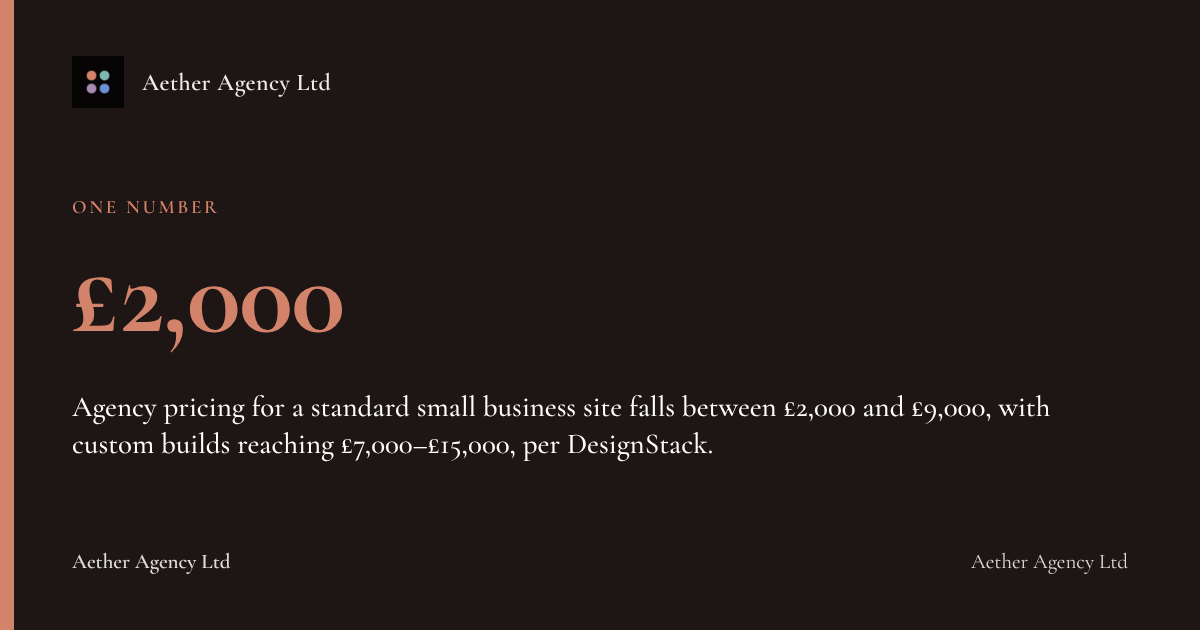
Small business website design in the UK typically costs between £2,000 and £9,000 through an agency in 2026, rising to £7,000–£15,000 for a fully custom build, according to DesignStack. Prices vary by scope, platform and whether you choose a freelancer, agency or DIY builder — the right route depends on budget, timeline and how much the site needs to do.
Key Takeaways
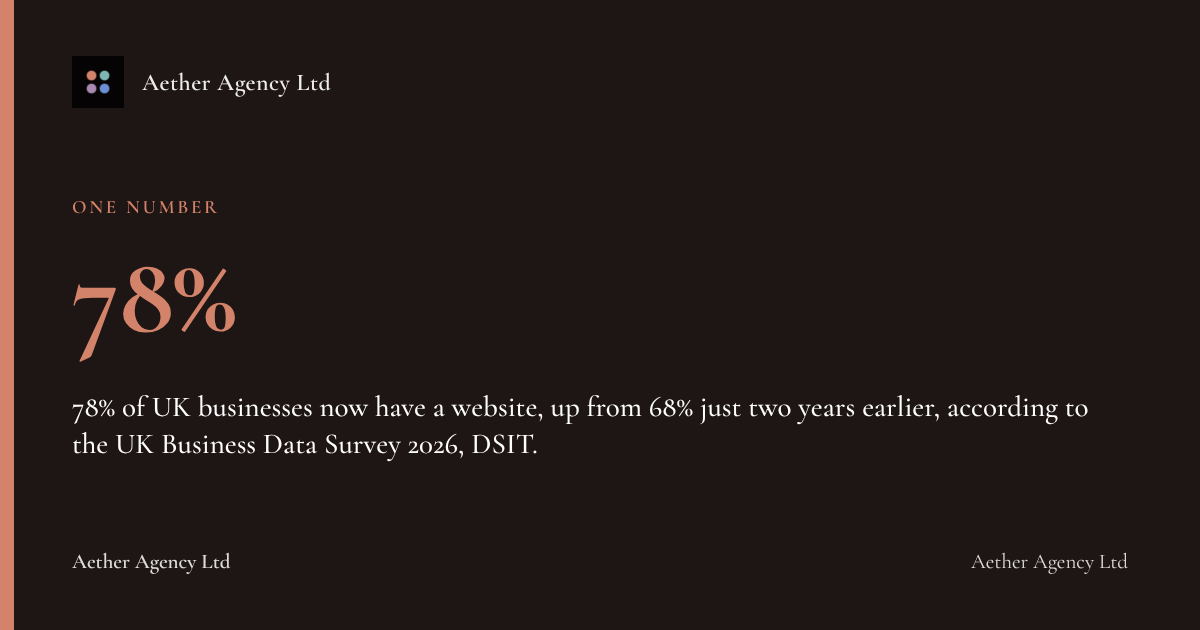
- 78% of UK businesses now have a website, up from 68% just two years earlier, according to the UK Business Data Survey 2026, DSIT.
- Agency pricing for a standard small business site falls between £2,000 and £9,000, with custom builds reaching £7,000–£15,000, per DesignStack.
- 92% of small businesses with 10-49 employees have a website, compared with 84% of micro businesses and 76% of sole traders, per UK Business Data Survey 2026 / Ace Web Studio.
- The UK web design services market is worth £675.9 million in 2026, serving part of a population of 5.7 million UK SMEs, according to IBISWorld and Department for Business and Trade figures.
- Fulk Butchers, a Surrey client of Aether Agency Ltd, saw online sales up 180% with a 4.8-star Google rating after a website and digital marketing overhaul.
How Much Does a Small Business Website Cost in the UK?
A small business website in the UK costs, on average, between £2,000 and £9,000 when built by a professional agency, with fully bespoke designs commanding £7,000 to £15,000, according to DesignStack. That range reflects the difference between a templated brochure site built on a platform like WordPress and a fully custom-coded build with bespoke functionality, integrations and brand design work baked in.
Several factors push a quote up or down within that bracket. The number of pages, whether you need e-commerce, booking systems or membership areas, how much original copywriting and photography is required, and whether branding needs building from scratch all affect the final figure.
Freelancers often undercut agency pricing significantly, sometimes delivering a simple site for under £1,000, but typically without the strategic input, project management or ongoing support an agency provides. DIY builders such as Wix or Squarespace reduce upfront cost further, usually to a monthly subscription fee rather than a one-off build cost, but the trade-off is your own time and a template-constrained design.
Illustrative cost comparison for a typical UK small business site:
| Route | Typical cost | Best suited to |
|---|---|---|
| DIY builder (Wix, Squarespace) | £10–£40/month | Sole traders, very tight budgets, simple needs |
| Freelancer | £500–£3,000 | Straightforward brochure sites, limited ongoing support |
| Small agency | £2,000–£9,000 | Growing businesses wanting strategy, brand and SEO alignment |
| Bespoke/custom build | £7,000–£15,000 | Businesses needing custom features, complex integrations |
Costs are illustrative ranges based on typical UK market pricing; agency figures per DesignStack.
What Are the Ongoing Costs After Launch?
Ongoing website costs after launch cover hosting, domain renewal, security updates and content maintenance, and they continue for as long as the site remains live. A .co.uk domain typically renews annually for somewhere between £10 and £20, while hosting for a small business site generally runs from around £5 a month for basic shared hosting up to £50+ a month for managed hosting with better speed and security.
Beyond infrastructure, most sites need periodic maintenance: plugin and software updates, security monitoring, backups, and occasional content refreshes. Many UK agencies offer a monthly retainer, typically in the low hundreds of pounds, that bundles hosting, maintenance and small content changes into one predictable cost.
It's worth budgeting for this before you sign off a build, not after. A website that launches well but gets no attention for two years tends to slip in Google's rankings, break on newer browsers, or fall foul of updated accessibility expectations — all of which cost more to fix retroactively than to maintain continuously.
Should You Hire a UK Agency, a Freelancer, or Use a DIY Builder?
The choice between a UK web design agency, a freelancer, or a DIY builder like Wix or Squarespace depends on budget, complexity and how much ongoing support the business needs. Each route suits a different stage of business growth, and getting the match wrong is one of the most expensive mistakes a small business can make.
A DIY builder suits a sole trader needing a simple, low-cost online presence fast, with no need for custom functionality or brand strategy. A freelancer suits a business with a modest budget and a fairly simple brief, though availability and continuity can be inconsistent if that freelancer takes on other clients or projects.
A full-service agency suits a business that wants its website tied to a wider brand and marketing strategy — not just a site, but a growth asset. Aether Agency Ltd, incorporated on 3 June 2020 (Companies House 12641621), positions its own work this way: brand, build, grow, treating the website as one part of a connected identity and marketing system rather than a standalone deliverable.
In practice: when Renton Dance Studio needed to reach a younger audience, Aether Agency Ltd didn't just rebuild the website — it delivered a complete rebrand alongside the redesign and new social content, moving the studio's entire digital presence from traditional to modernised. As the studio's owner, Olivia, put it: "I recently had the pleasure of working with Lauren and Ellie at Aether Agency to enhance the branding for my dance studio. Even though I struggled to articulate exactly what I wanted, they somehow captured the exact style I had envisioned." That's the kind of outcome a template alone rarely delivers.
Comparing the trade-off directly
| Factor | DIY builder | Freelancer | Agency |
|---|---|---|---|
| Upfront cost | Lowest | Low–medium | Medium–high |
| Strategic input | None | Variable | Built in |
| Ongoing support | Self-managed | Ad hoc | Structured |
| Brand cohesion | Limited | Depends on brief | Core offering |
| Best for | Simple, low-budget sites | Straightforward briefs | Growth-focused businesses |
What Legal Requirements Must a UK Business Website Meet?
A UK business website must comply with GDPR (the UK General Data Protection Regulation, which governs how personal data is collected and used), cookie consent rules under the Privacy and Electronic Communications Regulations, and accessibility expectations under the Equality Act 2010. These aren't optional extras — they shape how the site must be built from day one.
Any site that collects personal data — even just a contact form — needs a clear privacy policy explaining what's collected and why, consistent with ICO guidance on GDPR. Cookie banners must give users a genuine choice to accept or reject non-essential cookies before tracking begins, not a banner that only offers "accept."
Accessibility matters for every business, not just the public sector. While the Public Sector Bodies (Websites and Mobile Applications) (No.2) Accessibility Regulations 2018 formally apply to public bodies, the Equality Act 2010 means private businesses can also be challenged if disabled customers can't reasonably use their site — and GOV.UK's accessibility guidance sets the practical standard most designers now build to, commonly referenced as WCAG 2.2 AA. Good practice includes readable colour contrast, keyboard navigation and properly labelled images for screen readers.
If you sell products, you'll also need to display VAT registration details where applicable, clear pricing, and terms consistent with UK consumer protection law.
What Essential Pages and Features Should a Small Business Website Include?
Every small business website needs a core set of pages that cover what a visitor and Google both expect to find. Missing even one of these — particularly contact details or a clear service description — tends to hurt both conversions and search visibility.
Essential pages:
- Homepage — a clear statement of what the business does and who it's for
- About page — credibility signals: history, team, qualifications
- Services or products page — detailed enough for Google to understand and rank
- Contact page — address, phone number, email, and a working contact form
- Privacy policy and cookie policy — required for GDPR compliance
- Terms and conditions — especially important for e-commerce
- Testimonials or case studies — social proof that builds trust quickly
Beyond pages, a handful of features consistently separate a site that performs from one that just exists: fast loading speed, mobile responsiveness, an SSL certificate (the padlock that signals a secure connection), clear calls to action, and integration with Google Business Profile for local search visibility.
"Fighting for clicks that are not coming back is wasted energy; the visibility now happens inside the answer itself. The response is to make your pages the source the answer quotes — clear definitions, attributable facts, a named organisation behind them — and to measure mentions and citations alongside visits. The brand named in the answer is winning even on searches that never send traffic." — Lauren Dawkins, Head of Content, Aether Agency
That shift matters for small business sites too: a well-structured services page with clear facts isn't just for human visitors — it's increasingly what Google's AI Overviews and tools like ChatGPT pull from directly.
How Do You Make Sure a Website Is Optimised for Mobile and Search?
A website is optimised for mobile and search when it loads quickly on a phone, displays correctly across screen sizes, and follows basic on-page SEO practice — title tags, header structure and genuine, relevant content. Google has used mobile-first indexing for years, meaning it primarily evaluates the mobile version of a site when deciding rankings.
Practical mobile checks include tap targets large enough for a thumb, text that doesn't require zooming, and images compressed so pages load in a few seconds rather than ten. Google's own tools, including PageSpeed Insights, flag these issues directly and are worth running before launch, not after a client complains.
On the SEO side, the fundamentals are unglamorous but effective: unique page titles, one clear H1 per page, descriptive URLs, and content written for the actual questions local customers search for — not keyword-stuffed copy. This is where Aether Agency Ltd's AI Search Marketing work comes in, extending traditional SEO into generative engine optimisation so a business shows up both in classic Google results and inside AI-generated answers.
Grounding keyword decisions in real search behaviour rather than guesswork also matters here, as Aether Agency Ltd's Head of Content, Lauren Dawkins, puts it: "Start from the searches you are already being shown for, not from a tool's volume estimates. Search Console is measured demand — real people, real queries, no guesswork. Volume tools tell you what the whole market types; your own impression data tells you which of those battles you are actually invited to fight. The second list is shorter and far more honest."
The results of getting this right can be substantial: Just Simple Homes, a client of Aether Agency, saw a notable uplift in website traffic following its site work, and Priority First recorded a meaningful rise in search clicks over matched 28-day windows via Google Search Console, with 13 commercial enquiries traced in the first month. (Priority First is an Aether Agency client and a sister company: the two businesses have the same majority owner, so this is not an independent result.)
Your small business website design checklist
- Set a realistic budget using the £2,000–£15,000 UK agency range as a benchmark, depending on complexity
- Decide between DIY builder, freelancer or agency based on how strategic the site needs to be
- Confirm who owns hosting, domain renewal and ongoing maintenance before signing anything
- Check the contract specifies deliverables, revision rounds, timelines and who owns the final files
- Build in GDPR-compliant privacy policy, cookie consent and accessible design from the outset
- Include every essential page: homepage, about, services, contact, privacy policy, terms
- Test mobile responsiveness and page speed before launch, not after
- Agree who is responsible for updates, backups and security patches post-launch
FAQ
How much does a small business website typically cost in the UK?
A standard small business website built by a UK agency typically costs between £2,000 and £9,000, while a fully custom design runs £7,000 to £15,000, according to DesignStack. Freelancers and DIY builders can bring the upfront cost down significantly, but usually with less strategic input or ongoing support.
What are the ongoing costs after a website launches?
Ongoing costs typically include domain renewal (around £10–£20 a year for a .co.uk), hosting (roughly £5–£50 a month depending on service level), and maintenance, often bundled into a monthly retainer. Skipping maintenance tends to cost more later, through broken functionality, security vulnerabilities, or declining search rankings.
Should I hire a web design agency, a freelancer, or use a DIY builder?
It depends on how strategic and complex the site needs to be: DIY builders suit simple, low-budget needs, freelancers suit straightforward briefs, and agencies suit businesses wanting the website tied to wider brand and marketing strategy. Aether Agency Ltd, for example, frames its approach around brand, build, grow — treating the site as part of a connected system rather than a one-off deliverable.
How long does it take to design and launch a small business website?
Timelines vary with scope, but a straightforward brochure site typically takes four to eight weeks from brief to launch, while a fully custom build with bespoke functionality can take several months. Delays most often come from slow content delivery or feedback rounds on the client side, not the build itself.
What legal requirements must a UK business website meet?
A UK business website must comply with GDPR for any personal data collected, cookie consent rules, and reasonable accessibility standards under the Equality Act 2010. GOV.UK's accessibility guidance and ICO guidance on data protection are the two starting points for most small businesses.
Do I need a UK-based web designer, or can I use an overseas provider?
A UK-based designer typically brings better familiarity with UK-specific legal requirements, payment gateways, VAT display rules and local SEO considerations, though overseas providers can offer cost savings. For a small business whose website needs to reflect local trust signals and compliance correctly, that local knowledge often outweighs the price difference.
Who is responsible for maintaining the website after launch?
Responsibility for maintenance should be agreed explicitly before the build starts, whether that's the business itself, the original designer, or a separate maintenance retainer. Leaving this undefined is one of the most common reasons small business websites fall out of date within a year or two.
Why a Website Still Matters for UK Small Businesses in 2026
Despite strong website adoption, plenty of UK small businesses still operate without one. Around 27% of those without a site say it isn't relevant to their industry, 26% cite cost, and 21% rely on social media instead, according to WebLane.
That gap is shrinking, though. 78% of UK businesses now have a website, according to the UK Business Data Survey 2026, DSIT, and separately, Forbes Advisor found that 83.5% of small business owners who have a site say it plays a big part in their business. With 5.7 million SMEs making up 99.9% of the UK business population, per Department for Business and Trade figures, the businesses still relying solely on social media are increasingly the exception rather than the norm.
Building Your Website with Aether Agency Ltd
Aether Agency Ltd works with UK small businesses that need a website tied to a genuine brand and growth strategy, not a template thrown up to tick a box — exactly the gap this article has covered, from budget-setting through legal compliance to post-launch SEO. Whether a business needs a full rebrand alongside its site, as with Renton Dance Studio, or a focused website and digital marketing push, as with Hi-Speed's app redesign and social strategy, Aether Agency Ltd's approach starts with strategy and ends with a site built to perform.
Aether Agency Ltd has delivered 50+ projects with a team carrying 20+ years of combined experience, and clients working with the agency see average traffic growth of 3x. Results like Fulk Butchers' 180% rise in online sales and 4.8-star Google rating, or Natural Instinct's growth to 27,000+ Instagram followers and 500+ stockists, reflect what happens when a website launch is treated as the start of a growth strategy rather than the finish line.
If your business needs a website that's built properly — fast, findable, and ready to convert — get in touch with Aether Agency Ltd via its Website Development service to discuss your project and get a quote.
Related Reading
- Bespoke Web Design Agency UK: What to Pay in 2026
- Web Design Guildford: What It Costs & Who to Hire
- Website Design and SEO UK: Complete Guide for 2026
Add aether-agency.co.uk as a preferred source on Google
See How Your Brand Appears in AI Search
Aether AI monitors your visibility across ChatGPT, Perplexity, Google AI Overviews, and Claude in real time. Find out where you stand and what to fix.
Explore Aether AI