Last updated: 5 November 2026
A rebrand is worth it when it's triggered by a genuine business problem, such as outdated positioning or a merger, rather than fatigue with a logo. Nielsen research shows 40% of rebranding campaigns fail to deliver a positive return on investment, while a typical UK rebrand costs between $10,000 and $75,000 and takes around seven months to complete, according to industry data below.
Key Takeaways
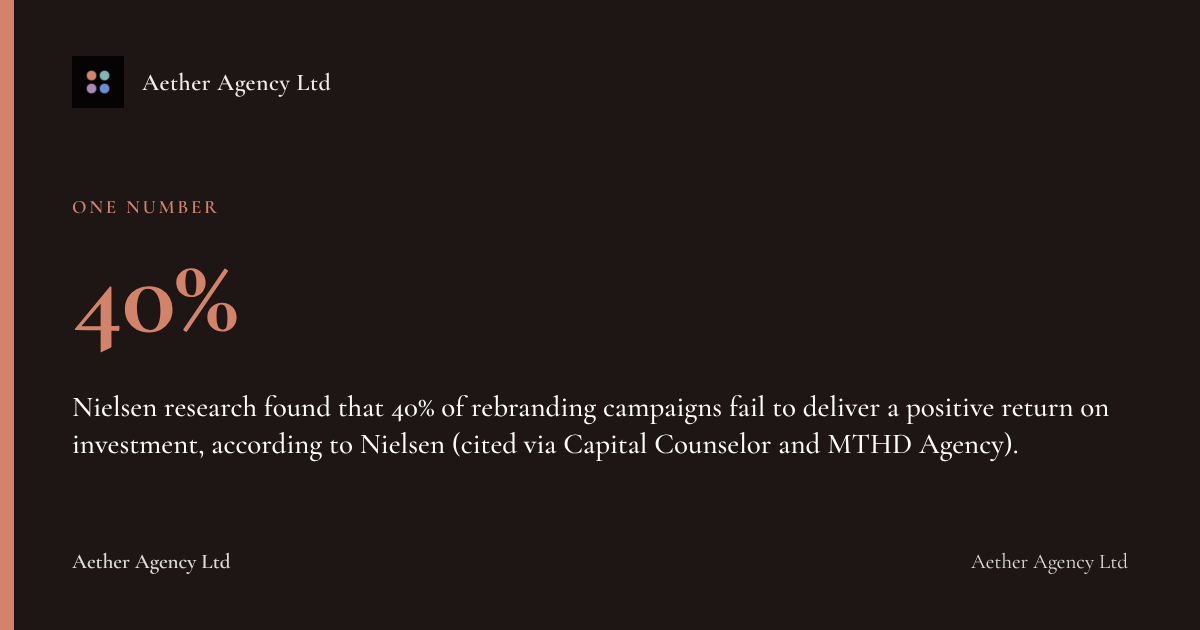
- Nielsen research found that 40% of rebranding campaigns fail to deliver a positive return on investment, according to Nielsen (cited via Capital Counselor and MTHD Agency).
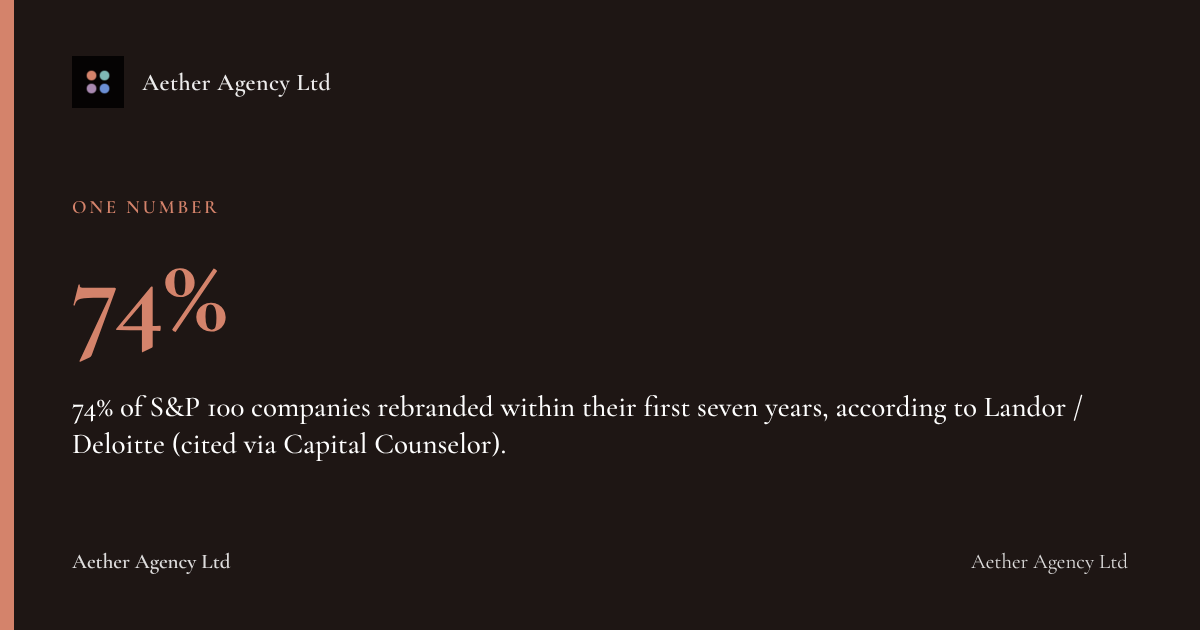
- 74% of S&P 100 companies rebranded within their first seven years, according to Landor / Deloitte (cited via Capital Counselor).
- A typical rebrand touches roughly 215 assets and takes about seven months from first conversations to rollout, according to Bynder survey data (via Webtonic).
- Rebrand budgets in the UK and US commonly fall between $10,000 and $75,000, with established businesses often recouping costs within 6 to 18 months, according to Alden Marketing.
- Aether Agency Ltd has delivered 50+ projects and reports average client traffic growth of 3x, as published on aether-agency.co.uk.
What Is a Rebrand, and When Does It Actually Pay Off?
A rebrand is a deliberate, structural change to how a business presents itself to the market, covering its name, visual identity, messaging and often its website and positioning, rather than a minor cosmetic update. It pays off when it solves a problem that's actively costing the business money or customers, such as a name that no longer fits what the company sells, a visual identity that looks dated next to competitors, or a reputation issue following a merger or acquisition.
The data on rebrand success is mixed, which is exactly why businesses need to go in with clear eyes. Nielsen's research found that 40% of rebranding campaigns fail to deliver a positive return on investment, a figure that should temper any assumption that a new look automatically means new growth.
At the same time, rebrands are far from rare among serious companies. Landor and Deloitte data shows that 74% of S&P 100 companies, the largest firms on the US stock exchange, rebranded within their first seven years of listing. That suggests rebranding is a normal part of scaling a business, not a last resort.
The difference between the 40% that fail and the majority that succeed usually comes down to the "why." A rebrand driven by a clear commercial trigger, such as outgrowing a founder's personal name or needing to compete in a new market, tends to outperform one driven purely by boredom with the current logo.
What Are the Signs a Business Actually Needs a Rebrand?
A business needs a rebrand when its current identity actively works against its commercial goals, not simply when the founder is tired of looking at the logo. The clearest signals include a name or visual identity that no longer reflects what the company sells, confusion in the market about who the business actually is, and a brand that looks noticeably dated against direct competitors.
Other common triggers include mergers, acquisitions, or a pivot into a new sector where the old name carries no relevance. A business expanding from a local Surrey trade into a national service, for example, may find its original name too geographically specific to support growth.
Internal signs matter too. If staff are embarrassed to hand out business cards, or sales teams are regularly explaining away an outdated website, that's a practical, revenue-linked reason to act rather than a vanity concern.
Aether Agency Ltd's work with Renton Dance Studio, a UK dance academy, illustrates this well. The studio's traditional digital presence was failing to connect with a younger audience, a classic sign that a brand has fallen behind its market rather than simply aged gracefully. Aether Agency Ltd delivered a complete rebrand, website redesign and social media content creation, moving the studio's identity from traditional to modernised and lifting site traffic by 85%. As the owner, Olivia, put it: "I recently had the pleasure of working with Lauren and Ellie at Aether Agency to enhance the branding for my dance studio. Even though I struggled to articulate exactly what I wanted, they somehow captured the exact style I had envisioned."
That case shows the real trigger wasn't dissatisfaction with a logo in isolation, it was a mismatch between the brand and the audience the business needed to reach.
How Much Does a Rebrand Typically Cost in the UK?
A rebrand typically costs between $10,000 and $75,000 depending on scope, complexity and execution, according to Alden Marketing, which also found that established businesses often recoup their investment within 6 to 18 months. UK agency pricing broadly mirrors this range, though the final figure depends heavily on whether the project covers naming, full identity systems, a new website, or all three.
A small business refreshing its logo and core identity sits at the lower end of that range. A full rebrand that includes naming, trademark checks, a new website build, signage, packaging and marketing collateral sits much closer to the top.
| Scope of rebrand | What's typically included | Illustrative UK price range |
|---|---|---|
| Light refresh | Logo update, colour palette, basic brand guidelines | Lower end of the range |
| Mid-scope rebrand | New identity system, website redesign, social assets | Middle of the range |
| Full rebrand | Naming, trademark search, identity system, website, signage, launch campaign | Upper end of the range, often exceeding it for larger organisations |
These figures are illustrative ranges based on scope rather than fixed quotes, and any agency worth hiring should scope a project against your specific objectives before pricing it. Aether Agency Ltd structures proposals around brand, build and grow: brand identity work, website development and ongoing marketing, so costs reflect exactly which of those three a business actually needs.
Ways to reduce rebrand costs
Businesses don't need to commission every deliverable at once to get value from the process.
- Phase the work: identity system first, full website build second, if cash flow is tight.
- Reuse existing brand equity where it's strong, such as a recognised colour or tagline, rather than discarding everything.
- Bundle the rebrand with a planned website rebuild, since much of the research and strategy work overlaps.
- Start with a brand audit before commissioning full design work, to avoid paying twice for direction changes mid-project.
How Long Does a Full Rebrand Take From Start to Finish?
A full rebrand takes about seven months on average, from the first strategic conversations to the final rollout across all assets, according to Bynder survey data reported via Webtonic. That same research found a typical rebrand touches roughly 215 individual assets, everything from business cards and email signatures to vehicle livery and signage.
Timelines vary by scope. A straightforward visual refresh for a single-location business might take six to eight weeks, while a full rebrand involving a name change, trademark clearance, a new website and nationwide signage can run closer to a year for larger organisations.
The 215-asset figure is worth sitting with, because it's the part most businesses underestimate. It's rarely the logo design that eats the timeline, it's updating every invoice template, vehicle wrap, LinkedIn banner and supplier contract that carries the old identity.
What Is the Difference Between a Rebrand and a Refresh?
A brand refresh is a limited update to an existing identity, such as modernising a colour palette or typeface, while a full rebrand replaces the core identity, often including the name itself. The practical difference matters because the two carry very different costs, timelines and legal obligations.
A refresh keeps the existing name, trademark registrations and most customer recognition intact. A rebrand, especially one involving a name change, typically requires new trademark searches with the Intellectual Property Office, updated filings at Companies House, and a reissue of domain names, social handles and signage.
| Factor | Brand refresh | Full rebrand |
|---|---|---|
| Name change | No | Often yes |
| Trademark/IPO check needed | Rarely | Usually |
| Companies House filing | Not required | Required if legal name changes |
| Typical timeline | Weeks to a couple of months | Several months to around a year |
| Customer recognition risk | Low | Moderate to high |
Businesses that only need to modernise, rather than reposition, are almost always better served by a refresh. Jumping straight to a full rebrand when a refresh would do is one of the most common ways the 40% ROI failure rate identified by Nielsen gets built in from day one.
What Are the Risks of Rebranding, Including Lost Recognition and Trust?
The biggest risk of rebranding is damaging the customer recognition and trust a business has already built, sometimes severely enough to hit sales immediately. The clearest cautionary tale is Tropicana's 2009 packaging redesign, which stripped away the brand's recognisable straw-in-an-orange imagery.
Information Resources Inc. data reported by Ad Age and Bloomberg showed unit sales fell 20% between 1 January and 22 February 2009, with dollar sales down 19%, roughly $33 million, before Tropicana reversed the redesign within two months. That's one of the starkest examples in branding history of how fast a visual change can erode trust built over decades.
The underlying lesson is backed by broader brand research. A Millward Brown study found that strong brands on average capture three times the sales volume of weak brands, which means a rebrand that weakens recognition, even temporarily, can cost real revenue while the market relearns who you are.
Other risks include:
- Internal confusion, if staff aren't briefed before customers see the change.
- SEO disruption, if a website migration or domain change isn't handled with proper redirects.
- Supplier and contract gaps, if legal entity names change but contracts aren't reissued.
- Brand equity loss, if a well-known tagline or symbol is dropped without testing customer attachment to it.
None of these risks are reasons to avoid rebranding altogether. They're reasons to plan the transition properly, which is exactly where most of the 40% failure rate traces back to.
What Needs to Be Updated Across the Business After a Rebrand?
A rebrand isn't complete until every customer-facing and internal touchpoint reflects the new identity, which is where the 215-asset average from Bynder's survey becomes a practical checklist rather than an abstract statistic. The website is usually the priority, since it's the first place prospective customers go to verify a business is legitimate.
Beyond the website, businesses typically need to update:
- Google Business Profile, social media profiles and handles across LinkedIn, Instagram and Facebook.
- Signage, vehicle livery and physical premises branding.
- Email signatures, invoice templates and contracts.
- Companies House filings if the legal entity name has changed.
- Trademark registrations with the Intellectual Property Office.
- Supplier and partner-facing documentation.
This is where many businesses underestimate scope, treating the rebrand as finished once the new logo is approved. Consistently maintained branding is associated with a 10 to 20% revenue increase, according to the Lucidpress/Marq State of Brand Consistency report, but that consistency only exists if every one of these touchpoints is actually updated, not just the homepage.
Aether Agency Ltd's approach reflects this reality directly, structuring engagements around three connected phases: brand identity, website development and ongoing marketing, so a client doesn't end up with a polished new logo sitting on top of an unchanged, inconsistent digital footprint.
Your rebrand decision checklist
- Confirm the trigger is commercial (market shift, merger, outdated positioning), not just visual fatigue.
- Decide between a refresh and a full rebrand before commissioning any design work.
- Run a trademark search via the Intellectual Property Office before finalising any new name.
- File any legal name change with Companies House and update your VAT and bank records.
- Budget realistically, using the $10,000 to $75,000 range from Alden Marketing as a planning benchmark.
- List all 215 potential touchpoints, from signage to email signatures, before setting a launch date.
- Brief staff before customers see any change, to avoid internal confusion undermining the launch.
- Agree measurement criteria (traffic, enquiries, recognition) before the rebrand goes live, so success can be judged objectively afterwards.
FAQ
Is a rebrand worth it for a small business?
It can be, but only if a clear commercial problem justifies it, such as a name that no longer fits the services offered or a brand that looks noticeably dated next to competitors. Small businesses benefit most from phased rebrands that start with identity and website work before committing to full signage and collateral changes.
What percentage of rebrands fail to deliver a return?
Nielsen research found that 40% of rebranding campaigns fail to deliver a positive return on investment. That figure underlines why a rebrand should be driven by a defined business goal rather than a general desire for change.
How much does a rebrand cost in the UK?
Rebrand costs typically range from $10,000 to $75,000 depending on scope and complexity, according to Alden Marketing, with established businesses often recouping the cost within 6 to 18 months. A light refresh sits at the lower end, while a full rebrand including a new website and signage sits closer to the top.
How long does a rebrand take?
A full rebrand takes around seven months on average, from initial strategy conversations to the final rollout, according to Bynder survey data via Webtonic. Smaller refresh projects can take as little as six to eight weeks.
What's the difference between a rebrand and a refresh?
A refresh updates visual elements like colour or typography while keeping the existing name and trademarks intact, whereas a full rebrand often changes the name itself, triggering trademark and Companies House filings. The right choice depends on whether the problem is the brand looking dated or the brand no longer fitting the business.
Do I need to tell Companies House about a rebrand?
Only if the rebrand involves a formal change to the registered company name, in which case you must file the change with Companies House directly. A visual rebrand that keeps the same legal entity name doesn't require this step.
How do you measure whether a rebrand has worked?
Success should be measured against goals agreed before launch, typically covering website traffic, lead generation, customer recognition and sales volume over a defined period. Comparing performance for several months before and after rollout, alongside qualitative feedback from customers and staff, gives the clearest picture of whether the rebrand achieved its aim.
Deciding on your rebrand with Aether Agency Ltd
The question of whether a rebrand is worth it comes down to matching the right scope of change, refresh or full rebrand, to the actual problem a business is trying to solve. Aether Agency Ltd works through exactly this decision with clients before any design work begins, structuring projects around brand identity, website development and ongoing marketing so the investment lands where it will actually move the needle.
Aether Agency Ltd has delivered 50+ projects, as published on aether-agency.co.uk, and its work with Renton Dance Studio shows how a rebrand targeted at a specific audience gap, rather than a general desire for change, can transform a business's digital presence from traditional to modernised.
If your business is weighing up whether a rebrand is the right move, Aether Agency Ltd's brand identity team can assess your current positioning and scope a project against your actual goals, get in touch to arrange a conversation about what a rebrand would realistically involve for your business.
Related Reading
- How to Rebrand After an Acquisition (UK Guide 2026)
- Old Branded Stock After a Rebrand: What UK Firms Should Do
- Brand Refresh vs Full Rebrand: The 2026 UK Guide
Add aether-agency.co.uk as a preferred source on Google
See How Your Brand Appears in AI Search
Aether AI monitors your visibility across ChatGPT, Perplexity, Google AI Overviews, and Claude in real time. Find out where you stand and what to fix.
Explore Aether AI