Last updated: 6 November 2026
Rebranding a family business means deliberately changing its name, visual identity or market positioning, usually to reflect succession, growth or a shift away from an outdated image. In the UK, this typically involves Companies House filings, a trademark check with the Intellectual Property Office, and a staged communications plan, with full projects costing anywhere from a few thousand pounds for a small refresh to £50,000 or more for a complete identity, website and launch campaign.
Key Takeaways
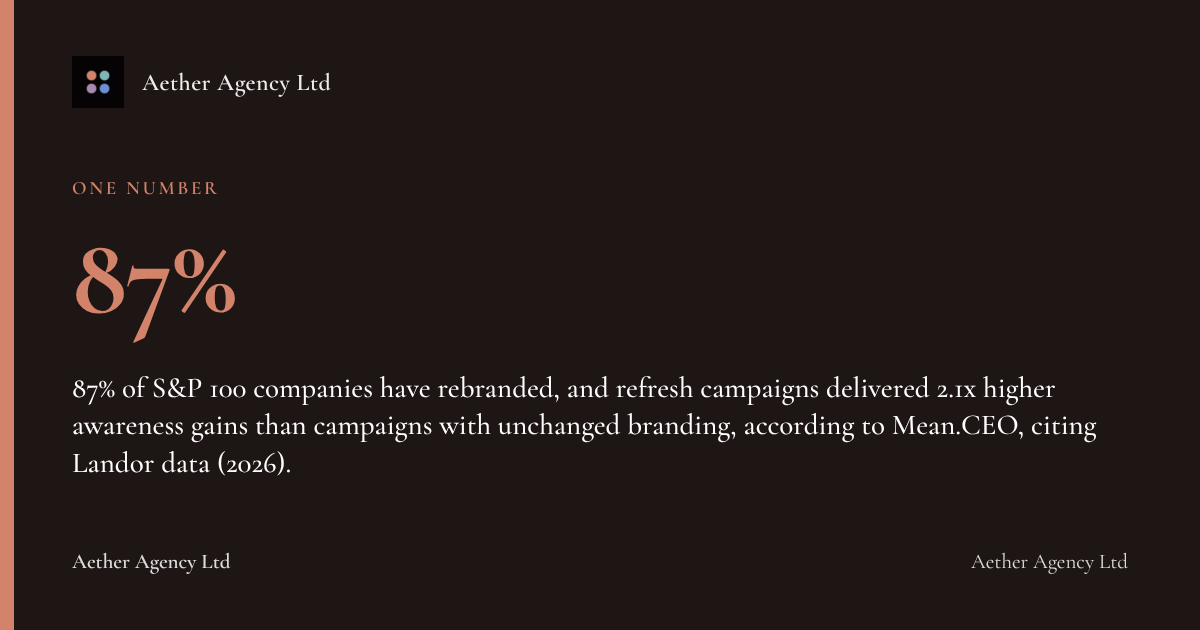
- 87% of S&P 100 companies have rebranded, and refresh campaigns delivered 2.1x higher awareness gains than campaigns with unchanged branding, according to Mean.CEO, citing Landor data (2026).
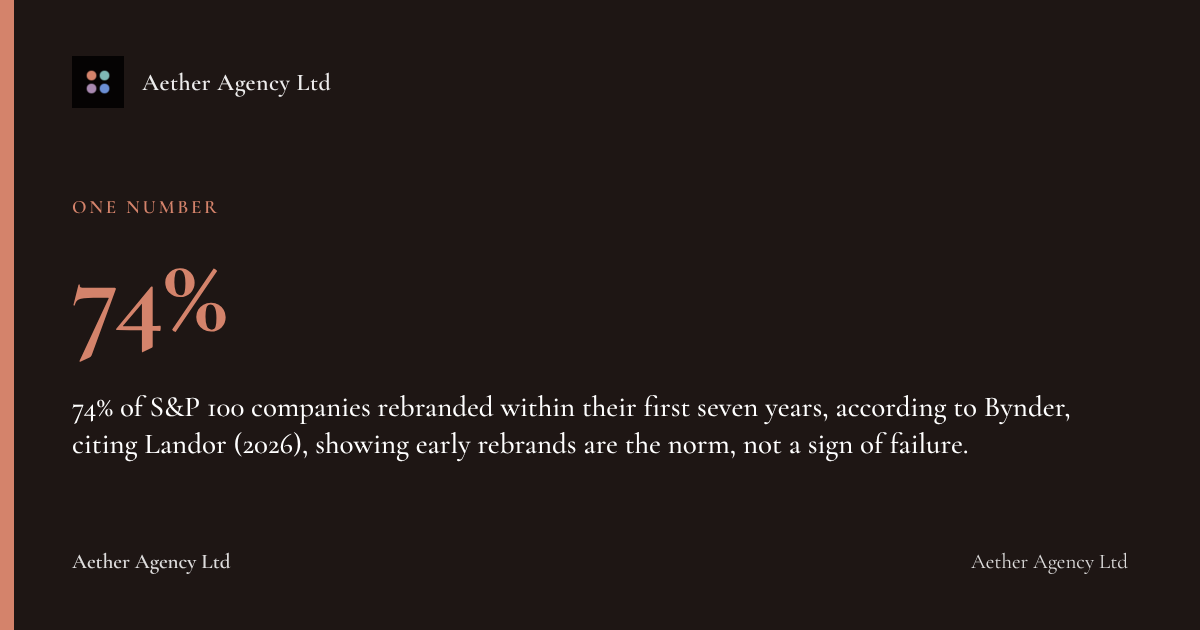
- 74% of S&P 100 companies rebranded within their first seven years, according to Bynder, citing Landor (2026), showing early rebrands are the norm, not a sign of failure.
- Only about 30% of family businesses reach the second generation and just 12% reach the third, according to the Family Business Institute, via Business Initiative (2022), which is why succession and rebranding so often happen together.
- 76% of the world's largest family-owned businesses keep "family-owned" visible in their branding, according to Grant Marketing (2017), meaning a rebrand rarely needs to erase the family story entirely.
- Aether Agency Ltd advises that changing a company name legally requires a special resolution filed with Companies House within 15 days, alongside a parallel trademark search at the UK Intellectual Property Office.
What Is Rebranding a Family Business?
Rebranding a family business is the process of changing a family-owned company's name, logo, visual identity or market positioning while managing the added complexity of family ownership, shared history and multi-generational stakeholders. Unlike a standalone corporate rebrand, it usually involves emotional decisions about whose name stays on the door, not just commercial ones about market fit.
This distinction matters because family firms carry a specific kind of brand equity. Family businesses account for 54% of US GDP and generate 59% of the country's employment, according to the Conway Center for Family Business (2024), underlining how economically significant this business model is globally, even though the UK has its own distinct family business landscape through bodies such as Family Business UK and regional business support organisations.
A rebrand for a family firm can range from a simple logo refresh ahead of a new website, through to a full name change triggered by a merger, a generational handover or a decision to shed a founder's surname that no longer reflects the business. Aether Agency Ltd works across this spectrum, delivering brand identity work that is designed to hold together across every channel, from packaging to email, rather than treating the logo as a one-off design job.
Signs a Family Business Actually Needs a Rebrand
A family business needs a rebrand when its current name, logo or positioning actively works against growth, not simply when it feels tired to the people who built it. The clearest trigger is a mismatch between what the business has become and what the brand still says, such as a "& Sons" butcher that now sells nationally online, or a regional surname-led firm expanding into markets where that name means nothing.
Watch for these concrete signals:
- The business has outgrown its original category. A name describing one product or one town no longer matches a wider offer.
- Succession is approaching and the next generation wants a mandate to lead, not just inherit. 63% of Trust Barometer respondents believe successors will mismanage the companies they inherit, according to Grant Marketing, citing the Edelman Trust Barometer (2017), so a visible, confident rebrand can be part of proving otherwise.
- The visual identity predates digital. Logos built for signage and print often fail on a mobile screen or social media avatar.
- A merger, acquisition or new investor has entered the picture and the old name no longer reflects ownership.
- Competitors with sharper branding are winning tenders or online searches the family business should be winning on reputation alone.
- There's no formal succession plan and the rebrand is being used to force the conversation. 43% of family-owned businesses operate without a formal succession plan, according to the Family Business Organization (2024), and a looming rebrand decision often surfaces that gap.
Aether Agency Ltd saw this pattern with Fulk Butchers, a family business in Surrey. The butchers had a strong local reputation but no brand identity at all and no route to online orders, a classic case of the business having outgrown its original presentation before anyone had formally decided to change it.
Key Steps in Rebranding a Family Business, From Strategy to Launch
Rebranding a family business follows a sequence that starts with strategy and research, moves through naming and identity design, and ends with a phased public launch rather than a single reveal day. Skipping the strategy phase to jump straight to a new logo is the single most common cause of rebrands that fail to land commercially.
Stage 1: Discovery and brand strategy
Start by auditing the current brand's strengths, weaknesses and what customers actually associate with the family name. This stage should map out who the next generation of leadership is, what legal structure the business sits under, and what the rebrand needs to achieve commercially, whether that's expansion, succession, or repositioning against competitors.
Stage 2: Naming, identity and trademark screening
Once the strategy is agreed, naming and visual identity work begins in parallel with a trademark search, because a beautiful new identity is worthless if it cannot legally be registered. This is also the point to brief a website development partner, since the identity system and the site need to be built together rather than handed over separately.
Stage 3: Legal, operational and systems updates
While design work finishes, the business should be filing Companies House paperwork, updating supplier contracts, and briefing its bank, insurer and HMRC in parallel, so nothing blocks launch day. This administrative stream often takes longer than the creative work and should start as soon as the name is finalised internally, even before public announcement.
Stage 4: Phased internal launch, then public launch
Brief employees and close suppliers before the public reveal, give customers advance notice through existing channels, then launch publicly across the website, signage, packaging and social media simultaneously. Aether Agency Ltd delivered exactly this kind of full-system rebrand for Renton Dance Studio, a UK dance academy whose traditional digital presence was failing to connect with a younger audience; the project combined a complete rebrand, a website redesign and new social content so the brand and the digital experience launched together rather than in stages that confuse the audience.
As studio owner Olivia put it: "I recently had the pleasure of working with Lauren and Ellie at Aether Agency to enhance the branding for my dance studio. Even though I struggled to articulate exactly what I wanted, they somehow captured the exact style I had envisioned."
How Much Does Rebranding a UK Business Typically Cost?
Rebranding a UK family business typically costs between £3,000 for a small identity refresh and £50,000 or more for a full rebrand including a new website, legal filings and a launch campaign, with the final figure depending heavily on whether a full e-commerce build is involved. There is no official UK price index for rebranding, so the ranges below are illustrative, built from typical agency project scopes rather than a cited study.
| Rebrand scope | Typical UK price range | What's usually included |
|---|---|---|
| Logo and identity refresh only | £1,500 to £5,000 | Updated logo, colour palette, basic brand guidelines |
| Mid-size rebrand | £5,000 to £20,000 | Full identity system, brand guidelines, stationery, signage artwork |
| Full rebrand with new website | £15,000 to £50,000+ | Identity, brand strategy, e-commerce or marketing website, launch support |
| Legal and admin costs (separate) | £50 to £500+ | Companies House filing, UK trademark application, contract reissuing |
Legal costs sit outside the design budget. A Companies House name change filing costs £8 online or £33 by post as a standard same-day service through Companies House, while a UK trademark application through the Intellectual Property Office costs £170 for one class of goods or services online, plus £50 for each additional class.
In practice: budgeting around the full picture
A family business weighing up cost should budget for design, legal filing, trademark registration, and reprinting physical assets such as signage, vehicle livery and packaging, since these last items are often forgotten until launch week. Fulk Butchers needed not just a logo but an entire e-commerce website built around the new identity, which is why Aether Agency Ltd scoped brand identity, website development and ongoing marketing as one connected engagement rather than three separate quotes.
How Long Does a Full Rebranding Process Usually Take?
A full family business rebrand usually takes between three and nine months from initial strategy work to public launch, with the timeline driven more by legal and operational updates than by the design work itself. A simple logo refresh with no name change can move much faster, sometimes in four to six weeks, while a full name change involving trademark clearance, Companies House filing and a new e-commerce website typically needs the longer end of that range.
A realistic phased timeline looks like this:
- Weeks 1 to 4: Discovery, stakeholder interviews and brand strategy.
- Weeks 4 to 8: Naming (if required) and trademark search at the Intellectual Property Office.
- Weeks 6 to 14: Visual identity design, brand guidelines, website build.
- Weeks 10 to 16: Legal filings with Companies House, bank and HMRC updates, contract reissuing.
- Weeks 14 to 18: Internal briefing, supplier notice, phased customer communication.
- Week 18 to 20+: Public launch across signage, website, packaging and social channels.
Trademark clearance is frequently the bottleneck, since the Intellectual Property Office typically takes around four months from application to full registration if there are no objections, even though the business can start trading under the new name sooner.
Legal Steps Required to Change a Business Name in the UK
Changing a limited company's name in the UK legally requires a special resolution passed by shareholders (or a decision made under the company's articles of association), then filing that change with Companies House within 15 days of the resolution. The name change is formalised when Companies House issues a certificate of incorporation on change of name, and the new name becomes legally effective on the date shown on that certificate, not before.
The core legal checklist:
- Pass a special resolution (75% shareholder approval) or use the alternative method set out in the company's articles, under the Companies Act 2006.
- File form NM01 with Companies House, either online for £8 or by post.
- Check the new name isn't "the same as" an existing registered company name, which Companies House will reject automatically.
- Avoid "sensitive" words restricted under the Companies, Limited Liability Partnerships and Business Names (Sensitive Words and Expressions) Regulations 2014 without special permission.
- Update the company's statutory registers and reissue any share certificates referencing the old name.
- If trading under a different name than the registered company name (a "trading as" or business name), note that sole traders and partnerships don't need Companies House filing at all, but still can't use certain restricted words.
Sole traders and partnerships rebranding under a trading name have a much lighter legal burden than limited companies, since there's no Companies House filing requirement, but they should still register the new trading name with HMRC for Self Assessment and VAT purposes.
Do You Need to Update Trademarks When Rebranding?
Yes, a family business should register its new name and logo as a UK trademark through the Intellectual Property Office, because operating under an unregistered name leaves the brand open to being copied or challenged by a competitor with a registered mark. A trademark search should happen before the name or logo is finalised internally, not after, since discovering a conflict post-launch means paying twice for design work.
To check whether a new brand name or logo might infringe an existing mark:
- Search the UK Intellectual Property Office trademark register directly, which is free and covers all live UK applications and registrations.
- Check the EU trademark database (eSearch plus) if the business trades or plans to trade into the EU, since UK registration alone gives no EU protection post-Brexit.
- Search Companies House's company name register separately, since trademark clearance and company name clearance are two different checks with different rules.
- Consider instructing a UK trademark attorney for a formal clearance search if the business plans significant marketing spend behind the new name, since a DIY search can miss similar marks in related classes.
- Register in every relevant Nice Classification class the business trades in, for example class 29 and 30 for a butcher selling meat products, since a trademark only protects the classes it's registered under.
Legal and Admin Obligations to Update After Rebranding
Beyond Companies House and trademarks, a rebranded family business must update its records with HMRC, its bank, its insurers and every active supplier and customer contract to avoid payment delays, invalid cover or compliance gaps. These updates don't need to happen before public launch, but most should be actioned in the same window.
| Area | What needs updating | Who to notify |
|---|---|---|
| VAT registration | Update business name on VAT certificate | HMRC |
| Business bank account | Change account name to match new legal name | Business bank |
| Insurance policies | Update named insured on all policies | Broker/insurer |
| Supplier and customer contracts | Issue formal notice of name change, reissue contracts if required | All active counterparties |
| PAYE and payroll | Update employer details | HMRC |
| Domain name and email | Register new domain, set up redirects from old site | Domain registrar |
| Google Business Profile and directories | Update name, address, category details | Google, trade directories |
| Companies House public record | File the name change itself | Companies House |
Insurance is the item most often missed. A policy issued under the old company name can technically complicate a claim if the insurer argues the named insured no longer matches the trading entity, so this update should happen the same week as the Companies House filing, not months later.
Managing Family Dynamics When Rebranding a Long-Standing Business
Family dynamics become the biggest practical risk in a family business rebrand when founders feel a name change erases their legacy, while the next generation sees the same name as a barrier to growth. This tension is well documented: only about 30% of family businesses make it to the second generation and just 12% make it to the third, according to the Family Business Institute, via Business Initiative (2022), and unresolved disagreement over identity and direction is frequently part of why.
Three practical steps reduce the conflict:
- Separate the emotional decision from the commercial one. Hold a dedicated family meeting about legacy and identity before any brand strategy work begins, so design decisions aren't where the real disagreement surfaces.
- Decide early whether "family-owned" stays in the story. 76% of the world's largest family-owned businesses keep this fact visible in their branding, according to Grant Marketing (2017), so a rebrand rarely has to mean hiding the family history, just reframing it.
- Bring in an external agency for the strategy and design decisions, since a neutral third party can propose options without being accused of favouring one generation's preference over another's.
61% of families do not have a formal succession plan in place, despite managing succession being a core mid-term objective for nearly half of family businesses, according to the World Economic Forum (2023). A rebrand often forces this conversation into the open, which is uncomfortable but usually healthier than deferring it indefinitely.
Communicating a Rebrand to Customers, Employees and Suppliers
Communicating a rebrand well means briefing employees and key suppliers before the public announcement, giving loyal customers direct notice through existing channels, and never letting people discover the change by stumbling on it online first. The sequence matters more than the content, since a customer who finds out from a competitor's social media post reacts very differently to the same news delivered in a personal email from the business owner.
A workable communication order:
- Brief staff first, in person or via a team meeting, explaining the "why" in plain terms rather than just the "what."
- Notify key suppliers and B2B partners directly, particularly if invoicing details or bank accounts are changing.
- Email existing customers with advance notice, framing the rebrand around continuity of service and ownership, not disruption.
- Update all digital assets simultaneously, website, Google Business Profile, social media, to avoid a window where different channels show conflicting names.
- Only then run any public announcement, press release or launch campaign.
Common Mistakes Family Businesses Make When Rebranding
The most common mistake is treating a rebrand as a design project rather than a strategic one, approving a new logo before agreeing what the business needs the brand to achieve commercially. This produces an identity that looks modern but doesn't change customer perception, win rates or search visibility, because the underlying positioning never changed.
Other recurring mistakes:
- Skipping the trademark search until after the logo is finalised, risking a costly redesign if the name conflicts with an existing mark.
- Underestimating the admin workload, particularly updating insurance, VAT records and legacy contracts, which can take longer than the creative work.
- Launching the new brand before internal systems catch up, so customers see a new logo on a website that still invoices under the old name.
- Letting one family member's personal preference override research, rather than testing the new identity with actual customers or staff first.
- Treating the rebrand as a one-off event rather than an ongoing programme, with no plan for the marketing, SEO and content work needed to make the new identity visible in search over the following months.
Measuring Whether a Rebrand Has Been Successful
A rebrand's success should be measured against the specific commercial goals set during the strategy phase, typically tracked through website traffic, online sales, search visibility and customer or staff sentiment in the months after launch. Vague goals like "look more modern" can't be measured, which is why the strategy stage must define concrete targets before design work starts.
Practical measurement points:
- Website traffic and conversion rate, comparing the months before and after launch.
- Search visibility for the new brand name, checking it's ranking and not being overshadowed by the old name in search results.
- Sales or enquiry volume, particularly for e-commerce-enabled rebrands.
- Customer and staff feedback, gathered through direct surveys rather than assumption.
- Online reviews and ratings, which reflect ongoing trust in the new identity.
Fulk Butchers, the Surrey family butcher that rebuilt its entire identity and e-commerce presence with Aether Agency Ltd, recorded online sales up 180% alongside a 4.8-star Google rating, figures that illustrate what a connected brand and e-commerce rebuild can produce for online sales when the identity and the sales channel launch together. These are specific, recorded client results rather than typical outcomes every rebrand should expect, since every business starts from a different baseline.
Who Should Lead a Family Business Rebrand?
A family business rebrand should be led by one clearly accountable senior family member, usually whoever will run the business post-rebrand, working alongside an external brand agency rather than relying entirely on internal design or marketing staff. Internal-only rebrands risk design decisions being driven by family politics rather than customer research, while an external partner brings a structured strategy process and no personal stake in which generation's preference wins.
In-house vs external agency: the trade-off
| Factor | Led entirely in-house | Led with an external agency |
|---|---|---|
| Objectivity | Lower risk of bias, but family politics can still drive decisions | Higher, since the agency has no personal stake in the outcome |
| Strategic rigour | Depends entirely on in-house marketing experience | Structured discovery, research and positioning process |
| Speed | Often slower, competing with day-to-day operational demands | Dedicated project timeline and milestones |
| Legal and trademark knowledge | Usually requires hiring external legal support anyway | Agency typically coordinates trademark and legal steps alongside design |
| Cost | Lower direct cost, but higher risk of costly rework | Higher upfront cost, lower risk of an identity that needs redoing |
Aether Agency Ltd brings over 20+ years of team experience to exactly this kind of brand, build and grow engagement, running brand identity, website development and ongoing marketing as one connected process rather than three disconnected suppliers.
Your Family Business Rebrand Checklist
- Confirm whether the rebrand needs a full name change or just a visual identity refresh.
- Run a trademark search at the Intellectual Property Office before finalising any name or logo.
- Hold a dedicated family conversation about legacy and succession before design work starts.
- File the special resolution and NM01 form with Companies House within 15 days if changing the registered name.
- Update VAT records, bank accounts, insurance policies and supplier contracts in the same window as the legal filing.
- Brief staff and key suppliers before any public announcement.
- Launch the new website, signage and social channels simultaneously to avoid conflicting messages.
- Set measurable goals (traffic, sales, search visibility) before launch so success can actually be assessed afterwards.
FAQ
What are the signs a family business needs a rebrand?
The clearest signs are a name or identity that no longer matches what the business has become, an approaching succession where the next generation wants a clear mandate, and competitors with sharper branding winning business the family firm should be winning on reputation alone.
How much does rebranding a UK family business cost?
Costs typically range from £1,500 for a basic logo refresh to £50,000 or more for a full rebrand with a new e-commerce website, plus separate legal costs of around £8 for a Companies House name change and £170 for a UK trademark application in one class.
How long does a full rebrand take from strategy to launch?
A full rebrand, including a name change, trademark clearance and a new website, typically takes three to nine months, while a logo-only refresh with no legal name change can be completed in four to six weeks.
Do I legally have to change my company name at Companies House?
Only if you're changing the legal registered name of a limited company, which requires a special resolution and filing form NM01 within 15 days; sole traders and partnerships trading under a new name don't need to file with Companies House at all.
How do I check if my new brand name infringes an existing trademark?
Search the free UK Intellectual Property Office trademark register before finalising the name, and consider the EU database too if you trade internationally, since UK registration alone doesn't protect the brand in the EU.
Should a family business keep "family-owned" in its new branding?
Not necessarily, but many choose to: 76% of the world's largest family-owned businesses keep this fact visible in their branding, according to Grant Marketing (2017), suggesting a rebrand doesn't have to mean hiding the family story to look modern.
Who should lead a family business rebrand, family members or an agency?
A single accountable senior family member should lead the decision-making, ideally working alongside an external brand agency for strategy, design and trademark coordination, since an outside partner reduces the risk of family politics driving the final identity.
Rebuilding Your Brand With Aether Agency Ltd
Rebranding a family business touches far more than a new logo, from succession conversations and Companies House filings through to the website that has to carry the new identity on day one. Aether Agency Ltd works through exactly this kind of project end to end, having delivered full brand identity, e-commerce website and ongoing marketing for Fulk Butchers, a family butcher in Surrey that had strong local trust but no brand system or online ordering route before the project began.
That engagement recorded online sales up 180% alongside a 4.8-star Google rating after the rebrand and e-commerce build, a concrete example of what happens when identity, website and marketing are planned as one connected process rather than three separate suppliers. If your family business is weighing up a rebrand, whether that's driven by succession, growth or simply an identity that no longer fits, get in touch with Aether Agency Ltd to talk through a brand identity project built around your specific family dynamics, timeline and budget.
Related Reading
- Data-Driven Brand Strategy: A UK Business Guide 2026
- Brand Strategy for SaaS Companies: A UK Guide 2026
- Brand Strategy UK 2026: Expert Guide for Business Growth
Add aether-agency.co.uk as a preferred source on Google
See How Your Brand Appears in AI Search
Aether AI monitors your visibility across ChatGPT, Perplexity, Google AI Overviews, and Claude in real time. Find out where you stand and what to fix.
Explore Aether AI