Last updated: 5 November 2026
---ARTICLE---
Should You Rebrand and Redesign Your Website at the Same Time? A Decision Framework for 2026
Yes, most growing businesses can rebrand and redesign their website at the same time, provided brand strategy is locked before design starts and the domain stays unchanged. Combining the two saves time and avoids a confusing "two identities" phase, but a poorly sequenced launch risks the kind of organic traffic loss, sometimes 30% to 80% of search visits in the first few weeks, that researchers have documented after rushed website migrations.
Key Takeaways
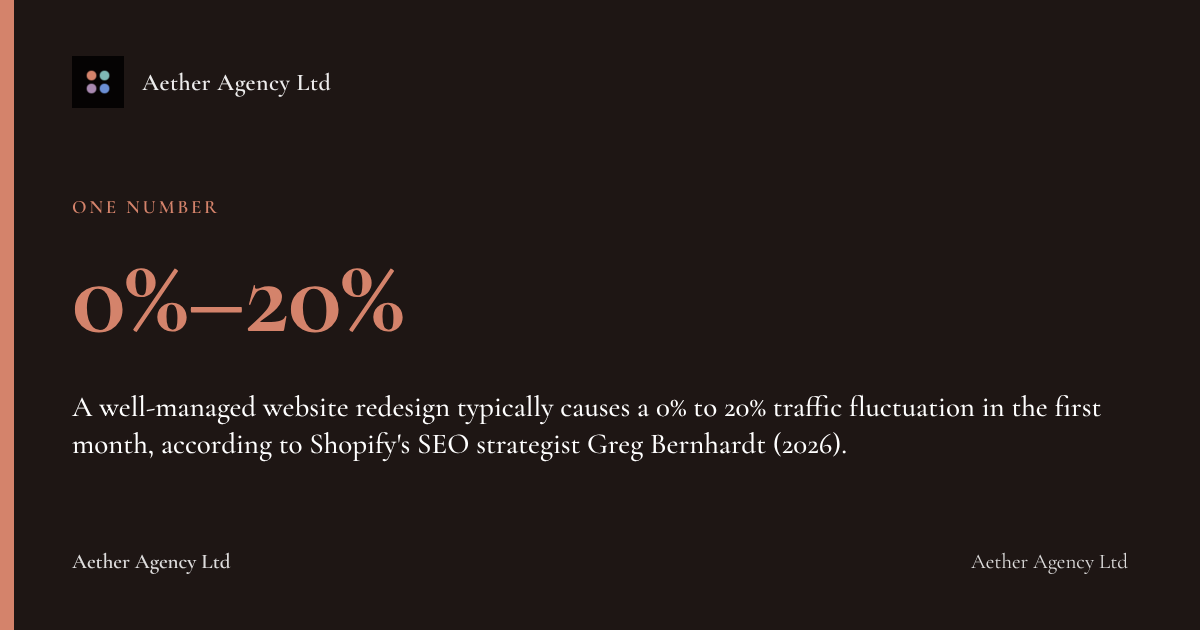
- A well-managed website redesign typically causes a 0% to 20% traffic fluctuation in the first month, according to Shopify's SEO strategist Greg Bernhardt (2026).
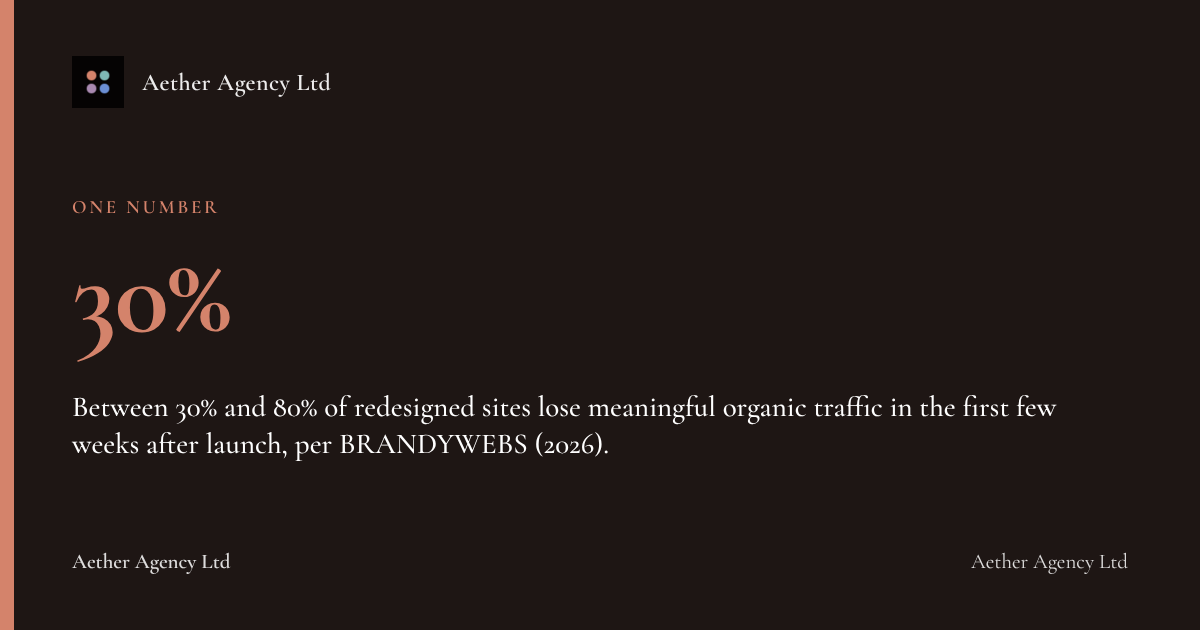
- Between 30% and 80% of redesigned sites lose meaningful organic traffic in the first few weeks after launch, per BRANDYWEBS (2026).
- A UK retailer that spent roughly £7.6 million on a full website redesign lost about £3.8 million in revenue when SEO redirects were implemented poorly, as documented by BRANDYWEBS (2026).
- A lean partial rebrand takes 3 to 4 months on average, while a total rebrand with naming and legal work can take 9 to 18 months, according to Branded Agency (2026).
- Aether Agency Ltd has delivered 50+ projects, combining brand identity and website development work for growing UK businesses.
What Does "Rebranding and Redesigning Together" Actually Mean?
A combined rebrand and redesign is a single project timeline in which a business changes its brand identity (name, logo, positioning or visual system) and rebuilds its website on the same schedule, rather than running the two as separate initiatives months apart. The distinction matters because a rebrand is a strategic exercise: it resets how a business is perceived, often involving new messaging, a new logo, and sometimes a new name.
A website redesign, by contrast, is a technical and design exercise: rebuilding the pages, navigation, and underlying code that deliver that brand to visitors. 11 Marketing's comparison guide draws this line clearly: a rebrand solves a perception problem, while a redesign solves a performance or usability problem.
When a business runs both simultaneously, the website becomes the first and most visible proof of the new brand. Aether Agency Ltd's client Renton Dance Studio, a UK dance academy, needed exactly this: a traditional digital presence was failing to connect with a younger audience, so Aether Agency Ltd delivered a complete rebrand, website redesign and social content programme together, moving the studio's identity and site from traditional to modernised in one coordinated engagement.
Advantages of Rebranding and Redesigning a Website at the Same Time
The main advantage of combining a rebrand and redesign is consistency: visitors never see a mismatched "old site, new logo" transition period. A new brand identity, including colours, typography and tone of voice, needs a website built around it from the ground up, so building the site once against the final brand avoids rework later.
Running both together also concentrates stakeholder attention into a single decision-making window rather than two. Businesses that separate the projects often find teams revisit decisions, such as navigation structure or page templates, once the new brand guidelines land, effectively redoing design work that could have been done once.
A combined project can also be more cost-efficient than two sequential engagements, because discovery, stakeholder interviews and content audits serve both workstreams at once. SmartBug Media's analysis notes that aligning the two projects allows messaging and visual identity to be tested on the same user research, rather than duplicating effort.
Fulk Butchers, a Surrey butcher, recorded a strong rise in online sales alongside a 4.8-star Google rating, and Fluent AI recorded traffic up 3x and a marked increase in lead generation. Fluent AI is a related business, not an independent client: it is owned by Lauren Dawkins, who also runs Aether Agency.
Risks of Combining a Rebrand and Website Redesign Into One Project
The central risk of a combined rebrand and redesign is SEO disruption, because changing the brand often triggers URL, content and sometimes domain changes all at once, which search engines must recrawl and re-evaluate together. Google Search Central's Change of Address guidance states plainly that combining a domain move with a redesign of content and URL structure means a business will probably see some traffic loss while Google reassesses each page.
The scale of that risk is well documented. Between 30% and 80% of redesigned sites lose meaningful organic traffic in the first few weeks after launch, according to BRANDYWEBS (2026), and a documented case saw a business lose 40% of its organic traffic for six months after a poorly executed redesign, per BRANDYWEBS, citing a Blogrator case study (2026).
The financial consequences can be severe at scale. A UK retailer that spent roughly £7.6 million on a full website redesign lost about £3.8 million in revenue when organic traffic collapsed in the first month after launch, because SEO redirect recommendations were not implemented properly, according to BRANDYWEBS (2026) (BRANDYWEBS).
Recovery from a botched migration is slow. A study of 892 domain migrations found an average recovery time of 523 days, with 17% of sites never fully recovering even after 1,000 days, according to Search Engine Journal, cited via BRANDYWEBS (2026) (Search Engine Journal (cited via BRANDYWEBS)). Beyond SEO, there is a brand-perception risk too: customers can become confused if messaging changes faster than the website can explain why.
"They brief the site they want to look at instead of the site their customer needs to act on. Every page should have one job, answer, reassure, or convert, and a visitor should never have to work out what you sell or what to do next. Beautiful and unclear loses to plain and obvious every single time.", Lauren Dawkins, Head of Content, Aether Agency
Rebrand vs Redesign Timelines and Costs: What to Expect
A combined rebrand and website redesign generally takes longer than either project alone, because brand strategy must finish before design work can begin properly. Industry benchmarks suggest a lean partial rebrand averages 3 to 4 months, a comprehensive refresh with research and testing takes 6 to 9 months, and a total rebrand including naming and legal work can run 9 to 18 months, according to Branded Agency (2026). Website redesigns alone typically run 8 to 16 weeks, depending on site complexity and stakeholder availability, per Widepool Creatives (2026).
| Project type | Typical timeline | Best suited to |
|---|---|---|
| Partial rebrand only | 3 to 4 months | Visual refresh, name unchanged |
| Comprehensive rebrand | 6 to 9 months | Repositioning with research and testing |
| Total rebrand (new name, legal) | 9 to 18 months | Mergers, trademark conflicts, major pivots |
| Website redesign only | 8 to 16 weeks | Technical or UX issues, no brand change |
| Combined rebrand and redesign | Roughly 4 to 9 months | Growing businesses refreshing identity and site together |
Costs vary enormously by scope, and no verified UK-wide figures exist for combined projects, so treat any quoted range as illustrative rather than a fixed benchmark. A sensible approach is to request a single scoped quote covering both brand strategy and website build, since this avoids paying twice for discovery and stakeholder workshops that would otherwise happen separately.
When It's Better to Separate the Rebrand From the Website Redesign
Separating the two projects makes sense when a business is not ready to commit to a full brand strategy but needs a technical website fix, such as poor mobile performance, broken checkout flows, or outdated accessibility compliance. Forcing a rebrand onto an urgent technical deadline usually produces a rushed brand strategy, which then has to be revisited within a year or two.
It also makes sense to separate them when legal or trademark work is unresolved. Branded Agency's benchmark notes that a total rebrand involving naming and legal clearance can take 9 to 18 months on its own, a timeline that would stall an unrelated website project unnecessarily if bundled together.
A third scenario is limited internal capacity. If marketing, sales and leadership cannot free up time for both brand workshops and website content reviews concurrently, running them sequentially, brand first, then website, produces better decisions than cramming both into overlapping deadlines.
Finally, businesses mid-way through a large SEO investment, such as a content programme building organic rankings, may want to delay any domain or URL structure change until that programme matures, since Google's own migration guidance confirms URL changes trigger a reassessment period regardless of how well the move is executed.
What Order Should the Work Happen In?
The work should follow brand strategy first, then visual identity and content, then website design, then development and launch, in that strict sequence. Starting website design before brand strategy is finalised is the single most common cause of rework, because navigation, tone of voice and visual hierarchy all depend on decisions the brand strategy phase should settle first.
A practical phased order looks like this:
- Brand strategy and positioning: define the audience, proposition and tone before any visual work begins.
- Visual identity: logo, colour palette, typography and brand guidelines.
- Content strategy: messaging hierarchy, page-by-page content plan, and an audit of existing content to carry forward.
- Website design: wireframes and visual design built against the finished brand guidelines.
- Development and technical SEO: build, redirect mapping, and testing.
- Launch and monitoring: phased rollout with close tracking of search performance.
One branding studio puts it bluntly: "Don't redesign until you realign." That captures why skipping straight to design, before the brand strategy is settled, so often produces a site that needs reworking within months.
Managing SEO Risk When Rebranding and Redesigning Together
The SEO impact of a combined rebrand and redesign depends almost entirely on whether the domain changes and whether redirects are mapped correctly, not on the rebrand itself. A well-managed redesign typically causes only a 0% to 20% traffic fluctuation in the first month, as Google recrawls and re-evaluates the new site, according to Shopify's Greg Bernhardt (2026).
Bernhardt's own benchmark for when to worry is specific: "If, by day six, you've dropped 60%, there's an issue, and you should not wait [to investigate]." That six-day checkpoint gives businesses a concrete early-warning signal rather than waiting weeks to assess whether a launch has gone wrong.
Google Search Central's official guidance recommends changing one major variable at a time wherever possible, meaning a brand-only change (logo, colours, tone) carries far less SEO risk than a brand change bundled with a domain move and a full URL restructure. Businesses that must change the domain as part of a rebrand (for example, after a name change) should treat redirect mapping, 301 redirects from every old URL to its new equivalent, as a non-negotiable technical step, since the £3.8 million revenue loss documented by BRANDYWEBS (2026) stemmed directly from redirects not being implemented properly.
Keeping the domain unchanged, even when the brand name changes, is one of the simplest ways to reduce SEO risk during a combined project.
Your rebrand and redesign checklist
- Finalise brand strategy, positioning and messaging before any wireframes are built.
- Confirm the domain decision early; keep the existing domain unless a name change makes it legally necessary to move.
- Run a full content audit and map every existing URL to its new destination before launch.
- Check trademark and company name availability if the rebrand includes a new name.
- Agree a single project lead, whether in-house, a branding agency, a web agency, or both working jointly, to prevent conflicting decisions.
- Build 301 redirects for every changed URL and test them before going live.
- Brief customer-facing teams (sales, support) on the new brand story at least two weeks before public launch.
- Monitor organic traffic daily for the first two weeks post-launch, using Google's day-six benchmark as an early warning point.
FAQ
Should you rebrand and redesign your website at the same time?
In most cases, yes, provided brand strategy is completed before design work begins and the domain is not changed unnecessarily. Combining the two avoids a mismatched transition period but requires careful sequencing to limit SEO risk.
Do I need a new website if I rebrand?
Not always. A partial rebrand, such as a logo or colour refresh with the name unchanged, can often be applied to an existing website without a full redesign, which is one reason 11 Marketing's comparison guide treats rebrands and redesigns as distinct decisions.
Will my website traffic drop if I rebrand and redesign simultaneously?
Some fluctuation is normal and expected. A well-managed redesign typically causes a 0% to 20% traffic fluctuation in the first month, according to Shopify (2026), though poorly executed projects have lost between 30% and 80% of organic traffic in the first few weeks, per BRANDYWEBS (2026).
How long does it take to rebrand and redesign a website together?
A combined project typically takes roughly 4 to 9 months, depending on scope. Partial rebrands average 3 to 4 months and website redesigns alone run 8 to 16 weeks, according to Branded Agency (2026) and Widepool Creatives (2026) respectively, with the combined brand-then-design sequence adding time on top.
Should I change my domain and redesign my site at the same time?
Changing the domain adds measurable SEO risk and should only happen if the rebrand genuinely requires a new name. Google Search Central's guidance confirms that combining a domain move with content and URL restructuring will probably cause some traffic loss while Google reassesses each page.
What order should you do a rebrand and website redesign in?
Brand strategy should always come first, followed by visual identity, content strategy, website design, then development and launch. Starting website design before the brand strategy is finalised is one of the most common causes of costly rework.
Who should manage a combined rebrand and redesign project?
Either a single agency offering both brand and web services, or a branding agency and web agency working jointly under one project lead, tends to produce more consistent results than running the two separately with no shared oversight. A single accountable lead prevents the brand and website workstreams making conflicting decisions.
Rebranding and redesigning with Aether Agency Ltd
Aether Agency Ltd exists precisely because businesses need brand and website decisions made by one team working to one plan, not two suppliers handing a project back and forth. As a branding studio offering brand identity, website development and marketing under one roof, Aether Agency Ltd sequences brand strategy, design and build in the order this article sets out, protecting both the visitor experience and the site's search performance.
Aether Agency Ltd has delivered 50+ projects for growing businesses, drawing on more than 20 years of combined team experience across brand identity and website development.
If your business is weighing up whether to rebrand and redesign together, get in touch with Aether Agency Ltd to discuss a scoped plan, starting with brand identity and moving into website development once the strategy is locked.
Related Reading
- Old Branded Stock After a Rebrand: What UK Firms Should Do
- How to Rebrand After an Acquisition (UK Guide 2026)
- Brand Refresh vs Full Rebrand: The 2026 UK Guide
Add aether-agency.co.uk as a preferred source on Google
See How Your Brand Appears in AI Search
Aether AI monitors your visibility across ChatGPT, Perplexity, Google AI Overviews, and Claude in real time. Find out where you stand and what to fix.
Explore Aether AI