Last updated: 4 November 2026
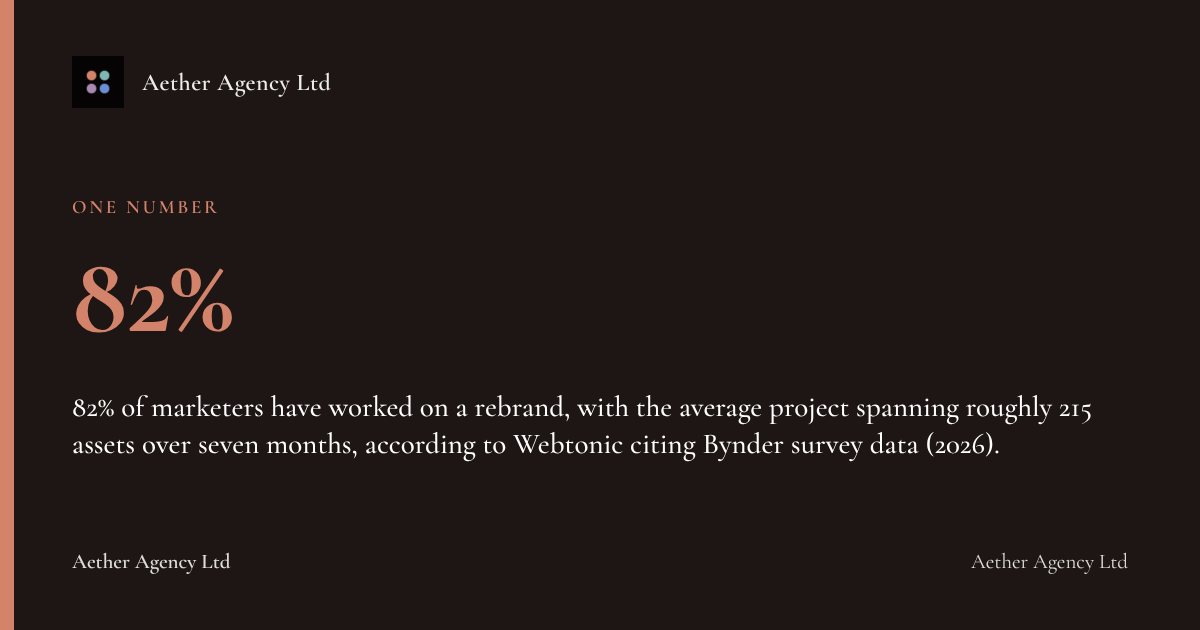
Measuring the success of a rebrand means tracking brand awareness, perception, financial performance, digital engagement and employee sentiment against a baseline set before launch, typically assessed at 3, 6 and 12 month intervals. There is no single metric: 82% of marketers have worked on a rebrand, and the average rebrand touches roughly 215 assets over seven months, according to Webtonic citing Bynder survey data (2026), so success has to be tracked across several dimensions at once.
Key Takeaways
- 82% of marketers have worked on a rebrand, with the average project spanning roughly 215 assets over seven months, according to Webtonic citing Bynder survey data (2026).
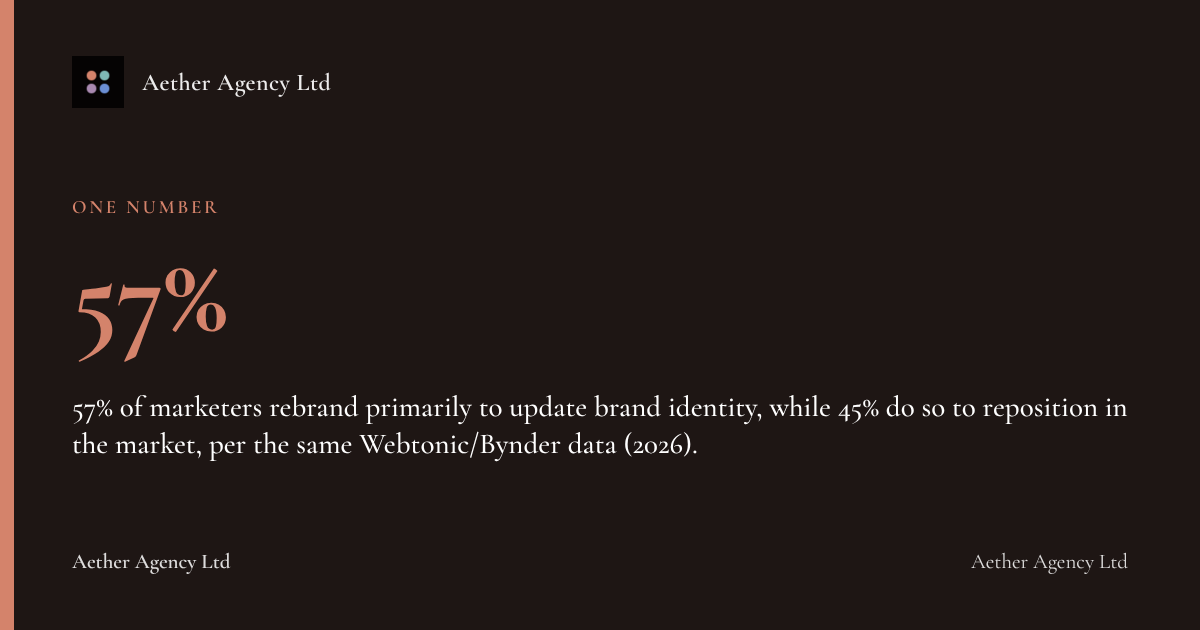
- 57% of marketers rebrand primarily to update brand identity, while 45% do so to reposition in the market, per the same Webtonic/Bynder data (2026).
- Net Promoter Score (NPS) ranges from -100 to 100 and is calculated as Promoters minus Detractors; it is widely used by major global companies, according to LinkedIn NPS survey research on arXiv (2019).
- A 20% uptick in website traffic alongside 15% sales growth is cited as a benchmark example of positive rebranding ROI by Brand Master Academy (2025).
- Rushed measurement timelines are a common failure point: Gap's 2010 logo redesign was reversed after only six days following social media backlash, according to The Drum (2025), showing why premature judgement calls can undo good work.
What Does "Measuring Rebrand Success" Actually Mean?
Measuring rebrand success is the practice of comparing a defined set of brand, financial and operational metrics before and after a rebrand launch to determine whether the change achieved its stated commercial objectives. It is not the same as measuring a single marketing campaign, because a rebrand typically reshapes identity, positioning, website, internal culture and customer-facing assets simultaneously.
Most UK businesses rebrand for one of two reasons. 57% of marketers rebrand to update brand identity, the single most cited driver, while 45% rebrand to reposition in the market, according to Webtonic citing Bynder survey data (2026). A further pattern shows up after acquisitions: 74% of S&P Global 100 companies rebrand within seven years of an acquisition, per Webtonic (2026), which means mergers and takeovers are a major trigger alongside straightforward identity refreshes.
Because the reason for rebranding varies, the measurement framework has to be tailored. A business repositioning for a new market segment needs perception and awareness data far more than one simply modernising a tired logo. Aether Agency Ltd, a branding studio working across brand identity, website development and marketing, builds measurement plans around the specific objective a client set at the outset, rather than applying a generic scorecard.
What KPIs Should Be Used to Measure Rebrand Success?
The KPIs that matter most for rebrand success fall into five categories: brand awareness, brand perception, financial performance, digital engagement, and employee sentiment. Tracking all five prevents the common mistake of declaring victory on one metric (say, a traffic spike) while ignoring a decline elsewhere (such as falling customer loyalty).
Brand awareness metrics typically include aided recall (do people recognise the name when prompted?) and unaided recall (do they name the brand unprompted in a category?). Brand perception metrics usually centre on Net Promoter Score, brand attribute association (words customers use to describe the brand) and sentiment analysis from social listening tools.
Financial KPIs cover revenue growth, customer lifetime value, average order value and cost per acquisition. Digital engagement KPIs include website traffic, time on site, conversion rate and organic search rankings. Employee-facing KPIs, often overlooked, include internal adoption rates, employee Net Promoter Score and staff turnover in the months following launch.
A useful benchmark comes from Old Spice, whose repositioning campaign saw a 107% increase in sales within six months of launch, according to Xolve Branding (2024). That scale of result is unusual, but it illustrates why financial KPIs sit alongside brand metrics rather than replacing them: a rebrand that lifts awareness without lifting sales has only done half its job.
| KPI category | What it measures | Typical tracking method | Review frequency |
|---|---|---|---|
| Brand awareness | Recognition and recall | Surveys, panel research | Pre-launch, 6 months, 12 months |
| Brand perception | Sentiment and associations | NPS, social listening | Pre-launch, 3 months, 12 months |
| Financial impact | Revenue, CLV, AOV | Sales data, CRM reporting | Monthly, with quarterly review |
| Digital engagement | Traffic, conversions, rankings | Google Analytics, Search Console | Weekly dashboard, monthly report |
| Employee sentiment | Internal buy-in | Internal surveys, exit interviews | Pre-launch, 3 months, 12 months |
How Long After Launch Should You Wait Before Measuring Impact?
Businesses should wait at least three months before drawing firm conclusions from rebrand metrics, with a fuller assessment at six and twelve months to account for seasonal variation and customer adjustment periods. Measuring too early risks the same trap that caught Gap in 2010, when its logo redesign was reversed after only six days following a crowdsourced backlash on social media, according to The Drum (2025).
Six days is nowhere near enough time to separate genuine customer sentiment from initial shock at change, and Gap's reversal is now widely cited as a case study in premature judgement. Barry Enderwick, former Marketing Director at Netflix, put a related principle well when discussing brand transitions: "Rather than make a strategic shift followed by a signal that things have changed, they signaled first. It's backwards." The same logic applies to measurement: judging a rebrand before customers and the market have had time to process it reverses the correct order of cause and effect.
A practical UK timeline looks like this: collect a pre-launch baseline across all five KPI categories, run a light-touch check at 4 to 6 weeks to catch any Gap-style crisis early, conduct a formal review at 3 months, and complete a full 12-month assessment that covers at least one full seasonal cycle.
Best Methods for Tracking Brand Awareness and Sentiment
Brand tracking is the ongoing, wave-based practice of surveying a consistent sample of customers and prospects at regular intervals to measure how awareness and perception shift over time, as detailed by CleverX. The two core methods are structured surveys and social listening, and most UK businesses need both because they capture different things.
Surveys measure aided and unaided brand recall, test reactions to new visual identity, and calculate NPS. SurveyMonkey explains that aided recall (showing a logo and asking "A rebrand earns its cost when the identity is making promises the business has outgrown, or hiding ones it can now keep. It is the wrong answer to slow sales and the right answer to being mistaken for a smaller, older, or narrower company than you have become. The test is whether your best client would recognise you from your website alone.") and unaided recall (asking "name a brand in this category") together give a fuller picture than either alone. NPS itself is calculated as the percentage of Promoters, those scoring 9 to 10, minus the percentage of Detractors, those scoring 0 to 6, and ranges from -100 to 100, a formula widely used by major global companies according to LinkedIn NPS survey research (2019).
Social listening tools monitor mentions, sentiment and share of voice across platforms in real time, which matters because negative reaction (as with Gap) tends to surface on social media first, long before a formal survey wave can be fielded. QuestionPro outlines sentiment tracking as a core component of ongoing brand tracking studies, alongside loyalty and perception measures.
An "in practice" example from Aether Agency Ltd's work: when Renton Dance Studio, a UK dance academy, found its traditional digital presence was failing to connect with a younger audience, Aether Agency Ltd delivered a complete rebrand, website redesign and social media content creation programme. The client, Olivia, the studio owner, said: "I recently had the pleasure of working with Lauren and Ellie at Aether Agency to enhance the branding for my dance studio. Even though I struggled to articulate exactly what I wanted, they somehow captured the exact style I had envisioned." The brand and website moved from traditional to modernised on record, an outcome that social content performance and audience feedback helped confirm over the course of the ongoing engagement.
How Do You Measure the Financial Impact of a Rebrand?
The financial impact of a rebrand is measured by comparing revenue, sales volume and customer lifetime value against pre-launch baselines over matched time periods, isolating the rebrand's effect from other variables where possible. Brand Master Academy (2025) cites a 20% uptick in website traffic alongside 15% sales growth as an example of positive rebranding ROI, giving UK businesses a rough benchmark for what a successful outcome can look like.
Calculating rebrand ROI isn't straightforward because, unlike a single ad campaign, a rebrand rarely runs in isolation from other marketing activity, pricing changes or market shifts. The honest approach is to track a basket of financial indicators rather than claim one number proves causation:
- Revenue growth in the 3, 6 and 12 months following launch, compared to the same periods the year before.
- Customer lifetime value (CLV), which indicates whether the rebrand is attracting higher-value, longer-retained customers.
- Average order value, useful for spotting whether repositioning has shifted the business into a higher price tier.
- Cost per acquisition, since a stronger brand should, over time, reduce the marketing spend needed to win a new customer.
- Customer retention and churn, covered in more depth below, since a rebrand's financial success often shows up in who stays rather than who's new.
The cautionary case here is Tropicana. Its 2009 packaging redesign caused unit sales to drop roughly 20% within two months and cost an estimated $30 to $35 million in lost sales before the company reverted to the original design, according to Flora Fountain (2026). That example shows financial tracking has to start immediately after launch, not months later, so a business can catch a damaging trend and act before losses compound.
What Role Does Employee Feedback Play in Assessing Rebrand Success?
Employee feedback and internal buy-in are a critical, often underweighted measure of rebrand success because staff are the ones who explain, defend and live the new brand with customers every day. A rebrand that lands well externally but confuses or alienates staff internally tends to underperform over the medium term, since inconsistent internal messaging undermines customer-facing consistency.
Practical ways to measure internal buy-in include a pre-launch and post-launch employee Net Promoter Score, direct surveys asking staff whether they understand and can explain the new brand positioning, and tracking staff turnover in the months following launch as an indirect signal of morale. Superside's measurement framework explicitly includes employee pride as one of five core categories alongside awareness, perception, financial impact and digital engagement, reflecting how widely this is recognised as a genuine success factor rather than a soft extra.
One contributor interviewed by MarketerInterview summed up the discipline required across every category, internal and external alike, with a simple line: "Metrics are your best friend." For a rebrand specifically, that means setting internal survey questions and a baseline before launch, not asking staff how they feel about the new identity only after problems surface.
How Can You Track Changes in Website Traffic and SEO Rankings?
Website traffic, keyword rankings and conversion rates can be tracked using Google Analytics, Google Search Console and rank-tracking tools, comparing matched periods before and after a rebrand's website launch. A rebrand almost always involves a new domain, redesigned site, or at minimum a changed URL structure and brand name, all of which can temporarily disrupt existing SEO rankings if migrations aren't handled correctly.
The metrics worth watching include organic sessions, branded versus non-branded search volume, keyword ranking positions, bounce rate, average session duration and conversion rate by channel. A branded search volume increase (more people searching the new company name directly) is itself a strong, direct signal that awareness is building.
Aether Agency Ltd has recorded a average client traffic growth of 3x, as published on its own site. For a live example of the mechanics involved, Priority First, a sister company of Aether Agency (the two businesses share the same majority owner, so this is not an independent result), recorded clicks from Google search across two back-to-back 28 day periods via Google Search Console: 543 clicks between 26 August and 22 September 2026, rising to 987 clicks between 23 September and 20 October 2026. That kind of period-on-period comparison, using Search Console's own data, is exactly the method any UK business should apply to its own post-rebrand traffic.
A rebrand that includes a new website development project should set up tracking before the old site is retired, not after, so the "before" baseline actually exists. Businesses working with an AI search marketing (GEO) programme should also track citation visibility in AI-generated answers, since this is increasingly where new customers first encounter a rebranded business.
What Benchmarks Should Be Collected Before a Rebrand Launch?
Baseline data should be collected across every KPI category covered above, roughly 4 to 8 weeks before launch, so there is a genuine pre-rebrand snapshot to compare against. Skipping this step is one of the most common and most damaging mistakes UK businesses make, because without a baseline there is no way to attribute any later change to the rebrand itself rather than to seasonality, a competitor's move, or unrelated market conditions.
A sensible baseline collection checklist includes:
- Aided and unaided brand recall survey, run with a representative sample of existing and prospective customers.
- Current NPS score, using the standard Promoters-minus-Detractors formula.
- Twelve months of historical revenue, CLV and average order value data, segmented by customer type.
- A full Google Analytics and Search Console export covering organic traffic, keyword rankings and conversion rates for at least the preceding 6 to 12 months.
- An internal staff survey measuring current understanding of, and pride in, the existing brand.
- A social listening snapshot capturing current share of voice and sentiment.
Collecting this before the first design concept is even finalised means the business can report a credible, defensible before-and-after story once the rebrand goes live.
Common Mistakes UK Businesses Make When Measuring Rebrand Success
The most common mistake is judging a rebrand too soon, as the Gap example shows: a six-day reversal gave the market almost no time to adjust before the company reacted to backlash, according to The Drum (2025). A second common mistake is tracking only one metric category, usually website traffic or social media followers, and declaring success or failure based on that alone, while ignoring financial performance or employee sentiment entirely.
Other frequent errors include failing to set a baseline before launch (covered above), not isolating the rebrand's effect from concurrent marketing campaigns or pricing changes, and under-resourcing the ongoing tracking once the initial launch excitement has faded. Many businesses also run a single post-launch survey and treat it as definitive, rather than running repeated tracking waves that show a trend over time, the methodology CleverX recommends for statistical rigour.
A final mistake worth naming: treating a rebrand that touches 215 assets over seven months, the average scope according to Webtonic/Bynder data (2026), as a single launch-day event rather than a phased rollout with staged measurement points built in from the start.
Who Should Be Responsible for Tracking Rebrand Performance?
Responsibility for tracking rebrand performance should sit with a named individual or small team, typically the marketing director or head of brand, reporting into the board or senior leadership on an agreed schedule. Diffuse ownership, where "everyone" is informally responsible for noticing whether the rebrand is working, is a reliable way for measurement to simply not happen.
In practice, this usually means one person owns the measurement framework end to end: agreeing the KPIs before launch, collecting the baseline, scheduling the 3, 6 and 12 month reviews, and reporting findings to leadership in a consistent format. Larger UK businesses sometimes split this across a marketing analytics lead (financial and digital KPIs) and an HR or internal comms lead (employee sentiment), but someone senior needs to own the combined picture so that a strong traffic number doesn't mask a weak NPS score, or vice versa.
How Do You Measure Customer Loyalty and Retention After a Rebrand?
Customer loyalty and retention after a rebrand are measured through repeat purchase rate, customer churn rate, NPS trends over time, and customer lifetime value, compared against the pre-launch baseline. NPS is particularly useful here because it's a single, standardised number, ranging from -100 to 100, that can be tracked in consecutive waves to show a clear trend line rather than a one-off snapshot, as LinkedIn's NPS survey research (2019) confirms is standard practice among major global companies.
Retention is often the slowest metric to move and the most revealing one. A rebrand can generate a short-term spike in new customer enquiries through curiosity and press coverage, but if existing customers don't stay loyal, or if churn increases because the new positioning doesn't match what they originally bought into, the rebrand has arguably failed even while top-line awareness numbers look strong.
Fulk Butchers, a Surrey-based client of Aether Agency, recorded online sales up 180% alongside a 4.8-star Google rating, a combination that reflects both new transaction growth and the kind of customer satisfaction that tends to sustain retention over time. Measuring both the sales figure and the review score together, rather than either in isolation, gives a fuller picture of whether customers are both buying more and staying satisfied.
Your Rebrand Measurement Checklist
- Set the primary objective for the rebrand (identity update, repositioning, post-acquisition merge) before choosing which KPIs matter most.
- Collect baseline data across brand awareness, perception, financial, digital and employee categories 4 to 8 weeks before launch.
- Agree a single owner, usually a marketing director or head of brand, responsible for reporting on rebrand performance.
- Run a light-touch sentiment check at 4 to 6 weeks to catch early backlash before it escalates.
- Conduct a formal review at 3 months, covering NPS, revenue and website traffic.
- Complete a full 12-month assessment covering at least one seasonal business cycle.
- Track branded search volume and organic rankings in Google Search Console alongside overall traffic.
- Run repeated brand tracking survey waves, not a single post-launch snapshot, to show a genuine trend.
FAQ
How do you measure the success of a rebrand?
Measure rebrand success by comparing pre-launch baselines across five categories: brand awareness, brand perception, financial performance, digital engagement and employee sentiment. Review formally at 3, 6 and 12 months rather than relying on a single snapshot.
What KPIs should you track after a rebrand?
Track aided and unaided brand recall, NPS, revenue and customer lifetime value, website traffic and conversion rate, and employee sentiment. A rebrand that performs well on one KPI but poorly on another hasn't fully succeeded, which is why all five categories matter together.
How long does it take to see results from a rebrand?
Allow at least 3 months before drawing firm conclusions, with fuller assessments at 6 and 12 months to capture a full seasonal cycle. Gap's six-day reversal of its 2010 logo, reported by The Drum, is widely cited as an example of judging far too soon.
What is a good NPS score after rebranding?
There's no universal "good" NPS figure, but the score ranges from -100 to 100 and is calculated as Promoters minus Detractors, according to LinkedIn's NPS survey research (2019). What matters most for a rebrand is the direction of change from your own pre-launch baseline, not an absolute benchmark.
How do you measure brand awareness before and after a rebrand?
Use aided recall (showing the logo and asking if it's recognised) and unaided recall (asking customers to name a brand in the category unprompted), run as matched survey waves before and after launch. Social listening tools add a real-time layer by tracking mentions and share of voice.
What metrics indicate a rebrand has failed?
Falling sales alongside flat or declining awareness, rising customer churn, and negative social sentiment are the clearest warning signs. Tropicana's 2009 redesign, which cut unit sales by roughly 20% within two months according to Flora Fountain, is the textbook example of financial metrics confirming a failed launch.
How soon after launch should you survey customers about a rebrand?
Run a light-touch sentiment check at 4 to 6 weeks to catch early problems, then a formal, fuller survey at the 3 month mark once initial reaction has settled. Repeat the survey at 6 and 12 months to build a genuine trend line rather than relying on one data point.
Measuring Your Rebrand With Aether Agency Ltd
Aether Agency Ltd works with growing UK businesses across the full brand, build, grow process, which means measurement is built into a rebrand from the outset rather than bolted on afterwards. The studio's approach to brand identity, covered through its Brand Identity service, pairs naming, identity systems and guidelines with the website and marketing infrastructure needed to actually track whether the new brand is working.
With "20+ years" team experience and "50+" projects delivered, as published on aether-agency.co.uk, Aether Agency Ltd has worked on rebrands of every scale, from a dance academy modernising its presence for a younger audience to larger businesses repositioning after growth or acquisition. If your business is planning a rebrand and wants a measurement framework in place before launch day, not after, get in touch with Aether Agency Ltd to discuss a baseline review and a tailored tracking plan.
Related Reading
- Old Branded Stock After a Rebrand: What UK Firms Should Do
- Custom Web Design vs Template: A UK Business Guide
- AI Brand Monitoring: Real-Time Analytics Services 2026
Add aether-agency.co.uk as a preferred source on Google
See How Your Brand Appears in AI Search
Aether AI monitors your visibility across ChatGPT, Perplexity, Google AI Overviews, and Claude in real time. Find out where you stand and what to fix.
Explore Aether AI