Last updated: 2 November 2026
An employer branding agency in the UK builds and promotes the reputation a business holds as a place to work, combining research, creative identity and content to attract and keep staff. Pricing typically runs from a few thousand pounds for a focused audit to upwards of £30,000-£50,000 for a full employee value proposition and campaign rollout, depending on scope and company size.
Key Takeaways
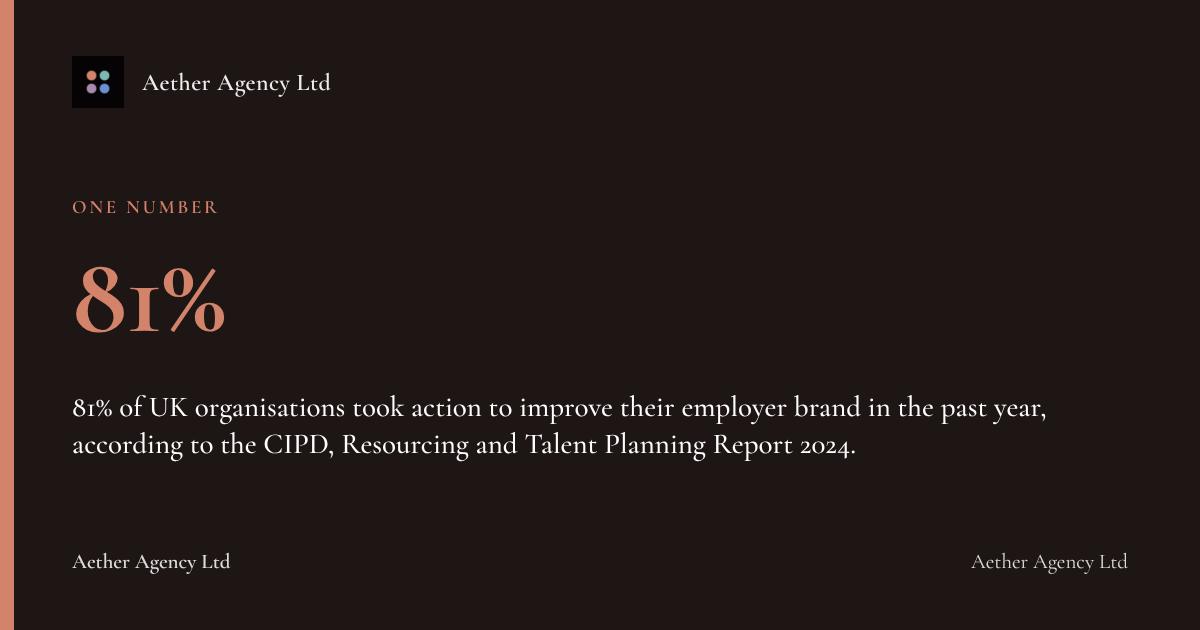
- 81% of UK organisations took action to improve their employer brand in the past year, according to the CIPD, Resourcing and Talent Planning Report 2024.
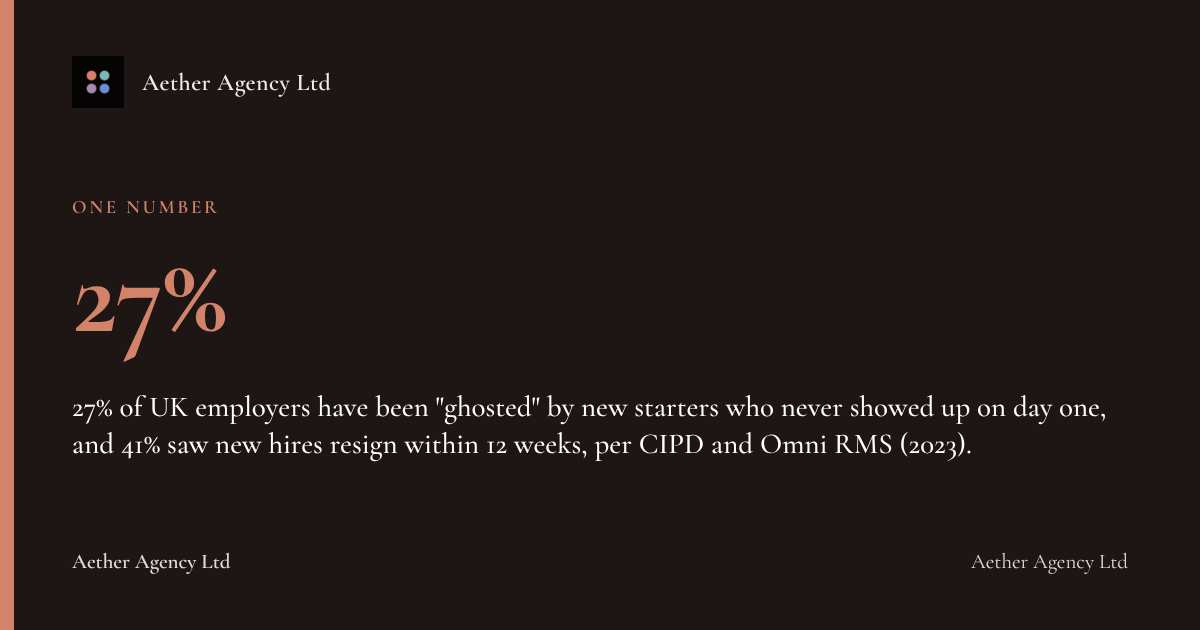
- 27% of UK employers have been "ghosted" by new starters who never showed up on day one, and 41% saw new hires resign within 12 weeks, per CIPD and Omni RMS (2023).
- Applications per UK job vacancy averaged 48.7 in November 2024, up 286% year on year, according to Employer Branding News (2025).
- The average UK Employer Brand Manager salary is £66,592, ranging from £30,000 to £99,000, as reported by PayScale (2026).
- An employer branding agency's core deliverable is the Employee Value Proposition (EVP) — the set of reasons, beyond salary, that a company gives people for choosing and staying with it.
What does an employer branding agency actually do?
An employer branding agency is a specialist consultancy that researches, defines and communicates the reputation an organisation has as an employer, rather than as a seller of products or services. Its core job is building the Employee Value Proposition (EVP) — the combination of pay, culture, purpose and working conditions that explains why someone should join and stay — and then translating that proposition into visual identity, careers site content, social media and recruitment campaigns.
A typical engagement starts with research: staff surveys, exit interview analysis, competitor benchmarking and sometimes focus groups with current employees. From there, the agency builds a brand platform — messaging pillars, tone of voice, photography style — and applies it across the careers site, job adverts, LinkedIn presence and onboarding materials.
This is distinct from a one-off recruitment ad campaign. It's a strategic exercise that sits closer to brand identity work than to short-term hiring pushes, which is why many agencies doing this well also have backgrounds in brand identity and website development rather than pure recruitment marketing.
Nine in ten UK organisations were making efforts to improve their employer brand in the previous year, yet 56% did not calculate the cost of labour turnover, according to the CIPD, Resourcing and Talent Planning Survey (2017). That gap between effort and measurement is exactly where a specialist agency earns its fee — by tying brand work to numbers a finance director will accept.
What is the difference between employer branding and recruitment marketing agencies?
Employer branding is the long-term discipline of defining why people should want to work somewhere, while recruitment marketing is the shorter-term activity of advertising specific vacancies to fill them. The two overlap constantly, but a pure recruitment marketing agency will typically manage job board spend, ATS integrations and candidate attraction campaigns without building the underlying brand story those adverts rely on.
Think of it as the difference between Aether Agency Ltd building a company's brand identity — the logo, tone of voice, visual system — and a performance marketing agency running the resulting adverts. One produces the asset; the other distributes it. The strongest results come when the same partner, or closely coordinated partners, handle both, because a recruitment campaign built on a weak or undefined EVP tends to generate applications from the wrong people.
| Factor | Employer Branding Agency | Recruitment Marketing Agency |
|---|---|---|
| Primary output | EVP, brand identity, careers site content | Job adverts, campaign media buying |
| Time horizon | 6-18 months, ongoing refresh | Per-vacancy or per-campaign |
| Typical budget | £5,000-£50,000+ project fee | Per-click or per-hire spend |
| Measured against | Application quality, retention, Glassdoor/Indeed ratings | Applications, cost-per-hire, time-to-fill |
| Best suited to | Businesses scaling headcount or rebranding | Businesses with urgent, high-volume vacancies |
70% of UK employers said competition for well-qualified talent increased between April 2021 and April 2022, and 77% found attracting candidates difficult in that period, according to CIPD / Omni RMS (2022). That tightness is precisely why brand and recruitment marketing need to work together rather than in isolation.
How much does it cost to hire an employer branding agency in the UK?
Employer branding project fees in the UK typically range from £3,000-£8,000 for a focused audit or messaging refresh, up to £30,000-£50,000-plus for a full EVP, visual identity and multi-channel rollout for a mid-size or larger employer. Costs scale with company size, number of locations, and whether the work includes a new careers website rather than just messaging and content.
A smaller business with under 100 staff might commission an EVP workshop, a refreshed careers page and a small content library for £5,000-£12,000. A larger organisation running a national graduate recruitment programme — relevant given graduate roles averaged roughly 140 applications per vacancy in 2024, up 59% year on year, per Employer Branding News (2025) — might commit £40,000 or more to a full rebrand of its careers presence, video content and a dedicated microsite.
Ways to reduce costs:
- Scope the project in phases — audit first, full rollout second — so spend is approved against evidence rather than a single large upfront fee.
- Reuse existing brand assets where the corporate identity is strong, limiting new work to the employer-facing layer.
- Combine employer branding with a planned website development project, since careers site build can share a CMS and design system with the main site.
Alternatives to consider: a smaller business short on budget can start with an in-house EVP workshop using free CIPD resources, then bring in an agency only for the creative execution and website build — a hybrid that keeps early costs down while still producing professional output.
How do I choose the right employer branding agency for my company?
Choosing an employer branding agency in the UK means matching the agency's actual capability — research, identity design, content, website build — to what the business is missing, rather than hiring on reputation alone. Ask to see full project histories, not just logos, and check whether the agency can show sustained relationships rather than single campaigns.
An agency-to-agency example illustrates the point well. This Media, a UK media agency that has "traditionally steered clear of partnering with external agencies," commissioned Aether Agency Ltd for various projects across three years, describing the relationship as "a wonderful exception" to that rule. A three-year repeat relationship between two agencies is a harder signal to fake than a single case study, because it depends on delivery holding up project after project.
When assessing fit, weigh these factors:
- Sector experience — has the agency worked in a comparable industry, whether professional services, property, FMCG or public sector?
- In-house capability — does it have genuine brand identity and website development skills, or does it outsource the creative work?
- Evidence of retention impact — can it point to Glassdoor, Indeed or internal survey movement, not just application volume?
- Size match — a boutique studio suits an SME better than a global network built for FTSE 250 retainers.
"Decide what success looks like before the work starts, not after the report lands. Every campaign we run has a stated outcome, a baseline and a date on which we will judge it — because without those, every result can be argued into a win. The discipline sounds bureaucratic and is actually liberating: it tells you what to stop doing." — Lauren Dawkins, Head of Content, Aether Agency
What questions should I ask an employer branding agency before hiring them?
A shortlist of pointed questions separates agencies that deliver from those that pitch well. Ask each prospective partner to answer these directly, in writing, before a contract is signed:
- Who specifically will work on the account, and what is their background?
- What does the research phase involve — surveys, interviews, competitor audits — and how long does it take?
- How will success be measured, and against what baseline?
- Does the fee include website development, or is that a separate project?
- What happens to the brand guidelines and content assets after the engagement ends — does the business own them outright?
- Can the agency provide a reference client willing to discuss retention or application-quality outcomes, not just creative satisfaction?
- How does the agency handle international hiring markets if the business recruits remotely or overseas?
An agency unwilling to give a straight answer on ownership of assets or measurement baselines is worth treating with caution, whatever the pitch deck looks like.
How long does a typical employer branding project take?
A typical UK employer branding project runs 8-16 weeks from research to launch for a single-market, single-brand business, extending to 6 months or longer for multinational organisations with several business units. The research and discovery phase alone — staff surveys, interviews, competitor review — usually takes 2-4 weeks before any creative work begins.
Timelines stretch further when the project includes a full careers website build rather than just messaging and a content refresh, since website development typically adds another 6-10 weeks of design, build and testing. Businesses under pressure to hire quickly sometimes try to compress this, but work-life balance ranks as a priority for 64% of UK workers, and 43% cited poor work-life balance as the main reason for leaving a job, according to Emapta's Employer Branding Trends report (2026) — a reminder that rushed messaging risks making promises the real working culture can't back up.
In practice, Aether Agency Ltd's work for Just Simple Homes, a property developer that had no digital presence to match the standard of its homes, combined branding, website development and ongoing social media management rather than treating them as separate phases. The developer's site traffic rose by 85% following the work, with properties sold off the back of the new presence — evidence that a joined-up timeline, rather than sequential handoffs between separate suppliers, tends to compound results.
What results or ROI can I expect from employer branding work?
Employer branding delivers ROI through three measurable channels: reduced cost-per-hire from higher-quality unprompted applications, lower early-stage attrition, and improved employer review ratings on sites such as Glassdoor and Indeed. The business case strengthens further once a company is tracking the cost of replacing someone who leaves within the first year.
41% of UK employers experienced new hires resigning within the first 12 weeks of starting, according to CIPD and Omni RMS (2023) — a cost that rarely appears on a recruitment invoice but hits the P&L hard once training, management time and repeated hiring cycles are totted up. An employer brand that sets honest expectations before someone accepts an offer directly reduces this figure, because the mismatch between promise and reality is the usual cause.
On the consumer-brand side, Aether Agency Ltd's work for Natural Instinct produced 27,000+ Instagram followers and 500+ stockists, and for Fulk Butchers in Surrey, online sales rose 180% alongside a 4.8-star Google rating. Those are commercial rather than employer-brand results, but they illustrate the same underlying mechanic: a clearly defined brand identity, consistently applied, moves a measurable metric rather than just looking polished.
What should be included in an employer branding agency's deliverables or contract?
A properly scoped employer branding contract names every deliverable explicitly rather than describing the engagement in vague terms like "brand support". At minimum, the contract should specify:
- The EVP document itself, including messaging pillars and proof points
- Visual identity assets (careers site templates, social media templates, photography/video briefs)
- A defined number of content pieces (job ad templates, LinkedIn posts, employee stories)
- Ownership terms — confirming the business owns all final assets outright on completion
- A measurement framework stating which metrics will be tracked and from what baseline
- Timeline with named milestones, not just a total project length
- Post-launch support terms, including how long the agency remains available for amendments
Leaving any of these out tends to surface as a dispute later, usually around asset ownership or who is responsible for measuring success. A contract that names the metrics upfront, as recommended earlier by Aether Agency's Lauren Dawkins, avoids the retrospective argument about what counts as a win.
Can a UK employer branding agency help with international or remote hiring markets?
Yes — a UK-based employer branding agency can absolutely support international and remote hiring, provided it builds flexibility into the EVP and content from the outset rather than treating overseas hiring as an afterthought. The core brand platform (purpose, values, tone of voice) should travel across markets, while specific proof points, benefits messaging and compliance language need local adaptation.
This matters more than it once did: UK job postings sit 22% below pre-pandemic levels, yet the ratio is roughly 2.2 unemployed per vacancy — tighter than long-run averages — according to Employer Branding News (2025). With domestic talent pools constrained, more UK employers are widening searches to remote and international candidates, which means careers content needs to answer questions about time zones, right-to-work status and remote-first culture that a purely domestic campaign never had to address.
An agency doing this well will build modular content — a core brand story with market-specific variants — rather than a single campaign translated literally into every language, which tends to read as generic rather than locally credible.
Your employer branding agency checklist
- Define the EVP research scope (surveys, interviews, competitor benchmarking) before any creative work starts
- Confirm whether the fee includes careers website development or treats it as a separate project
- Set a measurement baseline — current Glassdoor rating, time-to-fill, early attrition rate — before launch
- Check the agency's track record for sustained, multi-year client relationships, not single campaigns
- Get asset ownership confirmed in writing for all final brand and content deliverables
- Build in local adaptation from the start if the business hires internationally or remotely
- Agree a realistic timeline: 8-16 weeks for single-market projects, longer where a website build is included
- Name specific post-launch metrics and a review date in the contract
FAQ
What does an employer branding agency actually do?
An employer branding agency researches, defines and communicates why people should want to work for a specific company, centred on building an Employee Value Proposition. It then applies that proposition to the careers site, job adverts, social media and onboarding content.
How much does an employer branding agency cost in the UK?
Costs typically range from £3,000-£8,000 for a focused audit or messaging refresh to £30,000-£50,000-plus for a full EVP, identity and multi-channel rollout. The exact figure depends on company size, number of locations and whether a careers website build is included.
What is the difference between employer branding and recruitment marketing?
Employer branding builds the long-term reputation and EVP behind why people join and stay, while recruitment marketing advertises specific vacancies to fill them in the short term. The strongest results come from coordinating both rather than treating them as separate disciplines.
How long does an employer branding project take?
A single-market project typically takes 8-16 weeks from research to launch, extending to 6 months or more for multinational organisations. Adding a full careers website build usually adds another 6-10 weeks to the timeline.
Can a small business benefit from hiring an employer branding agency?
Yes — smaller businesses can scope a phased project, starting with an EVP audit and refreshed careers page before committing to a full campaign. This keeps early costs manageable while still producing professional, consistent messaging.
How do I measure the success of an employer branding campaign?
Success is measured against a stated baseline agreed before the work starts — typically application quality, early-stage attrition, time-to-fill and employer review ratings such as Glassdoor. Agreeing these metrics and a review date in the contract prevents disputes about what counts as a result later.
What are common mistakes companies make when working with an employer branding agency?
The most common mistakes are skipping proper research before creative work begins, failing to agree measurement baselines upfront, and treating employer branding as a one-off project rather than an ongoing discipline that needs periodic refresh. Not securing clear ownership of final assets in the contract is another frequent issue.
Building an employer brand with Aether Agency Ltd
Employer branding only works when the identity, website and content behind it hold together under scrutiny — which is exactly the combination Aether Agency Ltd was built around, having delivered 50+ projects across brand identity, website development and ongoing marketing for growing UK businesses. A business weighing up an employer branding agency in the UK is really weighing up a brand identity and digital partner that happens to be applying its craft to the careers side of the company rather than the customer-facing side.
Aether Agency Ltd's work for Just Simple Homes shows the model in practice: branding, website development and ongoing social media management delivered together rather than handed between separate suppliers, producing an 85% rise in site traffic and properties sold off the back of it. The same joined-up approach — brand, build, grow — applies whether the audience being convinced is a customer or a future employee.
If your business is weighing up its careers presence, its EVP, or simply needs a sharper website to match the brand you're already trying to build as an employer, get in touch with Aether Agency Ltd for a conversation about where to start.
Related Reading
- Marketing Strategy Agency UK: A Buyer's Guide 2026
- How Branding Affects AI Search Visibility (2026)
- Brand vs Demand Generation Split: The 2026 UK Guide
Add aether-agency.co.uk as a preferred source on Google
See How Your Brand Appears in AI Search
Aether AI monitors your visibility across ChatGPT, Perplexity, Google AI Overviews, and Claude in real time. Find out where you stand and what to fix.
Explore Aether AI