Last updated: 2 November 2026
Quick answer: AI marketing uses artificial intelligence tools — for content creation, customer segmentation, and campaign optimisation — to help UK businesses cut customer acquisition costs and improve targeting accuracy. As of 2026, Statista research found more than one in three UK small business owners planned to use AI to generate marketing content, campaigns and ideas, and separate research cited by Moneypenny found 44% of UK businesses were already using AI for content creation and marketing.
Key Takeaways
- According to Statista research (as of 2026), more than one in three UK small business owners planned to use AI to generate marketing content, campaigns and ideas.
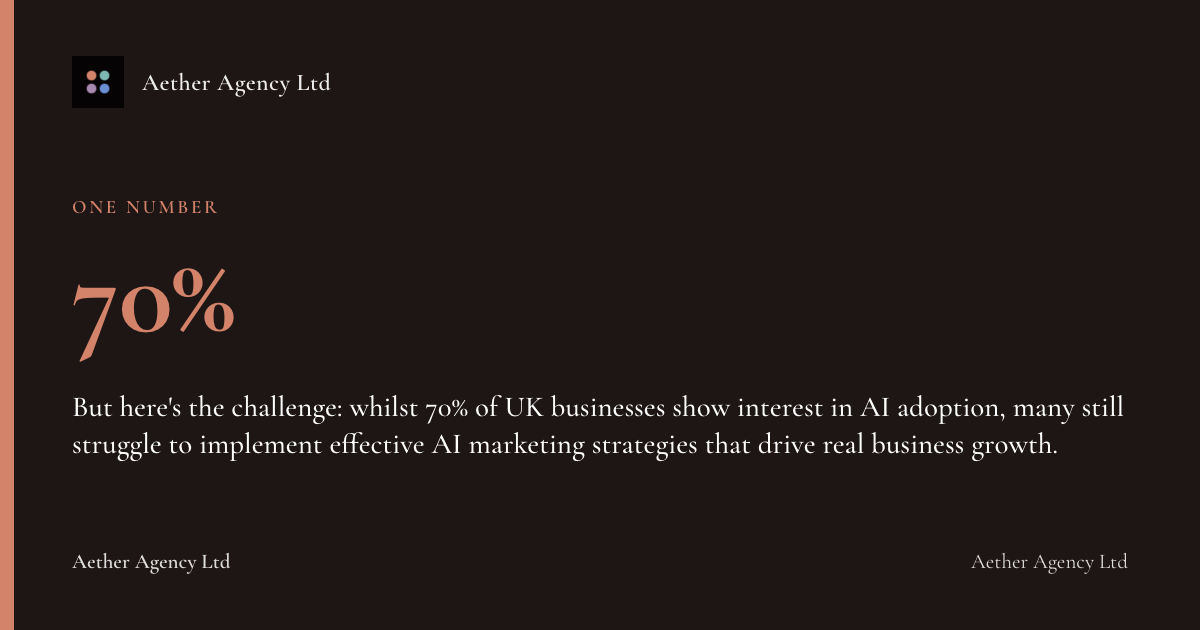
- Moneypenny's research found that 39% of UK businesses were already using AI in some capacity, with a further 31% seriously considering implementation — bringing total interest to nearly 70%.
- Moneypenny's research found that 44% of UK businesses used AI for content creation and marketing, and 51% of marketing teams used AI specifically to optimise content such as email campaigns and SEO copy.
- UK businesses must implement AI marketing within the UK General Data Protection Regulation (UK GDPR) framework, including transparent consent mechanisms and data minimisation principles.
- Aether Agency Ltd has delivered 50+ projects (as published on aether-agency.co.uk), spanning brand identity, website development and marketing work for growing businesses.
What Is AI Marketing?
AI marketing is the use of artificial intelligence — software that can analyse data, generate content or make predictions without step-by-step human instruction — to plan, personalise and optimise marketing activity. It covers tasks such as automated content generation, predictive customer segmentation, dynamic ad bidding and send-time optimisation for email campaigns.
Unlike traditional marketing automation, which follows fixed rules set in advance, AI marketing tools learn from data patterns and adjust their output over time — for example, refining which subject line a given customer segment is shown based on past open rates. For UK businesses, this typically means layering AI-powered tools onto existing marketing channels (email, social, paid ads, content) rather than replacing the channels themselves.
What Is the Current State of AI Marketing Adoption in the UK?
UK AI marketing adoption is advancing quickly: according to Moneypenny's research on the state of AI adoption in UK businesses, 39% of UK businesses were already using AI in some capacity as of 2026, with a further 31% seriously considering it. That combined figure brings total UK business interest in AI to nearly 70%.
The same research found that 44% of UK businesses used AI for content creation and marketing specifically, and that 51% of marketing teams used AI to optimise content — from email campaigns to SEO. Research from We Simplify Agency notes that AI tools are no longer reserved for large corporations, with small and medium-sized enterprises (SMEs) increasingly treating AI as an accessible route to competitive advantage.
Retail, financial services and professional services are among the sectors most associated with AI marketing adoption, largely because customer experience and personalisation have a direct link to revenue in those industries. Implementation still varies widely: some businesses integrate AI across the full marketing function, while others limit it to discrete tasks such as content drafting or social media scheduling.
What Are the Key Benefits of AI Marketing for UK Business Growth?
AI marketing's core benefit for UK businesses is efficiency: automating repetitive tasks such as content drafting, campaign scheduling and performance reporting frees marketing teams to focus on strategy and creative work. Beyond time savings, the technology supports more precise targeting, which can reduce wasted ad spend and improve the accuracy of customer segmentation.
Enhanced Marketing ROI and Cost Efficiency
AI-powered targeting and automated campaign optimisation can reduce the customer acquisition costs that come from poorly targeted ad spend. The main mechanisms behind this are:
- Improved targeting accuracy, which reduces wasted ad spend by narrowing campaigns to genuinely relevant audiences
- Automated campaign optimisation, which continuously reallocates budget towards better-performing ads or channels
- Predictive analytics, which can flag high-value prospects earlier in the sales funnel
Because these mechanisms compound — better targeting feeds better data, which improves predictions further — many UK businesses report that AI-led marketing investment pays back faster than traditional campaign management once the groundwork (clean data, defined goals) is in place.
Productivity and Strategic Execution
AI marketing tools take over time-consuming operational tasks, giving marketing teams more capacity for strategic and creative work. Typical tasks handed to AI include:
- Content creation and optimisation
- Social media scheduling and monitoring
- Email campaign personalisation
- Performance analysis and reporting
Marketing teams that automate these functions can redirect staff time towards planning, messaging strategy and relationship-building — the activities most closely tied to longer-term business growth rather than day-to-day campaign maintenance.
Data-Driven Decision Making
AI-powered predictive analytics allow marketing teams to anticipate customer behaviour rather than react to it after the fact. In practice, this supports:
- Predicting customer behaviour patterns ahead of a purchase decision
- Identifying emerging market opportunities from shifts in engagement data
- Optimising marketing mix allocation across channels
- Reducing campaign risk through structured A/B testing before full rollout
Businesses that build AI into their regular reporting cycle are generally better placed to spot underperforming campaigns early and reallocate budget before losses compound.
What Are the Essential AI Marketing Tools for UK Businesses?
The leading use case for AI marketing tools among UK businesses is content optimisation, according to SurveyMonkey research. From there, AI tools extend into customer segmentation, paid advertising and campaign analytics — each addressing a different stage of the marketing funnel.
Content Creation and Optimisation
UK businesses use AI across three main content areas:
Blog and Website Content:
- AI writing assistants for search-engine-optimised (SEO) articles
- Meta description and title tag generation
- Content gap analysis and topic research
Social Media Marketing:
- Automated post scheduling and optimisation
- Visual content creation and editing
- Hashtag research and audience analysis
Email Marketing:
- Subject line testing and optimisation
- Personalised content recommendations
- Send-time optimisation
Customer Segmentation and Targeting
AI-powered customer segmentation groups audiences by behaviour and likely value rather than broad demographics alone, enabling more precise targeting through:
- Behavioural analysis, which identifies purchase patterns from browsing and transaction data
- Demographic clustering, which improves message relevance by grouping similar customer profiles
- Predictive modelling, which forecasts customer lifetime value to prioritise retention spend
Advertising and Paid Media
AI changes how paid advertising budgets are managed by automating decisions that would otherwise require constant manual adjustment:
- Automated bid management optimises ad spend in real time across platforms
- Dynamic creative optimisation tests multiple ad variations simultaneously
- Audience lookalike modelling finds new customers who resemble existing high-value ones
Businesses evaluating a wider marketing or branding overhaul alongside AI adoption may also want to read this guide on how to choose a digital marketing agency in the UK, since tool selection often works best alongside a clear brand and content strategy.
How Do You Implement an AI Marketing Strategy Step by Step?
Implementing AI marketing successfully in a UK business follows three broad phases: assessing current performance and setting goals, selecting and integrating the right tools, and testing results before scaling. Skipping the assessment phase is the most common reason AI tools fail to deliver a measurable return.
Phase 1: Assessment and Planning
Audit Current Marketing Performance:
- Identify underperforming campaigns and channels
- Analyse customer acquisition costs by source
- Review content performance and engagement metrics
Define AI Implementation Goals:
- Set specific, measurable objectives
- Establish baseline metrics for comparison before any AI tool is introduced
- Determine budget allocation for AI tools
Phase 2: Tool Selection and Integration
Choose AI Tools Based on Priority Areas:
- Start with high-impact, low-complexity implementations
- Consider integration capabilities with existing systems
- Evaluate UK-specific compliance requirements, particularly UK GDPR
Popular AI Marketing Tools for UK Businesses:
- Content Creation: Jasper, Copy.ai, Writesonic
- Email Marketing: Mailchimp, HubSpot, Klaviyo
- Social Media: Hootsuite, Buffer, Sprout Social
- Analytics: Google Analytics 4, Adobe Analytics
Phase 3: Testing and Optimisation
A/B Testing Framework:
- Test AI-generated content against human-created versions
- Compare automated versus manual campaign optimisation
- Measure performance across different customer segments
Continuous Improvement:
- Monitor key performance indicators weekly
- Adjust AI parameters based on results
- Scale successful implementations across channels once they're proven
What Challenges Do UK Businesses Face When Implementing AI Marketing?
The three most common barriers to AI marketing adoption in the UK are data privacy compliance, internal skills gaps, and integration complexity with existing systems. Each is manageable with planning, but underestimating them is a frequent cause of stalled AI projects.
Data Quality and Privacy Compliance
UK businesses must implement AI marketing within the UK General Data Protection Regulation (UK GDPR) framework while still maximising AI effectiveness:
Data Collection Best Practices:
- Implement transparent consent mechanisms
- Ensure data minimisation principles are followed
- Regularly audit data usage and storage
Privacy-First AI Implementation:
- Use anonymised data for training models where possible
- Implement clear data retention policies
- Provide straightforward opt-out mechanisms for customers
Skills Gap and Training
A shortage of in-house AI literacy is a common obstacle for UK businesses adopting these tools. Options for closing that gap include:
Internal Training Strategies:
- Provide AI marketing workshops for existing staff
- Partner with educational institutions for ongoing learning
- Hire specialists or consultants for complex implementations
External Support Options:
- Work with an AI-experienced marketing or branding agency
- Engage freelance AI marketing specialists
- Join industry associations for peer learning
Integration Complexity
Integrating AI tools with existing marketing and sales systems requires technical planning before rollout:
Technical Considerations:
- Ensure API compatibility between systems
- Plan for data migration and synchronisation
- Establish backup and recovery procedures
What Are Industry-Specific Applications of AI Marketing?
AI marketing applications differ by sector because each industry has a different relationship between data, personalisation and revenue. Retail relies on AI chiefly for product discovery and pricing; professional services use it mainly for lead qualification and thought leadership; healthcare applies it to patient communication and scheduling.
Retail and E-commerce
UK retailers commonly use AI for:
- Product recommendation engines, which can increase average order value
- Dynamic pricing optimisation, which helps protect profit margins
- Inventory demand forecasting, which reduces stockouts
Professional Services
Law firms, accountants and consultancies commonly use AI for:
- Content marketing automation, which supports thought leadership at scale
- Lead scoring and qualification, which improves sales efficiency
- Client communication personalisation, which strengthens ongoing relationships
Healthcare and Wellness
Healthcare providers commonly implement AI for:
- Patient education content, which can improve treatment outcomes
- Appointment scheduling optimisation, which reduces no-shows
- Treatment outcome prediction, which supports service quality
How Do You Measure AI Marketing Success?
AI marketing success is measured through a combination of revenue, operational and engagement metrics, tracked before and after implementation against a clear baseline. Without a baseline set during the assessment phase, it becomes difficult to attribute any change in performance to the AI tools themselves.
Key Performance Indicators
Revenue Metrics:
- Customer acquisition cost (CAC) reduction
- Customer lifetime value (CLV) improvement
- Marketing qualified leads (MQL) increase
Operational Metrics:
- Content production efficiency
- Campaign setup time reduction
- Response rate improvements
Engagement Metrics:
- Email open and click-through rates
- Social media engagement growth
- Website conversion rate optimisation
ROI Calculation Framework
Direct ROI Measurement:
AI Marketing ROI = (Revenue Increase - AI Investment) / AI Investment × 100
Indirect Benefits Quantification:
- Time savings converted to an hourly rate value
- Improved customer satisfaction scores
- Brand awareness and reach expansion
What Are the Future Trends in UK AI Marketing?
The next phase of UK AI marketing adoption centres on voice search, visual recognition and tighter regulatory oversight. Businesses planning AI investment for the next 12-24 months should budget for compliance work alongside new tool spend, not instead of it.
Emerging Technologies
Voice Search Optimisation:
- AI-powered content optimised for voice queries
- Local SEO enhancement for voice searches
- Conversational AI customer service integration
Visual Recognition Marketing:
- Image-based product discovery
- Visual content optimisation
- Augmented reality shopping experiences
Regulatory Developments
The UK government continues developing AI governance frameworks that marketing teams will need to track, including:
- Enhanced data protection requirements under UK GDPR
- AI transparency and explainability expectations
- Industry-specific compliance standards
Market Predictions
Industry commentary points to continued growth in AI marketing investment among UK SMEs over the coming years, alongside deeper integration with channels such as TikTok and Instagram. As with any forward-looking projection, businesses should treat specific growth percentages as directional rather than guaranteed.
Your AI Marketing Implementation Checklist
- Audit current marketing performance and identify underperforming campaigns or channels
- Set specific, measurable goals for AI adoption and record baseline metrics before introducing any tool
- Select AI tools that address your highest-priority gap first (content, segmentation, or paid media)
- Confirm every tool and data process complies with UK GDPR, including consent and data minimisation
- Run A/B tests comparing AI-assisted output against your current approach before fully switching over
- Train staff or bring in outside specialists to close any AI literacy gaps in your team
- Review key performance indicators weekly during the first few months of implementation
- Scale only the AI applications that show a measurable improvement against your baseline
FAQ
What percentage of UK businesses are using AI for marketing in 2026?
44% of UK businesses used AI for content creation and marketing, with a further 31% seriously considering implementation — bringing total UK business interest in AI marketing to nearly 70%.
How much can AI marketing improve ROI for UK businesses?
The scale of ROI improvement varies by business and implementation, but UK adoption data suggests the direction is positive: Moneypenny's research found 51% of marketing teams already used AI to optimise content such as email campaigns and SEO, which is typically where early efficiency gains appear. Businesses should set their own baseline before implementation to measure genuine ROI improvement.
What are the most effective AI marketing tools for UK small businesses?
The most popular AI marketing tool categories for UK SMEs are content creation (Jasper, Copy.ai, Writesonic), email marketing platforms with AI features (Mailchimp, HubSpot, Klaviyo), social media management tools (Hootsuite, Buffer, Sprout Social), and analytics platforms (Google Analytics 4, Adobe Analytics). According to statistics on AI in marketing, 51% of marketing teams use AI specifically to optimise content, making content tools the most widely adopted category.
How can UK businesses reduce customer acquisition costs with AI marketing?
AI reduces customer acquisition costs mainly through improved targeting accuracy, automated campaign optimisation, predictive analytics for prospect identification, and personalised content that increases conversion rates. The size of the reduction depends on data quality and how well the tools are integrated with existing campaigns, so results vary between businesses.
What challenges do UK businesses face when implementing AI marketing?
The main challenges are UK GDPR compliance, gaps in internal AI literacy, integration complexity with existing systems, data quality issues, and upfront investment costs. These are generally surmountable with a structured assessment-and-planning phase before tools are selected.
Is AI marketing suitable for all UK business sectors?
Yes. 39% of UK businesses were already using AI in some capacity as of 2026, spanning retail, professional services, healthcare, manufacturing and hospitality. The key is selecting AI applications that align with a sector's specific customer behaviours and data availability, rather than adopting AI for its own sake.
How long does it take to see results from AI marketing implementation?
Most UK businesses report initial improvements within three to six months of AI marketing implementation, with fuller returns typically building over the first year as data accumulates and targeting improves. Businesses that skip the baseline-setting stage often find it harder to judge when results have actually materialised.
From AI Marketing Tools to a Brand That Can Carry Them
AI marketing tools can optimise content, targeting and campaign spend, but they still need a consistent brand identity, website and messaging framework to apply that optimisation to. A business running AI-personalised email campaigns or dynamic ad creative gets limited benefit if the underlying brand identity, website, or content strategy behind those campaigns is inconsistent or outdated — which is where branding and web development work typically comes in alongside AI tool adoption.
Aether Agency Ltd has delivered 50+ projects (as published on aether-agency.co.uk), covering brand identity, website development and marketing for growing UK businesses. If your AI marketing strategy needs a stronger brand foundation or website to run on — including before any Companies House changes that might follow a rebrand — get in touch with Aether Agency Ltd for a quote.
Related Reading
- Social Media Management UK: Expert Guide for Business Growth
- Get Found on ChatGPT UK: Expert Guide for Business Growth
- SEO Agency UK: Expert Services for Business Growth 2026
- How Do I Choose a Digital Marketing Agency in the UK?
Add aether-agency.co.uk as a preferred source on Google
See How Your Brand Appears in AI Search
Aether AI monitors your visibility across ChatGPT, Perplexity, Google AI Overviews, and Claude in real time. Find out where you stand and what to fix.
Explore Aether AI