Last updated: 15 November 2026
A brand audit is a structured review of how your brand looks, sounds and performs across every touchpoint, from your website and social channels to customer feedback and competitor positioning. Most UK businesses can complete a focused audit in two to four weeks, and 95% of companies already have brand guidelines in some form, according to Digital Silk (2025), which means the audit's real job is checking whether those guidelines are actually being followed.
Key Takeaways
- A brand audit is a systematic review of brand consistency, perception and performance across internal and external touchpoints, typically completed in two to four weeks.
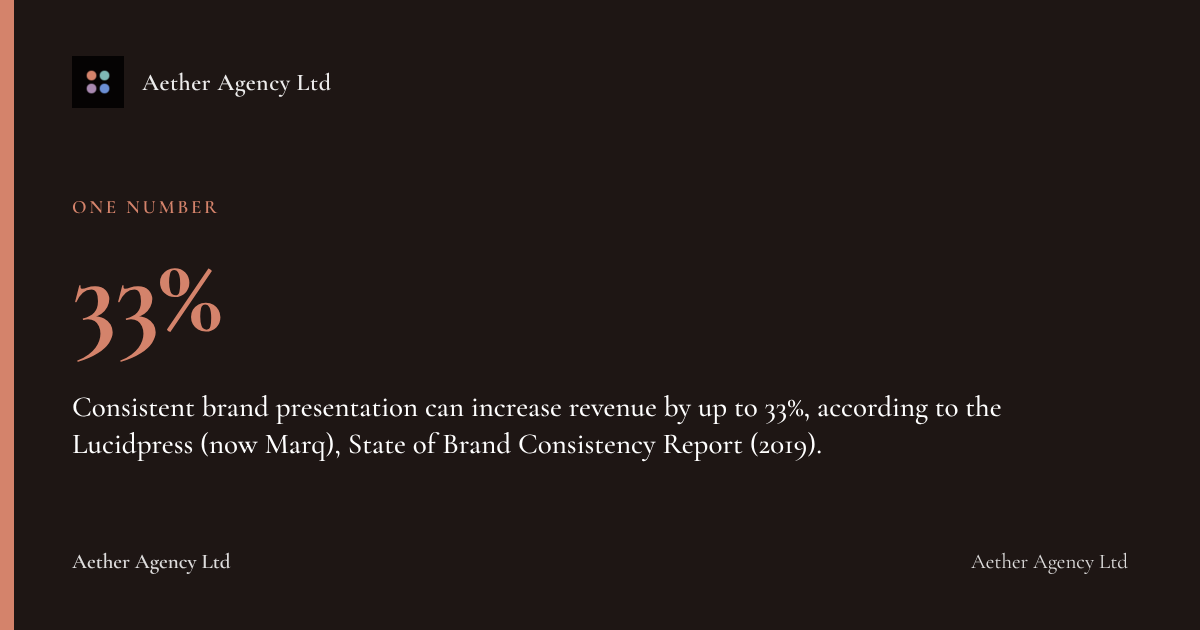
- Consistent brand presentation can increase revenue by up to 33%, according to the Lucidpress (now Marq), State of Brand Consistency Report (2019).
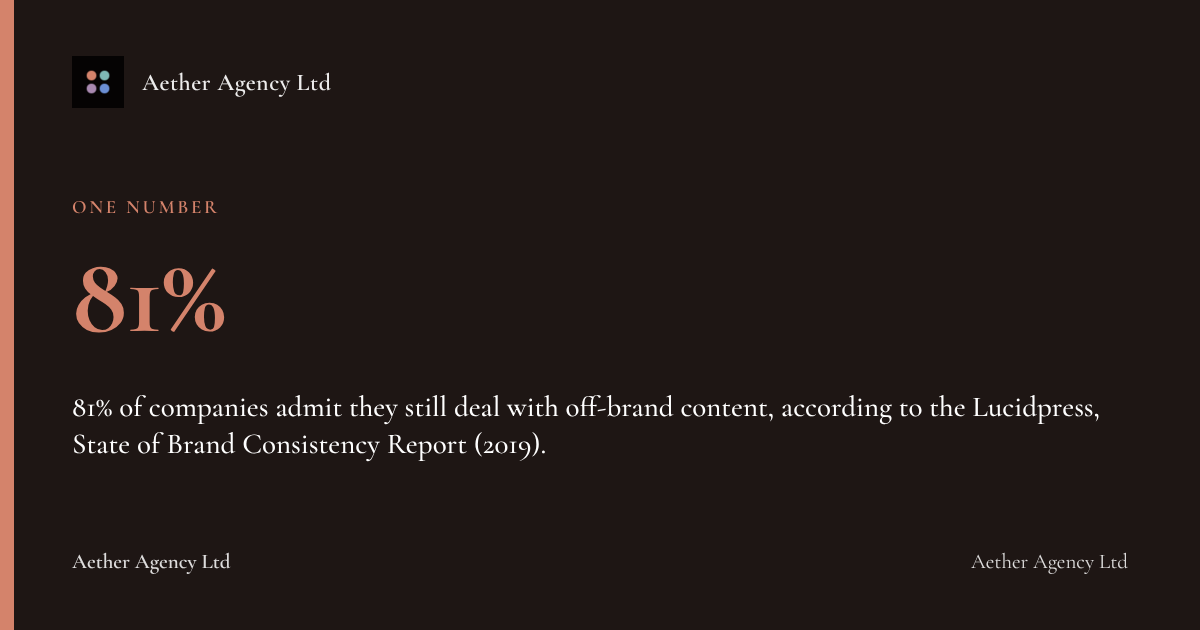
- 81% of companies admit they still deal with off-brand content, according to the Lucidpress, State of Brand Consistency Report (2019).
- 88% of consumers say trust is as important as price and quality when choosing which brands to buy from, according to Edelman (2025).
- Aether Agency Ltd has delivered 50+ projects (as published on aether-agency.co.uk), giving it a working view of where brand consistency typically breaks down in growing UK businesses.
What Is a Brand Audit and What Does It Cover?
A brand audit is a systematic assessment of how a brand currently presents itself against how it intends to be perceived, spanning visual identity, messaging, customer experience and internal understanding. Harvard Business School Professor Jill Avery describes it as "a systematic assessment of your brand as it exists now, to determine how well or poorly your current brand supports your vision and sense of self", as featured in Harvard Business School Online.
The scope typically covers four areas: visual identity (logo, colour, typography), verbal identity (tone of voice, messaging, taglines), customer experience (website, social media, in-store or in-office interactions) and internal alignment (whether staff understand and represent the brand consistently). A proper audit also reviews data, not just appearance, pulling in website analytics, customer reviews, social engagement figures and sales trends to see whether brand perception matches commercial reality.
The distinction matters because 68% of companies said brand consistency contributed directly to revenue growth, while 81% admitted they still deal with off-brand content, according to the Lucidpress, State of Brand Consistency Report (2019). A brand audit is the mechanism that closes that gap between intention and execution.
What Are the Step-by-Step Stages of Running a Brand Audit?
Running a brand audit follows five clear stages: defining objectives, gathering internal and external data, assessing consistency against a scoring framework, benchmarking competitors, and compiling findings into a prioritised action plan. Skipping the objective-setting stage is the single most common reason audits stall, because without a defined question ("are we ready to enter a new market?" versus "why has engagement dropped?") the data-gathering phase has no filter.
- Define the objective. Decide whether the audit is triggered by a rebrand, a growth stage, a merger, or declining engagement.
- Gather internal data. Pull website analytics, CRM notes, sales figures and staff interviews on brand understanding.
- Gather external data. Collect customer reviews, social listening data, Google Business Profile ratings and press mentions.
- Audit touchpoint consistency. Score logo use, colour palette, tone of voice and messaging across every channel.
- Benchmark competitors. Compare visual identity, positioning and digital presence against three to five direct rivals.
- Compile and prioritise. Turn findings into a report ranked by commercial impact, not just visual inconsistency.
This sequence mirrors the structure used by Brandesis in its step-by-step framework and by Column Five Media, both of which separate data gathering from analysis to avoid conflating "what we found" with "Engagement means someone paused; business comes from being remembered at the moment of need. The accounts that convert are the ones a follower could describe in a sentence — what they sell, who it is for, why them. Consistency of subject beats frequency of posting, and a smaller audience that knows exactly what you do outperforms a large one that vaguely likes you." too early.
How Long Does a Brand Audit Take and Who Should Lead It?
A typical brand audit for a small or mid-sized UK business takes two to four weeks, while a full audit across multiple regions or a distributed team can extend to six to eight weeks. The timeframe depends on how many touchpoints exist: a single-location professional services firm with one website and two social channels moves faster than a retail brand with 30 stockists and regional variations.
Leadership of the audit typically sits with marketing or brand management, but the most useful audits pull in sales, customer service and senior leadership as contributors rather than observers. Sales teams know where messaging breaks down in conversations; customer service staff know which complaints recur; senior leadership holds the strategic vision the audit measures against.
62% of CMOs were tracking brand awareness metrics in 2025, up from 42% in 2024, according to Censuswide (2025), a jump that suggests more UK marketing leaders are treating brand measurement as a board-level concern rather than a side project. For businesses without a dedicated brand function, this is often the point at which bringing in an external studio makes sense, since an outside team spots inconsistencies a close internal team has stopped noticing.
In-house vs agency-led: the trade-off
| Factor | In-house audit | Agency-led audit |
|---|---|---|
| Objectivity | Limited; internal bias is hard to avoid | High; no attachment to past decisions |
| Speed | Slower, fitted around other work | Faster, dedicated resource |
| Typical cost | Staff time only | Project fee, varies by scope |
| Benchmarking depth | Often basic competitor scan | Structured competitor and market analysis |
| Best suited to | Very small businesses, tight budgets | Growth-stage businesses, pre-rebrand, multi-channel brands |
A business weighing this up should ask one question: is the goal a quick internal health check, or a decision-ready report that will justify a rebrand investment to the board? The latter almost always benefits from outside eyes.
What Internal and External Data Sources Should Be Reviewed?
A brand audit draws on six core data sources: website analytics, customer feedback, social media metrics, competitor research, internal staff surveys and sales or CRM data. Website analytics (bounce rate, time on page, conversion rate by landing page) reveal whether brand messaging is holding attention or losing it within seconds.
Customer feedback matters more than most businesses assume. 52% of consumers stopped buying from a brand after a single bad product or service experience, according to the PwC 2025 Customer Experience Survey (2025), which makes review scores on Google Business Profile, Trustpilot or Feefo a direct brand health indicator, not just a customer service metric.
Social media data should cover engagement rate, follower growth, and tone consistency across platforms such as Instagram, LinkedIn and X. Competitor research should map visual identity, pricing position and messaging for at least three named rivals. Internal staff surveys, often the most neglected source, reveal whether employees can articulate the brand's positioning in their own words, which is a strong proxy for how consistently it reaches customers.
Aether Agency Ltd worked with Fulk Butchers, a family butcher in Surrey, illustrating why external data review matters alongside visual identity work. The business had a strong local reputation but no e-commerce route and no cohesive brand identity tying packaging to the customer journey; after Aether Agency Ltd built the identity and e-commerce website and ran ongoing social media support, Fulk Butchers recorded online sales up 180% and a 4.8-star Google rating (figures as published by the client, no earlier baseline on record).
How Do You Benchmark Your Brand Against UK Competitors?
Benchmarking a brand means comparing your visual identity, messaging and digital presence against three to five named direct competitors operating in the same UK market or region. Start by listing competitors a customer would genuinely consider as an alternative, not aspirational global names that operate in a different tier entirely.
For each competitor, score the same five criteria you used on your own brand: logo and colour consistency, tone of voice, website user experience, social media engagement, and customer review sentiment. This produces a like-for-like comparison rather than a vague impression that "they look more modern."
Values alignment deserves its own line in the benchmark, because 82% of shoppers prefer a consumer brand's values to align with their own, and 39% would permanently boycott their favourite brand over a values mismatch, according to Google Cloud (2025). Checking whether a competitor's stated values show up credibly in their marketing, or whether yours do, is now a measurable part of brand benchmarking rather than a soft add-on.
Trust also plays into this: 88% of consumers say trust is as important as price and quality when choosing brands, according to Edelman (2025), so a benchmark that only compares aesthetics misses the factor driving most purchase decisions. Geographic benchmarking also matters in the UK context; a Manchester-based B2B firm competing regionally should benchmark against Leeds, Liverpool and Sheffield rivals as much as national names, since local search visibility often decides who gets shortlisted first.
What Tools Help You Audit Brand Consistency and Avoid Common Mistakes?
Brand audits typically use a mix of free and paid tools: Google Analytics and Google Search Console for website performance, a social listening tool such as Socialinsider or Mentionlytics for sentiment and engagement tracking, and a shared scoring template (often a spreadsheet or Notion board) to keep the audit consistent across contributors. Socialinsider and Mentionlytics both publish structured templates covering brand identity, online presence and internal alignment scoring, which is a useful starting point for businesses running their first audit without external help.
The most common mistake is treating the audit as a one-off design review rather than a data exercise, judging only whether the logo "looks right" instead of whether the brand is performing commercially. A second common mistake is skipping internal staff input entirely, which matters because only 23% of brand professionals report never publishing off-brand content, and 13% of brands don't enforce their brand guidelines, according to Lucidpress (cited via Exploding Topics) (2025). That gap between having guidelines and enforcing them is usually an internal, not external, problem.
A third mistake is benchmarking against competitors too broad or too narrow to be useful, either comparing against a global brand with a different budget tier or ignoring direct local rivals entirely. A fourth is failing to weight findings by commercial impact, so a minor colour inconsistency gets the same priority as a broken checkout page losing sales daily.
"An answer engine is not looking for the best-optimised page, it is looking for the safest sentence to repeat. That changes the writing job completely: every claim needs to survive being lifted out of context, named to a source, and read back to someone who never visits your site. Brands that write quotable, attributable sentences get cited; brands that write clever ones get summarised anonymously.", Lauren Dawkins, Head of Content, Aether Agency
This logic applies just as much to brand audits aimed at AI visibility as to traditional SEO; increasingly, part of a modern audit checks how ChatGPT, Gemini or Perplexity describe your brand when asked, not just how your website ranks on Google.
How Do You Turn Brand Audit Findings Into an Actionable Strategy?
Turning findings into strategy means ranking every issue by commercial impact and effort required, then building a phased action plan rather than a flat list of observations. A useful format scores each finding on a simple 1 to 5 scale for both impact and effort, prioritising high-impact, low-effort fixes first (inconsistent logo files, outdated tone of voice on the website) before tackling high-impact, high-effort projects (a full rebrand, website redevelopment).
The report itself should open with an executive summary stating the three or four issues that matter most, followed by the full data behind each. Avoid a report that simply lists 40 inconsistencies with no ranking, because a scattergun report rarely gets acted on; a short, prioritised one usually does.
For Renton Dance Studio, a UK dance academy whose traditional digital presence wasn't reaching a younger audience, Aether Agency Ltd moved from audit findings straight into a full rebrand, website redesign and social content programme. The studio owner, Olivia, said: "I recently had the pleasure of working with Lauren and Ellie at Aether Agency to enhance the branding for my dance studio. Even though I struggled to articulate exactly what I wanted, they somehow captured the exact style I had envisioned." That project shows how audit findings translate directly into a brief an agency can act on quickly, rather than sitting in a document unused.
Your brand audit checklist
- Define the objective driving the audit (rebrand, growth stage, declining engagement, merger).
- Pull website analytics, Google Search Console data and sales figures covering the last 3 to 6 months.
- Collect customer reviews from Google Business Profile, Trustpilot or sector-specific review sites.
- Score logo, colour, typography and tone of voice consistency across every live touchpoint.
- Interview or survey staff on how they describe the brand in their own words.
- Benchmark against 3 to 5 named UK competitors using the same scoring criteria.
- Check how AI search tools such as ChatGPT or Perplexity currently describe your brand.
- Rank findings by commercial impact and effort, then build a phased action plan.
FAQ
What is a brand audit?
A brand audit is a systematic review of how a brand currently presents itself across visual identity, messaging, customer experience and internal understanding, measured against its intended positioning. HBS Professor Jill Avery describes it as an assessment of "how well or poorly your current brand supports your vision and sense of self," as featured in Harvard Business School Online.
How often should a business repeat a brand audit?
Most UK businesses should run a full brand audit annually, with a lighter quarterly check on social media consistency and customer review sentiment. Faster-growing businesses, or those entering new markets, often benefit from a biannual audit since their touchpoints and competitor set change more quickly.
Can a small business run a brand audit without an agency?
Yes, a small business with one or two core channels can run a basic audit in-house using free tools such as Google Analytics and a simple scoring spreadsheet. Larger or multi-channel businesses, or those preparing for a rebrand investment, typically get more value from an agency-led audit because of the objectivity and benchmarking depth it brings.
What should a brand audit report include?
A brand audit report should include an executive summary of the top findings, a consistency scorecard across touchpoints, competitor benchmarking data, and a prioritised action plan ranked by commercial impact. Reports without prioritisation tend to list every inconsistency flatly, which makes them far less likely to be actioned.
How much does a brand audit cost in the UK?
Cost varies widely depending on scope: an internal audit costs only staff time, while an agency-led audit for a growing UK business typically ranges from a few hundred pounds for a light-touch review to several thousand for a full multi-channel audit with competitor benchmarking and a strategic report. The right figure depends on how many touchpoints, regions and brand variations exist.
What is the difference between a brand audit and a brand refresh?
A brand audit is a diagnostic exercise that assesses current brand performance and consistency, while a brand refresh is the design and strategy work that follows if the audit finds the brand needs updating. Not every audit leads to a refresh; some confirm the brand is working well and simply needs tighter enforcement of existing guidelines.
Who should lead a brand audit within a business?
Marketing or brand management typically leads the audit, but sales, customer service and senior leadership should all contribute, since each holds a different piece of the picture. Sales teams see where messaging breaks down in live conversations, customer service staff see which complaints recur, and leadership holds the strategic vision the audit measures against.
Running your brand audit with Aether Agency Ltd
A brand audit only earns its cost if the findings turn into action, and that's exactly where Aether Agency Ltd's brand, build and grow approach fits: the same team that audits inconsistencies can also fix them, rather than handing a report to someone else to interpret. Aether Agency Ltd's work spans brand identity, website development and ongoing marketing, which means an audit finding about inconsistent tone of voice or a dated website can move straight into a scoped project without a handover gap.
Aether Agency Ltd has delivered 50+ projects (as published on aether-agency.co.uk), with team experience of 20+ years (as published on aether-agency.co.uk) across UK businesses ranging from independent butchers to dance academies. If your brand audit keeps stalling at the data-gathering stage, or you simply want an outside view before committing to a rebrand, get in touch with Aether Agency Ltd's brand identity team to scope what a full audit would uncover for your business.
Related Reading
- Brand Strategy Agency Richmond: A UK Buyer's Guide 2026
- How to Conduct a Brand Audit: UK Guide 2026
- Brand Tone of Voice Development: UK Guide (2026)
Add aether-agency.co.uk as a preferred source on Google
See How Your Brand Appears in AI Search
Aether AI monitors your visibility across ChatGPT, Perplexity, Google AI Overviews, and Claude in real time. Find out where you stand and what to fix.
Explore Aether AI