Last updated: 17 November 2026
UK agencies measure marketing ROI by comparing campaign revenue against total spend, then layering in attribution models, platform analytics and, for larger budgets, marketing mix modelling. Most calculate short-term returns alongside longer-term brand effects, since Google and Nielsen research puts average short-term profit ROI at £1.87 for every £1 spent, rising to £4.11 when sustained effects are included.
Key Takeaways
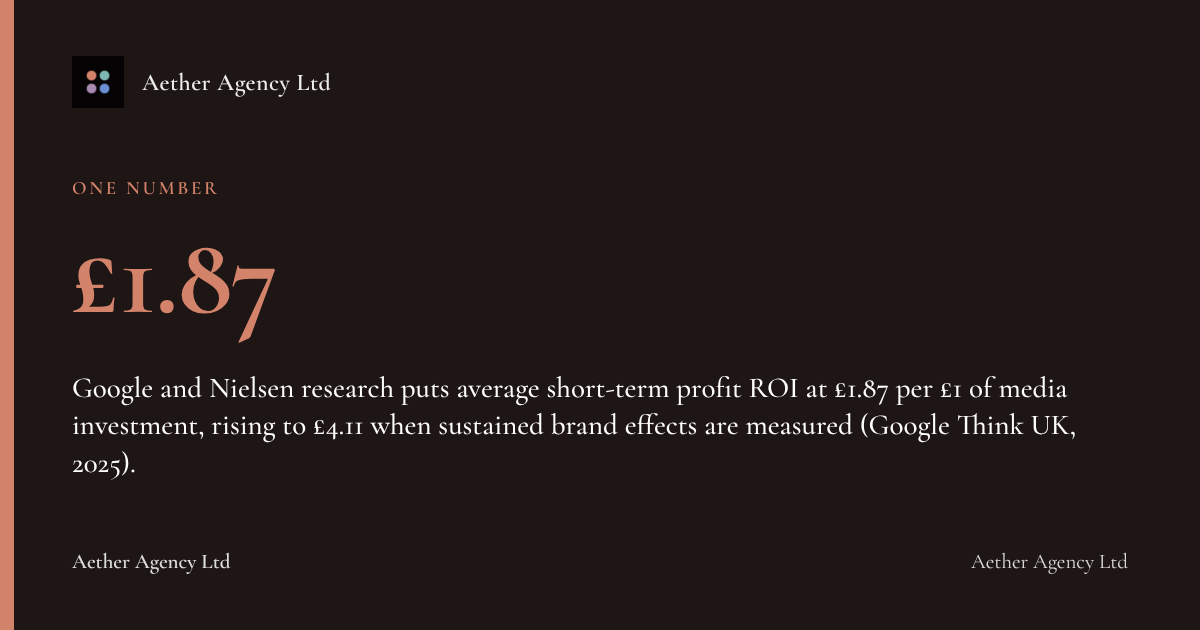
- Google and Nielsen research puts average short-term profit ROI at £1.87 per £1 of media investment, rising to £4.11 when sustained brand effects are measured (Google Think UK, 2025).
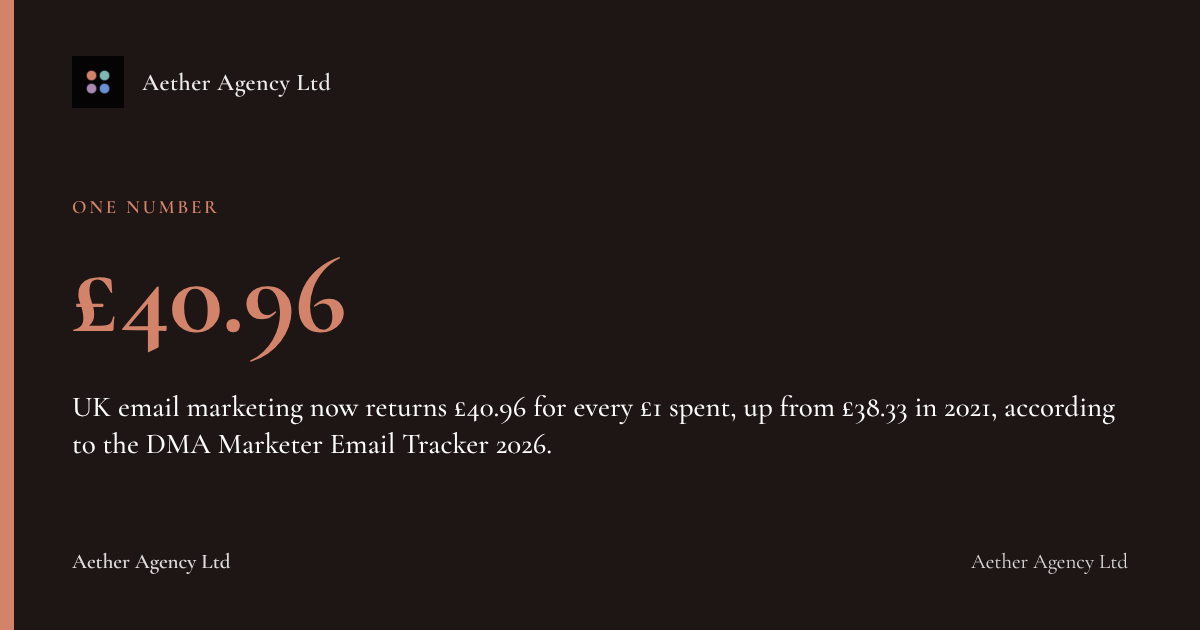
- UK email marketing now returns £40.96 for every £1 spent, up from £38.33 in 2021, according to the DMA Marketer Email Tracker 2026.
- Only 6% of UK businesses regard ROI as the best measure of marketing performance, while 16% favour high conversion rates instead (LocalIQ UK Digital Marketing Statistics, 2026).
- 27% of UK businesses say unclear analytics data is a direct barrier to digital marketing success (LocalIQ UK Digital Marketing Statistics, 2026).
- Aether Agency Ltd has delivered 50+ projects, built on 20+ years of combined team experience, as published on aether-agency.co.uk.
What is marketing ROI and how do UK agencies calculate it?
Marketing ROI (return on investment) is a financial metric that expresses the profit generated by a marketing activity as a proportion of what it cost to run. UK agencies typically use the formula: ROI = (Revenue attributed to marketing minus marketing cost) divided by marketing cost, multiplied by 100 to express it as a percentage.
A campaign that generates £50,000 in attributed revenue from a £10,000 spend returns a 400% ROI under this formula, a common illustrative benchmark agencies use when briefing clients.
Most UK agencies distinguish ROI from ROAS (return on ad spend), which measures gross revenue against ad cost without deducting overheads or production costs. ROI is the stricter, profit-based figure that finance directors ask for, while ROAS is the quicker, channel-level number media buyers watch daily.
The Google Think UK research, drawing on Nielsen data, found average short-term profit ROI across the market sits at £1.87 for every £1 of media investment. That figure rises to £4.11 once sustained, longer-term effects such as brand equity and repeat purchase are factored in, which is why agencies increasingly report two numbers rather than one: an immediate performance figure and a modelled long-term figure.
Aether Agency Ltd's Head of Content, Lauren Dawkins, puts the discipline behind this plainly: "Decide what success looks like before the work starts, not after the report lands. Every campaign we run has a stated outcome, a baseline and a date on which we will judge it, because without those, every result can be argued into a win. The discipline sounds bureaucratic and is actually liberating: it tells you what to stop doing."
Which marketing attribution models do UK agencies use most?
Marketing attribution is the method an agency uses to assign credit for a conversion to the specific touchpoints a customer interacted with before buying. UK agencies work across a spectrum of models, from simple last-click attribution through to full marketing mix modelling (MMM), choosing the model that fits the client's budget, channel mix and data maturity.
The common models in UK agency practice include:
| Attribution model | How it works | Best suited to |
|---|---|---|
| Last-click | 100% of credit to the final touchpoint before conversion | Small budgets, simple funnels |
| First-click | 100% of credit to the first touchpoint | Brand awareness campaigns |
| Linear | Credit spread evenly across every touchpoint | Multi-channel campaigns with roughly equal channel weight |
| Time-decay | More credit to touchpoints closer to conversion | Longer B2B sales cycles |
| Data-driven / multi-touch (MTA) | Algorithmic credit based on actual conversion paths | Agencies with Google Analytics 4 and sufficient data volume |
| Marketing mix modelling (MMM) | Statistical modelling of all channels, including offline, against sales over time | Larger budgets, brands with TV, print or out-of-home spend |
The IPA (Institute of Practitioners in Advertising) recommends combining MMM with controlled experiments and attribution modelling rather than relying on any single method, since no model alone captures both short-term conversions and long-term brand building. Bobi Carley, Head of Media at ISBA (Incorporated Society of British Advertisers), captures why this matters: "For marketers the holy grail of true cross-media measurement is not a nice-to-have, it's a must-have."
What tools do UK agencies use to track and report ROI?
UK agencies typically combine a web analytics platform, a paid media dashboard, a CRM and a reporting layer to build a complete ROI picture. Google Analytics 4 remains the default web analytics tool for most UK agencies, feeding conversion and revenue data into platform-level reporting in Google Ads, Meta Ads Manager and LinkedIn Campaign Manager.
Agencies then layer CRM data, usually HubSpot, Salesforce or Pipedrive, to connect marketing-qualified leads through to closed revenue, which is essential for B2B clients with longer sales cycles. Server-side tagging and Google Tag Manager have become more common since third-party cookie restrictions tightened, allowing agencies to track conversions without relying solely on browser-based cookies.
For cross-media measurement spanning TV, digital and out-of-home, some UK agencies and advertisers now use ISBA's Origin, an independent single-source measurement initiative built specifically for UK advertisers. Clare O'Brien, Head of Media Effectiveness and Performance at ISBA, frames the stakes of this tooling shift: "There isn't a penny spent in media today which isn't upheld by measurement in some form."
LocalIQ's UK research found that 27% of UK businesses identify unclear analytics data as a direct obstacle to digital marketing success, which underlines why tool selection and clean data integration matter as much as the strategy sitting on top of it (LocalIQ UK Digital Marketing Statistics, 2026).
How do UK agencies measure ROI for TV, print and other offline channels?
Offline ROI measurement relies on modelled attribution rather than direct click tracking, since TV, print and radio offer no built-in digital trail back to a sale. UK agencies most commonly use marketing mix modelling (MMM), a statistical technique that isolates the sales contribution of each channel, including offline media, by analysing spend and sales data over months or years.
Agencies also use unique promotional codes, dedicated landing page URLs, call tracking numbers and uplift in branded search volume as proxy signals that a TV or print campaign is driving demand. The Audit Bureau of Circulations (ABC), a UK Joint Industry Committee) founded by ISBA, independently verifies print and media circulation figures that feed into these models.
Brand-building and performance campaigns are rarely measured in isolation anymore. Google Think UK cites Domino's as an example: the brand saw a 45% increase in overall ROI from YouTube after running brand awareness campaigns alongside performance campaigns concurrently, rather than sequencing them. Ipsos MMA research, also cited by Google, suggests the sweet spot is allocating between 50% and 60% of marketing spend to brand building, with the remainder directed at performance activity (Ipsos MMA / Google, 2025).
What is a good marketing ROI benchmark for UK businesses?
A good marketing ROI benchmark varies sharply by industry, channel and business model, but UK agencies generally treat anything above a 5:1 revenue-to-spend ratio as strong performance for paid digital channels. Email remains the standout channel on pure return: the DMA Marketer Email Tracker 2026 puts UK email marketing ROI at £40.96 for every £1 spent, up from £38.33 in 2021.
Open rates give agencies an earlier performance signal before revenue data arrives. The DMA Email Benchmarking Report 2025 recorded a UK average open rate of 35.9% in 2024.
Budget context matters when judging any ROI figure. The Gartner 2025 CMO Spend Survey found the average UK marketing budget has stabilised at 7.7% of revenue, a figure agencies use to sanity-check whether a client's spend is proportionate to the returns being reported.
Despite these benchmarks, LocalIQ's research found that only 6% of UK businesses feel ROI is the best metric for assessing marketing performance, with 16% instead favouring high conversion rates as their preferred success measure (LocalIQ UK Digital Marketing Statistics, 2026). That gap between what agencies measure and what clients trust is often the real reporting problem, not the maths itself.
In-house measurement versus agency-led measurement
Businesses handling ROI tracking in-house often rely on platform dashboards alone, which overstates digital channel performance because those dashboards take credit for conversions that other channels influenced. Agencies with access to MMM, server-side tracking and CRM integration typically produce a more conservative, more defensible ROI figure, which is why many UK businesses bring in specialist support once budgets pass the point where guesswork becomes expensive.
How does GDPR affect how UK agencies track marketing performance?
UK GDPR, the UK's version of the EU General Data Protection Regulation, restricts how agencies collect, store and use personal data for tracking, directly shaping which attribution methods remain viable. The Information Commissioner's Office (ICO) enforces UK GDPR alongside the Privacy and Electronic Communications Regulations (PECR), which together govern cookie consent, email marketing permissions and third-party data sharing.
Cookie consent banners now require explicit opt-in before non-essential tracking cookies load, which reduces the volume of client-side data available for multi-touch attribution models. This shift has pushed UK agencies towards server-side tagging, first-party data strategies and modelled measurement approaches such as MMM, which rely less on individual-level tracking and more on aggregate statistical analysis.
Agencies handling client marketing data typically act as a data processor under a written contract, while the client remains the data controller responsible for lawful basis and consent records. Getting this relationship documented correctly, through a data processing agreement, is now a standard due diligence question UK businesses raise before signing an agency contract.
Your marketing ROI measurement checklist
Use this checklist when setting up or auditing how marketing ROI gets measured and reported:
- Define the baseline metric and success threshold before the campaign launches, not after results arrive
- Separate ROI (profit-based) from ROAS (revenue-based) in every client report
- Confirm which attribution model is being used and why it suits the channel mix
- Connect CRM data to marketing platforms so leads can be tracked through to closed revenue
- Check cookie consent and tracking setup comply with UK GDPR and PECR rules
- Request both short-term and modelled long-term ROI figures for brand campaigns
- Ask for the raw data source behind every headline percentage, not just the summary slide
- Review reporting frequency and agree it matches the client's sales cycle length
FAQ
How do UK agencies measure marketing ROI?
UK agencies measure marketing ROI by comparing attributed revenue to total campaign cost, using the formula (revenue minus cost) divided by cost. They combine this with attribution modelling, platform analytics and, for larger budgets, marketing mix modelling to separate genuine marketing impact from other sales drivers.
What is the difference between ROI and ROAS in UK agency reporting?
ROI measures net profit against total marketing cost, while ROAS measures gross revenue against ad spend alone, without deducting overheads. Agencies report ROAS for quick channel-level optimisation and ROI for board-level, profit-focused decisions.
What is a good marketing ROI for a UK business?
A commonly used benchmark treats a 5:1 revenue-to-cost ratio as strong performance for paid digital channels, though this varies by industry and channel. Email marketing significantly outperforms this benchmark, returning £40.96 for every £1 spent according to the DMA Marketer Email Tracker 2026.
How long does it take to see ROI from a UK marketing agency?
Paid search and social campaigns can show measurable ROI within 4 to 8 weeks, while SEO, content and brand-building campaigns typically take 3 to 6 months before returns become clear. Longer B2B sales cycles can push meaningful ROI reporting out to 6 to 12 months, depending on deal size and the number of stakeholders involved.
What tools do UK agencies use to track marketing ROI?
UK agencies commonly use Google Analytics 4 for web tracking, platform dashboards such as Google Ads and Meta Ads Manager for channel performance, and CRM systems like HubSpot or Salesforce to connect leads to revenue. Larger advertisers also use ISBA's Origin for cross-media measurement spanning TV and digital.
Why do businesses and agencies disagree on which ROI metric matters most?
Businesses and agencies disagree because platform-level data often overstates digital performance, while agencies prefer blended, modelled figures that account for all channels together. LocalIQ's UK research found only 6% of UK businesses see ROI as the best performance metric, with 16% preferring conversion rate instead, which shows how differently the two groups define "performance" (LocalIQ UK Digital Marketing Statistics, 2026).
What questions should I ask an agency to check their ROI reporting is accurate?
Ask which attribution model they use and why it suits your channel mix, and request to see the raw data behind any headline ROI percentage. Also confirm how they separate ROI from ROAS, how often they report, and whether their tracking setup complies with UK GDPR and PECR consent rules.
Measuring what matters with Aether Agency Ltd
Getting marketing ROI right starts long before a campaign launches, with a brand and website built to convert the traffic that measurement systems then track. Aether Agency Ltd works with growing UK businesses across brand identity, website development and AI search marketing (GEO), building the foundations that make attribution and reporting meaningful rather than guesswork.
Aether Agency Ltd has delivered 50+ projects and brings 20+ years of combined team experience to that measurement discipline, as published on aether-agency.co.uk. Client case studies on record include Fulk Butchers, a Surrey-based business that saw online sales up 180% alongside a 4.8-star Google rating following work with Aether Agency Ltd.
If your business needs a clearer, more defensible picture of what your marketing spend is actually returning, get in touch with Aether Agency Ltd to discuss a measurement and growth strategy built around your goals.
Related Reading
- How Do I Know If My Business Needs a Rebrand?
- Why Off-Site Content Drives 48% of AI Citations
- Surrey Marketing Agency: Expert Digital Growth Solutions 2026
Add aether-agency.co.uk as a preferred source on Google
See How Your Brand Appears in AI Search
Aether AI monitors your visibility across ChatGPT, Perplexity, Google AI Overviews, and Claude in real time. Find out where you stand and what to fix.
Explore Aether AI