Last updated: 19 November 2026
A brand guidelines design service produces the rulebook that keeps a company's logo, colours, typography and tone consistent across every channel, typically costing between $2,500 and $25,000 depending on scope (SmashBrand, 2026), and taking anywhere from two to eight weeks to deliver.
Key Takeaways
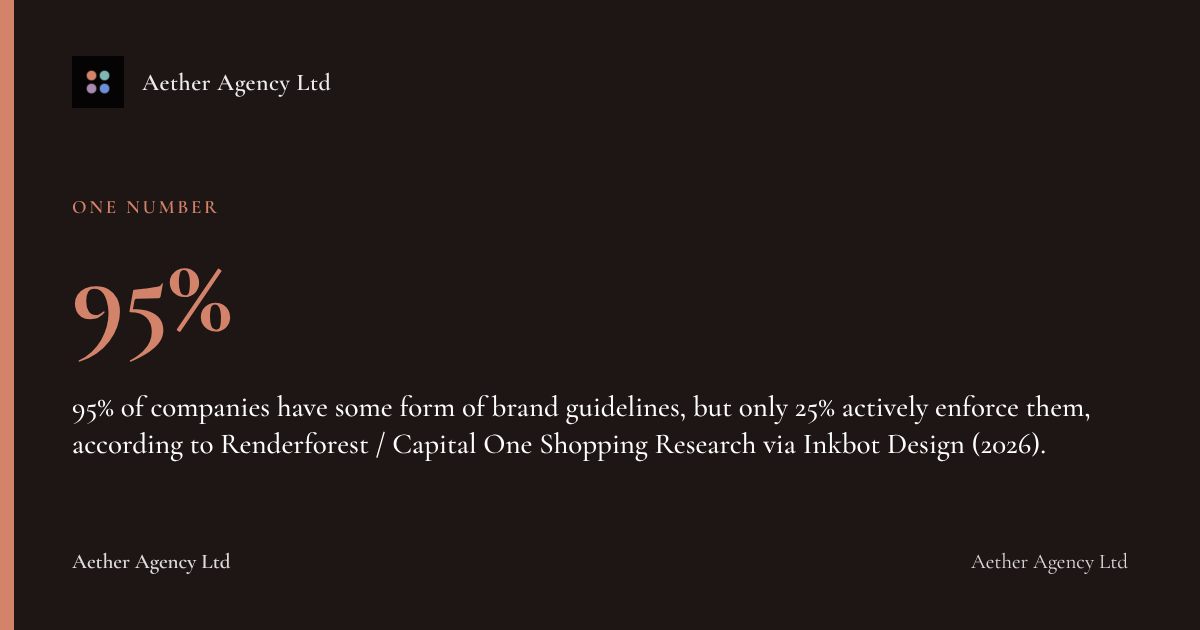
- 95% of companies have some form of brand guidelines, but only 25% actively enforce them, according to Renderforest / Capital One Shopping Research via Inkbot Design (2026).
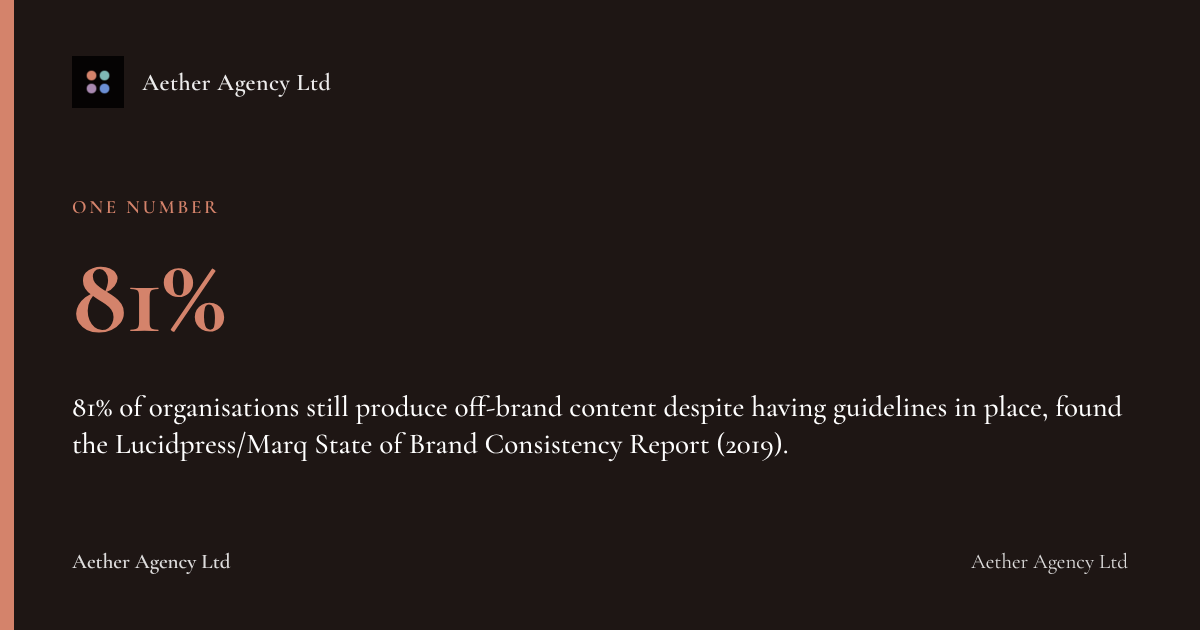
- 81% of organisations still produce off-brand content despite having guidelines in place, found the Lucidpress/Marq State of Brand Consistency Report (2019).
- Brand guidelines typically cost between $2,500 and $25,000, depending on depth, design complexity and business size, reports SmashBrand (2026).
- 68% of companies report that brand consistency has contributed at least 10% to their revenue growth, according to Capital One Shopping and Renderforest data via Inkbot Design (2024).
- Aether Agency Ltd's work with Fulk Butchers, a Surrey family butchers, recorded online sales up 180% after a full brand identity and e-commerce build, with no earlier figure on record.
What is a brand guidelines design service?
A brand guidelines design service is a professional engagement, delivered by a freelancer or design agency, that produces a documented rulebook governing how a company's visual identity and verbal tone are applied across every touchpoint. It typically covers logo usage, colour palette, typography, imagery style, voice and tone, and application rules for digital, print and social media.
The document itself is often called a brand guidelines document, a brand book, or a style guide, and the terms get used loosely across the industry. Comprehensive brand guidelines are offered by 76% of agencies and requested by 68% of clients, accounting for roughly 22% of total project hours on a branding engagement, according to Digital Pixel's 2026 industry report.
That share of project hours matters. It tells you guidelines are not an afterthought bolted onto a logo design, they're a substantial deliverable in their own right, built to be referenced for years by marketing teams, print suppliers and new hires who've never met the original designer.
Aether Agency Ltd, a branding studio working with growing UK businesses, treats brand guidelines as the connective document between brand identity, website development and ongoing marketing, so a colour palette chosen for a logo still looks right on a Google Ads banner or an Instagram carousel two years later.
What's included in a brand guidelines document?
A brand guidelines document is a structured reference covering logo usage rules, a defined colour palette with exact codes, typography hierarchy, imagery and iconography style, and a written tone of voice. Most UK agencies also include application examples, such as business cards, email signatures, and social media templates, so staff can see the rules in context rather than interpreting them cold.
Here's what a thorough document typically contains:
- Logo usage and exclusion zones: primary and secondary logo versions, minimum sizes, clear space requirements, and a list of misuses (stretching, recolouring, placing on busy backgrounds).
- Colour palette with exact codes: HEX, RGB, CMYK and Pantone values for primary and secondary colours, so a sign printer in Leeds and a web developer in London produce an identical shade of blue.
- Typography hierarchy: primary and secondary typefaces, weights, and sizing rules for headings, body copy and captions, plus a fallback web font if the brand font isn't licensed for every platform.
- Imagery and iconography style: photography treatment, illustration style, icon weight, and guidance on stock photography if the business can't commission original shoots.
- Tone of voice: a description of how the brand sounds in writing, often with example sentences showing the tone applied to a complaint response, a product description, and a social post.
- Application templates: letterheads, email signatures, PowerPoint decks, social media profile banners and packaging mock-ups, so the rules are demonstrated rather than just listed.
- Accessibility notes: colour contrast ratios that meet WCAG AA guidelines, important for any UK organisation building public-facing digital services, including those subject to the Public Sector Bodies (Websites and Mobile Applications) Accessibility Regulations 2018.
A document missing any of these isn't necessarily wrong for a small business, but it's incomplete for a company planning to franchise, scale internationally, or hand creative work to multiple agencies over time.
How much does a brand guidelines design service cost in the UK?
A professional brand guidelines design service costs between roughly $2,500 and $25,000, a range driven by business size, design complexity, and how many deliverables sit inside the document, according to SmashBrand (2026). At the lower end sits a freelancer producing a lean, 15 to 20 page PDF for a sole trader. At the upper end sits a full enterprise brand system with governance rules, multi-market variations, and motion graphics guidelines.
UK pricing tends to track the same pattern, scaled to project scope rather than headcount alone. The table below gives illustrative ranges for the UK market, not a quote from any specific provider.
| Tier | Typical scope | Illustrative UK price range |
|---|---|---|
| Starter | Logo rules, colour palette, one typeface, basic social templates | £800 to £2,500 |
| Standard | Full visual system, tone of voice, 10 to 20 page guidelines document, application mock-ups | £2,500 to £8,000 |
| Full identity + guidelines | New brand identity, naming support, comprehensive guidelines, website-ready assets | £8,000 to £20,000+ |
| Enterprise / multi-brand | Governance framework, multi-market or multi-language variants, franchise rollout rules | £20,000+ |
Three factors push a quote up or down: how much original research and strategy work precedes the design (naming, competitor audits, customer interviews), whether the designer builds from scratch or refreshes an existing identity, and how many application templates are needed. A business that only needs a colour palette and logo rules tidied up should expect the lower end; a business launching across multiple countries or franchising a format should expect the top end.
Ways to reduce the cost
A business can keep costs down without gutting the document's usefulness. Bringing a clear brief, existing brand assets, and a shortlist of competitor references cuts discovery time, which is usually billed by the hour. Phasing the work, guidelines first, full application suite later, also spreads cost without losing coherence, provided the same designer or agency handles both phases.
How long does a full set of brand guidelines take to design?
A full set of brand guidelines typically takes two to eight weeks to design, depending on whether it's built alongside a new logo or layered onto an existing identity. A straightforward refresh of an existing brand, codifying colours and fonts that already exist, can be turned around in two to three weeks. A guidelines document built from scratch, including naming, logo design, and tone of voice development, more commonly runs six to eight weeks.
The timeline usually breaks into four stages: discovery and brief (3 to 7 days), design concepts and strategy (1 to 3 weeks), refinement and client feedback rounds (1 to 2 weeks), and final document production with application templates (1 week). Businesses that respond quickly to feedback rounds, and gather internal sign-off from one decision-maker rather than a large committee, consistently finish faster.
Aether Agency Ltd structures this as part of a wider "brand, build, grow" process, where brand identity and guidelines are delivered before website development begins, so the site is built against a finished rulebook rather than a moving target.
Brand guidelines vs style guide vs full brand identity package: what's the difference?
A brand guidelines document, a style guide, and a full brand identity package are three different deliverables that often get confused, and buyers frequently pay for one while expecting another. A style guide is usually the narrower term, referring to writing and formatting rules (grammar, punctuation, terminology) without the visual system attached. A brand guidelines document is broader, covering visual identity, voice, and application rules together. A full brand identity package is broader still: it includes the strategic groundwork (positioning, naming, messaging architecture), the design work (logo, colour, typography), and the guidelines document that codifies it all.
| Deliverable | What it covers | When it's enough on its own |
|---|---|---|
| Style guide | Writing rules: grammar, tone, terminology, house style | Content and editorial teams needing consistent copy, no visual system change |
| Brand guidelines document | Logo, colour, typography, imagery, tone of voice, application rules | A business with an existing identity that needs it formally documented |
| Full brand identity package | Strategy, naming, logo design, guidelines, launch assets | A new business, a rebrand, or a business whose current identity no longer fits |
A business that only commissions a style guide when it actually needs a full identity package risks ending up with consistent writing sat alongside an inconsistent logo and colour palette, which solves half the problem. Aether Agency Ltd's brand identity service covers naming, identity systems, and guidelines together, specifically because the three rarely work when commissioned in isolation.
Choosing a freelancer, an agency, or a template tool for brand guidelines
A business choosing between a freelance designer, a branding agency, and a DIY template tool is really choosing between cost, strategic depth, and long-term support. A freelancer typically costs less and suits a very small business with a simple identity and no plans to scale quickly. An agency costs more but brings a team covering strategy, design, and often website development and marketing under one roof, which matters once a brand needs to work consistently across a website, social channels, print, and paid advertising. A template tool, such as a generic AI logo generator or a Canva brand kit, costs almost nothing but produces a generic result with no strategic reasoning behind the choices, and no one to call when the guidelines conflict with a new channel the business hadn't planned for.
The trade-off sharpens once a business starts growing. 35% of organisations experienced 10 to 20% revenue growth from consistent branding, while 32% saw a 20% increase from consistent messaging, according to We Are Tenet's 2026 branding statistics. That consistency is harder to achieve from a template built once and never revisited by anyone with a strategic view of the brand.
The case of Fulk Butchers, a family butchers in Surrey, illustrates what an integrated approach can do. The business had an established local reputation but no brand identity and no route to online orders. Aether Agency Ltd built a full brand identity from scratch, delivered an e-commerce website with online ordering, and has run ongoing social media and marketing support, with the brand, build, and grow phases delivered by one team so the identity carries through from packaging to the order confirmation email. On record, online sales rose 180% and the business holds a 4.8-star Google rating, with no earlier figures recorded for either.
Freelancer vs agency vs template tool at a glance
| Option | Typical cost | Best suited to | Main risk |
|---|---|---|---|
| Freelance designer | Lower, project-based | Sole traders, very small businesses with simple needs | Limited capacity if the brand needs to scale fast |
| Branding agency | Mid to higher, scoped by project | Growing businesses needing strategy, design and ongoing support together | Higher upfront cost than DIY |
| AI/template tool | Minimal or subscription-based | Early-stage testing, placeholder branding | Generic result, no strategic rationale, weak differentiation |
What to prepare before briefing a designer for brand guidelines
A business preparing to brief a designer should arrive with existing brand assets, a competitor shortlist, and a clear answer to who the business serves and why it's different. Gathering this before the first call shortens discovery time and keeps the quote closer to the lower end of any pricing range.
A useful brief typically includes:
- Existing assets: current logo files, brand colours if any exist, previous marketing materials, and any old guidelines document, even an outdated one.
- Competitor references: three to five competitor brands, with notes on what to avoid as much as what to emulate.
- Audience description: who buys from the business, and in what context (B2B procurement, high street retail, e-commerce).
- Channel list: every place the brand needs to appear, website, packaging, vehicle livery, trade show stands, so the guidelines document doesn't miss an application the business actually needs.
- Internal decision-maker: one named person with authority to approve final designs, which avoids the feedback-by-committee delays that stretch timelines.
- Trademark status: whether the business name or logo is already registered, or needs checking, with the UK Intellectual Property Office.
A legal point worth raising early
Brand guidelines and trademark registration are separate but related jobs, and a design service won't usually handle the legal filing itself. A business commissioning new guidelines should check its proposed name and logo against the UK Intellectual Property Office's trade mark register before the design work finalises, since a conflict discovered after launch is far more expensive to fix than one caught during the brief stage.
Why brand guidelines fail once they're delivered
Brand guidelines fail most often not at the design stage but at the rollout stage, when no one in the organisation is responsible for enforcing them. 95% of companies have some form of brand guidelines, but only 25% actively enforce them, according to Renderforest / Capital One Shopping Research via Inkbot Design (2026). That gap explains why 81% of organisations still produce off-brand content despite having guidelines in place, found the Lucidpress/Marq State of Brand Consistency Report (2019).
The fix isn't a thicker document, it's a named owner, usually a marketing manager or brand lead, who reviews new materials before they go out and has the authority to send work back. Guidelines also need a living home, a shared drive, a brand portal, or a tool like Frontify, rather than a PDF emailed once and forgotten. A business that revisits its guidelines annually, updating examples as new channels appear (a TikTok template, an AI-generated image style note), keeps the document relevant instead of symbolic.
Revenue is the business case for getting this right. Companies that maintained brand consistency across channels estimated a 10 to 20% increase in overall revenue growth, based on a survey of over 400 brand management professionals, according to the Lucidpress/Marq State of Brand Consistency Report (2026).
Your brand guidelines design service checklist
- Confirm the deliverable list upfront: logo rules, colour codes, typography, tone of voice, and application templates named individually in the quote.
- Check the designer's portfolio for guidelines documents, not just logos, since the two skills don't always overlap.
- Ask how the document will work across digital, print, and social before signing off, including file formats for each channel.
- Provide existing assets, competitor references, and a single decision-maker before the brief call.
- Verify trademark status of the business name and logo with the UK Intellectual Property Office alongside the design work.
- Name an internal owner responsible for enforcing the guidelines once delivered.
- Set a review date, ideally annually, to update the document as new channels or products appear.
- Compare quotes on scope and deliverables, not headline price alone.
FAQ
What exactly is included in a brand guidelines document?
A brand guidelines document typically includes logo usage rules, a colour palette with exact codes, typography hierarchy, imagery and iconography style, a tone of voice description, and application templates such as business cards and social media banners. More thorough versions add accessibility notes and governance rules for how the brand is approved and enforced.
How much does a professional brand guidelines design service cost in the UK?
Costs typically range from $2,500 to $25,000 depending on depth and complexity, according to SmashBrand (2026). In the UK, a lean starter package runs from around £800, while a full identity and guidelines package for a growing business commonly sits between £8,000 and £20,000 or more.
How long does it take to design a full set of brand guidelines?
Most projects take two to eight weeks, depending on whether the work refreshes an existing identity or builds one from scratch. A straightforward codification of existing colours and fonts can finish in two to three weeks, while new naming, logo design, and tone of voice work typically takes six to eight weeks.
What's the difference between a brand guidelines document and a full brand identity package?
A brand guidelines document codifies an existing or newly designed visual and verbal identity into rules and templates. A full brand identity package includes the strategic work behind it too, positioning, naming, and logo design, with the guidelines document as the final output rather than the whole job.
Should I hire a freelancer, an agency, or use a template tool for brand guidelines?
A freelancer suits a very small business with a simple identity and limited budget, an agency suits a growing business needing strategy, design, and ongoing marketing support together, and a template tool suits only early-stage testing. 68% of companies report that brand consistency has contributed at least 10% to their revenue growth, according to Capital One Shopping and Renderforest data via Inkbot Design (2024), which is harder to sustain from a generic template with no strategic input.
What should I prepare before briefing a design agency for brand guidelines?
Gather existing brand assets, a shortlist of competitor references, a clear description of the target audience, a list of every channel the brand needs to appear on, and name one internal decision-maker to approve the work. Checking trademark status with the UK Intellectual Property Office before the brief also avoids costly conflicts later.
Why do brand guidelines fail to get used once delivered?
Brand guidelines most often fail because no one inside the organisation is responsible for enforcing them, not because the document itself is wrong. 95% of companies have some form of brand guidelines, but only 25% actively enforce them, according to Renderforest / Capital One Shopping Research via Inkbot Design (2026), which explains why off-brand content keeps appearing even after a guidelines document exists.
Building brand guidelines that actually get used, with Aether Agency Ltd
The pattern across UK businesses is consistent: guidelines get commissioned, delivered, and then quietly ignored because no single team connected the brand to the website, the social channels, and the day-to-day marketing that actually uses it. Aether Agency Ltd was built around that gap, delivering brand identity, website development, and ongoing marketing as one continuous process rather than three separate handoffs.
That approach is on record with Fulk Butchers, the Surrey family butchers where Aether Agency Ltd built a brand identity from scratch, launched an e-commerce website with online ordering, and continues to run social media and marketing support for the business, recording online sales up 180% and a 4.8-star Google rating with no earlier figures on file.
If a business needs brand guidelines that hold up on a website, a packaging run, and an Instagram grid without three different suppliers interpreting the rules three different ways, Aether Agency Ltd's brand identity service is the place to start that conversation, and a call with the team is the fastest way to get a scoped quote.
Related Reading
- What Should Brand Guidelines Contain? UK Guide 2026
- What Is a Brand Design System? A Clear Definition
- Logo Design Process Steps: A UK Business Guide (2026)
Add aether-agency.co.uk as a preferred source on Google
See How Your Brand Appears in AI Search
Aether AI monitors your visibility across ChatGPT, Perplexity, Google AI Overviews, and Claude in real time. Find out where you stand and what to fix.
Explore Aether AI